AI Summary
About
Stripe Billing is the recurring-revenue and usage-based billing product inside Stripe’s wider payments platform. It handles subscriptions, quotes, multi-phase subscription schedules, invoice auto-reconciliation, dunning (Smart Retries and recovery automations), a hosted customer portal, and basic usage metering through the Meters API — turning the raw payment rails into a full subscription-and-invoicing system. It sits in Stripe’s “Revenue and finance automation” suite alongside Invoicing, Tax, Revenue Recognition, Sigma, and Data Pipeline, and it is one of the most widely-used billing engines for SaaS and, increasingly, AI companies that need to meter tokens, seats, or events.
Stripe itself was founded in 2010 by Patrick and John Collison and is one of the largest private fintech companies in the world, processing payments for businesses across 195 countries, handling 250 million+ API requests a day at a stated 99.999% average historical uptime. Billing is monetized as a percentage of billing volume rather than a seat or platform fee — a model that scales the price directly with how much recurring revenue a customer pushes through it. Crucially, the Billing fee is layered on top of standard Stripe payment processing, so the billing layer is an add-on to, not a replacement for, the per-transaction processing economics.
As of the current pricing page, advanced usage-based billing is no longer sold inside the 0.7% Billing rate. Stripe now lists Metronome — “a Stripe product” — as a separate line on both the Billing pricing page and the main pricing page, with its own Startup and Custom plans, while a footnote confirms that “Basic usage-based billing features will continue to be available via Stripe’s Meters API as part of Billing pricing, with up to 100M events per month included.” The Billing product description on stripe.com/pricing has correspondingly narrowed to “Subscription management software for recurring revenue models and one-time billing.”
For the most current information, visit Stripe Billing.
Pricing summary : How Stripe Billing’s pricing model works
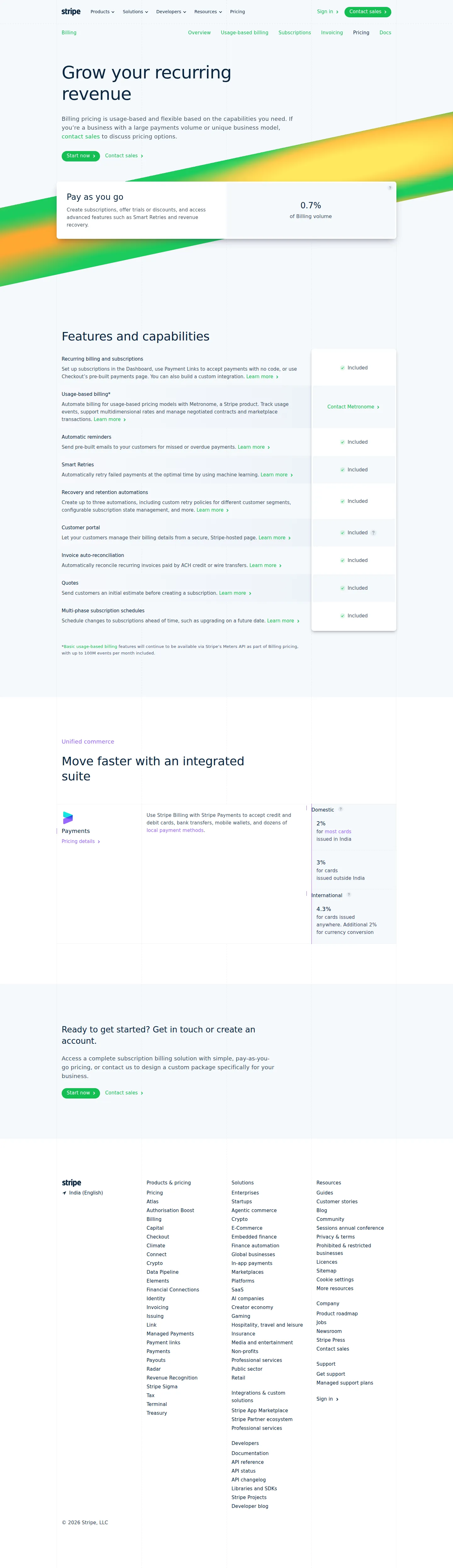
Stripe Billing is priced as a percentage of billing volume, not a flat subscription or per-seat license. The current public rate is 0.7% of Billing volume on the “Pay as you go” plan, covering recurring billing and subscriptions, automatic reminders, Smart Retries, recovery and retention automations, the customer portal, invoice auto-reconciliation, quotes, and multi-phase subscription schedules. That percentage includes Billing transactions processed on and off Stripe and excludes one-off invoices.
Usage-based billing is now a separate product line. The Billing pricing page lists “Usage-based billing*” with a Contact Metronome call-to-action rather than an “Included” checkmark, and the asterisk resolves to: “Basic usage-based billing features will continue to be available via Stripe’s Meters API as part of Billing pricing, with up to 100M events per month included.” On the main pricing page, Metronome has its own card with two plans:
- Startup — “Included”: US$100,000.00 billing allotment, 10 million usage events, “Overages subject to additional pricing”. Metronome’s own pricing page resolves those overages: 0.8% of billing volume above the included $100,000, and $0.04 per 1,000 events above the included 10M. (Metronome heads the same plan “Starter” on its own site.)
- Custom — “Custom pricing”, contact Metronome. For companies “scaling revenue or transforming pricing”.
One qualifier the pricing page itself doesn’t carry: 0.7% pay-as-you-go is the only published Billing rate, not the only way to buy Billing. Stripe’s Billing product page answers “How does pricing work for Stripe Billing?” with “Stripe Billing can be purchased as an annual subscription paid monthly, or on a pay-as-you-go plan.” No price is attached to that subscription option anywhere public — it is quoted.
Invoicing is a third line item: the Starter plan is 0.4% per paid invoice. Around that sit the adjacent Stripe products a billing stack usually pulls in — Connect at a 0.25% starting fee for platforms that deploy their own payments pricing (otherwise “Included with Payments”), Workflows with 10,000 steps per month included then ₹1.64 per additional step, and Atlas at a one-off US$500.00 setup fee. The customer portal is included, but a custom domain is US$10 per month.
The most important thing to understand: these billing percentages stack on top of standard Stripe payment processing fees. The captured (India-region) card rates are 2% for Mastercard and Visa cards issued in India, 3% for Mastercard and Visa issued outside India, 3.5% for American Express issued outside India, and 4.3% for international cards with USD or other currency presentment — each with +2% if currency conversion is required, and a domestic-debit Merchant Discount Rate of 0.4% capped to ₹200. Rates vary by country, so read your own region’s page; the 0.7% / 0.4% billing percentages are the layer that sits on whichever processing rate applies.
What makes this different: Stripe Billing meters what you bill, not what you do — a hybrid, revenue-share-style meter rather than a seat license. Because it rides on payment processing, the billing layer feels cheap (0.7%) relative to the processing fee underneath it, which is exactly how Stripe positions the upsell from Payments into the full Revenue suite. The Metronome split now adds a second step: high-volume per-event metering is a quoted product, not a bundled feature.
Pricing by product
Stripe Billing (Pay as you go)
| Tier | Price | Included | Key mechanics |
|---|---|---|---|
| Pay as you go | 0.7% of Billing volume | Recurring billing and subscriptions; automatic reminders; Smart Retries; recovery and retention automations (up to three); customer portal; invoice auto-reconciliation; quotes; multi-phase subscription schedules | ”Includes Billing transactions processed on and off Stripe. Excludes one-off invoices.” The only rate published on the pricing page |
| Annual subscription paid monthly | Not published | Same Billing product, bought on a committed subscription rather than pay-as-you-go | ”Stripe Billing can be purchased as an annual subscription paid monthly, or on a pay-as-you-go plan” (product-page FAQ). No price is shown anywhere public — quote-only |
| Usage-based billing* | Contact Metronome | Not marked “Included” on the Billing pricing page — routed to Metronome, a Stripe product | *“Basic usage-based billing features will continue to be available via Stripe’s Meters API as part of Billing pricing, with up to 100M events per month included.” |
| Customer portal custom domain | US$10 per month | Stripe-hosted billing-management page on your own domain | The portal itself is Included; only the custom domain is an extra monthly charge |
| Large volume / unique model | Contact sales | Custom package | ”If you’re a business with a large payments volume or unique business model, contact sales to discuss pricing options.” |
Metronome (usage-based billing — a Stripe product)
| Tier | Price | Included | Key mechanics |
|---|---|---|---|
| Startup (Metronome’s own site heads it “Starter”) | Included | US$100,000.00 billing allotment; 10 million usage events | ”For teams launching usage-based products. Pay as your business grows.” Stripe says only “Overages subject to additional pricing”; Metronome publishes the rates — 0.8% of billing volume above $100,000 and $0.04 per 1,000 events above 10M |
| Custom | Custom pricing | Everything in Startup, plus Salesforce/NetSuite and cloud-marketplace (AWS, Azure, GCP) invoicing integrations, data-warehouse exports, a dedicated account manager, and enhanced SLAs | ”For companies scaling revenue or transforming pricing.” Sign-up and quoting run through Metronome, not the Stripe checkout |
Metronome covers real-time metering, pricing and analytics: multidimensional rates, negotiated contracts, and marketplace transactions. Stripe states plainly that “Metronome, a Stripe product, is not included in Stripe Billing” — it is a separately-priced line.
Invoicing
| Tier | Price | Included | Key mechanics |
|---|---|---|---|
| Starter | 0.4% per paid invoice | ”Invoicing features to get started quickly” — no-code invoice creation, automated accounts-receivable and invoicing workflows | Charged per paid invoice; separate from the Billing percentage |
Adjacent Stripe products billed alongside Billing
| Product | Price | Included | Key mechanics |
|---|---|---|---|
| Connect | Included with Payments; 0.25% starting fee | Embedded payments for platforms and marketplaces | The 0.25% applies to “platforms that deploy their own payments pricing to earn revenue on each transaction” |
| Workflows | 10,000 steps per month Included, then ₹1.64 per additional step | Visual no-code automation; 600+ event triggers; logging and versioning | ”No commitment, no recurring fees” |
| Atlas | US$500.00 | One-off setup fee “(includes government fees and your first year of registered agent services)“ | Startup incorporation; not part of the billing stack but sold on the same page |
| Radar | Included on standard payments pricing; ₹4.00 per screened transaction on custom pricing | Fraud protection across the Stripe network | Radar for Fraud Teams is ₹6.00 per screened transaction on standard payments pricing, free for 30 days |
Payment processing rates (India-region render)
| Card type | Rate | Notes |
|---|---|---|
| Mastercard/Visa issued in India | 2% | Domestic debit has an MDR of 0.4% capped to ₹200 |
| Mastercard/Visa issued outside India | 3% | + 2% if currency conversion is required |
| American Express issued outside India | 3.5% | + 2% if currency conversion is required |
| International cards, USD or other presentment | 4.3% | + 2% if currency conversion is required |
| Dispute received / countered | ₹1,000.00 each | Countered fee is returned on won disputes, not on lost ones |
| Smart Disputes (public preview) | 30% of the disputed amount | Charged only on disputes you win; the dispute received fee still applies |
Card rates are region-specific — the capture above is the India render. The 0.7% Billing and 0.4% Invoicing percentages are the layer that sits on top of whichever processing rate applies in your market.
Sales motions across products: self-serve PLG for the standard published rates — create an account, integrate the Billing/Invoicing APIs, and pay 0.7% / 0.4% pay-as-you-go with no setup or monthly fee — and sales-led for Custom (enterprises with large payments volume or unique models get volume-based discounts, country-specific rates, and a tailored package). Metronome is a third motion: a Stripe-branded product with its own sign-up and its own contact-sales path.
Hidden costs : What Stripe Billing users actually pay
The single biggest thing buyers miss is that Billing fees stack on top of payment processing fees — the 0.7% is not your all-in cost. If you collect cards, you also pay the processing fee (about 2.9% + 30¢ per US charge) on every payment. The Billing percentage is the management layer; processing is separate and usually the larger number.
Below are two illustrative builds (these are computed examples, not quoted prices). They assume a US payment-processing rate of roughly 2.9% + 30¢ per charge for the processing line.
| Line item (SaaS billing ~$100,000/mo, ~1,000 charges) | Monthly cost (illustrative) |
|---|---|
| Stripe Billing (0.7% of $100,000 billing volume) | ~$700 |
| Payment processing (~2.9% + 30¢ × 1,000 charges) | ~$3,200 |
| Customer portal custom domain (optional add-on) | $10 |
| Estimated total (Billing layer + processing) | ~$3,910 |
| Line item (Invoicing: 200 paid invoices, ~$50,000 paid) | Monthly cost (illustrative) |
|---|---|
| Invoicing Starter (0.4% per paid invoice on $50,000) | ~$200 |
| Payment processing on collected invoices (~2.9% + 30¢ × 200) | ~$1,510 |
| Estimated Invoicing total | ~$1,710 |
Other things to budget for: metered-event overages — 100 million events/month are included, but very high-volume token/event metering can require a custom plan (contact sales). Credit grants and some advanced features carry standard invoicing/processing fees on top. Currency conversion adds ~2% on cross-currency card charges (per the capture). And the 0.7% applies to off-Stripe transactions too, so if you bill via Stripe Billing but settle some payments elsewhere, the billing fee still applies to that volume.
Want to estimate your own Stripe Billing bill? Use the Stripe Billing pricing calculator to model your costs based on billing volume, paid invoices, and processing fees.
Pricing evolution : Stripe Billing pricing history and changes
Cadence
| Period | Price changes | Product / SKU additions | Notes |
|---|---|---|---|
| 2018–2020 | Starter ~0.5% / Scale ~0.8% (approx.) | Billing launched as standalone subscriptions product | Two-tier structure with a reported free monthly billing-volume allowance on Starter |
| 2021–2023 | Consolidating toward single rate | Native usage-based/metered billing, credit grants, quotes | Metered billing folded into core Billing rather than a separate SKU |
| 2024 – 2026 Q2 | Single 0.7% Billing rate live | 100M metered events/mo included; Invoicing Starter 0.4% | Published as one pay-as-you-go percentage; discounts behind custom/sales |
| 2026 Q3 | 0 (0.7% and 0.4% both held) | Metronome added as its own product line (Startup, Custom); usage-based billing removed from Billing’s Included list | 2026-07-22 — the change is packaging, not price: advanced usage-based billing moved out of the 0.7% into a separately-quoted product, leaving basic Meters API metering (up to 100M events/mo) inside Billing |
Tracked range: 2018–present. The pre-2024 Starter ~0.5% / Scale ~0.8% two-tier split and the old free-billing-volume threshold are approximate figures drawn from contemporaneous reporting rather than the live page, and should be treated as indicative.
Notable changes
- 2018 — Stripe Billing launched as a standalone subscriptions/recurring-revenue product with an approximate two-tier structure: a Starter plan around ~0.5% of billing volume (with a reported free monthly allowance) and a Scale plan around ~0.8% adding the advanced Invoicing/quoting suite and custom retry logic. (Historical, approximate.)
- 2023 — Native usage-based / metered billing (meter events, credit grants, graduated/tiered pricing) was built into core Billing rather than sold as a separate SKU, positioning Stripe Billing for token- and event-metered AI/SaaS companies.
- 2026-06-10 — Live page shows a single 0.7% of Billing volume rate (100M metered events/month included; on- and off-Stripe transactions; excludes one-off invoices) and Invoicing Starter at 0.4% per paid invoice, with custom/volume pricing via sales.
- 2026-07-22 — Advanced usage-based billing left the 0.7%. The Billing pricing page replaced the “Included” checkmark on the “Usage-based billing*” row with a Contact Metronome call-to-action, and Metronome — “a Stripe product” appeared as its own card between Billing and Invoicing on stripe.com/pricing with a Startup plan (“Included”; US$100,000.00 billing allotment, 10 million usage events, overages subject to additional pricing) and a Custom plan (quoted). Headline rates did not move: Billing held at 0.7% of Billing volume, Invoicing Starter at 0.4% per paid invoice, and the customer portal custom domain at US$10 per month.
The Metronome unbundling in detail
This is the second reversal of the same decision. In 2023 Stripe pulled metered billing into the core Billing rate as a bundling play — one percentage, no separate metering vendor, 100M events a month included. On 2026-07-22 it pulled the high end back out again, and the wording of the split is precise about where the line now sits: the asterisk on the Billing page reads “Basic usage-based billing features will continue to be available via Stripe’s Meters API as part of Billing pricing, with up to 100M events per month included.” Everything the page calls advanced — multidimensional rates, negotiated contracts, marketplace transactions — is Metronome’s.
Three details make the split more than a relabelling:
- The unit of account changes at the boundary. Inside Billing you are metered on events (100M/month via the Meters API) and charged on billed volume (0.7%). Metronome Startup is bounded by two ceilings at once — a US$100,000.00 billing allotment and 10 million usage events — so a customer with modest revenue but heavy event volume, or heavy revenue on few events, can hit a wall from either direction. The 10M event ceiling is a tenth of what basic metering allows, which is the clearest signal that Metronome is priced on metering complexity rather than metering volume.
- “Included” no longer means the same thing on both cards. Billing’s “Included” rows are entitlements inside a rate you are already paying. Metronome Startup’s price literally reads “Included” while its overages are “subject to additional pricing” — a free-to-start allotment, not a bundled feature. Stripe’s page leaves that overage unpriced; Metronome’s own pricing page resolves it to 0.8% of billing volume above the US$100,000 allotment and $0.04 per 1,000 events above 10M.
- The quoting path leaves Stripe. Both Metronome plans route to “Sign up with Metronome” or “Contact Metronome” rather than Stripe checkout or Stripe sales, so the buyer crosses a product boundary rather than adding a line to an existing Stripe bill. Stripe’s Billing product-page FAQ states the position plainly: “Metronome, a Stripe product, is not included in Stripe Billing.”
That 0.8% is the number to sit with. Advanced usage-based billing is now priced above the 0.7% recurring rate, where a month earlier it was inside it. For a company billing US$500,000 a month on usage, the line goes from roughly $3,500 folded into Billing to roughly $3,200 on the US$400,000 above the allotment — comparable today, but on a rate that is no longer the same rate, no longer moves with Billing, and no longer covers recurring volume as well. The packaging change is neutral-to-mild on price and structural on everything else.
The steer is stronger in the docs than on the pricing page. Stripe’s usage-based billing documentation reads: “Unless you’re maintaining an existing Billing Meters integration, use Metronome” — Metronome is the recommended path for all new usage-based integrations, with the Meters API “fully supported for existing integrations”. Read together with the footnote, “basic usage-based billing stays in Billing pricing” is a grandfathering promise, not a live product choice: the 100M-events allowance protects the installed base while new buyers are routed to the quoted product. The named exceptions run the other way too — you stay on Meters if you need full compatibility with Connect, Checkout, Adaptive Pricing or Workflows, so the platform-and-marketplace crowd inherits the legacy path precisely because Metronome does not yet reach into the rest of Stripe.
Stripe’s own surfaces have not fully caught up: the Billing product card on stripe.com/pricing now describes “recurring revenue models and one-time billing”, but the access block directly beneath it still reads “Start billing for recurring subscriptions & usage based billing.” That inconsistency is the tell that this is a live migration rather than a settled packaging state — buyers renewing in the next few quarters should get the boundary in writing rather than reading it off the page.
What’s unique : Stripe Billing’s distinctive pricing mechanics
1. It meters billed revenue, not product usage
Most billing/monetization tools charge a platform fee or per-seat license. Stripe Billing charges 0.7% of your billing volume — a slice of your own customers’ subscription and usage revenue. That makes the price a revenue-share that scales with your top line, and aligns Stripe’s incentive with growing your billed revenue rather than capping your seats.
2. The fee applies to off-Stripe transactions
The 0.7% covers billing transactions processed on and off Stripe. So even if you settle some payments through another processor, running the subscription logic through Stripe Billing still incurs the percentage — a deliberate design that monetizes Billing as a system-of-record, not just as a payments add-on.
3. Metering is now split by sophistication, not by volume
Since 2026-07-22 the 0.7% buys basic metering only — the Meters API, up to 100 million events per month. Multidimensional rates, negotiated contracts, and marketplace transactions route to Metronome, a Stripe product, whose Startup plan is capped at a US$100,000.00 billing allotment and 10 million usage events. The shape looks backwards at first: the bundled tier allows ten times more events than the unbundled one. It isn’t a volume ladder — the boundary is drawn at pricing-model complexity. A company firing 80 million flat-rate token events a month stays inside Billing; a company with three rate dimensions and a negotiated enterprise contract crosses into a quote at a fraction of that volume. Stripe’s docs make the direction explicit — “Unless you’re maintaining an existing Billing Meters integration, use Metronome” — so the generous 100M allowance is best read as a grandfathering clause for existing integrations rather than the on-ramp for new ones.
4. The billing layer is cheap because it rides on processing
At 0.7%, Billing looks inexpensive — but it stacks on top of payment processing (~2.9% + 30¢ in the US). Stripe can keep the billing percentage low precisely because it already earns the larger processing fee, making the Revenue-suite upsell feel almost free to existing Payments customers.
Strengths & weaknesses
| Strengths | Weaknesses |
|---|---|
| Fully transparent, published percentage rate (0.7% / 0.4%) | Billing fee stacks on top of processing — all-in cost is higher than 0.7% |
| No setup fee, no monthly platform minimum on the published rate | Percentage of billing volume can exceed flat-fee competitors at very high volume |
| Basic metering still included at up to 100M events/month via the Meters API | 0.7% applies to off-Stripe transactions too, even when Stripe isn’t processing |
| Deep integration with Payments, Tax, Revenue Recognition, Sigma | Best economics require staying inside the full Stripe stack (lock-in) |
| Volume/custom discounts available for enterprises | Real discounted rates are quote-only — published rate is the list price |
| Metronome gives sophisticated usage-based billers a first-party path instead of a third-party vendor | Since 2026-07-22 advanced usage-based billing is priced outside the 0.7%, and Metronome’s overage rates appear on metronome.com rather than on the Stripe card the buyer is reading |
Billing UX : Stripe Billing billing controls and transparency
- Customer portal — A secure, Stripe-hosted page where your customers manage their own billing details. Marked Included in the Billing plan, with one named exception: US$10 per month for a custom domain.
- Smart Retries + recovery and retention automations — Failed payments are retried at an ML-chosen time. On top of that you can “create up to three automations, including custom retry policies for different customer segments, configurable subscription state management, and more” — a hard, named cap worth checking against your dunning design.
- Automatic reminders and invoice auto-reconciliation — Pre-built emails for missed or overdue payments, plus automatic reconciliation of recurring invoices paid by ACH credit or wire transfer. Both Included.
- Quotes and multi-phase subscription schedules — Send an estimate before creating a subscription, and schedule future subscription changes (e.g. an upgrade on a set date) ahead of time. Both Included.
- Meters API vs Metronome — Usage metering is now split across two surfaces. Basic usage-based billing runs on Stripe’s Meters API inside Billing pricing, with up to 100M events per month included; anything beyond “basic” — multidimensional rates, negotiated contracts, marketplace transactions — routes to Metronome, whose Startup plan is bounded by a US$100,000.00 billing allotment and 10 million usage events, then 0.8% of billing volume and $0.04 per 1,000 events beyond those. Stripe’s docs make the default explicit: “Unless you’re maintaining an existing Billing Meters integration, use Metronome.”
- Cost transparency for custom contracts — Custom-pricing customers get named “dashboards, tools, and APIs that give you transparency into your costs”, alongside technical account management, Professional Services, and certified implementation partners.
- Self-serve entry, no platform fee — on the published plan only — “No setup fees, monthly fees, or hidden fees” on standard pricing: you create an account, integrate the Billing/Invoicing APIs or no-code tools, and pay the percentage on what you bill. The pricing page shows exactly one plan, but Stripe’s product-page FAQ names a second purchase path — Billing “can be purchased as an annual subscription paid monthly, or on a pay-as-you-go plan” — and publishes no price for it, so buyers comparing on the 0.7% alone are only seeing one of the two options.
Strategic wins : Why Stripe Billing’s pricing decisions worked
1. Pricing the upsell as a cheap layer on processing
By keeping Billing at 0.7% on top of the larger processing fee, Stripe made the Revenue-suite upsell feel almost frictionless for existing Payments customers — they’re already paying ~2.9%, so adding subscription management for 0.7% is an easy yes. See how AI companies structure pricing.
2. A revenue-share meter that scales with the customer
Charging a percentage of billing volume ties Stripe’s revenue directly to its customers’ growth, so the price never becomes a fixed tax on small accounts and never caps out big ones. Related: choosing the right usage metric.
3. Bundling metered billing first, then charging for the hard part
Folding usage-based billing into the core rate in 2023 with 100M events/month included made Stripe Billing the default for token- and event-metered AI companies who would otherwise have shopped for a metering vendor. The 2026-07-22 split monetizes the customers that land-grab produced, and does it without an eviction: existing Meters integrations keep the 100M-event allowance inside the 0.7%, while every new usage-based build is pointed at Metronome, where multidimensional rates and negotiated contracts — the work metering vendors actually earn on — carry their own rate. Bundle to acquire, grandfather to keep, unbundle to monetize. See outcome-based pricing trends.
4. Holding headline rates flat while re-drawing the package
Nothing in the 2026-07-22 change moved a published number — 0.7%, 0.4%, 0.25% Connect, and the US$10 portal domain all held. Every existing recurring-revenue customer’s invoice was unaffected, so the move generated none of the renewal friction a rate rise would have. The cost lands only on the subset of buyers who need advanced metering, and it lands as a quote rather than a comparable rate, which also removes the number from competitors’ price sheets. Repricing through packaging rather than percentages is the lower-blast-radius way to do this. See understanding entitlements and usage grants.
Areas to improve : Gaps in Stripe Billing’s pricing approach
1. The stacked cost is easy to underestimate
Buyers see 0.7% and forget it sits on top of ~2.9% processing — the all-in number is much larger. Surfacing a combined “Billing + processing” estimate up front would reduce bill-shock. See bill shock and cost unpredictability.
2. Percentage-of-volume penalizes high-volume billers
At large billing volume, 0.7% of revenue can dwarf a flat-fee competitor’s bill, pushing the biggest customers toward a custom quote or an in-house build. A published volume-tier schedule (rather than quote-only discounts) would help mid-market self-qualification.
3. Best economics require full-stack commitment
The favorable bundle economics assume you run Payments, Billing, Tax, and Revenue Recognition all on Stripe. Companies that mix processors still pay 0.7% on off-Stripe volume, which can feel punitive and creates lock-in pressure.
4. “Basic” is doing too much work on the pricing page
The 2026-07-22 split turns on a single word, and the pricing page never defines it: it says basic usage-based billing stays inside Billing pricing at up to 100M events per month, names multidimensional rates, negotiated contracts, and marketplace transactions as Metronome’s, and stops. It does not say where prepaid credit burndown, commits and ramp schedules, or real-time usage visibility land — which are exactly the models most AI companies are building. Stripe’s docs do answer this, and answer it decisively (all of the above are Metronome; the Meters API only reconciles usage at invoice time), but a buyer should not have to read the integration guide to learn which product they are buying. The fix is cheap and already half-written: lift the docs’ capability split onto the pricing page as a two-column table.
5. The real Metronome rate is published on the wrong page
Stripe’s card prices Metronome Startup as “Included” against a US$100,000.00 billing allotment and 10 million usage events, with “overages subject to additional pricing” and no number. The number exists — Metronome’s own pricing page lists 0.8% of billing volume past the allotment and $0.04 per 1,000 events past 10M — but a buyer comparing billing platforms on stripe.com sees a cliff without an edge, which is the bill-shock pattern the rest of Stripe’s pricing page is unusually good at avoiding. Surfacing the 0.8% and $0.04 on the Stripe card would cost Stripe nothing it hasn’t already disclosed, and would let the honest comparison happen where the buyer actually is: advanced usage billing costs slightly more than the 0.7% recurring rate, and that is a defensible thing to say out loud.
Monetization stack & signals : how Stripe Billing builds & buys its revenue engine
Buys 0 Builds 1 135 open roles
Stripe is the billing-and-metering vendor much of the corpus buys instead of building (Cursor invoices through Stripe; Intercom names Stripe Billing in its billing-platform roadmap). Internally it builds and dogfoods that stack — Stripe Billing, Invoicing, and Revenue Recognition — and is staffing it heavily: 22 open billing-engineering roles alongside a large post-sale org. It is the canonical "buy" side of the build-vs-buy decision this surface maps.
-
“Hundreds of thousands of businesses of all sizes and types use Stripe Billing to collect revenue for recurring and one-time payments across a variety of different pricing models.”
Signals reviewed · derived from public job posts
Key takeaways
- Meter what customers bill, not what they use. Stripe Billing charges 0.7% of billing volume — a revenue-share that scales with the customer’s own top line rather than a flat or per-seat fee.
- Stacking matters. The 0.7% Billing fee sits on top of ~2.9% + 30¢ processing, so the published rate is the management layer, not the all-in cost — always model both lines.
- Bundle to acquire, grandfather to keep, unbundle to monetize. Stripe bundled metered billing into the base rate in 2023 to become the default for token- and event-metered companies, then on 2026-07-22 routed advanced usage-based billing to separately-priced Metronome while leaving basic Meters API metering (up to 100M events/month) inside the 0.7% for existing integrations — a repackaging that charges new sophisticated buyers without re-pricing anyone already on the invoice.
- A cheap add-on rides on an expensive base. Stripe can keep Billing at 0.7% because it already earns the larger processing fee — the classic platform upsell mechanic.
- Transparency is the on-ramp; discounts are the close. The published 0.7%/0.4% rates qualify self-serve customers, while volume and country-specific discounts live behind a sales quote.
UBP implications
- Percentage-of-revenue is a clean value metric when you sit on the money flow. Because Stripe already processes the payment, taking a slice of billed revenue is friction-free and self-aligning — a model only payment-adjacent vendors can run. See usage-based pricing strategy.
- A bundled meter is a land-grab, not a permanent package — and the unbundled price reveals what the bundle cost. Stripe folded usage-based billing into its headline rate in 2023 to remove the “price a second metering vendor” objection, then on 2026-07-22 moved the advanced half into Metronome, which prices billing volume past its allotment at 0.8% — a higher rate than the 0.7% that used to absorb it. When a sub-meter comes out of a bundle priced above the bundle, the bundle was carrying it. UBP vendors should read a competitor’s bundled sub-meter as a stage rather than a settled price, and buyers should treat “included” on a fast-growing capability as having an implicit renewal date.
- Stacked fees need transparent all-in modeling. When a usage fee layers on top of another fee, the headline percentage understates true cost — UBP vendors should expose the combined number to preserve trust.
Sources
- Stripe Billing pricing (accessed 2026-07-22) — 0.7% of Billing volume; “Usage-based billing*” with a Contact Metronome CTA and the Meters API footnote (up to 100M events/month); customer portal custom domain at US$10 per month
- Stripe pricing — all products (accessed 2026-07-22) — Billing 0.7%, Metronome Startup (US$100,000.00 billing allotment, 10 million usage events) and Custom, Invoicing Starter 0.4%/paid invoice, Connect 0.25% starting fee, Workflows 10,000 steps/mo + ₹1.64/step (India-region render)
- Stripe Billing documentation (accessed 2026-07-22) — subscriptions, metered billing, credit grants, quotes
- Stripe Billing product page — “How does pricing work for Stripe Billing?” (accessed 2026-07-23) — second source: “Stripe Billing can be purchased as an annual subscription paid monthly, or on a pay-as-you-go plan”; “Metronome, a Stripe product, is not included in Stripe Billing”
- Stripe docs — basic usage-based billing vs Metronome (accessed 2026-07-23) — second source: “Unless you’re maintaining an existing Billing Meters integration, use Metronome”; Meters API “fully supported for existing integrations”
- Metronome pricing (accessed 2026-07-23) — second source for the Startup/“Starter” plan: “$100,000 in billing volume included, billed at 0.8% after that”; “10M events included, billed at $0.04 / 1k events after that”
Bottom line
Stripe Billing is priced as a percentage of billing volume — 0.7% for recurring subscriptions, plus a separate 0.4% per paid invoice for Invoicing Starter — all layered on top of standard Stripe payment processing fees. It meters what you bill, not what you do, applies even to transactions processed off Stripe, and keeps the billing percentage cheap precisely because it rides on the larger processing fee. Since 2026-07-22 that 0.7% no longer buys the whole metering story: basic usage-based billing stays inside it via the Meters API at up to 100 million events per month, while multidimensional rates, negotiated contracts, and marketplace transactions are priced by Metronome, a Stripe product, whose Startup plan is bounded by a US$100,000.00 billing allotment and 10 million usage events and whose own page rates the overage at 0.8% of billing volume and $0.04 per 1,000 events. There is no monthly platform minimum on the published pay-as-you-go rate and no perpetual free tier; enterprises with large volume negotiate custom, country-specific, and multi-product discounts via sales. There are now two traps rather than one — the stacking, since 0.7% is the management layer and not the all-in cost, and the boundary, since Stripe’s pricing page does not say which metering features sit on which side of it while its docs quietly point every new usage-based build at Metronome. Browse the pricing blueprint for more fully-researched company profiles.
Want to compare Stripe Billing against other billing and monetization infrastructure companies? Browse the pricing blueprint.
Pricing timeline : Major events on a vertical axis
Each milestone below corresponds to a public pricing change, product launch, or material adjustment. Major events use a filled marker; minor adjustments use a faded one.
Usage-based billing unbundled into Metronome, a Stripe product
Stripe split advanced usage-based billing out of the 0.7% Billing rate. The Billing pricing page now shows 'Usage-based billing*' with a Contact Metronome CTA instead of an Included checkmark, footnoted 'Basic usage-based billing features will continue to be available via Stripe's Meters API as part of Billing pricing, with up to 100M events per month included.' On stripe.com/pricing, Metronome appears as its own product card between Billing and Invoicing with two plans — Startup (Included; US$100,000.00 billing allotment, 10 million usage events, overages subject to additional pricing) and Custom (custom pricing, contact Metronome). Billing stays 0.7% of Billing volume and Invoicing Starter stays 0.4% per paid invoice; the customer portal custom domain is listed at US$10 per month. Stripe's Billing FAQ states 'Metronome, a Stripe product, is not included in Stripe Billing', and Stripe's docs direct all new usage-based integrations to Metronome while keeping the Meters API supported for existing ones. Metronome's own pricing page resolves Stripe's unpriced overage to 0.8% of billing volume above the US$100,000 allotment and $0.04 per 1,000 events above 10 million.
Single 0.7% Billing rate; Invoicing Starter 0.4%/paid invoice
Live shape at this date: 0.7% of Billing volume for recurring + usage-based billing (100 million metered events per month included; transactions on and off Stripe, excludes one-off invoices), and Invoicing Starter at 0.4% per paid invoice. Both layer on top of standard Stripe payment processing fees; Connect platform pricing starts at a 0.25% fee and Workflows includes 10,000 steps/month. Custom/volume pricing for enterprises via sales.

Usage-based billing (metered) built into Billing
Stripe folded native usage-based/metered billing into the core Billing product — meter events, credit grants, and tiered/graduated pricing models — rather than charging it as a separate SKU. The published rate consolidated toward a single percentage-of-billing-volume model with a large included metered-event allowance.
Two-tier Billing: Starter (0.5%) + Scale (0.8%)
Stripe launched Billing as a standalone product with a two-tier structure: a Starter plan at roughly 0.5% of billing volume (with a reported free monthly billing-volume allowance) and a Scale plan at roughly 0.8% adding advanced features like the full Invoicing/quoting suite and custom retry logic. These historical percentages are approximate and drawn from contemporaneous reporting, not the current live page.
- · Stripe Billing doesn't meter what you do — it meters what you bill. The 0.7% is taken on your billing volume, including transactions processed off Stripe, which makes it a revenue-share-style fee that rises with your own customers' subscription and usage revenue rather than with your usage of Stripe's product.
- · Stripe unbundled its own usage-based billing: the Billing pricing page now shows a 'Contact Metronome' link where an 'Included' checkmark used to sit, with only basic metering (up to 100M events per month via the Meters API) left inside the 0.7% rate. The company that sells other people's usage-based billing has made its own usage-based billing a separately-quoted product.
- · The 0.7% Billing fee stacks on top of payment processing, so a SaaS company collecting cards in the US effectively pays roughly 2.9% + 30¢ to take the payment AND 0.7% of the billed amount to manage the subscription — the billing layer is cheap relative to processing, which is exactly how Stripe wants the bundle to feel.
Questions & answers
- What is Stripe Billing's pricing model?
- Stripe Billing is priced as a percentage of billing volume rather than a flat subscription. The current public rate is 0.7% of Billing volume for recurring subscriptions — covering transactions processed on and off Stripe and excluding one-off invoices. Invoicing is a separate 0.4% per paid invoice (Starter plan). Advanced usage-based billing is now sold as Metronome, a Stripe product, with basic metering still available via the Meters API at up to 100M events per month inside Billing pricing. All of it stacks on top of standard Stripe payment processing fees.
- Does Stripe Billing offer a free tier?
- There is no perpetual free Billing tier on the current public page — Billing is 0.7% of billing volume from the first dollar billed. Historically Stripe's Billing Starter plan included a free monthly billing-volume threshold (reported as roughly the first $1M of billing volume per month) before the percentage kicked in, but the current page shows a single 0.7% rate with no published free threshold. You only pay payment-processing fees on payments you actually take, and Invoicing's 0.4% is charged only on invoices that are actually paid.
- How much does Stripe Billing cost per month?
- On the published pay-as-you-go plan there is no fixed monthly fee — cost scales with billing volume. At 0.7% of Billing volume, $100,000 of monthly recurring/usage billing costs about $700 in Billing fees, on top of the payment processing fees (e.g. ~2.9% + 30¢ per US card charge) on whatever you collect. Invoicing adds 0.4% per paid invoice, and the customer portal custom domain is US$10 per month. Stripe also sells Billing as an annual subscription paid monthly — that option has no published price and is quoted by sales, as are custom rates for large volume.
- Is Stripe Billing pricing usage-based or subscription?
- It is usage-based on your own billing volume, not a seat or subscription license. You pay 0.7% of the recurring revenue Stripe Billing processes plus 0.4% per paid invoice — so your bill rises and falls directly with how much you bill your customers. That makes it a revenue-share-style meter layered on top of per-transaction payment processing, with no monthly platform minimum on the published rate.
- Is usage-based billing still included in Stripe Billing's 0.7%?
- Only the basic version. Stripe's Billing pricing page now shows 'Usage-based billing*' with a Contact Metronome call-to-action instead of an Included checkmark, and the footnote reads: 'Basic usage-based billing features will continue to be available via Stripe's Meters API as part of Billing pricing, with up to 100M events per month included.' Advanced usage-based billing — multidimensional rates, negotiated contracts, marketplace transactions — runs on Metronome, a Stripe product, whose Startup plan is bounded by a US$100,000.00 billing allotment and 10 million usage events.