AI Summary
About
Synthesia is an AI video generation platform that turns scripts into studio-quality videos narrated by AI avatars, with no cameras, mics, or actors required. The company markets itself as “the world’s #1 rated AI video software,” citing a 4.7 G2 rating from 2,000+ reviews and use by 50,000+ teams. Its enterprise positioning leans on compliance and trust — the enterprise page claims adoption by “over 90% of the Fortune 100” and badges for SOC 2, GDPR, and ISO 42001.
The product is sold as a tiered subscription. Four plans span a free Basic tier through a sales-led Enterprise tier, with the two paid self-serve plans (Starter and Creator) metered by credits that translate into video minutes. A site-wide “NEW LOWER PRICES” banner advertises plans starting from $18/month billed yearly (“Save 38%”) — and that banner is itself localised: the same page served to an Indian visitor reads “plans now starting from ₹1,499/month — Save 25%”.
Synthesia Ltd is headquartered in London. It competes most directly with HeyGen in the AI-avatar video category, but the two diverge on packaging: Synthesia meters fixed video minutes via a credit pool and sells an enterprise governance story (compliance, collaboration, dedicated CSM), while HeyGen leans on a per-feature credit model aimed at individual creators. For current pricing, see Synthesia’s pricing page.
Pricing summary : How Synthesia’s pricing model works
Synthesia prices on four interacting dimensions: a plan tier (Basic, Starter, Creator, Enterprise), a credit allowance that converts to video minutes (the real value metric), billing cadence (monthly vs. annual, which changes both the headline price and the size of the credit pool), and — newly visible — the buyer’s country, which selects a per-currency price table with its own discount percentage. Seats are a soft fifth dimension: each plan caps the number of editors and guests rather than charging per seat. Unless stated otherwise, figures below are the USD list prices.
- Plan tiers (monthly billing): Basic — Free; Starter — $29/month; Creator — $89/month (Most Popular); Enterprise — Custom pricing.
- Annual billing discount: Starter drops to $18/mo and Creator to $64/mo when billed yearly — the headline “NEW LOWER PRICES — plans now starting from $18/month, Save 38%”. The page now opens on the yearly view, with the monthly price shown struck through on the same card.
- Regional price tables: the same page served to an Indian visitor quotes Starter at ₹1,999/month (₹1,499/mo billed yearly) and Creator at ₹6,199/month (₹4,649/mo billed yearly), with the banner discount reading “Save 25%” instead of 38%.
- Credits → minutes: every second of video costs 2 credits, so 120 credits buy one minute. Basic includes 1,200 credits/mo (10 minutes of video/month, 25 AI-generated video assets). Billed monthly, Starter also gets 1,200 credits/mo (10 min/month) and Creator 3,600 credits/mo (30 min/month, 75 assets); billed yearly, Starter gets 14,500 credits/yr (120 minutes of video or AI Dubbing/year, 300 assets) and Creator 44,000 credits/yr (360 minutes of video or AI Dubbing/year, 900 assets).
- Seat caps: Basic = 1 editor; Starter = 1 editor + 3 guests; Creator = 1 editor + 5 guests; Enterprise = custom number of editors & guests.
- Enterprise: quote-only (“Let’s talk” / Book demo), unlimited video minutes, custom credits, SAML/SSO, and compliance (SOC 2, GDPR, ISO 42001).
What makes this different: Synthesia decouples price from seats and ties it to generated video minutes via a credit pool. Minutes are consumed only when a video is generated (drafts and playback are free), and Synthesia states it only charges for new seconds when you edit — so a 3-second change to a 1-minute video costs 3 seconds, not 60. Unused minutes do not roll over month to month.
Pricing by product
Synthesia sells a single product (the AI video platform) packaged into four plans. The pricing page opens on the yearly view and prints the monthly price struck through on the same card, so both cadences are visible at once. Prices are USD list unless a row says otherwise.
Synthesia plans (USD list price)
| Plan | Price | Included usage | Key mechanics |
|---|---|---|---|
| Basic | Free ($0/mo) | 1,200 credits/mo · 10 minutes of video/month · 25 AI-generated video assets | No credit card; 1 editor; 9 AI avatars; no personal avatars; AI chat support |
| Starter | $29/month, or $18/mo billed yearly | Monthly: 1,200 credits/mo · 10 min of video/month · 25 assets. Annual: 14,500 credits/yr · 120 minutes of video or AI Dubbing/year · 300 assets | 1 editor & 3 guests; 3 personal avatars; remove Synthesia logo; 125+ AI avatars; regular support |
| Creator | $89/month, or $64/mo billed yearly | Monthly: 3,600 credits/mo · 30 min of video/month · 75 assets. Annual: 44,000 credits/yr · 360 minutes of video or AI Dubbing/year · 900 assets | ”Most popular”; 1 editor & 5 guests; 5 Personal Avatars; API access; 180+ AI avatars; priority support |
| Enterprise | Custom (“Let’s talk”) | Unlimited video minutes · custom credits · unlimited dubbing minutes | Sales-led (Book demo); SAML/SSO; 240+ stock avatars; unlimited Personal Avatars (subject to reasonable consumption and compute); dedicated CSM |
Regional price tables (same plans, localised)
Synthesia ships one price table per currency and picks it from the visitor’s country, so the “list price” depends on where you buy. The rupee table below is what the page serves an Indian visitor today; the same location was served a discounted USD table in May (see the pricing timeline).
| Market | Starter | Creator | Advertised discount |
|---|---|---|---|
| USD list | $29/month · $18/mo billed yearly | $89/month · $64/mo billed yearly | ”Save 38%“ |
| India (INR) | ₹1,999/month · ₹1,499/mo billed yearly | ₹6,199/month · ₹4,649/mo billed yearly | ”Save 25%“ |
Add-ons & metered extras
| Item | Price | Notes |
|---|---|---|
| Studio Avatars | $1,000/year (paid add-on) | Same price across Starter, Creator, and Enterprise in the compare-plans table; the row’s tooltip qualifies it as “a paid add-on ($1000/year) for annual plan users only” and warns a Studio Express-1 avatar can take up to 10 days to process |
| Synthesia API (Creator) | Included, drawn from the plan pool | ”Up to 360 minutes of video / year, deducted from the plan’s usage limits” |
| Synthesia API (Enterprise) | 360 minutes/year included; extra is a paid add-on | ”Additional usage available as a paid add-on” |
| Overage / extra minutes | Not pay-per-minute | Exceeding the limit caps usage until renewal; users must upgrade the plan to get more minutes |
Sales motions across products: PLG / self-serve for Basic, Starter, and Creator (instant signup, no credit card on Basic); sales-led for Enterprise (Book demo, custom quote, annual contract).
Hidden costs : What Synthesia users actually pay
Synthesia’s pricing avoids the usual usage-billing surprises — there is no per-minute overage and no per-seat charge — so the “hidden” costs are structural rather than metered: the annual commitment required to hit the headline price, the paid Studio Avatars add-on, and the upgrade-to-unblock dynamic when a team runs out of minutes mid-cycle.
Archetype 1 — a solo creator who wants the $18/mo headline. The advertised “from $18/month” requires an annual commitment, billed up front.
| Line item | Effective monthly cost |
|---|---|
| Starter plan, billed yearly ($216/yr) | $18 |
| Per-minute overage | $0 (not offered — usage caps at 120 min/yr until renewal) |
| Effective total | $18/mo ($216 paid up front) |
The same plan billed month-to-month is $29/mo, so the advertised 38% saving is real but locks in a year of spend. A creator who only needs a few videos may find the free Basic tier (10 min/month) sufficient and pay $0.
Archetype 2 — a small enablement team on Creator that needs branded personal avatars. Creator at $64/mo annual covers 360 min/yr, but a custom likeness of a presenter is a paid add-on.
| Line item | Annualized monthly cost |
|---|---|
| Creator plan, billed yearly ($768/yr) | $64 |
| Studio Avatars add-on ($1,000/yr) | $83 |
| Extra video minutes beyond 360/yr | $0 metered — must upgrade plan to raise the cap |
| Effective total | $147/mo ($1,768/yr) |
So a team that needs a studio-grade custom avatar can more than double its effective bill via the add-on, and a team that outgrows 360 minutes/year has no pay-as-you-go path — the only lever is upgrading to a higher plan or Enterprise. That trade — predictable budgets at the cost of elastic capacity — is the defining feature of Synthesia’s model.
Want to estimate your own Synthesia bill? Use the Synthesia pricing calculator to model your monthly cost based on plan, billing cadence, and video-minute volume.
Pricing evolution : Synthesia pricing history and changes
Synthesia’s packaging has moved through three phases: minute-metered self-serve tiers, consolidation onto a unified credit pool shared across AI features, and most recently a “new lower prices” annual push whose headline number is geo-tiered — $18/month in the USD list table, ₹1,499/month in India, each with its own advertised discount. Dated Internet Archive snapshots back the 2022–2024 milestones in the timeline below; quarter-level change counts are left coarse where a primary snapshot has not pinned the exact quarter.
Cadence
| Quarter | Price changes | Product / SKU additions | Notes |
|---|---|---|---|
| 2024 | unknown | 1 | Self-serve Starter and Creator tiers packaged with annual video-minute allowances (Starter ~120 min/yr, Creator ~360 min/yr) per Synthesia’s pricing page and a 2024 Speechify review; no per-minute overage. |
| 2025 | unknown | 1 | Usage consolidated onto a single credit pool that is the shared currency across video generation, AI Dubbing, and other AI features (Synthesia help center / pricing FAQ). |
| 2026 Q2 | 1 | 0 | 2026-05-31 capture: “NEW LOWER PRICES” banner. The capture host was served Synthesia’s discount-market USD table — Starter $19/month ($14/mo yearly), Creator $89/month ($59/mo yearly), “Save 34%” — while the standard USD list table on the same page carried Starter $29/$18 and Creator $89/$64. |
| 2026 Q3 | 0 | 0 | 2026-07-22 capture: no change to the USD list ($29/$18 Starter, $89/$64 Creator, “Save 38%”), but the price table is now openly geo-tiered — the same location served the discounted USD table in May is now quoted in rupees (Starter ₹1,999/month, ₹1,499/mo yearly, “Save 25%”). |
Tracked range: 2024–present. Quarter-level price-change counts are marked unknown where a dated archive snapshot has not yet confirmed the exact quarter.
Notable changes
- 2026-07-22 — USD list price re-confirmed at Starter $29/month ($18/mo billed yearly) and Creator $89/month ($64/mo billed yearly) under a “NEW LOWER PRICES — plans now starting from $18/month, Save 38%” banner; India moved onto a rupee table (₹1,999/₹1,499 Starter, “Save 25%”), replacing the discounted USD table it saw in May.
- 2026-05-31 — “NEW LOWER PRICES — plans now starting from $14/month, Save 34%” banner observed live, but as Synthesia’s discount-market USD table (Starter $19/month, $14/mo yearly; Creator $89/month, $59/mo yearly), not the standard USD list price (captured from synthesia.io/pricing).
- 2025 — Unified credit pool introduced as the shared currency across AI features; one credit allowance now spans video generation and AI Dubbing on self-serve plans (per Synthesia help center).
- 2024 — Public self-serve Starter and Creator tiers offered alongside free Basic and sales-led Enterprise, packaging usage as fixed annual video minutes rather than pay-as-you-go (corroborated by a Speechify pricing review, 2024).
The 2026 “new lower prices” repricing in detail
The most recent move is a discount, not an increase — unusual for a category where AI compute costs have pushed many vendors to raise prices. Synthesia discounts the annual effective price of both self-serve tiers (USD list: Starter to $18/mo, Creator to $64/mo) while the monthly prices stay at $29 and $89. The structure makes the discount conditional on an annual commitment: the headline “from $18/month” is only available billed yearly. Annual billing also front-loads a far larger credit pool — Starter jumps from 1,200 credits/mo to 14,500 credits/yr, Creator from 3,600 credits/mo to 44,000 credits/yr — so the offer simultaneously lowers price and rewards commitment with capacity, a classic levers-pulled-together move to push month-to-month users onto annual contracts.
The less obvious half of the story is that there is no single headline number. The May 2026 capture and the July 2026 capture were served different USD tables from the same URL (a $19/$14 “Save 34%” discount table versus the $29/$18 “Save 38%” list table), and India has since been moved onto rupees entirely. The advertised entry price is therefore a function of where you browse from, which makes any single “Synthesia starts at $X” claim market-specific rather than global.
What’s unique : Synthesia’s distinctive pricing mechanics
1. Minutes, not seats, are the value metric. Synthesia deliberately does not charge per editor. Each plan caps editors and guests (1+3 on Basic/Starter, 1+5 on Creator) but the lever that actually scales the bill is generated video minutes via a credit pool. This aligns price with output (videos shipped) rather than headcount, which is rare in a category where many tools default to per-seat SaaS.
2. Bounded spend by design — no per-minute overage. When a team hits its minute limit, usage caps until renewal; there is no pay-as-you-go meter that can spike a bill. The only way to get more capacity is to upgrade the plan. That trades elasticity for predictability and is the opposite of the bill-shock dynamic that plagues consumption-metered AI products — a deliberate enterprise-procurement-friendly choice.
3. Edits bill only the new seconds. Synthesia charges credits only for newly generated seconds — a 3-second change to a 1-minute video costs 3 seconds, not 60 — and drafts and previews are free. This fine-grained metering keeps the value metric honest and avoids penalizing iteration, which is a recurring complaint about whole-render credit models elsewhere.
4. Annual billing front-loads capacity, not just discount. The “from $18/month” headline isn’t only a 38% saving off the $29 monthly price — committing annually also swaps a monthly credit pool for a much larger yearly one (Starter: 1,200/mo → 14,500/yr; Creator: 3,600/mo → 44,000/yr). Pricing the discount and the capacity bump together is a sharper push toward annual contracts than a flat percentage off.
5. Compliance as a pricing moat. The Enterprise tier sells governance — SAML/SSO, SOC 2, GDPR, and ISO 42001 (an AI-management-system standard) — as the gate to “unlimited” minutes and custom credits. For regulated buyers (Synthesia cites 90%+ Fortune 100 adoption), the trust posture, not the per-unit rate, is what justifies the custom quote.
Strengths & weaknesses
| Strengths | Weaknesses |
|---|---|
| Predictable bills — no per-minute overage and no per-seat charge mean spend is bounded before purchase. | No pay-as-you-go path: outgrowing your minutes forces a full plan upgrade rather than buying incremental capacity. |
| Free Basic tier (10 min/month, no card) lowers the trial barrier and seeds PLG adoption. | Headline “$18/month” requires an annual commitment billed up front; the $29 month-to-month price is 61% more. |
| Honest metering — edits bill only new seconds; drafts and previews are free. | Unused minutes/credits do not roll over, so under-utilizing an annual pool is pure waste. |
| Strong enterprise trust posture (SOC 2, GDPR, ISO 42001; 90%+ Fortune 100) justifies sales-led pricing. | Studio Avatars add-on ($1,000/yr) can more than double a Creator team’s effective bill. |
| Minutes-as-value-metric aligns price with output, not headcount. | Enterprise pricing is fully opaque (quote-only), making peer comparison hard for buyers. |
| Annual billing pairs a price cut with a large capacity bump, rewarding commitment. | Credit-to-minute conversion has shifted over time (unified pool), which can confuse cost forecasting. |
Billing UX : Synthesia billing controls and transparency
- Per-card billing-cycle switch — Each plan card carries its own “Billed yearly. Pay monthly” switch (identified in markup as
switch-monthly) that re-renders the headline price and the included credit/minute allowance. The page now defaults to the yearly view and prints the monthly price struck through above it ($29/month above $18/mo on Starter), so the cadence trade-off is legible without touching the switch. - Country-selected price table — The page resolves the visitor’s country and swaps in a per-currency price table with its own “Save X%” banner (USD list $29/$18 with “Save 38%”; the Indian view ₹1,999/₹1,499 with “Save 25%”). There is no on-page currency picker, so a buyer cannot see the other market’s price or choose which table applies.
- Stale figures in the on-page FAQ — The pricing FAQ still answers “How much does Synthesia cost?” with “$29 per month or $264 if you go with an annual plan” for Starter and “$89/month or $804/year” for Creator, which do not reconcile with the $18/mo and $64/mo annual cards directly above it.
- Hard usage cap, not metered overage — Per Synthesia’s FAQ, exceeding your plan’s minute limit caps usage until renewal rather than billing an overage; the only way to get more minutes immediately is to upgrade the plan. Budgets are therefore bounded by design.
- No rollover — Unused video minutes/credits do not carry into the next billing period (stated in the pricing FAQ).
- Credit-only-on-generation metering — Minutes are consumed only when a video is generated; drafts and the play/preview function do not draw down credits, and edits charge only for new seconds (e.g., a 3-second change = 3 seconds billed).
- Self-serve signup & cancel — Basic requires no credit card; users can cancel anytime from account settings. Upgrading Starter/Creator to an annual plan or to Enterprise routes through customer support / sales rather than fully self-serve.
- Free trial paths — A free single-video generator, a 5-minute product tour, and a sales demo are offered as no-commitment entry points.
- Enterprise procurement — Enterprise is quote-only (“Let’s talk” / Book demo) on an annual contract, with SOC 2, GDPR, and ISO 42001 surfaced as trust signals.
Strategic wins : Why Synthesia’s pricing decisions worked
1. Picking video minutes as the value metric
By metering generated minutes rather than seats, Synthesia ties price to the thing customers actually value — videos shipped — and sidesteps the seat-count negotiations that cap per-seat SaaS expansion. This is a textbook example of choosing the right usage metric: the meter scales with customer success, so heavy users pay more without feeling nickel-and-dimed per login.
2. Trading elasticity for predictability to win enterprise
Refusing per-minute overage looks like leaving revenue on the table, but it removes the single biggest objection regulated buyers have to AI tooling — unbounded spend. Bundling that with SOC 2, GDPR, and ISO 42001 turns pricing into a procurement asset, not a hurdle. It is the opposite bet from consumption-metered peers and matches how AI companies are shifting away from per-user licenses toward value-aligned but predictable packaging.
3. Pairing the discount with a capacity bump to drive annual contracts
The 2026 “new lower prices” move cut annual price and enlarged the credit pool simultaneously, making the month-to-month plan look strictly worse on both axes. Pulling two levers together is a sharper conversion play than a flat percentage discount and pushes cash flow forward via up-front annual billing. See introduction to usage-based pricing for why commitment incentives matter to UBP businesses.
4. Using a generous free tier as the top of the funnel
A no-card Basic plan with 10 minutes/month lets buyers produce a real video before paying, which is a stronger proof point than a watermarked demo. It seeds product-led growth while the minute cap creates a natural, value-aligned upgrade trigger once a team’s output grows.
Areas to improve : Gaps in Synthesia’s pricing approach
1. Offer incremental capacity instead of forcing a full upgrade
The hard cap is predictable, but a team that exceeds 360 minutes/year on Creator has no option except jumping a whole tier or going Enterprise. A self-serve “minute pack” add-on (sold at a clear per-minute rate) would let teams handle a busy month without renegotiating their plan, capturing demand that today either churns or sits frustrated. This avoids the all-or-nothing cliff that drives cost unpredictability and friction.
2. Make annual-vs-monthly value comparison explicit at the point of sale
Because annual billing changes both price and the credit pool, buyers can’t easily see the true trade. A side-by-side “$29/mo = 1,200 credits/mo vs $18/mo annual = 14,500 credits/yr” comparison — and clear messaging that the headline price needs a yearly commitment — would reduce post-purchase surprise and the perception that “$18” is the entry price.
3. Publish enterprise pricing anchors
Fully opaque Enterprise pricing forces every regulated buyer into a sales cycle just to learn the rough order of magnitude. Publishing a starting band or representative minute-tier pricing (as some peers do) would shorten the funnel for self-qualifying large teams and reduce wasted sales motion, without giving up custom negotiation for genuine enterprise deals.
Monetization stack & signals : how Synthesia builds & buys its revenue engine
Buys 5 Builds 2 9 open roles
Synthesia builds its monetization core in-house and buys the commercial CRM/CPQ layer around it. A February 2026 engineering post details an in-house billing-and-usage-metering system the company built in ~3 months and ran on roughly one engineer while scaling from $40M to ~$140M ARR, including the 2025 move to a unified credit-based model — with Stripe kept strictly as the payment provider behind an isolated data model. The revenue org leans on bought tools elsewhere: Salesforce as CRM, DealHub as the deal-desk CPQ, and a Snowflake + dbt commercial data stack. Hiring skews to the lifecycle and deal motion (23 customer-success and 22 retention-tagged commercial roles, plus a RevOps/deal-desk build-out via a Deal Strategy Analyst and Order Management Specialist) rather than to billing engineering, consistent with a metering platform that is already built and low-maintenance.
-
“we needed to build a solution, and we needed it to grow with us … It took us about three months to build, and about a month later, we completed migrating over $40 million in usage onto the new system.”
-
“Usage metering is how we maintain a comprehensive history of usage that tracks all activity and supports audit logging. This is an immutable log of events that shows, for example, that five minutes of video generation have been used at a given point in time.”
-
“Stripe is our payment provider, and our goal was to maintain an independent data model from Stripe.”
-
“Salesforce was our CRM, and our goal was similar – isolate for the sake of flexibility.”
-
“Work within DealHub (CPQ) to validate deal configurations, flag misconfigurations, and escalate system issues during the deal review workflow.”
-
“Architect and scale robust, end-to-end data pipelines that ingest and transform complex semi-structured and structured data into our Snowflake data warehouse.”
-
“Own the evolution of our dbt project - implementing modular modelling patterns and other best practices to ensure a "single source of truth" for the entire organisation.”
- Enterprise Customer Success Manager Customer success Jun 17, 2026
- Strategic Customer Success Manager - French Speaking Customer success Jun 17, 2026
- Solutions Consultant Customer success Jun 17, 2026
- Product Designer, Growth (Senior/Staff-Level) Retention Jun 17, 2026
- Product Manager, Enterprise (Senior/Staff-level) Retention Jun 17, 2026
- Deal Strategy Analyst - EMEA RevOpsDeal desk seen May 19, 2026
- Commercial Data Scientist RevOps seen May 19, 2026
- Order Management Specialist Deal desk seen May 12, 2026
- Principal Backend Engineer Billing engineering seen Jan 12, 2026
- +44 more matched roles
Signals reviewed · derived from public job posts, engineering blogs
Job postings fill and close over time — once a posting is filled we keep it as a dated citation (the quoted evidence remains); use View open roles for current listings.
Key takeaways
- Predictability can be a feature, not a limitation. Synthesia turns “no overage” into a selling point for risk-averse enterprise buyers — a deliberate counter to the bill-shock anxiety around consumption pricing. If your buyers fear unbounded AI spend, a hard cap with an upgrade path can convert better than elastic metering.
- Choose a value metric that scales with customer success. Metering generated minutes (output) rather than seats (headcount) keeps the meter aligned with the value the customer perceives, so expansion feels earned rather than extracted.
- Pull discount and capacity levers together. The 2026 repricing made annual strictly better on both price and credits at once, which is a far stronger conversion incentive than a standalone percentage discount and pulls cash forward.
- Meter at a granularity that doesn’t punish iteration. Charging only for newly generated seconds (not whole re-renders) removes a friction that would otherwise discourage the editing customers do most, protecting the core workflow.
- Compliance can gate your highest tier. For regulated segments, SOC 2 / GDPR / ISO 42001 can be the actual product behind the “Enterprise — contact us” tier; the per-unit rate is secondary to the trust posture.
UBP implications
- “Capped usage” is a legitimate UBP packaging, not a failure to commit. Synthesia shows you can meter a real value unit (minutes) while still bounding the bill — a middle ground between pure subscription and pure pay-as-you-go that suits buyers who want usage alignment without spend risk.
- A unified credit pool simplifies multi-feature metering but can muddy forecasting. Consolidating video, dubbing, and other AI features onto one credit currency reduces SKU sprawl, but if the credit-to-minute conversion shifts over time, customers lose the ability to forecast — UBP teams should hold conversion rates stable and communicate changes loudly.
- Commitment incentives are the UBP lever that funds growth. By rewarding annual billing with both lower price and more capacity, Synthesia trades a smaller headline ARPU for forward cash and lower churn — the same dynamic that makes annual commits central to durable usage-based businesses.
Sources
- Synthesia pricing page (accessed 2026-07-23)
- Synthesia Enterprise page (accessed 2026-07-22)
- Synthesia help center — “What are credits, and how do they work on self-serve plans?” (accessed 2026-07-23)
- Synthesia help center — “What are Synthesia’s pricing plans?” (accessed 2026-07-23)
- Synthesia help center — Account & Billing (accessed 2026-07-23)
- Synthesia official website (accessed 2026-07-22)
Bottom line
Synthesia’s pricing is a study in deliberate constraint: it meters the right value unit — generated video minutes via a credit pool — but caps it rather than letting it run, trading the elastic upside of consumption billing for the predictable, audit-friendly bills that win regulated enterprise buyers. The 2026 “new lower prices” push, which pairs a 38% annual discount with a larger credit pool, shows the same instinct: move customers onto committed contracts by making the predictable choice the obviously better one.
Want to compare Synthesia against other AI video and Generative Media companies? Browse the pricing blueprint.
Pricing timeline : Major events on a vertical axis
Each milestone below corresponds to a public pricing change, product launch, or material adjustment. Major events use a filled marker; minor adjustments use a faded one.
Geo-tiered price tables surface — US list $29/$18, India moved to INR
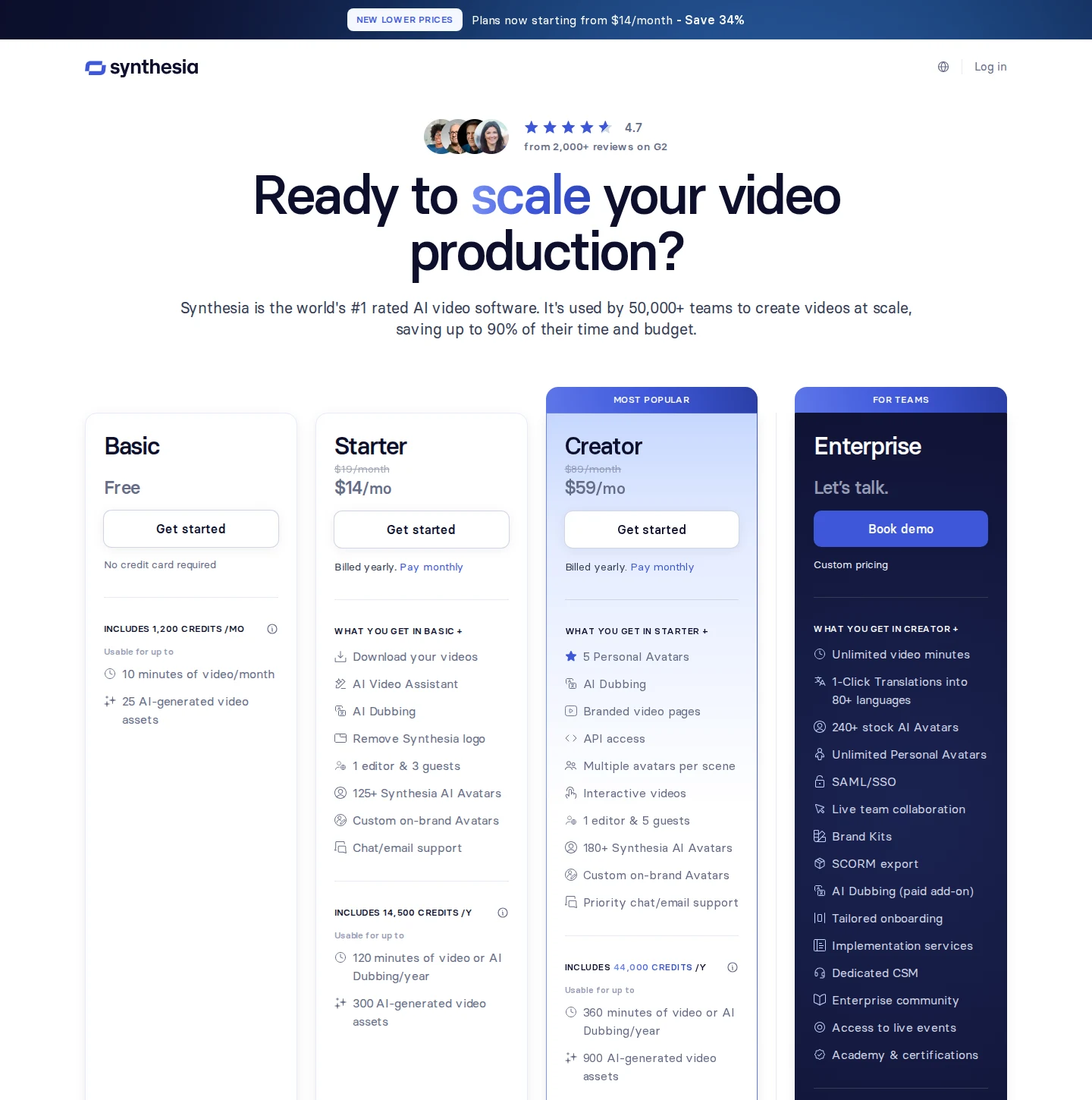
Captured 2026-07-22: the pricing page defaults to the yearly view and localises by visitor country. The standard USD list price is Starter $29/month ($18/mo billed yearly) and Creator $89/month ($64/mo billed yearly) under a 'NEW LOWER PRICES — plans now starting from $18/month, Save 38%' banner. India is now quoted in rupees (Starter ₹1,999/month, ₹1,499/mo yearly; Creator ₹6,199/month, ₹4,649/mo yearly, Save 25%) instead of the discounted $19/$14 USD table it was served in May. Basic stays free (1,200 credits/mo, 10 min/month) and Enterprise stays quote-only.
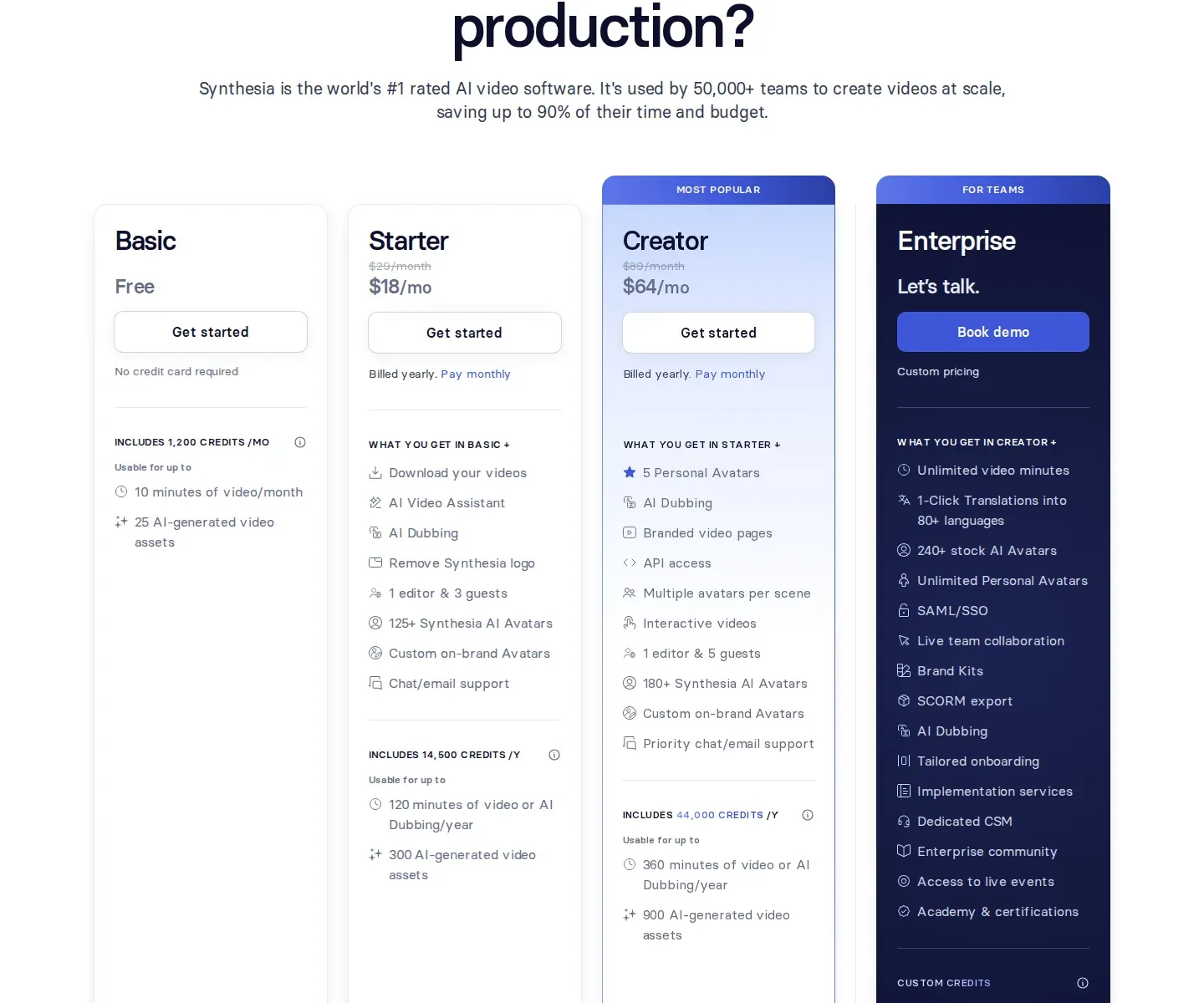
New lower prices — discount-market table served at $14/mo (Save 34%)
Captured 2026-05-31: Basic free, Starter $19/mo monthly ($14/mo annual), Creator $89/mo monthly ($59/mo annual), Enterprise custom, under a 'NEW LOWER PRICES — plans now starting from $14/month, Save 34%' banner. These are the figures Synthesia's discount-market (T1) USD table served to the capture host; the standard USD list table on the same page carried Starter $29/$18 and Creator $89/$64.
Annual pricing surfaced — Starter $22/mo, Creator $67/mo (yearly)
Wayback 2024-04 (yearly view): Starter US $22/mo billed yearly (120 minutes of video/year), Creator US $67/mo billed yearly (360 minutes of video/year), Enterprise 'Let's talk'. Same three-tier structure as 2024-02; the ~25% yearly discount converts the $29/$89 monthly prices to $22/$67 effective annual.

Three-tier overhaul — Starter $29, Creator $89, minute-metered
Wayback 2024-02: major repricing to three tiers. Starter $29/mo (1 editor & 3 guests, 10 minutes of video/month, 70+ AI avatars, 120+ languages), Creator $89/mo (1 editor & 5 guests, 30 minutes of video/month, 90+ AI avatars), Enterprise 'Let's talk' (custom editors/guests, unlimited minutes, 140+ avatars). Packaging shifted from 'video credits' to 'minutes of video', with 'save 25% with yearly'.

Dedicated sales-led Enterprise page (no public price)
Wayback 2023-11 and 2023-12 (synthesia.io/enterprise): a standalone 'Synthesia for Enterprise' surface — 'Scale in-house video production with AI', book-a-demo only with no public price, citing enterprise-grade security, a strict AI ethics policy, and 'Trusted by over 50% of the Fortune 100' (logos incl. Zoom, Accenture, Reuters, BestSeller). Both monthly snapshots were identical.

Personal $30/mo + Enterprise 'Let's talk' confirmed
Wayback 2023-05: Personal $30/month billed monthly (1 seat, 10 video credits/month); Enterprise priced via 'Let's talk — price based on number of seats' with unlimited video credits. Confirms the $30 two-tier credit model held through at least May 2023.

'Corporate' renamed 'Enterprise'; Personal stays $30/mo
Wayback 2023-04: the second tier was renamed from Corporate to Enterprise ('Contact us — price based on number of seats', unlimited video credits, custom number of seats). Personal remained $30/month billed monthly with 1 seat and 10 video credits/month. Hero now cited '50,000 teams'.

Personal held at $30/mo; Corporate moved to 'Let's talk'
Wayback 2022-08: Personal still $30/month billed monthly with 10 video credits/month; languages bumped to 60+ and the page added 'Text to video'. Corporate's price block changed from 'Custom pricing' to 'Let's talk — pricing packages depend on your organization's needs' (up to 50 slides/video, 10+ premium avatars, priority support). Price unchanged through 2022.

Two-tier STUDIO pricing — Personal $30/mo, Corporate custom
Wayback 2022-01 (synthesia.io/pricing): 'Synthesia STUDIO Pricing' with two plans. Personal $30/month billed monthly, including 10 video credits/month, 50+ languages, 40+ built-in avatars, 25+ templates, MP4 downloads, up to 6 slides per video; API access and custom avatars were paid add-ons. Corporate was custom-priced ('Custom pricing depending on your needs').

Unified credit pool across AI features
Synthesia consolidated usage onto a single credit pool that is the shared currency across video generation, AI Dubbing, and other AI features (per Synthesia help center and pricing FAQ). Credits convert to video minutes on self-serve plans; minutes are consumed only on generation, with edits charged for new seconds only.
- · Synthesia decouples price from seats entirely — paid plans cap editors and guests rather than charging per seat, with the real value metric being generated video minutes.
- · Editing a video only bills the new seconds you change: a 3-second tweak to a 1-minute clip costs 3 seconds, not 60.
- · There is no per-minute overage — exceeding your plan caps usage until renewal, so the bill is bounded by design rather than risk of spend spikes.
Questions & answers
- How much does Synthesia cost per month?
- Basic is free. Starter is $29/month ($18/month billed yearly), Creator is $89/month ($64/month billed yearly), and Enterprise is custom-quoted. Those are the USD list prices; Synthesia quotes local currency in some markets.
- Does Synthesia have a free plan?
- Yes. The Basic plan is free with no credit card required, including 1,200 credits/month (10 minutes of video per month) and 25 AI-generated video assets.
- How does Synthesia's credit and video-minute system work?
- Self-serve plans include a credit allowance that converts to video minutes. Credits are consumed only when a video is generated, and edits charge only for the new seconds you change.
- What happens if I exceed my Synthesia plan's video minutes?
- Synthesia caps usage until your next renewal rather than billing per-minute overage. To get more minutes immediately you must upgrade your plan. Unused minutes do not roll over.
- Is Synthesia cheaper than HeyGen?
- Synthesia's entry paid plan starts at $18/month on annual billing versus HeyGen's higher-priced Creator tier, but the models differ: Synthesia meters fixed video minutes while HeyGen meters credits that vary by feature.
- Does Synthesia charge per seat?
- No. Self-serve plans cap editors and guests (1 editor + 3 guests on Basic/Starter, 1 editor + 5 guests on Creator) rather than charging per seat. Enterprise seats are custom.