AI Summary
About
Unbabel is a translation and localization company that pairs AI translation with human-in-the-loop editing, marketed under the banner of “Language Operations” (LangOps). The platform is built to let enterprises translate customer support, content, and communications across many languages at scale, with quality control layered on top of machine output by a global community of freelance editors. Founded in 2013 and a Y Combinator W14 alum, Unbabel runs hubs across Lisbon, London, Edinburgh, San Francisco, New York, Cebu, and Timisoara.
The company raised roughly $91M across its life, anchored by a $60M Series C in September 2019 led by Point72 Ventures (with M12, Samsung Next, Greycroft and others). In 2024 it pivoted hard into proprietary models — shipping TowerLLM (a translation-specialized LLM) in June and the self-serve Widn.ai product in November — before being acquired by TransPerfect, the world’s largest language-services provider, in August 2025 on undisclosed terms. Its TowerLLM, COMET (the industry-standard MT-quality metric), and Widn.ai assets are now being folded into TransPerfect’s GlobalLink platform.
The core Unbabel platform is sold exclusively through a sales-led motion. There is no public pricing page — the /pricing URL returns a 404, and the only buying surface is the contact-us form (“Talk to our Sales Team”, “Get a demo”). Pricing is custom-quoted, which is typical for enterprise translation/LangOps vendors where volume, language pairs, turnaround SLAs, and human-review depth all drive the deal.
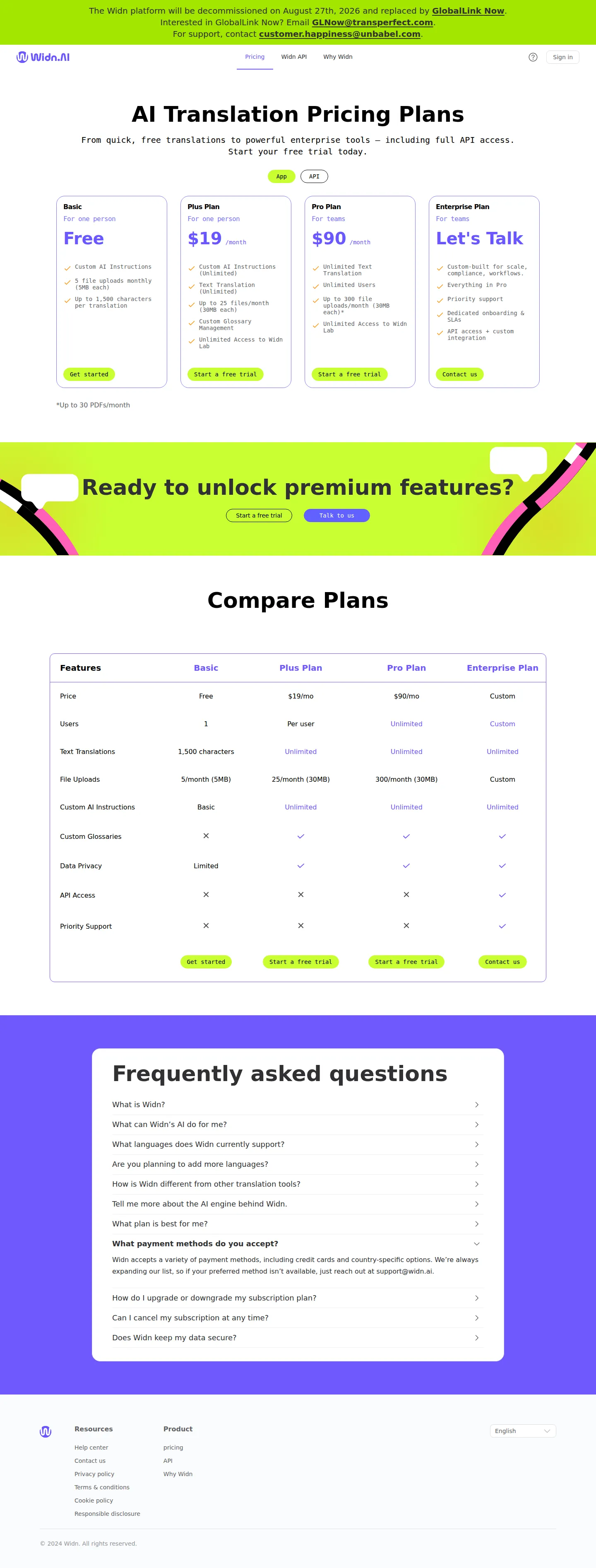
Alongside the enterprise platform, Unbabel ships a self-serve product, Widn.ai, powered by its own TowerLLM models. Widn.ai is the transparent counterpart to the gated core: it publishes plan prices openly (Free, $19/month, $90/month, and custom Enterprise) and targets individuals and small teams who want AI translation without a sales conversation. Note that Widn.ai displays a notice that the platform will be decommissioned on 27 August 2026 and replaced by GlobalLink Now (TransPerfect’s offering).
Pricing summary : a sales-only enterprise core beside a self-serve Widn.ai product
Unbabel runs a two-speed pricing model split across two products:
- Core Unbabel (LangOps platform) — sales-led, quote-only: No public price. The pricing page 404s; the contact-us form and “Get a demo” are the only paths to a number. Deals are custom-quoted, and the underlying value metric for enterprise translation work is volume of translated content (words/documents) across language pairs with human-review SLAs — but none of that is publicly priced. This is a sales-led pricing motion end to end.
- Widn.ai — self-serve subscription with a free tier: Public flat monthly plans. Basic is Free (one user; capped at 5 file uploads/month and 1,500 characters per translation). Plus is $19/month (one user; unlimited text translation, 25 files/month at 30MB, custom glossary). Pro is $90/month (teams; unlimited text + users, 300 file uploads/month). Enterprise is custom (“Let’s Talk”) and is the only tier that unlocks API access. This is a freemium ladder layered onto flat subscription tiers — there is no public per-word or per-token usage meter.
What makes this different: The same company deliberately runs opposite transparency postures — a fully gated enterprise platform and a fully public self-serve product — rather than exposing a single price ladder. It is also a live example of the broader shift toward outcome- and usage-based AI pricing: the enterprise deal’s real value metric (translated content with human-review quality SLAs) simply doesn’t reduce to a flat published rate.
Pricing by product
Unbabel LangOps platform (Enterprise)
| Tier | Price | Included | Key mechanics |
|---|---|---|---|
| Unbabel (LangOps) | Custom | AI translation + human-in-the-loop editing across languages, integrations, LangOps tooling | Sales-led; no public price, quote-only via contact form |
Widn.ai (Individual plans)
| Tier | Price | Included | Key mechanics |
|---|---|---|---|
| Basic | Free | One person; 5 file uploads/month (5MB each); up to 1,500 characters per translation; basic custom AI instructions | Free entry point for a single user |
| Plus | $19 / mo | One person; unlimited text translation; 25 files/month (30MB each); custom glossary management; Widn Lab | Lowest paid step for solo regular use |
Widn.ai (Team & Enterprise plans)
| Tier | Price | Included | Key mechanics |
|---|---|---|---|
| Pro | $90 / mo | Teams; unlimited text translation + unlimited users; 300 file uploads/month (30MB each, up to 30 PDFs); Widn Lab | Flat team price, not per-seat; “Most popular” for teams |
| Enterprise | Custom | ”Everything in Pro” plus priority support, dedicated onboarding & SLAs, and API access + custom integration | Sales-led, quoted; only tier with API access |
Sales motions across products: self-serve / freemium for Widn.ai (Basic, Plus, Pro); sales-led for the core Unbabel LangOps platform and Widn.ai Enterprise.
Widn.ai API access
Widn.ai exposes a RESTful, OpenAPI-compatible API (https://api.widn.ai/v1) covering translation, language identification, chat completions, glossaries, documents, and quality estimation, with models named anthill, sugarloaf, vesuvius, sugarloaf-3.1, and sugarloaf-4.0. Critically, the public “API” tab on the pricing page is developer documentation, not a pricing surface — no public per-call, per-word, or per-token API rate is advertised. API access is bundled into the custom-priced Enterprise plan.
Hidden costs : what Widn.ai teams actually pay beyond the headline
The honest answer for the core Unbabel platform is that the largest cost — the price itself — is undisclosed. Enterprise translation is custom-quoted via sales, so the real bill depends on negotiated terms a public page can’t show. The value metric for AI + human translation is volume of content (words/documents) across language pairs, multiplied by how much human review each tier of quality requires — but Unbabel never published a per-word rate or a starting band. We will not invent one. Third-party aggregator sites quote specific per-word figures (e.g. fractions of a cent per word with five- and six-figure annual minimums), but those numbers cite no source, are implausibly low for human-in-the-loop work, and fail corroboration — treat them as indicative at best, not as Unbabel’s actual pricing.
For the public Widn.ai product, the headline tiers are clean, but a few capacity ceilings can push a user up a tier sooner than expected:
| Where the cost lands | What the public Widn.ai page shows |
|---|---|
| Basic (Free) translation length cap | Up to 1,500 characters per translation — long documents won’t fit, forcing an upgrade to Plus for “unlimited text translation” |
| Basic file ceiling | 5 file uploads/month (5MB each) — light evaluation only |
| Plus → Pro jump | Plus is $19/mo (one person, 25 files/mo); a team needs Pro at $90/mo for unlimited users and 300 files/mo — there is no mid-step |
| API access | Not on any self-serve tier — only the custom Enterprise plan unlocks the API, so any programmatic use means a sales conversation |
| Net | Widn.ai is genuinely transparent up to $90/mo; the moment you need API, compliance, or scale you cross into undisclosed custom pricing |
So the “hidden cost” is structural, not a surprise line item: the public ladder caps at $90/month, and everything past it — the enterprise platform, API access, compliance, SLAs — sits behind a quote. For buyers comparing localization vendors, that opacity is the cost.
Want to estimate your own Unbabel bill? Use the Unbabel pricing calculator to model Widn.ai monthly cost across the public tiers, or browse the pricing blueprint for comparable translation and localization vendors.
Pricing evolution : from gated enterprise core to a public Widn.ai ladder
Cadence
Unbabel’s arc runs from per-job translation-as-a-service, to an enterprise LangOps platform sold entirely sales-led, to launching its own models (TowerLLM) and a transparent self-serve product (Widn.ai) — and finally to acquisition by TransPerfect, which is now sunsetting that self-serve product. Across the entire period the core platform never carried a public price; the only structural pricing change is the 2024 arrival, and 2026 retirement, of the Widn.ai self-serve ladder.
| Quarter | Price changes | Product / SKU additions | Notes |
|---|---|---|---|
| 2019 Q3 | 0 | 0 | 2019-09-24 $60M Series C (Point72 Ventures); enterprise platform already sales-led/quote-only, no public price introduced. |
| 2021–2023 | 0 | 0 | LangOps positioning; Wayback shows the contact-us gate held throughout, with a “Pricing” nav item present in 2022–2023 that routed to sales rather than a list price. |
| 2024 Q2 | 0 | 1 | 2024-06-06 TowerLLM launched (proprietary translation LLM); seeded the self-serve line. |
| 2024 Q4 | 0 | 1 | 2024-11-13 Widn.ai launched with the first public price ladder (Free / $19 / $90 / Custom). |
| 2025 Q3 | 0 | 0 | 2025-08-22 Acquired by TransPerfect (undisclosed terms); assets to fold into GlobalLink. |
| 2026 Q3 | 0 | 0 (−1) | 2026-08-27 Widn.ai scheduled for decommissioning, replaced by GlobalLink Now — the public ladder is being retired. |
Tracked range: 2019–2026. The core platform’s price was never public in any captured snapshot; the only public pricing surface (Widn.ai) existed only from 2024-11 and is being retired in 2026-08.
Notable changes
- 2019-09-24 — $60M Series C led by Point72 Ventures; buying motion already sales-led/quote-only (TechCrunch).
- 2024-06-06 — TowerLLM launched; Unbabel claimed it beat GPT-4o on machine translation (47-point HN thread).
- 2024-11-13 — Widn.ai launched with the company’s first public price ladder; CEO Vasco Pedro told CNBC AI could replace human translators within ~3 years.
- 2025-08-22 — TransPerfect acquired Unbabel on undisclosed terms (Slator).
- 2026-08-27 — Widn.ai scheduled for decommissioning, replaced by GlobalLink Now (notice shown on the Widn.ai pricing page, captured 2026-06-08).
The Widn.ai sunset in detail
Widn.ai — Unbabel’s only transparent pricing surface — is being retired barely 21 months after launch. The pricing page itself carries a live banner: “The Widn platform will be decommissioned on August 27th, 2026 and replaced by GlobalLink Now,” directing interested users to [email protected] and support to [email protected]. The sequence is a textbook post-acquisition consolidation: TransPerfect absorbs the underlying TowerLLM/COMET technology into its own GlobalLink stack and folds the standalone self-serve brand into it. The practical effect for the corpus is that Unbabel’s one public price ladder has a known expiry date, and after it the company reverts to a fully sales-gated posture under the GlobalLink name.
What’s unique : opposite transparency postures inside one company
1. Two opposite transparency postures under one roof. Unbabel keeps its enterprise LangOps platform fully gated (no public price, sales-led only) while running Widn.ai as a fully public freemium product — a deliberate split, not a single ladder. Most vendors pick one stance; Unbabel runs both at once, letting the self-serve product harvest bottom-up demand while enterprise quotes stay invisible to competitors and to anchoring effects.
2. The same company sells both the AI and the humans. Unbabel’s enterprise value proposition is explicitly hybrid: TowerLLM does the machine translation, and a global community of freelance editors does human-in-the-loop quality control. That blended cost structure — model inference plus paid human review — is precisely why the enterprise price can’t be a flat published number: it scales with how much human review a given quality SLA demands, per language pair, per content type.
3. Flat team pricing, not per-seat, on Widn.ai Pro. The $90/month Pro tier advertises unlimited users rather than a per-seat charge — unusual for a team subscription plan, where per-seat is the default. The metered ceilings move to file uploads (300/month) and to API access (Enterprise-only) instead of headcount, which keeps the team-adoption decision frictionless while reserving the real upsell levers for volume and integration.
4. The one public price ladder has an expiry date. Uniquely in this corpus, Widn.ai’s price page tells you when it stops existing: a banner sets a hard 2026-08-27 decommissioning date. The transparent product is a transitional artifact of a company mid-absorption into TransPerfect’s GlobalLink, not a durable pricing commitment.
Strengths & weaknesses
| Strengths | Weaknesses |
|---|---|
| Widn.ai’s public tiers are genuinely clean: Free / $19 / $90 / Custom, with a side-by-side Compare Plans matrix. | The core enterprise platform exposes no list price, no starting band, no per-word rate — maximum buyer friction for mid-market evaluators. |
| Flat team pricing ($90/mo, unlimited users) removes per-seat math from team adoption. | There is no mid-tier between $19 solo and $90 team — a 2–3 person team must jump straight to Pro. |
| Free Basic tier lets a single user trial AI translation with zero sales contact. | Basic’s 1,500-character per-translation cap makes the free tier a demo, not a usable workflow. |
| Hybrid AI + human model is a real quality differentiator versus pure-MT competitors. | API access is locked to custom Enterprise — no published per-call/per-word API rate blocks bottom-up developer adoption. |
| Proprietary TowerLLM + COMET give defensible technology and a credible quality story. | A live decommissioning banner (2026-08-27) on the pricing page actively discourages new Widn.ai signups. |
| Post-acquisition backing by TransPerfect adds scale and longevity to the underlying tech. | The public price ladder is transitional — Widn.ai is being absorbed into GlobalLink, so today’s prices have a known shelf life. |
Billing UX : self-serve trial-to-paid on Widn.ai, contact-form on the core
- “Start a free trial” / “Get started” CTAs (Widn.ai) — each public Widn.ai tier has its own in-page call to action; paid tiers (Plus, Pro) start with a free trial, while Basic is “Get started” and Enterprise routes to “Contact us”.
- App / API tab toggle (Widn.ai pricing page) — a segmented control switches the page between the self-serve plan grid (“App”) and the developer API reference (“API”); only the App view carries prices.
- “Compare Plans” feature matrix (Widn.ai) — a side-by-side table comparing Basic/Plus/Pro/Enterprise across Price, Users, Text Translations, File Uploads, Custom AI Instructions, Custom Glossaries, Data Privacy, API Access, and Priority Support.
- Self-serve subscription self-management (Widn.ai) — the FAQ confirms users can upgrade/downgrade their subscription plan and cancel at any time; payment is by credit card plus country-specific options.
- “Talk to our Sales Team” / “Get a demo” (core Unbabel) — the only billing path for the enterprise platform is the contact-us form, which routes pricing questions to sales; there is no in-product self-checkout for the core product.
Strategic wins : why the gated-core, public-Widn.ai split works
1. A self-serve front door without exposing enterprise pricing
By shipping Widn.ai as a public freemium product, Unbabel captured individual and small-team demand without ever putting its enterprise LangOps quotes on a page competitors (or procurement teams) could anchor to. This is the classic two-motion play covered in our guide to usage-based pricing models: a low-friction self-serve ladder feeds the funnel while the high-touch sales motion protects margin and negotiating leverage. The split let Unbabel test transparent pricing on the new TowerLLM product without disturbing the gated core.
2. Flat team pricing on Widn.ai Pro removes adoption friction
The $90/month Pro tier offers unlimited users instead of per-seat billing, so a growing team never re-negotiates as it adds people. As we argue in the move away from per-user licenses, AI products increasingly decouple price from headcount because the cost driver is compute and content volume, not seats — Widn.ai moves its ceilings to file uploads and API access instead, exactly where the real cost sits.
3. A free Basic tier as the acquisition top of funnel
The Free Basic plan lets a single user trial TowerLLM-powered translation before hitting the 1,500-character and 5-file ceilings, seeding self-serve conversion to Plus. A capped-but-real free tier is a well-understood freemium acquisition lever; the discipline here is that the caps (translation length, file count) are tight enough to convert serious users quickly rather than letting them live on free forever.
Areas to improve : the decommissioning notice and the gated core
1. A live decommissioning banner undercuts trial conversion
Widn.ai’s pricing page tells prospective buyers, at the moment of consideration, that the product dies on 2026-08-27 — a near-guaranteed conversion killer for new signups. The concrete fix is a migration-forward message: replace the “decommissioned” framing with “now becoming GlobalLink Now — start here and migrate seamlessly,” with a clear continuity path so a trial today doesn’t feel like a dead end.
2. No public price signal for the core platform
The enterprise platform exposes no list price, starting band, or even a “from $X/month” anchor, which forces every mid-market evaluator into a sales call before they can size the deal. A concrete fix is a published starting band or representative deal example (even “enterprise plans typically start in the low five figures annually”), which our guide to choosing the right usage metric shows can pre-qualify buyers without committing to a public rate card.
3. API access locked behind a custom quote
Developers cannot see any per-call or per-word API rate — the public “API” tab is documentation, and access is bundled into the custom Enterprise tier. A concrete fix is a self-serve metered API tier (per-character or per-document, like the credit-and-usage models other AI vendors expose) so developers can prototype and scale without a sales gate, the single biggest lever for bottom-up adoption Widn.ai is leaving unused.
Monetization stack & signals : how Unbabel builds & buys its revenue engine
Buys 4 Builds 0
A fully-bought, sales-led revenue stack: Salesforce CRM, Gong call intelligence and ChurnZero CS retention behind the gated enterprise core, with Stripe handling Widn.ai self-serve payments. No disclosed metering platform, CPQ, or in-house billing build.
-
“Salesforce – Client relationship manager – United States”
-
“ChurnZero – Customer success management – United States”
-
“Gong – Call recording software – United States”
-
“Stripe – Cloud-based payment services – United States”
Signals reviewed · derived from product docs
Key takeaways
- You can run two transparency postures at once. Unbabel gates its enterprise platform completely while publishing its self-serve product openly. The split lets the new product harvest bottom-up demand without exposing enterprise quotes to anchoring — a deliberate strategy, not an oversight.
- A hybrid AI + human cost structure resists flat pricing. When part of your delivery is paid human review whose depth varies by quality SLA, language pair, and content type, a single published per-word number genuinely doesn’t fit. Sales-led quoting is a defensible response — but it still costs you mid-market evaluators.
- Move the ceilings off seats. Widn.ai’s Pro tier prices flat for unlimited users and meters file uploads and API access instead. If your real cost driver is volume and integration, putting the upsell levers there (not on headcount) makes team adoption frictionless.
- Don’t broadcast your product’s death on the pricing page. Widn.ai’s live “decommissioned 2026-08-27” banner is a conversion killer at the exact moment of consideration. A migration-forward message (“becoming GlobalLink Now”) would preserve the funnel; “this product is dying” destroys it.
- Self-serve pricing can be a transitional artifact. Widn.ai’s public ladder existed for ~21 months before being absorbed into an acquirer’s stack. A transparent price page is a commitment buyers read as durable — reverting to a gated posture after acquisition erodes the trust the transparency earned.
UBP implications
- Undisclosed enterprise pricing is itself a data point. When a translation/LangOps vendor never publishes a per-word rate even though words are the obvious value metric, the silence signals that human-review intensity — not raw volume — is the real cost driver. Buyers should price the human layer, not just the word count.
- Flat-for-unlimited-seats is spreading in AI products. Widn.ai joins a pattern of decoupling price from headcount because compute and content volume, not seats, drive cost. Expect more AI tools to meter usage dimensions (files, calls, characters) while leaving user counts unlimited.
- Acquisition consolidates pricing surfaces. Post-acquisition, a transparent self-serve product is the first thing to get folded into the acquirer’s gated enterprise stack. Usage-based and freemium ladders are fragile to M&A; durable UBP commitments tend to come from independent vendors, not absorbed ones.
Sources
- Unbabel contact / sales page (accessed 2026-06-08)
- Widn.ai pricing page (accessed 2026-06-08)
- Widn.ai API reference (API tab;
https://api.widn.ai/v1) (accessed 2026-06-08) - Unbabel pricing blueprint corpus (accessed 2026-06-08)
Bottom line
Unbabel runs two opposite pricing postures at once: its enterprise LangOps translation platform is entirely sales-led and quote-only, while its Widn.ai sibling lists self-serve plans openly from Free to $90/month — with API access reserved for a custom Enterprise tier and a live notice that Widn.ai is being decommissioned in August 2026.
Want to compare Unbabel against other translation and localization pricing? Browse the pricing blueprint.
Pricing timeline : Major events on a vertical axis
Each milestone below corresponds to a public pricing change, product launch, or material adjustment. Major events use a filled marker; minor adjustments use a faded one.
Widn.ai decommissioning (announced) — replaced by GlobalLink Now
Widn.ai displays a banner that the platform will be retired on 27 August 2026 and replaced by TransPerfect's GlobalLink Now, completing the absorption of Unbabel's self-serve product into the acquirer's stack.
Facts captured — sales-only core + public Widn.ai tiers
Core Unbabel confirmed sales-only (no public price; contact-us is the gate). Widn.ai self-serve tiers captured: Free / $19 / $90 / Custom, with a 27 Aug 2026 decommissioning notice.
Acquired by TransPerfect
TransPerfect acquired Unbabel on undisclosed terms; TowerLLM, COMET, and Widn.ai are slated to fold into TransPerfect's GlobalLink platform (transperfect.com press, slator.com).
Widn.ai launched — public self-serve AI translation
Unbabel shipped Widn.ai, a TowerLLM-powered self-serve product with public tiers (Free / $19 / $90 / Custom) — its first transparent price ladder, sitting beside the still-gated enterprise core. CEO publicly predicted AI could replace human translators by 2027 (cnbc.com 2024-11-13).
TowerLLM launched — proprietary translation LLM
Unbabel released TowerLLM, a translation-specialized model it claimed beat GPT-4o/GPT-3.5 on machine translation. This seeded the self-serve product line; the enterprise platform remained quote-only (47-point HN thread, 2024-06-06).
LangOps positioning — 'Language Operations' as a category
Unbabel reframed its enterprise platform around Language Operations (LangOps). Pricing stayed sales-led and quote-only; Wayback shows the contact-us gate in place from at least 2021-04, with a 'Pricing' nav item present in 2022–2023.
$60M Series C — scaling enterprise translation-as-a-service
Unbabel (YC W14) raised a $60M Series C led by Point72 Ventures, funding its AI + human translation platform. The buying motion was already sales-led/quote-only; no public price ladder was introduced (techcrunch.com/2019/09/25).
- · Unbabel's core enterprise translation platform has no public price page — the only buying surface is a sales-contact form, and that gate has held since at least 2021 (Wayback shows a 'Pricing' nav item in 2022–2023 that has since disappeared).
- · Its self-serve sibling Widn.ai (TowerLLM-powered) publishes prices openly: Free, $19/mo, $90/mo, and Custom — the transparent counterpart to the gated core.
- · Widn.ai carries a banner that the platform will be decommissioned on 27 August 2026 and replaced by GlobalLink Now (TransPerfect).
Questions & answers
- How much does Unbabel cost?
- Unbabel's core enterprise translation platform does not publish prices — pricing is quote-only via its sales team. Its self-serve Widn.ai product is public: Free, $19/month, $90/month, or custom Enterprise.
- Is there a free version of Unbabel?
- The core Unbabel platform has no free self-serve tier. Its Widn.ai product offers a free Basic plan limited to one user, 5 file uploads/month, and 1,500 characters per translation.
- What is Widn.ai and how does it relate to Unbabel?
- Widn.ai is Unbabel's self-serve AI-translation product, powered by its TowerLLM models. Unlike the enterprise platform, it lists public subscription prices. Widn.ai is scheduled to be decommissioned on 27 August 2026 and replaced by GlobalLink Now.
- Does Widn.ai offer API access?
- Yes, but API access is bundled into the Enterprise (custom-priced) plan — there is no separately advertised per-call or per-word API price on the public pricing page.
- Does Unbabel charge per word?
- Unbabel does not publish a per-word rate. Enterprise translation is custom-quoted via sales, and the public Widn.ai product bills by flat monthly subscription, not per word. Third-party per-word figures online are uncorroborated and should be treated as indicative only.
- Who owns Unbabel?
- TransPerfect, the world's largest language-services provider, acquired Unbabel in August 2025 on undisclosed terms. Unbabel's TowerLLM, COMET, and Widn.ai technology is being integrated into TransPerfect's GlobalLink platform.