AI Summary
About
Usage AI (legal entity Usage.ai, Inc.) is a cloud cost-optimization company that automates Reserved Instance, Savings Plan, and Committed Use Discount (CUD) purchasing across AWS, Azure, and GCP — then nets the risk of those commitments back to you. As of its mid-2026 site it markets itself as “Insurance for your cloud commitments” that lets teams “Save 30–50% on AWS, GCP and Azure, without owning the commitment risk,” under the standing promise: “Pay nothing until we save you something.”
Founded in 2020 by Kaveh Khorram, the company is based in New York (with a San Francisco office) and has raised roughly $9 million from investors including JAM Fund, Backend Capital, Amity Ventures, and 10VC. It reported around $3M revenue with a ~28-person team in 2023 (getLatka) and today claims 300+ teams, more than $1B in cloud spend now managed across AWS, Azure, and GCP, and $300M+ in realized savings delivered, with named customers including Blank Street, FabFitFun, and Secureframe. It is SOC 2 Type II certified.
This is the recursive-FinOps pattern in its purest form: Usage.ai is priced as a cut of the very bill it shrinks. For the most current terms, see Usage.ai pricing.
Pricing summary : How Usage AI’s pricing model works
Usage AI has no seats, no tiers, and no flat fee. It runs a single savings-share model: you pay a percentage of the cloud savings it actually realizes for you, and you pay $0 if it saves you nothing. The platform fee is $0, and there is no minimum, no subscription, and no multi-year contract — “only pay when you save.”
As of its mid-2026 site redesign, Usage.ai no longer publishes an explicit fee percentage on its pricing page or homepage — the former inline fee calculator and the ICR-vs-ESR comparison have both been removed, and the copy now reads only “a percentage of the savings we realize for you, billed monthly against verified savings.” The publicly documented rate lives on its AWS Marketplace listing: 20% of realized savings on EC2 and 35% on managed data services (RDS, ElastiCache, Redshift, OpenSearch). The exact savings-share for a given account is quoted during onboarding, which is why we classify transparency as gated rather than public; the site markets a personalized “Save 30–50%” projection before you commit.
The fee lands where the savings do: as a single recurring line item on your existing AWS, Azure, or GCP invoice via cloud marketplace — “no new vendor, no new MSA, no new AP setup.” That billing path is itself a selling point, because it skips the procurement cycle a net-new SaaS vendor would trigger.
What makes this different: Usage.ai bundles insurance into the savings-share. Every dollar of unused commitment is refunded — “100% cashback guaranteed,” as cashback or cloud credits, automatically, every month — and netted against the fee you owe. If your roadmap shifts, Usage.ai buys back the commitments it placed — no lock-in, no exit penalty.
Pricing by product
| Offering | Price | Included | Key mechanics |
|---|---|---|---|
| Savings Calculator | Free | Personalized “Save 30–50%” savings projection | Lead magnet; read-only, no commitment |
| Savings Share (core) | 20–35% of realized savings | Multicloud commitment autopilot, 100% cashback, buyback | Pay only when savings land; $0 platform fee; no contract |
| Enterprise | Quoted per account | Multicloud parity, EDP/MACC/PPA coexistence, SOC 2 Type II | Savings-share % negotiated; buyback guarantee |
The free calculator is pure self-serve / PLG — the top of the funnel. The paid Savings Share engagement is sales-onboarded (a 15-minute, read-only install) with the percentage quoted per account, so the actual motion is PLG-into-sales-led. Usage.ai’s own site no longer prints a fee number; the only publicly documented rate is on its AWS Marketplace listing — 20% of savings on EC2 and 35% on RDS/ElastiCache/Redshift/OpenSearch — so treat the headline as a service-dependent band, not a fixed rate.
Sales motions across products: the free calculator is self-serve / PLG, while the paid savings-share engagement is sales-onboarded and quoted per account (PLG-into-sales-led).
Hidden costs : What Usage AI users actually pay
The model is unusually clean on hidden costs — by design, the only thing you pay is a slice of money you wouldn’t otherwise have had. There is no platform fee, no minimum, no setup fee, and no contract. The real “cost” questions are about the base the percentage is applied to and what happens when usage drops.
| Line item | What you pay |
|---|---|
| Platform / minimum fee | $0 — pay as we save |
| Savings-share fee | 20–35% of realized savings — 20% on EC2, 35% on managed data services (RDS/ElastiCache/Redshift/OpenSearch) per AWS Marketplace; exact rate quoted per account |
| Underused commitment | Netted against fee owed, balance refunded as cash |
| Early exit / buyback | $0 — Usage.ai buys back what it placed |
| Net effect | You keep ~65–80% of realized savings |
The watch-item is the definition of “realized savings” — the baseline against which the percentage is computed (on-demand-equivalent spend) is the lever every savings-share vendor controls, so it is worth pinning down in the contract. Usage.ai’s answer to the usual savings-share complaint (you keep paying for capacity you no longer use) is its cashback-on-underuse mechanic, which floors the downside.
Want to estimate your own Usage AI bill? Use the Usage AI pricing calculator to model your cost as a share of projected savings.
Pricing evolution : Usage AI pricing history and changes
Cadence
| Period | Price changes | Product / SKU additions | Notes |
|---|---|---|---|
| 2020–2024 | n/a | AWS commitment autopilot | Launched as an AWS-first RI/SP optimizer |
| 2025–2026 | 0 headline | Multicloud (Azure, GCP); ICR metric; cashback/buyback | Savings-share model unchanged; coverage and insurance mechanics expanded |
| 2026 (Jul) | 0 headline | Pricing-page redesign | Transparency regression: the inline fee calculator and the ICR-vs-ESR comparison were pulled from usage.ai, leaving the AWS Marketplace listing (20% EC2 / 35% RDS-class) as the only public rate; repositioned around Insured Commitments + Autopilot, with traction restated as “$1B+ cloud spend managed” |
Tracked range: 2026 (first full capture). Usage.ai has kept its core “percentage of realized savings, $0 platform fee” model stable; the visible evolution is in scope (AWS-first to AWS/Azure/GCP, expanding to RDS/ElastiCache/OpenSearch/Redshift/DynamoDB and ML/analytics) and in the insurance layer it added on top of plain savings-share.
Notable changes
- 2020 — Founded as an AWS Reserved Instance / Savings Plan optimizer charging a percentage of realized savings.
- 2025–2026 — Expanded to multicloud (Azure, GCP) and broadened service coverage; introduced the Insured Commitment Rate (ICR) metric and the full-cashback + buyback “insured commitments” framing.
- 2026-06-16 — Captured current state: single savings-share model (20% EC2 / 35% managed data services per AWS Marketplace), $0 platform fee, no contract, free overpayment calculator.
- 2026-07-23 — Mid-2026 site redesign removed the inline fee calculator (a ~15% worked example: $8,000/mo of savings split $6,800 to the customer / $1,200 to Usage.ai) and the ICR-vs-ESR comparison from usage.ai/pricing; the fee is now described only as “a percentage of the savings we realize for you, billed monthly.” That leaves the company’s AWS Marketplace listing — 20% of EC2 savings, 35% on RDS/ElastiCache/Redshift/OpenSearch — as the only publicly documented rate. The page repositioned around Insured Commitments + Autopilot and a “Save 30–50%” projection, and restated traction as “$1B+ cloud spend managed.” The savings-share model itself was unchanged.
What’s unique : Usage AI’s distinctive pricing mechanics
1. Pure outcome pricing with a true $0 floor. Most “savings-share” vendors still attach a platform fee, minimum, or setup premium. Usage.ai’s platform/minimum fee is literally $0 — “pay as we save” — so a buyer’s worst case is breaking even, never going backwards.
2. Cashback as real cash, not credits. When commitments go underutilized, Usage.ai nets the loss against fees you owe and refunds the remainder as cash, monthly. That converts the classic savings-share risk (paying for capacity you stopped using) into a hedge, and it’s why the company can underwrite an aggressive commitment with no lock-in.
3. The fee rides your cloud bill, not a new invoice. Charging through cloud marketplace as a single line item means no new MSA, no AP onboarding, and no net-new procurement vendor — a pricing-delivery innovation that lowers the buying friction as much as the rate does.
4. A new metric to sell the rate. By introducing the Insured Commitment Rate (ICR = (savings + cashback) / on-demand-equivalent spend), Usage.ai reframes the buying decision away from the headline percentage and toward a downside-protected savings floor that the standard ESR can’t promise.
Strengths & weaknesses
| Strengths | Weaknesses |
|---|---|
| True $0 platform fee and no contract — worst case is break-even | Exact savings-share % is gated — the mid-2026 redesign pulled the last on-site figures, so buyers can only self-compare via the AWS Marketplace rate (20% EC2 / 35% RDS-class) |
| Cashback on underuse returned as cash, not locked credits | ”Realized savings” baseline is vendor-defined — the lever to scrutinize |
| Fee rides the existing cloud bill (no new procurement vendor) | Requires read-only billing access — a trust/security ask |
| Multicloud (AWS/Azure/GCP) under one model | Savings-share economics shrink as your own FinOps maturity rises |
| Free calculator + 15-min install lowers the barrier to trying it | Crowded category (ProsperOps, Archera, Zesty, nOps) competing on the same model |
Billing UX : Usage AI billing controls and transparency
- Billing controls — The fee is taken only on realized savings, billed monthly against verified savings, and appears as a single recurring line item on your AWS/Azure/GCP bill via cloud marketplace; cashback for unused commitment is refunded automatically each month as cashback or cloud credits (“100% cashback guaranteed”) and netted against the fee owed.
- Usage visibility — A “Savings overview” dashboard shows lifetime savings rate and a per-service breakdown of Savings, Fee, and Net Fee across AWS, Azure, and GCP, plus recent activity — a unified view of cloud economics the customer fully owns.
- Autopilot controls — Per-account Autopilot settings let the customer toggle continuous automated commitment buying and rebalancing on or off per account/region/commitment type, keep manual approvals on the rest, and override or pause any automated decision at any time.
- Payment options — Charged through cloud marketplace, so it settles inside the existing cloud relationship — no new vendor, MSA, or AP setup. Read-only billing access, 15-minute install, cancel anytime with buyback.
Strategic wins : Why Usage AI’s pricing decisions worked
1. Risk reversal as the entire pitch
By making the platform fee $0 and pricing only on delivered savings, Usage.ai removes the single biggest objection in FinOps buying — “what if it doesn’t work?” The buyer’s downside is capped at zero. See outcome-based pricing trends for why this risk-reversal converts.
2. Pricing the delivery, not just the rate
Routing the fee through cloud marketplace as one bill line is a quiet masterstroke: it sidesteps procurement entirely. The “win” isn’t the percentage — it’s that there’s no net-new vendor to approve. Related: how AI companies structure pricing.
3. Inventing the metric you’re judged on
ICR lets Usage.ai compete on a downside-protected floor instead of a headline percentage, steering the comparison onto ground its cashback model wins. See choosing the right usage metric.
Areas to improve : Gaps in Usage AI’s pricing approach
1. Publish the savings-share band
The mid-2026 redesign moved the wrong way here: the two figures that used to be in the open — the inline calculator’s ~15% worked example and the FAQ’s “~20%” — were both pulled, so a self-serve buyer now finds no rate on usage.ai at all. The only publicly documented figure is the AWS Marketplace listing (20% of EC2 savings, 35% on RDS/ElastiCache/Redshift/OpenSearch), which a buyer has to leave the site to find and then reconcile against the “Save 30–50%” projection. A published range or rate card would cut the friction of booking a call just to learn the percentage. See bill shock and cost unpredictability.
2. Define “realized savings” up front
The percentage is only as honest as the baseline it’s applied to. Spelling out the on-demand-equivalent baseline and how cashback nets against it — before the contract — would defuse the most common savings-share dispute.
3. The maturity ceiling
As a customer’s own FinOps practice matures, the marginal savings (and therefore Usage.ai’s fee) shrink. A complementary flat or capped option for sophisticated teams would extend the relationship past the easy-wins phase.
Monetization stack & signals : how Usage AI builds & buys its revenue engine
Buys 1 Builds 1
The meter is the product — Usage.ai's own realized-savings/ICR engine IS what it sells — but the billing rail is bought: it charges its savings-share (20% EC2, 35% RDS/etc.) as a metered AWS Marketplace product on the customer's existing cloud bill, not via its own invoicing or Stripe. Bucket-C company, no public ATS; careers page lists only HR/marketing/frontend roles, no revenue/billing-eng hire yet.
-
“Insured Commitment Rate (ICR) = Savings + Cashback / On-Demand Equivalent Spend. Cashback is real money — not vendor-locked credits. Floors at zero.”
Signals reviewed · derived from product docs
Key takeaways
- Usage.ai is priced as a cut of the bill it reduces — a percentage of realized cloud savings, $0 otherwise; after the mid-2026 redesign the only public rate is its AWS Marketplace listing (20% of EC2 savings, 35% on RDS-class services).
- The $0 platform fee and no-contract terms make the buy a near-free option — worst case is break-even.
- Cashback returned as cash (not credits) plus buyback turns savings-share risk into a hedge.
- Billing through cloud marketplace removes procurement friction as much as the rate removes cost.
- ICR is a pricing-narrative move — invent the metric, then win the comparison on it.
UBP implications
- Outcome pricing works best when the outcome is denominated in the customer’s own money. Usage.ai charges a share of dollars saved — the cleanest possible value metric, because the customer is strictly better off at any positive percentage. See the introduction to usage-based pricing for where outcome models sit on the spectrum.
- Risk reversal can be the headline. “$0 until we save you something” does more selling than any rate would; the percentage is almost secondary.
- Insurance mechanics (cashback, buyback) let you charge aggressively for value while capping the customer’s downside — a template for any usage-based vendor whose value can swing.
Sources
- Usage.ai pricing page (accessed 2026-08-28)
- Usage.ai homepage — savings calculator (accessed 2026-08-28)
- Usage AI — AWS Marketplace listing (published savings-share rate: 20% EC2 / 35% RDS-class) (accessed 2026-07-23)
- Usage.ai — ProsperOps alternatives (own pricing framing) (accessed 2026-06-16)
- Usage AI — Crunchbase profile (accessed 2026-06-16)
- Usage AI — getLatka revenue/team data (accessed 2026-06-16)
Bottom line
Usage AI is the textbook recursive-FinOps play: it makes money only as a percentage of the cloud savings it delivers — 20% of EC2 savings and 35% on managed data services per its AWS Marketplace listing, the only public rate left after a mid-2026 redesign pulled the figures off its own site — with no platform fee, no minimum, and no contract. The free “how much am I overpaying AWS” calculator is the lead magnet; the paid model is a sales-onboarded savings-share whose exact rate is quoted per account. What sets it apart from the ProsperOps/Archera/Zesty field is the insurance layer — full cashback on underutilization paid as cash, plus buyback with no lock-in — wrapped in a billing path (cloud marketplace, one line item) that sidesteps procurement entirely.
Want to compare Usage AI against other FinOps and billing-infrastructure companies? Browse the pricing blueprint.
Pricing timeline : Major events on a vertical axis
Each milestone below corresponds to a public pricing change, product launch, or material adjustment. Major events use a filled marker; minor adjustments use a faded one.
Pricing page redesigned; fee percentage pulled off-site
Site redesign removed the inline fee calculator and the ICR-vs-ESR comparison from usage.ai/pricing; the fee is now described only as 'a percentage of realized savings' with no on-site number. Repositioned around Insured Commitments + Autopilot and a 'Save 30-50%' projection; traction updated to $1B+ cloud spend managed. The only published rate is now the AWS Marketplace listing (20% EC2 / 35% RDS/ElastiCache/Redshift/OpenSearch). Model unchanged.
Savings-share model documented
Full research: percentage-of-realized-savings, $0 platform fee, no contract, full cashback on underuse, free overpayment calculator, ICR metric. Multicloud (AWS/Azure/GCP).

Blueprint stub created
Initial stub generated for batch blueprint expansion, ahead of full pricing research.
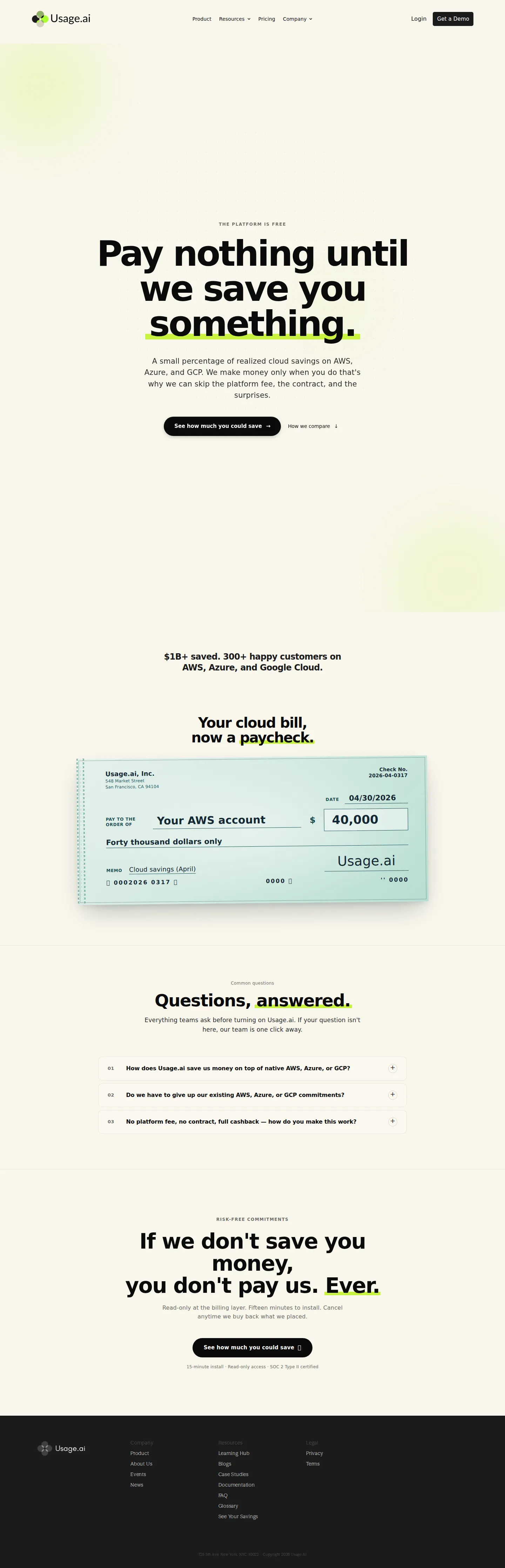
- · Usage.ai's entire pitch is 'pay nothing until we save you something' — the platform fee, the contract, and the minimum are all $0, and the company only earns a cut of savings it actually delivers.
- · Its homepage renders your future bill as a literal paycheck: a check made out to 'Your AWS account' for $40,000 of 'Cloud savings (April).'
- · Usage.ai coined the Insured Commitment Rate (ICR) — a savings metric that adds cashback recovery so it can't go negative, unlike the industry-standard Effective Savings Rate (ESR), which has been recorded at -9% when usage dropped.
Questions & answers
- How much does Usage AI cost?
- Usage.ai charges a percentage of the cloud savings it actually delivers. Its own site no longer prints a number (as of a mid-2026 redesign), but its AWS Marketplace listing prices this at 20% of realized savings on EC2 and 35% on RDS, ElastiCache, Redshift, and OpenSearch, with the exact rate quoted per account. There is no platform fee, no minimum, and no contract: you pay nothing until savings land.
- Does Usage AI have a free tier?
- Yes, in two senses. The 'see how much you could save' savings calculator is free to use, and the platform itself charges $0 until it generates realized savings — so onboarding (a 15-minute, read-only install) costs nothing up front.
- How is Usage AI's fee billed and where does it appear?
- The fee is taken only on realized savings and appears as a single line item on your existing AWS, Azure, or GCP bill via cloud marketplace — no new vendor, no new MSA, no new AP setup. Unused-commitment cashback is netted against the fee first, with any balance refunded as cash monthly.
- How is Usage AI different from ProsperOps or Archera?
- All three use a savings-share model, but Usage.ai pairs it with 100% cashback on underutilization (refunded automatically each month as cashback or cloud credits) and a buyback guarantee with no multi-year lock-in. It absorbs the commitment risk rather than passing it back, and introduced the Insured Commitment Rate (ICR) metric versus the standard ESR.