AI Summary
About
VEED is a browser-based video editing platform that has expanded into AI-powered generation. The core product is an online editor — trimming, subtitles, captions, the audio/video catalog, background removal — that millions of teams use without ever touching a token meter. On top of that sits Gen-AI Studio, where text-to-video, AI avatars, AI voice, dubbing and translation are generated by a mix of VEED’s own models (Fabric, VEED Motion) and surfaced third-party models (Sora 2, Google Veo 3.1/3/2, Kling, Seedance, PixVerse, MiniMax, LTX). The product targets individual creators, marketing teams and content studios, with an Enterprise tier for larger organizations.
VEED monetizes through per-seat subscriptions — Free, Creator, Pro and Studio — where the seat fee covers unlimited core editing and each paid plan bundles an annual AI-credit allowance that meters generative output. This makes VEED a seat-first SaaS with a usage-metered AI layer, rather than a pure credit-consumption tool: you buy the seat, and credits act as a soft ceiling on how much generative AI that seat can run before you upgrade. Company financials (ARR, headcount, valuation) are left for wiki-research.
For the most current information on VEED’s pricing and market position, visit VEED.
Pricing summary : How VEED’s pricing model works
VEED runs a seat-plus-credits model. You buy a per-user subscription (Free, Creator, Pro, Studio) and each paid plan bundles an annual AI-credit allowance; credits are the metered unit for Gen-AI Studio generation (text-to-video, avatars, dubbing), while ordinary editing — subtitles, the media catalog, exports — is included with the seat. Credit cost varies by model, so the published “AI videos” figures assume VEED’s cheapest in-house model. AI voice is metered separately as hours per year. The free tier is a watermarked, capped trial rather than a usage plan.
Billing dimensions captured:
- Per-seat subscription — on the page’s default yearly-billed view, Creator is $12/user/mo, Pro $22/user/mo and Studio $39/user/mo, billed yearly as $147, $265 and $465 per user. The pure monthly-billed rate is not shown by default; VEED advertises “Save up to 51%” for choosing yearly. Free is $0, reached through a “Start for free” link rather than a plan card.
- A live A/B test on the Pro rung — Pro is the only tier without a single stable list price. Repeat renders of the same URL from the same US egress on 2026-07-22 alternated between $22/user/mo (billed yearly as $265) and $24/user/mo (billed yearly as $288) — 10 loads versus 6 across 16 attempts — while Creator and Studio returned identical figures every time. Treat $22/$265 as the modal price and $24/$288 as a concurrently live variant, not a successor price.
- AI credits — bundled per plan (Creator 6,000 ~1,200 AI Videos; Pro 30,000 ~6,000 AI Videos; Studio 180,000 ~36,000 AI Videos), metered per generation by model; Enterprise gets custom AI Credits. The allowance tracks the billing term rather than being annual by definition: VEED’s own FAQ says a plan “includes a set amount of AI credits each month or year” and that the “full allowance refreshes when your subscription renews”, and the plan-comparison table shows the monthly-billed equivalents at one-twelfth of the annual figures (Pro AI voice “Up to 12 hr/mo” against “Up to 144 hr/yr”). On the yearly-billed plans quoted above, the pool is annual.
- AI voice hours — up to 144 hr/yr on Pro, up to 960 hr/yr on Studio (and up to 4 hr/yr on Creator, per VEED’s help centre; the free plan gets up to 10 min/mo).
- Translation — both Pro and Studio now list “Translate to 50+ Languages”; Studio’s previous “12 hr/yr of Translations” line no longer appears on the plan card.
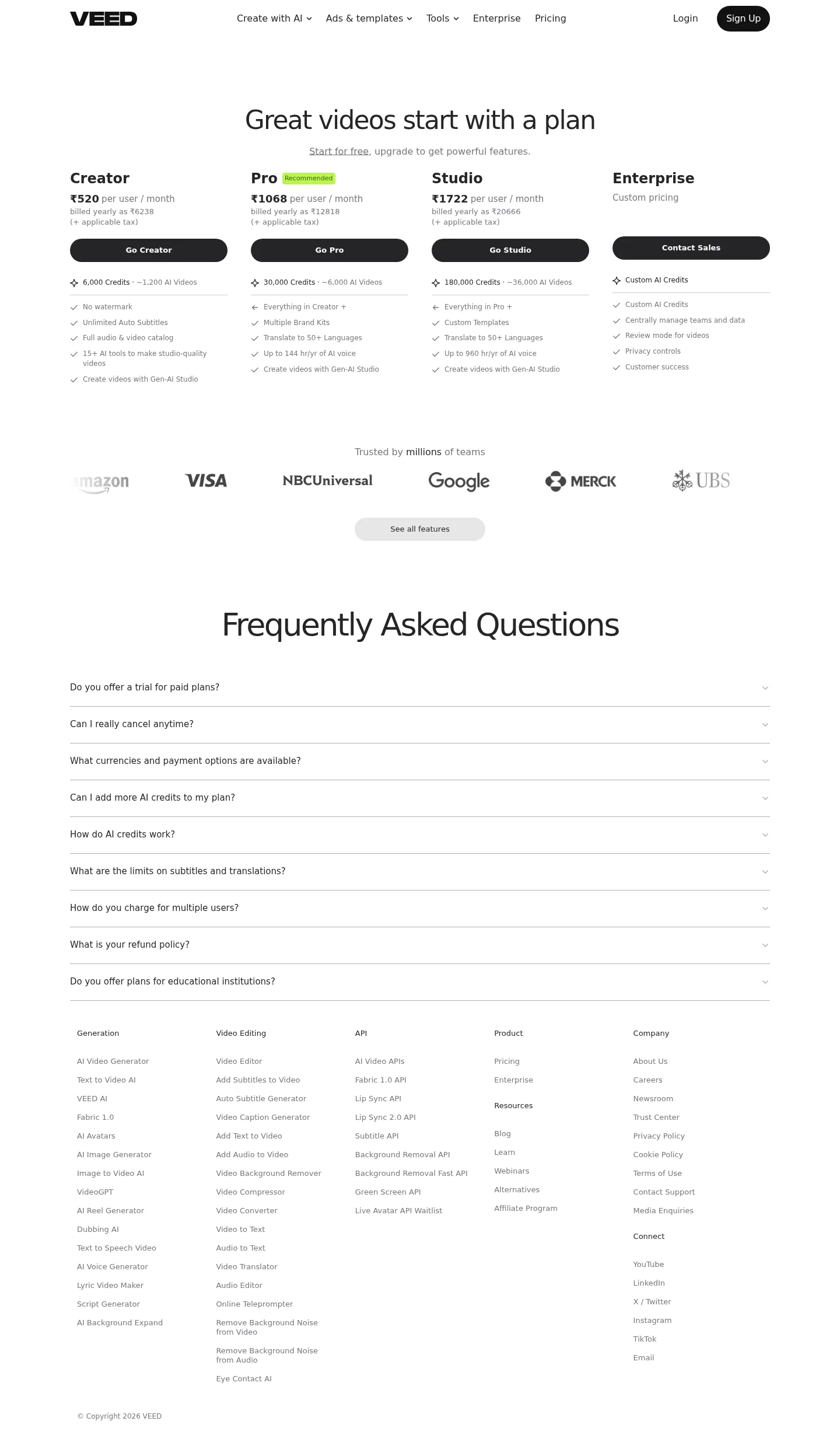
- Currency / region — prices are geo-localized. VEED’s FAQ states prices “are listed in your local currency if available, and if not they are listed in USD”; the India render shows Creator ₹520, Pro ₹1068 and Studio ₹1722 per user per month (billed yearly as ₹6238 / ₹12818 / ₹20666, ”+ applicable tax”).
- Watermark & export — Free stamps a VEED watermark and caps export quality/length; paid plans remove the watermark and unlock the full catalog.
What makes this different: VEED sells seats but meters only its generative layer in a single credit currency, published as concrete “AI videos” output — a credit-based billing layer wrapped around a seat-based subscription. The twist is the annual, non-rolling credit cadence and the absence of à-la-carte top-ups: the allowance is the upgrade lever, not a pay-as-you-go meter.
Pricing by product
VEED editor + Gen-AI Studio (self-serve plans, USD)
| Tier | Price (USD) | Included (credits) | Key mechanics |
|---|---|---|---|
| Free | $0 | No Gen-AI credit allowance | Not shown as a plan card — entered via the “Start for free” link above the grid; VEED watermark and capped export quality/length |
| Creator | $12 /user/mo, billed yearly as $147 | 6,000 Credits ~1,200 AI Videos | No watermark; unlimited auto subtitles; full audio & video catalog; 15+ AI tools; “Create videos with Gen-AI Studio” |
| Pro | $22 /user/mo, billed yearly as $265 (A/B variant: $24 /user/mo, billed yearly as $288) | 30,000 Credits ~6,000 AI Videos | Recommended badge; everything in Creator + multiple brand kits, translate to 50+ languages, up to 144 hr/yr of AI voice |
| Studio | $39 /user/mo, billed yearly as $465 | 180,000 Credits ~36,000 AI Videos | Everything in Pro + custom templates, translate to 50+ languages, up to 960 hr/yr of AI voice |
| Enterprise | Custom pricing | Custom AI Credits | Contact Sales; centrally manage teams and data; review mode for videos; privacy controls; customer success |
All four self-serve prices are the yearly-billed per-user rate the page shows by default; the pure monthly-billed rate is not displayed in that state, and VEED advertises “Save up to 51%” for paying yearly. Every paid card is annotated “per user / month”.
The Pro row carries two prices because VEED is A/B testing that rung. Sixteen repeat loads of veed.io/pricing from one US egress on 2026-07-22 returned $22/user/mo ($265/yr) ten times and $24/user/mo ($288/yr) six times, with the credit pool (30,000), the AI-voice cap (144 hr/yr) and every feature line identical in both arms — only the headline number and its “billed yearly as” figure moved. Creator ($12 / $147) and Studio ($39 / $465) were stable across all sixteen loads. Which price a given buyer sees is therefore assignment, not geography or billing term.
Regional list prices (India render, INR)
VEED geo-localizes the same page — its FAQ says prices “are listed in your local currency if available, and if not they are listed in USD”. The India render is materially cheaper than a straight FX conversion and adds a tax caveat:
| Tier | Price (INR) | Included (credits) | Key mechanics |
|---|---|---|---|
| Creator | ₹520 /user/mo, billed yearly as ₹6238 | 6,000 Credits ~1,200 AI Videos | ”(+ applicable tax)” noted under every paid card |
| Pro | ₹1068 /user/mo, billed yearly as ₹12818 | 30,000 Credits ~6,000 AI Videos | Recommended badge, same feature list as the USD render |
| Studio | ₹1722 /user/mo, billed yearly as ₹20666 | 180,000 Credits ~36,000 AI Videos | Same allowances and AI-voice caps as the USD render |
| Enterprise | Custom pricing | Custom AI Credits | Contact Sales |
Credit allowances, AI-voice caps and feature lists are identical across renders — only the currency and the headline number move. The Monthly/Yearly toggle is not rendered in the India view; that region shows yearly-billed pricing only.
Sales motions across products: PLG / self-serve for Free, Creator, Pro and Studio — sign up, edit, generate, pay per user — and sales-led for Enterprise, where AI credits, central team management and privacy controls are quoted under a custom contract.
Hidden costs : What VEED users actually pay
The sticker price on a VEED plan is the seat fee, but the number that actually governs your AI usage is how fast credits burn — and VEED’s published “AI videos” counts quietly assume the cheapest in-house model. Credit burn rates are model-specific: third-party reporting puts VEED’s own Motion/Fabric at roughly 2 credits/second, while premium surfaced models run far hotter (around 6 credits/sec for Kling, ~12 for Sora 2, and as much as ~50 for Google Veo 2). The same allowance therefore buys wildly different output volumes depending on which model you pick.
Effective $-per-output (annual billing, illustrative). Using the 2026-07-22 annual prices and the unchanged credit allowances, and the third-party burn rates above:
| Plan | Annual seat cost | Credits/yr | $ per 1,000 credits | In-house seconds (~2 cr/s) | Premium Veo 2 seconds (~50 cr/s) |
|---|---|---|---|---|---|
| Creator | $147 | 6,000 | $24.50 | ~3,000 sec (~50 min) | ~120 sec |
| Pro | $265 | 30,000 | $8.83 | ~15,000 sec (~250 min) | ~600 sec (~10 min) |
| Studio | $465 | 180,000 | $2.58 | ~90,000 sec (~25 hr) | ~3,600 sec (~60 min) |
So a Pro seat’s 30,000 credits is “6,000 AI videos” on the cheap model but only about 10 minutes of Google Veo 2 output — roughly $0.44 per premium-model second before you exhaust the year’s pool. Because credits are annual and do not roll over, and VEED sells no standalone top-up packs, the practical overage path is a forced tier upgrade (Creator → Pro → Studio) rather than a small à-la-carte purchase.
The 2026-07-22 increase raised every one of those unit costs without touching the entitlement: allowances stayed at 6,000 / 30,000 / 180,000, so Creator’s cost per 1,000 credits moved from $19.33 to $24.50 (+27%), Pro’s from $8.57 to $8.83 (+3%) and Studio’s from $2.30 to $2.58 (+12%). The tiering is steep — a Creator credit now costs roughly 9.5x a Studio credit — so buyers who generate at all seriously are paying a large premium for staying on the entry rung.
The other budget items are gating, not metering: the free tier’s watermark, ~720p export ceiling and ~10-minute length cap (third-party-reported) push any professional use onto at least Creator, and AI voice hours (up to 144 hr/yr on Pro, 960 hr/yr on Studio) are a separate annual cap that can force a tier jump independent of video credits.
Want to estimate your own VEED bill? Use the VEED pricing calculator to model your cost based on seat count, credit allowance and model choice.
Pricing evolution : VEED pricing history and changes
Cadence
| Period | Price changes | Product / SKU additions | Notes |
|---|---|---|---|
| 2018–2023 | Per-seat editor plans | Browser video editor (subtitles, captions, catalog) | Seat-based SaaS before the generative-AI layer |
| 2024 | Credit allowance added | Gen-AI Studio (text-to-video, avatars, dubbing) | AI credits become the metered unit on top of seats |
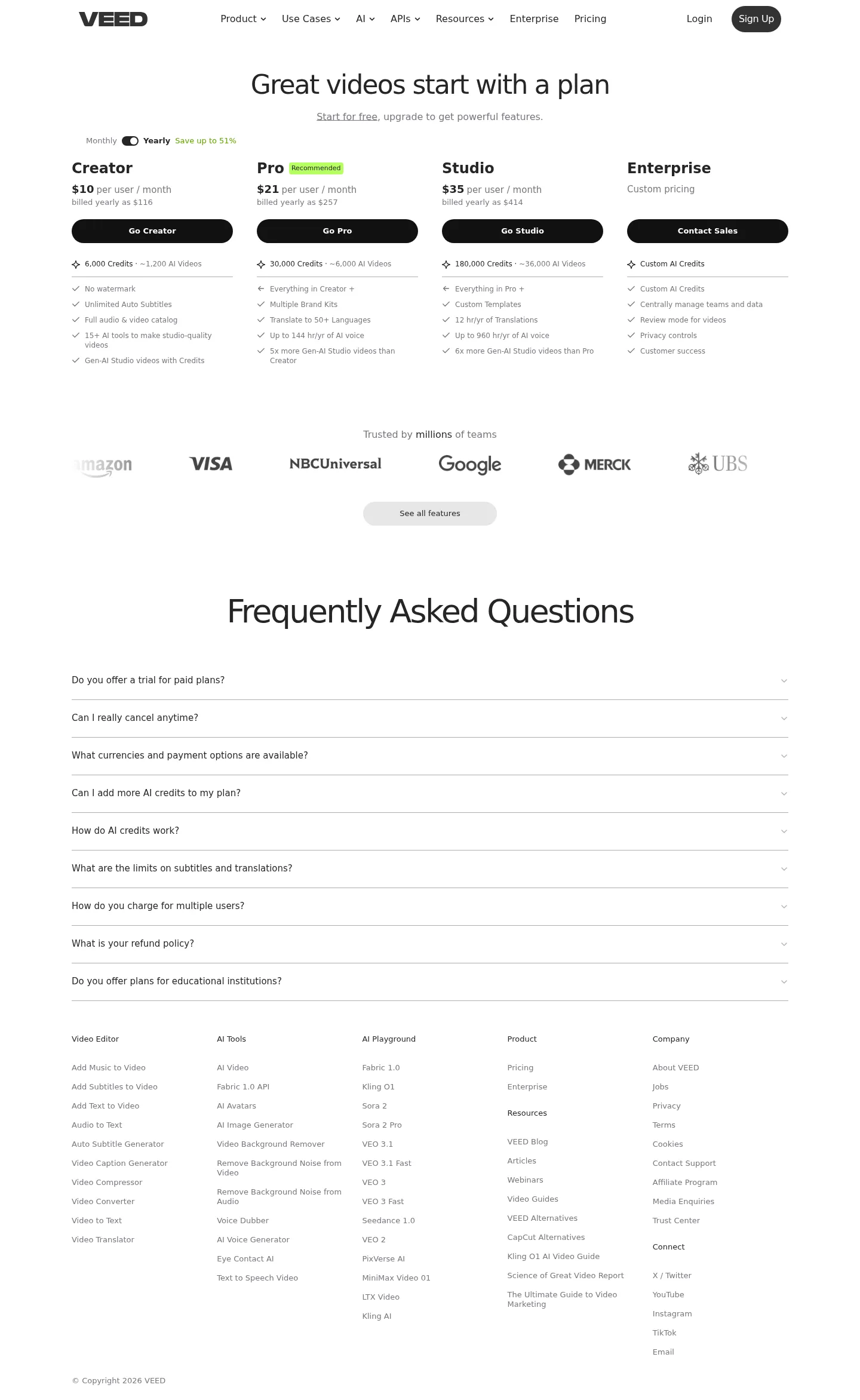
| 2026 Q2 | 0 | Premium third-party models surfaced (Sora 2, Veo 3.1, Kling) | 2026-06-11 capture: Creator $10 / Pro $21 / Studio $35 yearly-billed, annual credit pools per tier |
| 2026 Q3 | 3 (Creator +20%, Pro +5%, Studio +11%) | 0 | 2026-07-22: Creator $12 / Pro $22 / Studio $39 yearly-billed; credit pools unchanged; two plan-card wording edits |
Tracked range: 2018–present. The endpoints above anchor on the live 2026-06-11 and 2026-07-22 captures of veed.io/pricing and the documented 2024 introduction of Gen-AI Studio credits. Individual per-quarter price points between 2018 and 2026 Q2 are not separately documented, so the table records the shape of VEED’s pricing changes rather than a complete price series.
Notable changes
- 2018–2023 — VEED runs as a per-seat browser video editor (subtitles, captions, audio/video catalog, background removal), monetized by subscription seats with no generative-AI credit meter.
- 2024 — VEED layers Gen-AI Studio (text-to-video, AI avatars, dubbing, translation) onto the seat plans and introduces an annual AI-credit allowance as the metered unit for generative output — establishing today’s seat-plus-credits structure (source: VEED help docs / third-party pricing reports).
- By 2026-06-11 — Four-tier seat ladder (Free / Creator $10 / Pro $21 / Studio $35, yearly-billed) with annual credit pools of 6,000 / 30,000 / 180,000, AI voice hour caps per tier, and a roster of surfaced premium models (Sora 2, Google Veo 3.1/3/2, Kling) that burn credits at very different rates (source: captured
veed.io/pricing). - 2026-07-22 — First observed USD price increase, and it landed entirely on the seat rather than the meter: Creator $10 → $12/user/mo ($116 → $147/yr), Pro $21 → $22 ($257 → $265) and Studio $35 → $39 ($414 → $465), with credit allowances, AI-voice caps and the feature ladder untouched. Because the entitlement did not move, the increase is a pure repricing of the same bundle — every tier’s cost per credit rose, hardest at the entry rung. The rise is also uneven: Creator absorbed +20% while Pro took +5%, cutting the monthly Creator → Pro step from $11 to $10 and the annual step from $141 to $118, so the upgrade that buys 5x the credits now costs less than it did a month earlier.
- 2026-07-22 (packaging) — Two card-level edits shipped with the increase. Studio’s quantified “12 hr/yr of Translations” became the unquantified “Translate to 50+ Languages” already used on Pro, removing a published cap from the plan card and making Pro and Studio read identically on translation. The comparative volume claims (“5x more Gen-AI Studio videos than Creator”, “6x more than Pro”) were also dropped for a plain “Create videos with Gen-AI Studio” — which removes the on-card arithmetic that made the tier-to-tier value jump legible right as the prices moved.
What’s unique : VEED’s distinctive pricing mechanics
1. Seat-first, with credits as a soft AI ceiling — not a pay-as-you-go meter.
Unlike pure credit tools, VEED includes unlimited core editing with the seat and only meters the generative layer. Credits are a soft cap on Gen-AI Studio usage, so most customers experience VEED as a flat per-seat seat-based subscription and only the heavy AI users feel the meter. That keeps the headline price simple while still rationing GPU-bound generation.
2. An annual, non-rolling credit pool — an unusual cadence.
Where most generative-media tools reset credits monthly, VEED’s allowance is annual and does not roll over — unused credits expire at the end of the subscription year. That front-loads a large number (180,000 on Studio looks generous) while still forfeiting whatever you don’t spend by renewal, a quietly important detail for bursty, project-based workflows.
3. No standalone top-ups — the credit ceiling is a forced-upgrade lever.
VEED does not sell à-la-carte credit packs. If you exhaust the annual pool mid-year, your only options are to upgrade a tier or wait for renewal. That turns the credit allowance into a deliberate upsell path (Creator → Pro → Studio) rather than a smooth overage meter — a design that maximizes plan migration over incremental revenue.
4. Credits published as “AI videos,” but burn varies ~25x by model.
VEED translates its credit pools into concrete output (“6,000 Credits ~1,200 AI Videos”) so buyers reason in deliverables. But because surfaced premium models (Veo 2, Sora 2, Kling) burn many times more credits per second than VEED’s in-house Motion/Fabric, the same allowance can mean 1,200 in-house clips or barely a hundred premium ones — the headline count assumes the cheapest model.
Strengths & weaknesses
| Strengths | Weaknesses |
|---|---|
| Seat fee covers unlimited core editing; only generative AI draws credits, so most users get predictable flat pricing | Credit “AI videos” counts assume the cheapest in-house model; premium models burn up to ~25x faster, so real output can fall far short |
| Transparent public four-tier ladder — every self-serve price is listed, with a large advertised annual discount (up to 51%) | Annual, non-rolling credits forfeit unused allowance at renewal — penalizing bursty, project-based usage |
| Credit allowances, AI-voice caps and feature lists are identical across the USD and local-currency renders, so entitlements do not quietly vary by region | The page opens on the yearly-billed view and does not display the monthly rate, so the advertised “up to 51%” saving has no shown comparator — and in some regions the toggle is not rendered at all |
| Credits published as concrete “AI videos” output, so buyers can self-estimate before paying | No standalone top-up packs — exhausting the pool forces a full tier upgrade rather than a small à-la-carte buy |
| Low entry point ($12 Creator removes watermark + unlocks full catalog) | Free tier is a watermarked, capped trial (720p, ~10-min) rather than a durable usage plan |
| AI voice metered separately by tier (144 / 960 hr/yr) gives a clear scaling signal | AI voice hours are a second annual cap that can force a tier jump independent of video credits |
| The 2026-07-22 increase left the credit and voice entitlements intact, so no existing workflow lost capacity overnight | Same increase means every tier’s price per credit rose (Creator +27%, Studio +12%) with no added entitlement to justify it — and Studio lost its quantified “12 hr/yr of Translations” line in the same edit |
Billing UX : VEED billing controls and transparency
- Monthly / Yearly toggle — the pricing page carries a Monthly vs Yearly switch advertising “Save up to 51%”. It defaults to Yearly, so the headline figure is the yearly-billed per-user rate (e.g. Creator $12 per user / month, “billed yearly as $147”); the monthly-billed rate only appears after switching. The toggle is not rendered in every region.
- Local-currency rendering — prices are geo-localized by IP. The FAQ entry “What currencies and payment options are available?” states prices “are listed in your local currency if available, and if not they are listed in USD”, and non-USD renders add a ”(+ applicable tax)” line under each paid card (India: Creator ₹520, Pro ₹1068, Studio ₹1722 per user / month).
- Pro price varies by session — the Pro card is under a live A/B test: repeat loads of the same URL from the same egress on 2026-07-22 returned $22/user/mo (“billed yearly as $265”) in 10 of 16 loads and $24/user/mo (“billed yearly as $288”) in the other 6, with no on-page indication that an experiment is running. Creator and Studio were identical every time.
- Credit allowance shown as output — each paid plan states its credit pool alongside an “~AI Videos” equivalent (6,000 ~1,200; 30,000 ~6,000; 180,000 ~36,000), translating credits into concrete deliverables. The FAQ entry “How do AI credits work?” explains that the plan “includes a set amount of AI credits each month or year”, that the “full allowance refreshes when your subscription renews” and that “Credits do not carry over” — so the pool is annual on yearly billing and monthly on monthly billing.
- Per-user billing — plans are priced per user per month, so a multi-seat team’s total scales with seat count; the page notes seat handling in its “How do you charge for multiple users?” FAQ.
- No self-serve top-ups — there is no à-la-carte credit purchase path on the pricing page; running out means upgrading a tier, which the FAQ (“Can I add more AI credits to my plan?”) addresses.
- Trial & cancellation — the FAQ covers “Do you offer a trial for paid plans?”, “Can I really cancel anytime?”, “What is your refund policy?” and “Do you offer plans for educational institutions?”.
- “See all features” comparison — a “See all features” control below the plan grid opens the full plan-comparison view for side-by-side entitlement checking before purchase.
- Enterprise quote flow — Enterprise routes to “Contact Sales” (no public price) for custom AI credits, central team/data management, review mode and privacy controls.
Strategic wins : Why VEED’s pricing decisions worked
1. Keeping core editing seat-included and metering only AI.
By bundling unlimited editing, subtitles and the media catalog into the seat and metering only generative output, VEED gives most customers a predictable flat price while still rationing the expensive GPU layer. This sidesteps the bill-shock and cost-unpredictability that pure-usage AI tools suffer, and matches how content teams want to budget. See choosing the right usage metric.
2. A cheap entry rung that removes the two things free users hate most.
Creator (now $12/user/mo on yearly billing) kills the watermark and unlocks the full catalog — the exact frictions of the free tier — making the first paid step feel obvious. That cheap, high-value first rung is a textbook conversion lever and mirrors how AI companies are moving away from rigid per-user licensing toward value-tiered seats.
3. Using the credit ceiling to drive tier migration, not micro-overages.
By declining to sell top-ups and resetting credits annually, VEED steers heavy users into the next tier instead of nickel-and-diming overages — a cleaner expansion path that grows ARPA in bigger steps. Related: outcome-based and value-tier pricing trends.
4. Raising the entry price faster than the mid tier, which pulls buyers up the ladder.
The 2026-07-22 increase was deliberately uneven — Creator +20%, Pro +5% — which narrowed the Creator → Pro gap from $11 to $10 per user per month while Pro still carries 5x the credits. VEED took its largest percentage increase on the tier with the worst unit economics for the buyer ($24.50 per 1,000 credits) and its smallest on the tier it labels “Recommended”, so the same move harvests price from casual seats and makes the upgrade look better. That is an expansion lever disguised as a price rise.
Areas to improve : Gaps in VEED’s pricing approach
1. Make per-model credit burn visible on the pricing page.
The “~AI Videos” counts assume the cheapest in-house model, so a buyer who plans to use Veo 2 or Sora 2 can be off by an order of magnitude. Publishing a simple per-model credits/second table on the pricing page would let buyers model real output up front and reduce unpredictable-cost anxiety.
2. Add credit roll-over or top-ups for bursty workflows.
Annual, non-rolling credits with no top-up path penalize project-based creators who render heavily in one month and barely at all the next. A modest roll-over cap, or an à-la-carte top-up, would soften the all-or-nothing reset — the standard thresholding-and-alerting pattern applies here.
3. Surface the second meter — AI voice hours — earlier.
AI voice is a separate annual cap (144 hr/yr Pro, 960 hr/yr Studio) that can force a tier jump independent of video credits, but it is easy to miss on the plan card. Calling out both meters side by side would help dubbing-heavy teams pick the right tier without a surprise mid-year wall. See choosing the right usage metric.
4. Say what a price rise buys — or move the entitlement with it.
The 2026-07-22 increase raised seat prices by 5–20% while holding credits, AI-voice hours and the feature ladder flat, so from the buyer’s side the only visible change is a worse rate per credit. Pairing a repricing with either a larger allowance or a published rationale (new models, higher inference cost) is what keeps a metered plan feeling like value rather than drift. Removing quantified lines in the same release compounds the problem: Studio’s “12 hr/yr of Translations” and the “5x/6x more videos” comparisons were the two easiest ways for a buyer to check what a tier was worth, and both disappeared on the day the price went up. Publishing entitlement changes alongside price changes is the customer-communication baseline for usage-metered plans.
5. Show the monthly rate beside the yearly one.
The page opens on the yearly-billed view and advertises “Save up to 51%”, but the monthly figure that saving is measured against is not displayed by default, and in some regions the toggle is not rendered at all. That gap got more expensive on 2026-07-22: the numbers a buyer now reads as VEED’s price — $12, $22 and $39 per user per month — are annual-commit rates, so anyone comparing them against a competitor’s month-to-month list is comparing a committed price to an uncommitted one without being told. Rendering both figures side by side would make the discount checkable and stop the yearly rate from being mistaken for a no-commitment price.
Monetization stack & signals : how VEED AI builds & buys its revenue engine
Buys 2 Builds 0
VEED buys its whole payments-and-billing spine from Stripe — Billing, Payments and Radar fraud — with a co-founder and senior PM on record that "we wouldn't be here as a company" without it. No in-house billing or deployed meter.
-
“We benefit hugely from having Stripe handle all of our payments and billing.”
-
“Everyone knows you use Stripe. It's the only option that's dev-friendly.”
Signals reviewed · derived from press & filings
Key takeaways
- Meter the expensive layer, include the cheap one. VEED bundles core editing into the seat and meters only generative AI, so most customers get a flat, predictable price while VEED still rations GPU-bound output. Seat-plus-credits beats pure usage when only part of the product is costly to serve.
- An annual, non-rolling pool looks generous but forfeits the unused remainder. 180,000 credits is a big number, but expiry at renewal with no roll-over quietly penalizes bursty work — buyers should size to actual monthly cadence, not the headline annual figure.
- Headline “AI videos” counts hide model choice. Burn varies ~25x between in-house and premium models, so the published equivalents assume the cheapest path; always re-derive output for the model you actually intend to use.
- No top-ups turns the credit ceiling into an upgrade funnel. Declining à-la-carte credits steers heavy users into the next tier, growing ARPA in bigger steps but removing a smooth overage option.
- A cheap first rung converts well, and it is also where price rises land. Creator (now $12/user/mo yearly-billed) kills the two biggest free-tier frictions — watermark and locked catalog — which makes the first upgrade nearly automatic. But the 2026-07-22 increase raised that rung 20% while holding the credit allowance flat, pushing it to $24.50 per 1,000 credits against Studio’s $2.58. When the meter is a fixed entitlement, a price rise is a silent unit-cost rise that never appears on the plan card.
UBP implications
- Hybrid seat-plus-credits is the natural fit when only one feature is GPU-bound — and the seat becomes your price lever. VEED shows you can keep the simplicity of seat-based pricing for the bulk of the product and bolt a credit meter onto just the costly generative layer. Its 2026-07-22 move then demonstrated the follow-on: raising seat prices 5–20% with every allowance untouched is the low-friction way to reprice a hybrid plan — no customer loses capacity and nothing on the plan card changes — but it silently degrades the buyer’s rate per credit, so expect sophisticated buyers to re-derive $-per-unit and publish the entitlement side when you move price. See usage-based pricing strategy.
- Credit cadence (annual vs monthly) is itself a pricing lever. An annual non-rolling pool front-loads a large number while still forfeiting waste — a different psychological and margin profile from a monthly reset. UBP designers should treat reset cadence as a deliberate choice, not a default.
- Withholding top-ups converts a usage ceiling into an expansion mechanic. By forcing tier upgrades instead of selling overage credits, VEED trades incremental usage revenue for larger plan migrations — a reminder that how you handle “running out” shapes your whole expansion motion.
Sources
- VEED pricing page (accessed 2026-07-22) — live capture: Creator, Pro, Studio and Enterprise cards, credit pools, AI-voice hour caps, and the local-currency (INR) render. The USD list prices ($12 / $22 / $39 per user per month; $147 / $265 / $465 per user per year) were read from two independent US-egress renders of the same page on the same day, which agreed exactly
- VEED pricing page — repeat US-egress renders (accessed 2026-07-22) — sixteen repeat loads of the same URL used to test price stability; Creator ($12 / $147) and Studio ($39 / $465) identical every time, Pro alternating between $22 ($265/yr) and $24 ($288/yr), which is how the live A/B test on the Pro rung was identified
- VEED Help Center (accessed 2026-07-22) — AI tools, account & subscription articles
- VEED Help Center — How to use Text to Speech (accessed 2026-07-22) — per-plan AI-voice caps: Free up to 10 min/mo, Creator up to 4 hr/yr, Pro up to 144 hr/yr, Studio up to 960 hr/yr
- VEED Help Center — How to use VEED’s AI Playground (accessed 2026-07-22) — “How AI Credits and Pricing Work”: credit cost is per generation and model-dependent, and “Credits expire monthly unless in an annual plan, where credits reset after a year”
- VEED Help Center — Account and subscription (accessed 2026-07-22) — subscribing and managing a subscription, invoices, cancellation, voucher codes
- VEED Help Center — How collaborator charges are calculated (accessed 2026-07-22) — how VEED bills additional per-user seats mid-cycle
- VEED Help Center — Will the videos I created have a VEED watermark on them? (accessed 2026-07-22) — free exports are watermarked; a paid subscription is the only way to export without it
Bottom line
VEED is a seat-first video editor with a usage-metered AI layer: per-user plans (yearly-billed Creator $12, Pro $22, Studio $39) bundle annual AI-credit pools that meter Gen-AI Studio generation, while core editing stays seat-included. Its sharpest design choices are also its sharpest caveats — the credit pool is annual and does not roll over, there are no standalone top-ups, and the headline “AI videos” counts assume VEED’s cheapest model while premium options burn up to ~25x faster. The 2026-07-22 increase sharpened rather than changed that thesis: seats rose 5–20% with allowances held flat, so the entry tier now costs $24.50 per 1,000 credits against Studio’s $2.58, and the pull toward the recommended Pro tier is stronger than ever. That makes VEED predictable for ordinary editing and upgrade-driven for heavy generative use — a clean case study in metering only the expensive layer of a freemium product. Browse the pricing blueprint for more fully-researched company profiles.
Want to compare VEED against other generative-media and AI-platform companies? Browse the pricing blueprint.
Pricing timeline : Major events on a vertical axis
Each milestone below corresponds to a public pricing change, product launch, or material adjustment. Major events use a filled marker; minor adjustments use a faded one.
USD list prices raised across all three self-serve tiers
VEED raised its USD yearly-billed rates: Creator $10 → $12/user/mo (billed yearly $116 → $147), Pro $21 → $22 ($257 → $265) and Studio $35 → $39 ($414 → $465). Credit allowances were unchanged (6,000 / 30,000 / 180,000), but Studio's '12 hr/yr of Translations' line was replaced with 'Translate to 50+ Languages' and the comparative '5x/6x more Gen-AI Studio videos' claims were dropped from the Pro and Studio cards.
Four-tier seat ladder with annual credit allowances
Captured veed.io/pricing (USD): Free $0 (watermark, 720p, 10-min cap), Creator $10/user/mo (billed yearly as $116; 6,000 credits ~1,200 AI videos), Pro $21/user/mo ($257; 30,000 credits ~6,000 AI videos, up to 144 hr/yr AI voice), Studio $35/user/mo ($414; 180,000 credits ~36,000 AI videos, up to 960 hr/yr AI voice), Enterprise custom (custom AI credits, SSO). Annual billing advertised at up to 51% off.
Per-seat plans with bundled AI credits
VEED layered an AI-credit allowance onto its existing per-seat subscription tiers as it expanded from a browser video editor into Gen-AI Studio (text-to-video, avatars, dubbing). Credits became the metered unit for generative features while core editing stayed seat-included — establishing today's seat-plus-credits shape.
- · VEED publishes its credit allowance in two units at once — Creator's 6,000 credits is shown as '~1,200 AI videos', Pro's 30,000 as '~6,000 AI videos' and Studio's 180,000 as '~36,000 AI videos' — but each 'AI video' assumes the cheapest in-house model; a premium model like Google Veo 2 can burn ~25x more credits per second.
- · AI credits at VEED are an ANNUAL pool, not monthly — and they do not roll over: unused credits expire at the end of the subscription year, an unusual cadence versus the monthly-reset credit pools common to other generative-media tools.
- · VEED does not sell standalone top-up credit packs — if you exhaust your annual allowance mid-year, the only options are upgrading a tier (Creator → Pro → Studio) or waiting for renewal, which turns the credit ceiling into a forced-upgrade lever.
Questions & answers
- What is VEED's pricing model?
- VEED is a per-seat subscription. You pay per user per month (on yearly billing: Creator $12, Pro $22, Studio $39), and every paid plan bundles an annual AI-credit allowance that meters Gen-AI Studio video generation, dubbing and AI avatars. Most core editing (subtitles, trimming, the asset catalog) is included with the seat; only generative AI draws credits. Enterprise is a custom quote with custom AI credits.
- Does VEED offer a free tier?
- Yes. VEED has a free plan at $0 that lets you edit and export video, but every export carries a VEED watermark — VEED's help centre states the only way to export without it is a paid subscription. The commonly cited free-tier caps (720p exports, a 10-minute video length limit and roughly 2GB of storage) are third-party-reported rather than published on the pricing page. Removing the watermark and unlocking the full audio/video catalog and Gen-AI Studio credits requires upgrading to at least Creator.
- How much does VEED cost per month?
- On yearly billing the paid plans show as Creator $12/user/mo, Pro $22/user/mo and Studio $39/user/mo — billed yearly as $147, $265 and $465 per user per year respectively. Pro is currently A/B tested: repeat loads of the pricing page on 2026-07-22 also served $24/user/mo (billed yearly as $288) for the identical Pro entitlement, so check the price your own session shows. VEED advertises savings of up to 51% on annual billing, so the pure monthly rate is higher; Enterprise is custom-priced via Contact Sales, and prices are shown in your local currency where VEED supports it.
- Is VEED pricing usage-based or subscription?
- It is primarily a per-seat subscription with a usage-metered AI layer. The seat fee covers unlimited core editing, auto-subtitles and the media catalog, while generative AI (text-to-video, avatars, dubbing) is metered against a bundled annual credit allowance. So it is seat-first, with credits acting as a soft usage cap on the AI features rather than a pure pay-as-you-go meter.
- Can you use VEED videos commercially and do credits roll over?
- Paid plans remove the watermark and unlock the full catalog for professional use, while the free plan stamps a VEED watermark on exports. AI credits do not roll over: VEED's FAQ states the full allowance refreshes when the subscription renews and that credits do not carry over, which means an annual pool on yearly-billed plans and a monthly pool on monthly-billed ones. VEED does not sell standalone top-up credit packs, so running out means upgrading a tier or waiting for renewal.