AI Summary
About
Atlassian is a publicly traded (NASDAQ: TEAM) enterprise software company, founded in 2002 by Mike Cannon-Brookes and Scott Farquhar, built around team collaboration and software-development tooling. Its portfolio anchors on three products — Jira (project & work tracking), Confluence (team knowledge base/wiki), and Jira Service Management (IT service management) — alongside Bitbucket, Trello, Loom, and its newer AI layer, Rovo. Atlassian scaled for most of its history on a low-friction, self-serve go-to-market rather than a traditional enterprise sales force, relying on free trials and bottom-up adoption inside engineering and IT teams before layering on sales-led motions for its largest accounts.
Atlassian serves everyone from small teams just getting started (its Free tier caps at 10 users for Jira/Confluence and 3 agents for Jira Service Management) up to enterprises running 100,000+ licensed users across as many as 150 isolated sites, competing against Monday.com and Asana in work management, ServiceNow and Freshservice in IT service management, and Notion and SharePoint in knowledge management. Its most consequential recent strategic move is Rovo, an AI layer (search, chat, and agents) rolled out across its Cloud product line as a bundled, credit-metered add-on rather than a stand-alone purchase — layering Atlassian’s AI monetization on top of its long-standing per-seat subscription core.
Pricing summary : How Atlassian prices Jira, Confluence & Jira Service Management
Atlassian uses a hybrid per-seat + AI credit overlay model with 4 dimensions:
- Per-user/per-agent seat tier: Each product (Jira, Confluence, Jira Service Management) is sold on its own Free → Standard → Premium → Enterprise ladder, priced per user (per agent for Jira Service Management), with Enterprise always quoted and billed annually only.
- Progressive seat-count discounting: The displayed per-user rate isn’t flat — Atlassian publishes banded monthly rates (Jira Standard runs USD 9.05/user for 1–100 users down to USD 2.45/user above 90,000) so the effective blended price falls as headcount grows; a 350-user Jira Standard site nets a blended ~$7.91/user/month.
- Rovo AI credits, bundled by tier: Every paid Standard/Premium/Enterprise plan bundles a fixed Rovo AI credit allowance (25/70/150 credits per user per month respectively) plus an indexed-object cap for Rovo Search — Free tiers get no Rovo access at all.
- Per-resolution AI agent overage (Jira Service Management only): Jira Service Management’s Premium and Enterprise plans separately meter Rovo’s virtual customer-service agent at $1 per AI-handled resolution, on top of the seat fee and Rovo credit pool.
What makes this different: Atlassian bundles its core AI monetization as a credit allotment inside existing per-seat tiers rather than selling Rovo as a stand-alone SKU — the one exception is Rovo Dev, a separate AI coding agent sold per developer seat with its own credit pool and per-credit overage.
Pricing by product
Jira (Cloud plans)
| Tier | Price | Included | Key mechanics |
|---|---|---|---|
| Free | $0 | Free forever for up to 10 users; unlimited projects, boards, backlogs & forms, 100 automation rule runs/mo, 2GB storage | Community support only |
| Standard | $7.91/user/mo* | Everything from Free, plus Rovo Search/Chat/Agents (25 Rovo credits + 100 indexed objects/user/mo), user roles & permissions, external collaboration, 1,700 automation runs/mo, 250GB storage, 9/5 regional support, up to 100,000 users/site | *Blended rate shown at a 350-user team size on the pricing-page slider |
| Premium | $14.54/user/mo* | Everything from Standard, plus cross-team planning & dependency management, customizable approvals, 70 Rovo credits + 250 indexed objects/user/mo, per-user automation (1,000 runs/user/mo), unlimited storage, 24/7 critical-issue support, 99.9% uptime SLA | ”RECOMMENDED” tier on the pricing page |
| Enterprise | Contact sales | Everything from Premium, plus 150 Rovo credits + 625 indexed objects/user/mo, Atlassian Analytics & Data Lake, enterprise-grade IAM/SSO, unlimited automation, up to 150 sites, 24/7 support for all issues, 99.95% uptime SLA | Billed annually only, “Switch to Annual billing to view Enterprise pricing”; no published number even then |
*Atlassian publishes banded monthly per-user rates for Jira Standard/Premium (e.g. Standard: USD 9.05/user for 1-100 users, USD 6.40/user for 251-1,000, down to USD 2.45/user above 90,000) - the plan-card price is the blended average at whatever team size the buyer slider is set to, not a single flat rate.
Confluence (Cloud plans)
| Tier | Price | Included | Key mechanics |
|---|---|---|---|
| Free | $0 | Free forever for up to 10 users; pages, spaces, databases, up to 3 active whiteboards/user, 10 automation runs/mo, 2GB storage | Community support only |
| Standard | $5.42/user/mo* | Everything from Free, plus Rovo Search/Chat/Agents (25 Rovo credits + 100 indexed objects/user/mo), free guest access, advanced permissions, 100 automation runs/mo, 250GB storage, 9/5 regional support, up to 250,000 users/site | *Blended rate shown at a 300-user team size on the pricing-page slider |
| Premium | $10.44/user/mo* | Everything from Standard, plus unlimited pages/spaces, a new dynamic intranet, 10x more automations, unlimited whiteboards & storage, admin controls & insights, 24/7 critical-issue support, 99.9% uptime SLA | 70 Rovo credits + 250 indexed objects/user/mo; “RECOMMENDED” tier |
| Enterprise | Contact sales | Everything from Premium, plus Atlassian Analytics & Data Lake, enterprise IAM/SSO, unlimited automations, up to 150 sites, 24/7 support for all issues, 99.95% uptime SLA | Billed annually only; 150 Rovo credits + 625 indexed objects/user/mo |
Jira Service Management (Cloud plans)
| Tier | Price | Included | Key mechanics |
|---|---|---|---|
| Free | $0 | Free forever for 3 agents, unlimited customers; alerts/on-call/incident templates, multi-channel support (portal, email, chat), embedded knowledge base | Community support only; no Rovo access |
| Standard | $20/agent/mo | Everything from Free, plus Rovo Agents/search/chat, asset & configuration management (5,000 Assets objects), custom-branded help center, unlimited email, audit logs & multi-region residency, up to 100,000 agents | 25 Rovo credits + 100 indexed objects/user/mo; no virtual service agent |
| Premium | $51.42/agent/mo | Everything from Standard, plus a virtual service agent (1,000 assisted conversations/mo or 12,000/year included, then add-on volume pricing), advanced AIOps, real-time incident monitoring, change management with AI risk assessment, 50,000 Assets objects | ”RECOMMENDED” tier; Rovo Customer Service AI resolutions billed at $1/resolution |
| Enterprise | Contact sales | Everything from Premium, plus 500,000 Assets objects, status pages, unlimited automation, up to 150 sites, cross-product analytics | Billed annually only; same $1-per-resolution Rovo Customer Service metering as Premium |
Sales motions across products: PLG / self-serve for Free, Standard, and Premium across Jira, Confluence, Jira Service Management, and Rovo Dev; sales-led for every Enterprise tier (annual-only, contact sales).
Rovo & Rovo Dev (AI add-on pricing)
- Rovo (Search, Chat, Agents, Studio) is bundled automatically into any paid Standard/Premium/Enterprise Cloud subscription of Jira, Confluence, or Jira Service Management, and is not sold as a separate SKU for those apps. Credit allowance scales by tier: Standard = 25 credits/user/mo (100 indexed objects), Premium = 70 credits/user/mo (250 indexed objects), Enterprise = 150 credits/user/mo (625 indexed objects). Admins receive usage alerts at 80% and 100% of the monthly allowance and can opt into extra usage (disabled by default).
- Rovo Dev, a separate AI coding agent for engineering teams, is priced independently at $20 per developer per month, including 2,000 Rovo Dev credits per developer per month; overage bills at $0.01 per credit, with an additional 2,000 credits per user per month of extra usage auto-enabled by default so work is not blocked at the cap. Seats can be purchased for individual developers rather than upgrading an entire site.
- Rovo Customer Service (Jira Service Management AI virtual agent) is bundled into Premium/Enterprise JSM plans at $1 per AI-resolved conversation, with an included allotment of 1,000 assisted conversations per month (or 12,000 per year) and volume-discounted add-on packs beyond that.
Hidden costs : What a multi-product Atlassian bill actually looks like
The $7.91/user headline on the Jira Standard card is only ever paid by one product, at one specific team size, in isolation. Most real customers run Jira plus Confluence plus a Jira Service Management desk, and pay Rovo overage on top. Two representative examples:
A 350-person engineering & IT organization on Premium
| Line item | Monthly cost |
|---|---|
| Jira Premium — 350 users x $14.54/user | $5,089 |
| Confluence Premium — 300 users x $10.44/user | $3,132 |
| Jira Service Management Premium — 20 agents x $51.42/agent | $1,028 |
| Rovo Customer Service overage — 500 AI resolutions beyond the 1,000/mo included, at $1/resolution | $500 |
| Total | $9,749 |
Once Confluence and a Premium-tier JSM desk are layered on top of the advertised per-seat Jira number, the blended bill is nearly 2x the Jira-only Premium line by itself — and Rovo Customer Service’s per-resolution overage can add hundreds of dollars a month before any seat count even changes.
A 50-developer team standardized on Rovo Dev
| Line item | Monthly cost |
|---|---|
| Rovo Dev seats — 50 developers x $20/developer | $1,000 |
| Included credits — 50 x 2,000 = 100,000 credits/mo | $0 |
| Overage — 30,000 extra credits x $0.01/credit | $300 |
| Total | $1,300 |
Because Rovo Dev auto-enables an additional 2,000 credits/developer/month of extra usage by default rather than hard-capping the team, a group that regularly exceeds its pool pays a predictable ~30% premium on top of seat fees instead of being blocked mid-sprint. It’s a textbook credit-based billing trade-off: bill predictability up front, in exchange for an overage line that compounds silently unless someone is watching the admin usage dashboard.
Want to estimate your own Atlassian bill? Use the Atlassian pricing calculator to model your monthly cost based on team size, product mix, and Rovo credit usage.
Pricing evolution : From a flat per-user fee to a two-stage self-hosted sunset and bundled AI credits
Cadence
| Quarter | Price changes | Product / SKU additions | Notes |
|---|---|---|---|
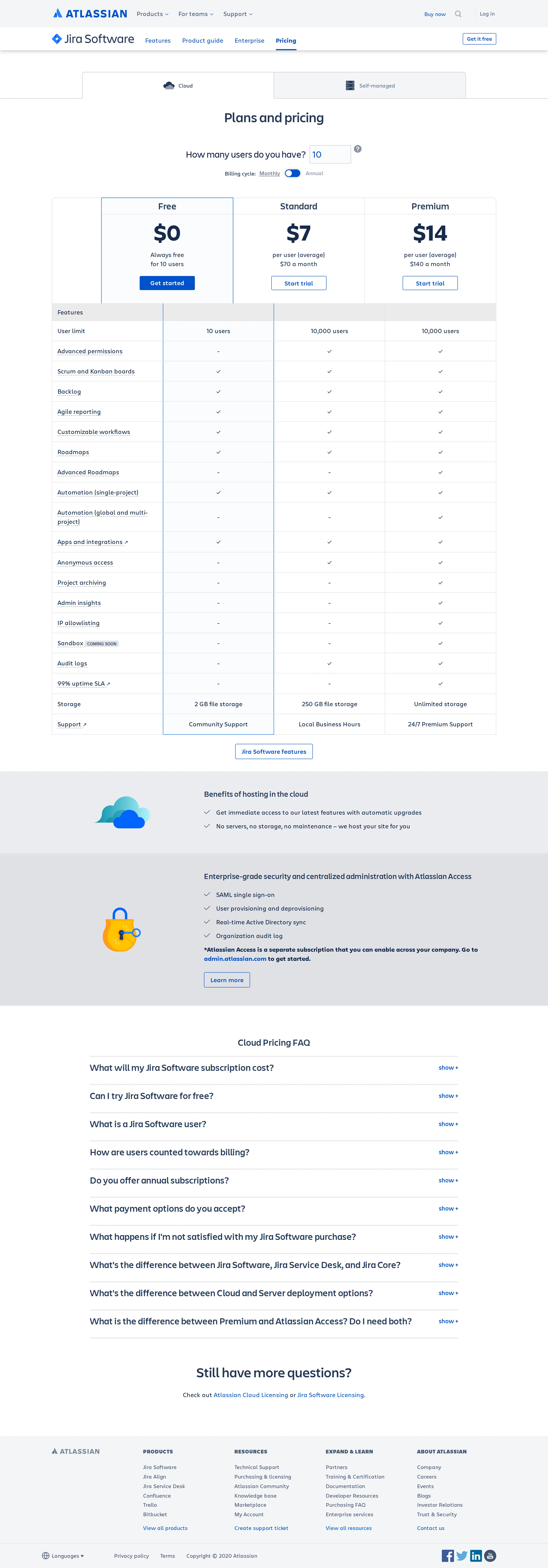
| 2020 Q3 | 1 | 1 | Jira Cloud replaced its 2019 flat/per-user model with a Free/Standard/Premium three-tier ladder by September 2020. |
| 2020 Q4 | 0 | 2 | October 19, 2020 — Server sunset announced (end-of-sale Feb 2021, end-of-support Feb 2024); an Enterprise column appeared on the Cloud pricing page the same month. |
| 2021 Q1 | 0 | 1 | February 2, 2021 — Server end-of-sale took effect and Cloud Enterprise became a fully quotable fourth tier. |
| 2023 Q4 | 1 | 0 | October 18, 2023 — First annual Cloud price increase: ~5% average across Standard/Premium/Enterprise (Jira, Confluence); JSM +5-20%. |
| 2024 Q1 | 1 | 0 | February 15, 2024 — Server end-of-support; Data Center list prices rose 23-24% (Jira +24%, Confluence +29%, JSM +23%), Advantage legacy pricing up to +30%. |
| 2024 Q4 | 2 | 2 | October 9, 2024 — Rovo reached GA as a $20/user/mo add-on. October 16, 2024 — Cloud prices rose again (Standard +5%, Premium/Enterprise +10%, JSM +8-20%); JSM introduced its first consumption AI pricing ($0.30/resolution above 1,000/mo free). |
| 2025 Q1 | 1 | 0 | February 11, 2025 — Second annual Data Center increase: 15-25% on list prices, 30% for Advantage-pricing Jira Software customers. |
| 2025 Q2 | 1 | 0 | April 9, 2025 — Rovo’s $20/user/mo add-on charge ended; credits became bundled free into Premium/Enterprise. |
| 2025 Q3 | 0 | 1 | September 9, 2025 — Data Center itself given a full end-of-life date of March 28, 2029. |
| 2025 Q4 | 1 | 2 | October 15, 2025 — Third annual Cloud price increase (Standard +5%, Premium +7.5%, Enterprise +7.5-10%); Rovo bundling reached Standard; Rovo Dev reached GA. |
| 2026 Q1 | 1 | 0 | February 2026 — Third annual Data Center increase: flat 15%, Advantage customers 18-40%. |
| 2026 Q3 | 0 | 1 | August 17, 2026 — Default AI-training data collection took effect for Free/Standard/Premium customers with no opt-out. |
Tracked range: 2019–2026. Quarters not listed above were verified stable (0 price changes, 0 SKU additions).
Notable changes
- 2020-09 — Jira Cloud’s flat $10/mo (10 users) + $7/user/mo (11-100 users) model from 2019 is replaced by a Free/Standard/Premium three-tier ladder, with no Enterprise tier yet.
- 2020-10-19 — Atlassian announces it will stop selling new self-hosted Server licenses; the plan draws a 380-point, 298-comment Hacker News thread.
- 2021-02-02 — Server end-of-sale takes effect; Cloud Enterprise launches as a fully quotable, unlimited-instance top tier the same day.
- 2023-10-18 — First annual October Cloud price increase (~5% average).
- 2024-02-15 — Server reaches full end-of-support; Data Center list prices rise 23-29% depending on product.
- 2024-10-09 — Rovo reaches general availability priced at $20/user/month as a separate add-on.
- 2024-10-16 — Jira Service Management introduces its first consumption-based AI pricing: $0.30 per Rovo virtual-agent resolution above a 1,000/month free allowance.
- 2025-02-11 — Second annual Data Center price increase (15-25% list, 30% Advantage).
- 2025-04-09 — Rovo’s per-user add-on charge is discontinued; credits bundle free into Premium/Enterprise.
- 2025-09-09 — Atlassian announces Data Center will fully end of life on March 28, 2029.
- 2025-10-15 — Rovo bundling reaches Standard; Rovo Dev reaches general availability; third annual Cloud price increase.
- 2026-02 — Third annual Data Center price increase (flat 15%).
- 2026 (exact date unknown) — Jira Service Management’s Rovo Customer Service overage rate rises from its October 2024 introductory $0.30/resolution to $1.00/resolution — more than 3x the launch rate — though Atlassian has not published the exact effective date.
- 2026-08-17 — Atlassian begins collecting customer metadata by default to train its AI models, reversing its earlier no-training pledge; the change draws a 604-point, 136-comment Hacker News discussion.
The self-hosted sunset in detail
Atlassian’s move away from self-hosted deployment happened in two distinct stages nearly a decade apart. Server — the original self-hosted product — was announced for discontinuation in October 2020: new license sales stopped February 2, 2021 (the same day Cloud Enterprise launched), and support fully ended February 15, 2024. Data Center, the more expensive self-managed successor Atlassian had positioned as Server’s replacement, looked like the permanent home for regulated and large on-prem customers — until September 9, 2025, when Atlassian announced Data Center will also fully end of life on March 28, 2029, with new-customer sales ending March 30, 2026 and existing-customer expansions ending March 30, 2028. Every Data Center price increase since 2024 (23-24% in 2024, 15-25% in 2025, a flat 15% in 2026) has landed in the years immediately preceding this wind-down, which is the clearest example in this corpus of pricing being used as a deliberate migration lever rather than a simple revenue lever.
What’s unique : Three AI pricing mechanics inside one company
1. Three genuinely different AI monetization patterns, all live at once. Most vendors pick one AI pricing mechanic and apply it everywhere; Atlassian runs three simultaneously. Rovo’s core search/chat/agents are bundled with a per-seat credit allowance baked into the existing Jira/Confluence/JSM subscription (no separate line item). Rovo Dev, the standalone coding agent, is seat-plus-credit-overage — its own $20/developer/month SKU with a per-seat base and metered overage. Rovo Customer Service, JSM’s virtual agent, is pure outcome-based pricing at $1 per AI-resolved conversation, with zero relationship to seat count. Few companies in this corpus run all three archetypes — bundled-credits, seat-plus-overage, and per-outcome — under one brand at the same time.
2. AI credits as a loss-leader upsell lever, not a revenue line. Atlassian doesn’t monetize Rovo’s core credits directly — it gives them away to push customers into higher-credit tiers. Premium and Enterprise plans carry roughly 3x and 6x the Standard credit allowance respectively, and Atlassian has publicly said customers who adopt Rovo grow their subscription ARR at more than twice the rate of non-adopters. The AI feature is the upgrade incentive; the seat-tier ladder is where the money is actually collected.
3. Pricing as a migration lever, not just a revenue lever. Atlassian’s Data Center list-price increases (23-24% in 2024, 15-25% in 2025, 15% in 2026) have landed in the exact years surrounding two forced self-hosted exits: Server’s 2021/2024 sunset and Data Center’s own newly announced 2029 end-of-life. The price gap between self-hosted and Cloud isn’t incidental — it’s a deliberate lever widening every year self-hosted remains available, a pattern worth understanding alongside the broader usage-based pricing fundamentals this corpus tracks.
4. A published, banded per-seat rate card instead of a black-box quote. Unlike most Enterprise-gated SaaS, Atlassian publishes its actual banded per-user rates (e.g., Jira Standard: $9.05/user for 1-100 users, down to $2.45/user above 90,000) rather than hiding volume discounts behind “contact sales.” The team-size slider on every pricing page recalculates the blended rate live against that published table — a rare level of pricing transparency at Atlassian’s scale.
Strengths & weaknesses
| Strengths | Weaknesses |
|---|---|
| Publishes real banded per-user rates (down to $2.45/user above 90,000 users) instead of gating volume pricing behind sales | Reaching that full band table, and Enterprise pricing at all, still requires talking to sales — the headline card only shows one slider position |
| Rovo’s core AI credits are free inside every paid plan, removing the “should we even try AI” adoption friction other vendors charge for | Free Rovo credits are funded by pushing customers into pricier seat tiers with 3-6x more credits, an indirect but real AI monetization tax |
| Three AI pricing mechanics (bundled credits, seat-plus-overage, per-outcome) let Atlassian match billing to how each AI product is actually consumed | The same three mechanics mean a customer must learn three different AI billing models to predict one company’s total AI spend |
| A single admin usage dashboard tracks Rovo credit burn with proactive alerts at 80%/100% of the monthly pool | Jira Service Management’s Rovo Customer Service overage rate roughly tripled from its 2024 launch price ($0.30/resolution) to $1.00/resolution, with no public announcement of the exact date it changed |
| Free tier remains genuinely usable (unlimited projects/boards on Jira, unlimited pages on Confluence) for teams under 10 users | Annual Cloud list-price increases every October since 2023, plus Data Center increases exceeding 40% cumulatively since 2024, have made “Atlassian tax” a recurring budget-planning line item |
| Self-hosted customers get a long, clearly telegraphed multi-year runway (Server: 2020-2024; Data Center: 2025-2029) rather than an abrupt cutoff | The runway still ends in forced migration to Cloud, and 2026’s default AI-training data collection policy offers no opt-out below Enterprise |
Billing UX : How Atlassian’s pricing calculator and admin usage controls work
- Team size slider — an interactive users/agents slider on each product’s pricing page recalculates the displayed per-user price live against Atlassian’s published volume bands.
- Monthly/Annually toggle — switches billing cadence and surfaces “SAVE UP TO 17%” messaging on every paid tier; Enterprise pricing is only reachable after switching to Annual.
- Maximum Quantity Billing (MQB) — for monthly subscriptions, Atlassian bills on the highest seat count assigned at any point in the billing cycle; adding seats mid-cycle is prorated, but removing seats does not reduce that cycle’s bill.
- Cloud Calculator — a separate multi-step tool (atlassian.com/software/pricing-calculator) lets buyers select multiple products at once (Jira, Jira Service Management, Jira Product Discovery, Confluence, Bitbucket, Compass, Atlassian Guard) and estimate a combined bill.
- Rovo Platform usage dashboard — an admin panel shows total Rovo AI credit allowance versus consumption over time, broken out by app and by user, with proactive email/in-product alerts at 80% and 100% of the monthly allowance.
Strategic wins : Why Atlassian’s AI and migration bets paid off
1. Bundling Rovo’s core credits into existing seat tiers, instead of a new per-user AI add-on
Atlassian tried the industry-default move first — launching Rovo in October 2024 as a $20/user/month add-on — and reversed it within six months once adoption lagged. Folding Rovo’s credits into Premium and Enterprise for free in April 2025 (and Standard in October 2025) removed the “should we even pay to try AI” purchase decision entirely, which is exactly the per-user-license-to-AI-bundle shift playing out across the whole SaaS market. Atlassian’s own reporting that Rovo adopters grow ARR more than 2x faster than non-adopters suggests the bundle is working as an upsell engine rather than a cost center.
2. Splitting Rovo Dev and Rovo Customer Service into billing models that match how they’re actually consumed
Rather than forcing every AI surface through one mechanic, Atlassian priced Rovo Dev on seats-plus-credit-overage (matching how individual developers burn tokens continuously) and Rovo Customer Service on pure per-outcome pricing (matching how a support desk only cares about tickets actually resolved). That’s a more disciplined value-metric exercise than most vendors attempt across even one AI product, let alone three.
3. Publishing the real banded rate card instead of hiding volume pricing behind a sales call
Most SaaS vendors gate any volume discount behind “contact sales.” Atlassian’s team-size slider recalculates the actual blended per-user price live against a published table (Jira Standard: $9.05/user at 1-100 users down to $2.45/user above 90,000) — a level of self-serve pricing transparency that materially shortens the usage-metric evaluation a buyer has to do before committing.
4. Telegraphing the self-hosted sunset years in advance, in two clearly separated stages
Server’s wind-down (announced 2020, sold until 2021, supported until 2024) and Data Center’s own newly announced 2029 end-of-life give affected customers multi-year runways rather than an abrupt cutoff — a rare example of a vendor sequencing a forced-migration pricing lever with enough lead time that customers can actually plan around it instead of being blindsided.
Areas to improve : Where the AI credit story gets harder to trust
1. Publish the Rovo Customer Service overage-rate change instead of letting it surface only in screenshots
The per-resolution rate for JSM’s Rovo virtual agent rose from its October 2024 introductory $0.30 to $1.00 by 2026 — more than a 3x increase — with no dated blog post, changelog entry, or investor notice found for the change itself (only the before/after prices). A vendor charging per AI outcome should treat that rate the way it treats seat-tier prices: a dated, citable pricing-change announcement, not a silent update to a support-page table.
2. Give Free/Standard/Premium customers a real opt-out from AI-training data collection, not just Enterprise
Starting August 17, 2026, Atlassian collects Jira/Confluence metadata by default to train its AI models, with no opt-out available below Enterprise — a policy reversal from its earlier no-training pledge that drew a 604-point Hacker News thread. Tying a core data-governance right to the highest, sales-quoted tier (rather than offering it as a toggle on any paid plan) reads as pricing power exercised over privacy, not a technical constraint.
3. Resolve the tension between “free AI credits” messaging and the seat-tier upsell they’re funding
Rovo’s headline is “included at no additional cost,” but Premium and Enterprise carry 3x and 6x the Standard credit pool — meaning the real price of more AI usage is upgrading the whole team’s seat tier, not a transparent AI line item. Disclosing an explicit “cost per additional 1,000 Rovo credits by tier” the way prepaid credit models elsewhere in this market do would let buyers actually compare AI cost per tier instead of reverse-engineering it from the plan-comparison table.
4. Shorten the gap between three AI products and one mental model for total AI spend
A customer must separately track Rovo core credits (per seat, bundled), Rovo Dev credits (per developer, metered), and Rovo Customer Service resolutions (per outcome, metered) to know their real AI bill. A single consolidated AI-usage view spanning all three — not just the existing per-product Rovo dashboard — would match the usage-based billing consolidation buyers increasingly expect from multi-product AI vendors.
Monetization stack & signals : how Atlassian builds & buys its revenue engine
Buys 6 Builds 2 6 signal roles
Buys the money movement — Stripe has run subscriptions and payments since 2021 — but built the meter: Forge's Usage Tracking Service and Commerce entitlements are in-house. The tell-role below is a Value Management Office advisor, not another billing engineer.
-
“All of those events flow into a shared usage pipeline called UTS (Usage Tracking Service), which acts as the nervous system for Forge Billing.”
-
“That's the role of our entitlements and enforcement layer, which maps each app to concrete entitlements (what resources an app can use) and enforces limits and budgets”
-
“Atlassian, a leading provider of team collaboration and productivity software including Jira Software, Confluence, Trello, and Bitbucket, is partnering with Stripe to simplify and scale its global subscription management and billing system.”
-
“Proficient in using large scale ERP systems (Oracle Fusion a plus), and Revpro”
-
“improve data quality, reporting consistency, and usability across platforms such as Salesforce, Gainsight, and Tableau.”
-
“improve data quality, reporting consistency, and usability across platforms such as Salesforce, Gainsight, and Tableau.”
-
“improve data quality, reporting consistency, and usability across platforms such as Salesforce, Gainsight, and Tableau.”
-
“Experience using Salesforce, Clari and Tableau.”
-
A standing Revenue Operations org runs post-sales on bought systems — Salesforce, Gainsight and Tableau are named as the platforms it maintains — so the commercial spine is configured while the usage meter behind Forge is engineered in-house.
“Partner with analytics, systems, and tooling teams to improve data quality, reporting consistency, and usability across platforms such as Salesforce, Gainsight, and Tableau.”
-
A dedicated technical CS layer exists to push Rovo from activation into production use — the demand side of credit-based AI pricing, where bundled credits only convert into revenue once customers actually consume them.
“you'll execute time-boxed, co-built technical engagements that take customers from "Rovo is turned on" to real, measurable business value in production”
-
A dedicated technical CS layer exists to push Rovo from activation into production use — the demand side of credit-based AI pricing, where bundled credits only convert into revenue once customers actually consume them.
“you'll execute time-boxed, co-built technical engagements that take customers from "Rovo is turned on" to real, measurable business value in production”
-
The EMEA revenue-accounting req asks for RevPro and Oracle Fusion proficiency and centers on ASC 606 treatment of non-standard enterprise terms — pointing to a bought rev-rec platform behind the Cloud/Data Center contract mix rather than a built one.
“Proficient in using large scale ERP systems (Oracle Fusion a plus), and Revpro”
-
A standing Value Management Office staffs Principal and Senior Value Advisors to build customer business cases and define metrics for adoption and value realization — Atlassian sells its enterprise motion on quantified outcomes, not seat count alone.
“The Value Management Office exists to infuse all interactions and engagements towards the fulfillment of the customers' strategic business needs with joint ownership of their long term success”
-
A standing Value Management Office staffs Principal and Senior Value Advisors to build customer business cases and define metrics for adoption and value realization — Atlassian sells its enterprise motion on quantified outcomes, not seat count alone.
“The Value Management Office exists to infuse all interactions and engagements towards the fulfillment of the customers' strategic business needs with joint ownership of their long term success”
2 more matched roles — supporting evidence
- Customer Retention Manager, Mid-Market, Renewals (German Speaking) Retention Aug 20, 2026
- Principal, Success Portfolio Design & Transformation Customer success Aug 5, 2026
Signals reviewed · derived from public job posts, press & filings, engineering blogs
Job postings fill and close over time — once a posting is filled we keep it as a dated citation (the quoted evidence remains); use View open roles for current listings.
Key takeaways
- A failed pricing experiment is recoverable if you reverse it fast. Atlassian launched Rovo as a $20/user/month add-on and walked it back to a free bundled credit allowance within six months once adoption lagged. Pricing teams should treat a new AI SKU’s launch price as a hypothesis to test, not a permanent commitment.
- Different AI products can use different pricing mechanics under one brand. Rovo core (bundled credits), Rovo Dev (seat + overage), and Rovo Customer Service (per-outcome) each match a different consumption pattern rather than forcing one mechanic company-wide. Match the meter to how the specific feature is actually used, not to organizational convenience.
- Published banded rate cards build more trust than “contact sales” at every volume tier. Atlassian’s live team-size slider against a public per-user rate table removes the black-box feeling most enterprise software pricing creates, even though Enterprise itself still requires a quote.
- A pricing lever can double as a migration lever, but the timing has to be defensible. Atlassian’s Data Center price increases (23-24% in 2024, 15-25% in 2025, 15% in 2026) landed in the exact years surrounding two forced self-hosted exits — a deliberate sequencing that only works because customers were given years of advance notice.
- Silent AI overage-rate changes erode the trust that outcome-based pricing depends on. JSM’s Rovo Customer Service per-resolution rate roughly tripled from $0.30 to $1.00 with no dated public announcement found for the change itself. Outcome-based pricing’s core promise — “pay for value delivered” — requires the price of that value to be as visible as the seat-tier price is.
UBP implications
- AI credit bundling is becoming the default on-ramp for AI features inside existing SaaS products. Rather than charging a separate AI subscription, Atlassian folds Rovo credits into the seat tiers customers already buy, using higher-tier credit allowances (not a distinct AI price) as the monetization lever — a pattern other incumbent SaaS vendors adding AI are likely to converge on.
- A single vendor can validate three different usage-based pricing archetypes at once, which is useful evidence for the field. Bundled-credit, seat-plus-overage, and per-outcome billing are usually studied as competing philosophies; Atlassian runs all three simultaneously and profitably, suggesting the “right” AI pricing model is a function of the specific feature’s consumption pattern, not a single company-wide doctrine.
- Forced platform migrations (cloud-only, self-hosted sunset) show that usage-based and packaging pricing levers can be combined with deployment-model levers. Atlassian’s Data Center price increases only make sense in the context of its multi-year self-hosted sunset — a reminder that usage-based pricing strategy doesn’t operate in isolation from deployment, packaging, and product-lifecycle decisions happening at the same time.
Sources
- Jira pricing (accessed 2026-09-01)
- Confluence pricing (accessed 2026-09-01)
- Jira Service Management pricing (accessed 2026-09-01)
- Atlassian Cloud pricing calculator (accessed 2026-09-01)
- Jira licensing & pricing docs (accessed 2026-09-01)
- Rovo licensing FAQs (accessed 2026-09-01)
- Rovo Dev pricing (accessed 2026-09-01)
- Data Center end of life (accessed 2026-09-01)
- Future pricing hub (accessed 2026-09-01)
- Atlassian blog (accessed 2026-09-01)
Bottom line
Atlassian’s per-seat Jira/Confluence/JSM ladder is a familiar SaaS structure, but its AI layer is the more interesting story: three distinct Rovo products — bundled credits, seat-plus-overage, and pure per-outcome billing — running simultaneously under one brand, funded by a deliberate loss-leader upsell strategy, and shadowed by a fast-moving self-hosted sunset and a 2026 AI-training data policy that together show how much a pricing page can obscure about where the real leverage sits.
Want to compare Atlassian against other hybrid and AI-pricing models? Browse the pricing blueprint.
Pricing timeline : Major events on a vertical axis
Each milestone below corresponds to a public pricing change, product launch, or material adjustment. Major events use a filled marker; minor adjustments use a faded one.
Baseline: Free/Standard/Premium/Enterprise with Rovo AI credits
Captured baseline structure: Jira, Confluence, and Jira Service Management each sell Free/Standard/Premium/Enterprise per-user tiers with progressive volume discounting, and every paid tier bundles a Rovo AI credit allowance (25/70/150 credits per user/month); JSM additionally meters its Rovo virtual agent at $1 per resolution on Premium/Enterprise — up from the $0.30 introductory rate — and Rovo Dev sells separately at $20/developer/month.

Default AI-training data collection takes effect; no opt-out below Enterprise
Atlassian began collecting Jira/Confluence metadata by default to train its AI models for roughly 300,000 customers, reversing its earlier pledge not to train on customer data. Free, Standard, and Premium customers cannot opt out; only Enterprise can decline both metadata and in-app content collection. The policy drew a 604-point, 136-comment Hacker News discussion.
Third annual Data Center price increase (flat 15%)
Atlassian applied a flat 15% Data Center list-price increase across all tiers, with legacy Advantage-pricing customers facing 18-40% increases depending on tier — roughly a 41% average cumulative Data Center increase since February 2024.
Rovo bundling reaches Standard; Rovo Dev reaches GA; third October price rise
Rovo's free credit bundle extended to Standard-tier Cloud subscriptions, and Rovo Dev (the standalone AI coding agent) reached general availability. Atlassian's own Investor Relations pricing notice confirms Cloud list prices rose again effective this date: Standard +5%, Premium +7.5%, Enterprise +7.5-10%, Bitbucket +10%.
Data Center itself gets an end-of-life date: March 28, 2029
In a blog post titled "The next chapter for Atlassian and our customers," Atlassian announced Data Center (Jira Software, Jira Service Management, Confluence, Bamboo, Crowd) will fully end of life on March 28, 2029, with new-customer sales ending March 30, 2026 — the second and final stage of Atlassian's self-hosted sunset, after Server's 2021/2024 wind-down.
Rovo's per-user add-on pricing ends; credits bundle free into Premium/Enterprise
Atlassian discontinued Rovo's separate $20/user/month add-on charge; Rovo credits became bundled at no additional upfront cost into Premium and Enterprise Cloud subscriptions, rolling out through July 2025.
Second annual Data Center price increase (15-25%, ~30% advantaged)
Per Atlassian's FY25 Investor Relations notice, Data Center list prices rose 15% (<=1K users/250 agents), 20% (2K-5K users/251-1K agents), or 25% (>5K users/1K+ agents), with Jira Software "Advantage" legacy-pricing customers seeing a flat 30% increase across all tiers.
Rovo reaches GA as a $20/user/mo add-on; JSM adds consumption AI pricing
Rovo (search, chat, agents) launched in general availability priced separately at $20/user/month annual ($24/month monthly), with usage-based pricing originally planned for mid-2025 (TechCrunch, 2024-10-09). The same week, Atlassian raised Cloud list prices again (Standard +5%, Premium/Enterprise +10%, JSM +8-20%) and introduced Jira Service Management's first consumption-based AI pricing: 1,000 free Rovo virtual-agent assisted conversations/month (or 12,000/year), then $0.30 per conversation above that, per Atlassian's own FY25 Investor Relations pricing notice.
Server end-of-support; Data Center prices jump ~23-24%
Server reached full end-of-support with no further security patches or bug fixes, and Atlassian simultaneously raised Data Center list prices roughly 23-24% (Jira +24%, Confluence +29%, JSM +23%), with legacy "Advantage" discount customers seeing realignments up to 27-30% — widening the self-hosted-vs-Cloud price gap to accelerate migration.
First of the annual October Cloud price increases
Atlassian raised Cloud list prices roughly 5% on average across Standard, Premium, and Enterprise for Jira and Confluence, and 5-20% for Jira Service Management — the first in what became a yearly October increase cadence.
Server end-of-sale takes effect; Cloud Enterprise becomes a full tier
Atlassian stopped selling new on-premises Server licenses and launched Cloud Enterprise as a fully quotable, unlimited-instance top tier the same day (TechCrunch, "Atlassian stops selling on-prem server licenses, adds new enterprise pricing tier," 2021-02-02).
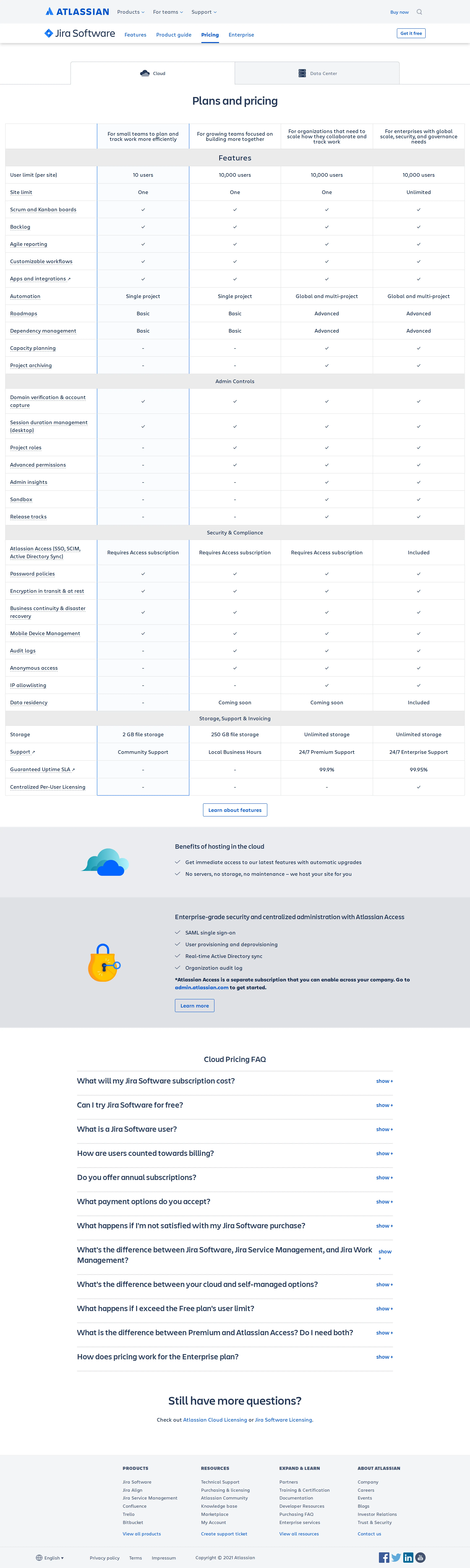
Server sunset announced; an Enterprise column appears
Atlassian announced it would stop selling new self-hosted Server licenses, targeting end-of-sale February 2021 and end-of-support February 2024 — a 380-point, 298-comment Hacker News discussion. Within weeks Jira Cloud's pricing page added a fourth Enterprise column (unlimited sites, included Atlassian Access, data residency).
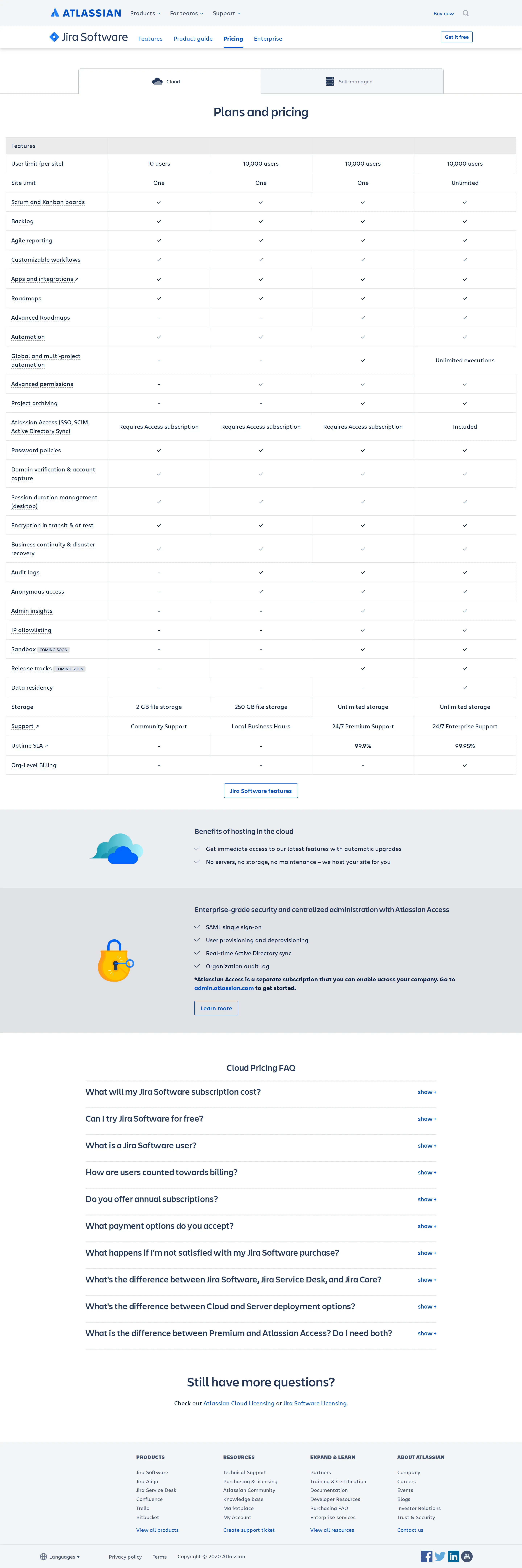
Free/Standard/Premium three-tier ladder replaces the flat model
By September 2020 Jira Cloud had moved to a Free (10 users)/Standard ($7/user avg)/Premium ($14/user avg) three-tier structure; no Enterprise tier existed yet.
Baseline: flat/per-user Cloud pricing, no free tier
Jira Cloud priced at a flat $10/month for up to 10 users and $7/user/month for 11-100 users, with a banded annual price list published up to 2,000 users; no Free tier and no Standard/Premium/Enterprise ladder existed yet.
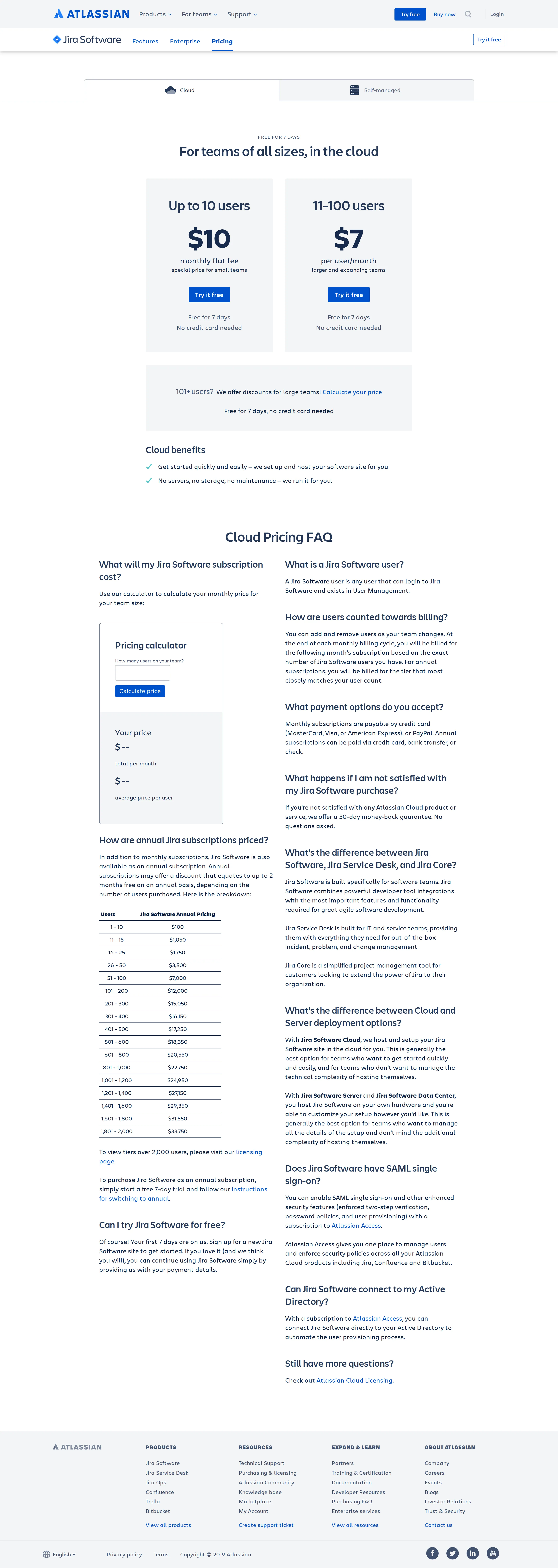
- · Jira Cloud's March 2019 pricing page had no free tier at all — just a $10/month flat fee for up to 10 users and $7/user/month for 11-100 users, years before the Free/Standard/Premium/Enterprise ladder existed.
- · Atlassian runs three genuinely different AI monetization mechanics under one roof: Rovo's core credits are bundled free into seat tiers, Rovo Dev is sold as a separate per-developer seat with credit overage, and Rovo Customer Service is billed purely per AI-resolved conversation.
- · Atlassian discontinued self-hosted Server licenses in 2021 and, in September 2025, announced it will also end life on self-managed Data Center by March 28, 2029 — a self-hosted sunset spanning nearly a decade.
Questions & answers
- How much does Atlassian's Jira cost per user?
- Jira Cloud is Free for up to 10 users, then Standard from about $7.91/user/month and Premium from about $14.54/user/month at typical team sizes — Atlassian publishes banded rates that fall further at higher volumes — and custom-quoted Enterprise billed annually only.
- What are Rovo AI credits and how many do I get?
- Rovo is bundled free into paid Jira, Confluence, and Jira Service Management subscriptions; Standard includes 25 credits per user per month, Premium 70, and Enterprise 150, alongside a separate indexed-object cap for Rovo Search.
- Does Atlassian charge extra for AI features?
- Rovo's core search, chat, and agent credits are bundled at no extra charge into paid plans, but two AI products are billed separately: Rovo Dev (a coding agent) costs $20/developer/month plus $0.01-per-credit overage, and Jira Service Management's Rovo Customer Service virtual agent costs $1 per AI-resolved conversation on Premium/Enterprise.
- Is Atlassian Data Center being discontinued?
- Yes. Atlassian ended new Server licenses in 2021, and in September 2025 announced that self-managed Data Center will fully end of life on March 28, 2029, with new-customer sales ending in phases starting March 2026.
- Has Atlassian raised its prices recently?
- Yes. Atlassian has raised Cloud list prices roughly 5-10% every October since 2023, and raised Data Center list prices by roughly 15-25% in February 2024, February 2025, and February 2026, coinciding with its push to migrate self-hosted customers to Cloud.
- Does Atlassian use my Jira and Confluence data to train its AI?
- As of August 17, 2026, Atlassian collects certain metadata by default to train its AI models across Free, Standard, and Premium tiers with no opt-out; only Enterprise customers can fully decline both metadata and in-app content collection.