AI Summary
About
Bright Data (formerly Luminati Networks) is a web-data platform that sells the full stack of “get public data off the web” tooling: proxy networks (residential, ISP/static-residential, datacenter, and mobile), unblocking and SERP APIs, a managed scraping browser (Browser API), prebuilt and AI-prompt-driven scraper products (Web Scraper API, Scraper Studio, Crawl API), a live data firehose and historical web archive, ready-made datasets, an eCommerce-focused insights product, and fully managed data-acquisition services. It markets itself to 20,000+ customers worldwide and positions around the largest geographic proxy coverage (400M+ residential IPs across 195 countries).
The company has an unusually colorful lineage. It launched in 2014 as Luminati Networks, the B2B arm of the consumer Hola VPN — Hola’s “free VPN” resold its users’ idle bandwidth as residential exit nodes, a model a 296-point 2015 Hacker News thread put under a harsh spotlight. London private-equity fund EMK Capital acquired Luminati out of Hola in 2017 at roughly a $200M valuation, and the business rebranded to Bright Data in March 2021 (shedding the “Luminati”/“Illuminati” association). That history still shapes the product: residential and mobile networks sit behind a KYC compliance gate, and the company markets heavily on “ethical” and “transparent” data sourcing.
The buyer spectrum is wide — individual developers and small scraping shops buying a few GB or IPs pay-as-you-go, mid-market data teams committing to monthly plans, and enterprises negotiating custom volume contracts and managed data acquisition. Increasingly the center of gravity is AI: agent-oriented surfaces (Search & Extract, Agent Browser, an MCP server, a +50PB Web Archive, and LLM-ready data packages) now sit atop the core proxy and scraping infrastructure. That pivot is the growth engine — Bright Data reports crossing roughly $300M ARR in 2025 (up from about $128M in 2024) and targeting ~$400M by mid-2026, with more than 20,000 customers and a stated footprint across most of the top global LLM labs. It is also one of the few scraping vendors to have won in court: Meta’s contract claims were rejected at summary judgment in January 2024, and X Corp’s were dismissed as copyright-preempted in May 2024.
What ties the portfolio together is a consistently usage-based commercial model — but the meter changes per product. Bandwidth-heavy products (rotating residential, Browser API) bill per GB; static-IP products (ISP, datacenter) bill per dedicated IP; request-shaped products (Web Unlocker, SERP, Scraper API, Scraping Functions) bill per 1,000 successful results or page loads; and datasets bill per 1,000 records. This is the defining structural fact of Bright Data’s pricing and the reason a single headline number can’t describe it.
Pricing summary : one platform, four billing meters
Bright Data is usage-based across every product, but with four different value metrics depending on what the product consumes. Each product offers a pay-as-you-go entry point plus committed monthly tiers that lower the per-unit rate in exchange for a minimum monthly commitment and included volume; enterprise contracts are quoted.
- Per-GB (bandwidth): Rotating residential proxies ($8 → $2.50/GB) and, as of this capture, the Browser API on a Free / PAYG ($8/GB) / Scale ($499/mo, slider-adjustable) / Enterprise model.
- Per-IP (dedicated static IPs): ISP proxies ($1.8 → $1.3/IP) and datacenter proxies ($1.40 → $0.90/IP), tiered by IP count (10 → 1,000).
- Per 1,000 requests/results/records/page-loads (Free/Scale ladder): Web Unlocker, SERP API, Web Scraper API, and (newly documented) Scraper Studio each expose a 5,000-unit/month free tier, then $1.5/1k pay-as-you-go, then a single $499/mo Scale tier (~380–384k included, $1.3/1k overage) before Enterprise.
- Per 1,000 requests/page-loads (four-tier ladder): Scraping Functions (IDE) and the newly documented Crawl API keep the older committed ladder — $1.5 → $1.0 per 1k across $499 / $999 / $1,999 monthly tiers.
- Per 1,000 records: Datasets ($2.50/1k base, i.e. $250 per 100k) with refresh-cadence discounts up to 80%.
- Per 1,000 HTML pages (newly documented): Data Firehose ($0.2/1k, live data ≤24hrs old) and Web Archive ($1/1k, historical cached pages 90PB+).
- Per-month subscription (by quote): Bright Insights eCommerce intelligence — both the eCommerce Tracker and Sales & Market Share lines list from $2,000/mo; Managed Services (formerly Managed Data Acquisition) from $1,000/mo (Standard) or $2,500/mo (Strategic Annual), plus a $500 setup fee and $4/1k-request usage rate.
What makes this different is the refusal to flatten everything onto one meter: Bright Data deliberately matches each product to the unit that best tracks its underlying cost (bandwidth for rotating IPs, dedicated IP count for static ones, successful requests for unblocking), which is a textbook example of picking the right value metric per product line. Because committed tiers add a seat-like monthly floor on top of metered overage, the overall shape is closer to a hybrid usage model than to pure pay-as-you-go. It also layers a compliance gate — residential and mobile networks require KYC before use — on top of an otherwise self-serve bandwidth-metered flow.
Pricing by product
The hero grid above summarizes the flagship product lines. The tables below give the full per-tier detail captured from each product’s pricing page on 2026-08-28, plus four additional product lines (Scraper Studio, Crawl API, Data Firehose & Web Archive, Managed Services) whose dedicated pricing pages were newly discovered at this capture. Where a vendor promo was live at capture, the post-discount price is noted; base rates are shown as the authoritative figure.
Proxy Networks — Residential (per GB)
| Tier | Price | Included | Key mechanics |
|---|---|---|---|
| Pay-as-you-go | $8 / GB | No commitment | Highest per-GB rate; switch plans anytime |
| Growth | $7 / GB | $499 billed monthly | Small businesses, moderate usage |
| Business | $6 / GB | $999 billed monthly | Large teams, extensive operations |
| Scale | $5 / GB | $1,999 billed monthly | Enterprises, large-scale operations |
| 1 TB+ | Custom | Contact us | Unlimited scale, premium SLA, 99.99% uptime |
A 50% promo (code RESIGB50) was live at capture, halving the above to $4 / $3.50 / $3 / $2.50 per GB for 3 months. Residential network use requires passing KYC.
Proxy Networks — ISP (static residential, per IP)
| Tier | Price | Included | Key mechanics |
|---|---|---|---|
| 10 IPs | $1.8 / IP | $18 billed monthly | Permanent, non-rotating residential IPs |
| 100 IPs | $1.45 / IP | $145 billed monthly | Teams scaling operations |
| 500 IPs | $1.4 / IP | $700 billed monthly | Large teams |
| 1,000 IPs | $1.3 / IP | $1,300 billed monthly | Enterprise-scale |
| 1,000+ IPs | Custom | Contact us | Custom price per IP |
Proxy Networks — Datacenter (per IP)
| Tier | Price | Included | Key mechanics |
|---|---|---|---|
| 10 IPs | $1.40 / IP | $14 billed monthly | Most cost-effective IP type |
| 100 IPs | $1.0 / IP | $100 billed monthly | Mass crawling of simple sites |
| 500 IPs | $0.95 / IP | $475 billed monthly | Large teams |
| 1,000 IPs | $0.90 / IP | $900 billed monthly | Enterprise-scale |
| 1,000+ IPs | Custom | Contact us | Custom price per IP |
Mobile proxies are referenced in the network FAQ (3G/4G/5G rotating IPs) but no public per-unit price is shown on the proxy-network page; mobile, like residential, requires KYC. Recorded as unknown pending a capturable surface.
Web Unlocker API & SERP API (per 1,000 results)
Both APIs were restructured by the 2026-07-14 capture from a four-tier committed ladder to a simpler Free / PAYG / Scale / Enterprise model (the same shape as the Web Scraper API), adding a free tier and dropping the old $1.1 and $1.0 committed rates:
| Tier | Price | Included | Key mechanics |
|---|---|---|---|
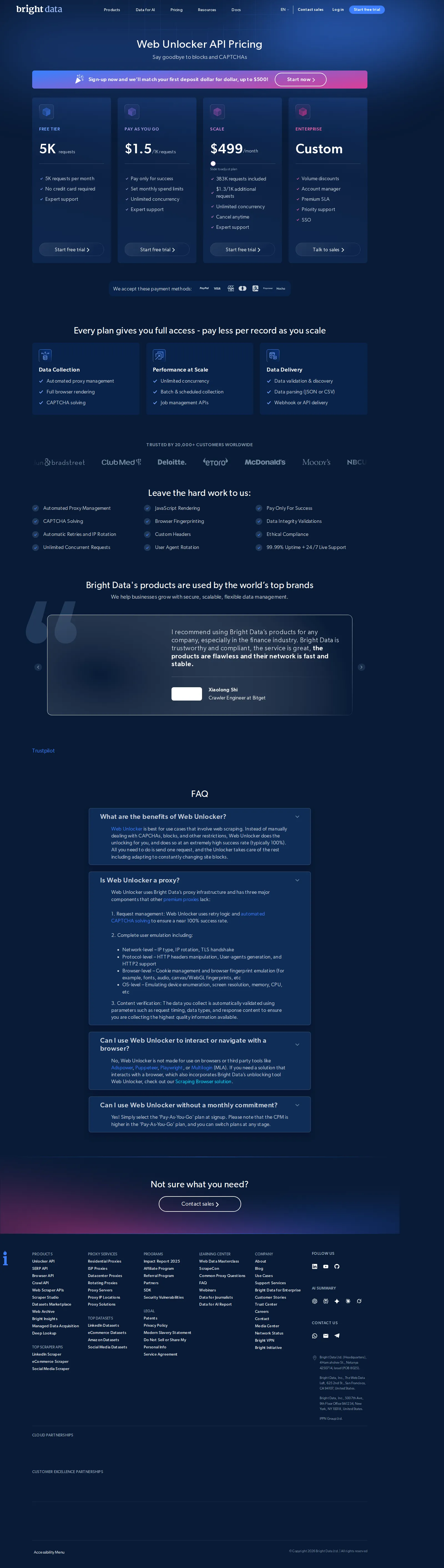
| Free tier | $0 | 5,000 results / month | No credit card required; expert support |
| Pay-as-you-go | $1.5 / 1k results | No commitment | Pay only for success; set monthly spend limits |
| Scale | $499 / mo | ~380k results included (383k Unlocker, 380k SERP) | $1.3/1k additional results; unlimited concurrency; cancel anytime |
| Enterprise | Custom | Contact us | Volume discounts, account manager, premium SLA, SSO |
Scraping Functions (IDE, per 1,000 page loads)
| Tier | Price | Included | Key mechanics |
|---|---|---|---|
| Pay-as-you-go | $1.5 / 1k page loads | No commitment | Serverless scraper functions |
| Growth | $1.3 / 1k page loads | 380k page loads, $499/mo | Teams scaling operations |
| Business | $1.1 / 1k page loads | 900k page loads, $999/mo | Large teams |
| Scale | $1.0 / 1k page loads | 2M page loads, $1,999/mo | Critical operations |
| Enterprise | Custom | Contact us | SSO, audit logs, tailored onboarding |
Web Scraper API (per 1,000 records)
| Tier | Price | Included | Key mechanics |
|---|---|---|---|
| Free tier | $0 | 5,000 records / month | No credit card required; expert support |
| Pay-as-you-go | $1.5 / 1k record | Pay only for success | Unlimited concurrency, spend limits |
| Scale | $499 / mo | 384,000 records included | $1.3 / 1k additional records; cancel anytime |
| Enterprise | Custom | Volume discounts | Account manager, premium SLA, SSO |
By the 2026-07-14 capture the old “1,000 records, one-time, 1-week trial” was replaced by a recurring 5,000-records/month free tier. A 25% Scraper API promo (code APIS25) for 3 months was live at capture (e.g. $1 → $0.75/1k record on the platform overview).
Browser API / Scraping Browser (per GB)
As of the 2026-08-28 capture, Browser API was restructured off its fixed four-tier ladder (Pay-as-you-go / Growth / Business / Scale at $8 → $5/GB across $499/$999/$1,999) onto the same Free / PAYG / Scale / Enterprise shape now used by the request-metered APIs:
| Tier | Price | Included | Key mechanics |
|---|---|---|---|
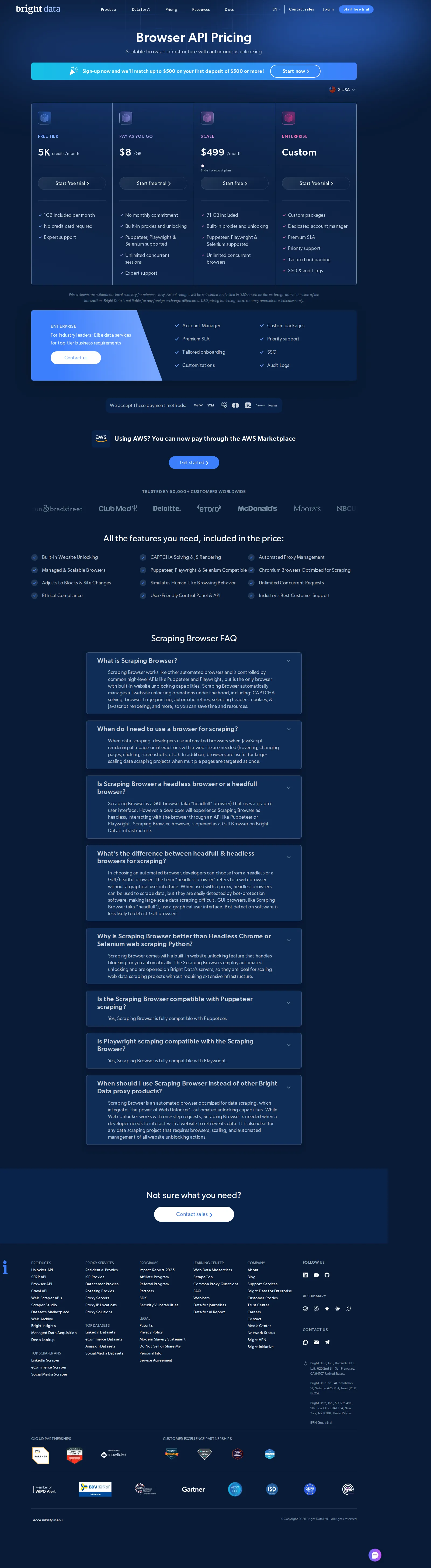
| Free tier | $0 | 5K credits/month (1GB included) | No credit card required; expert support |
| Pay-as-you-go | $8 / GB | No commitment | Built-in proxies + unlocking; Puppeteer/Playwright/Selenium; unlimited concurrent sessions |
| Scale | $499 / mo | 71 GB included by default | ”Slide to adjust plan” — a slider raises the commitment; unlimited concurrent browsers |
| Enterprise | Custom | Contact us | Account manager, SLA, priority support, tailored onboarding, SSO & audit logs |
The nav pricing menu still lists Browser API “starts from $5/GB,” indicating the old $5/GB floor remains reachable at the top of the Scale slider — but the specific $6/GB and $999/$1,999 breakpoints are no longer statically displayed on the page, so the exact intermediate rungs are recorded as unknown.
Datasets (per 1,000 records)
| Tier | Price | Included | Key mechanics |
|---|---|---|---|
| Base rate | $2.50 / 1k records | $250 per 100k records | Clean, validated, JSON/CSV/Parquet |
| Biannual refresh | 25% off | Subscription | Lower per-record cost for fresher data |
| Quarterly refresh | 50% off | Subscription | — |
| Monthly refresh | 80% off | Subscription | Cheapest per-record at highest cadence |
Bright Insights (eCommerce intelligence, per month)
| Tier | Price | Included | Key mechanics |
|---|---|---|---|
| eCommerce Tracker | from $2,000 / mo | Get a quote | Monitor products, prices, promotions, rankings |
| Sales & Market Share | from $2,000 / mo | Get a quote | Market size, weekly sales trends, segments |
Bright Insights list prices rose sharply by the 2026-07-14 capture: the eCommerce Tracker from $250/mo and Sales & Market Share from $400/mo both now start from $2,000/mo (each still get-a-quote, with unlimited users and a dedicated CSM).
Scraper Studio (AI-prompt scraper builder, per 1,000 page loads)
Newly discovered pricing surface at brightdata.com/pricing/web-scraper/studio — an AI-prompt-driven scraper generator (“describe the data in plain English, and the AI instantly generates a ready-to-run scraper”). Uses the same Free / PAYG / Scale / Enterprise ladder as Web Unlocker, SERP, and Web Scraper API.
| Tier | Price | Included | Key mechanics |
|---|---|---|---|
| Free tier | $0 | 5K page loads / month | No credit card required; expert support |
| Pay-as-you-go | $1.5 / 1k page loads | No commitment | Pay only for success; set monthly spend limits |
| Scale | $499 / mo | 383K page loads included | $1.3/1k additional page loads; slider-adjustable; cancel anytime |
| Enterprise | Custom | Contact us | Volume discounts, account manager, premium SLA, SSO |
Crawl API (per 1,000 requests)
Newly discovered pricing surface at brightdata.com/pricing/crawl-api — a cloud-based crawler product distinct from Web Scraper API/Scraper Studio. Keeps the older four-tier committed ladder (the same shape Web Unlocker/SERP/Web Scraper API used before their July 2026 restructure).
| Tier | Price | Included | Key mechanics |
|---|---|---|---|
| Pay-as-you-go | $1.5 / 1k requests | No commitment | Pay-as-you-go without a monthly commitment |
| Growth | $1.3 / 1k requests | 380K requests, $499/mo | Tailored for teams scaling their operations |
| Business | $1.1 / 1k requests | 900K requests, $999/mo | Designed for large teams |
| Scale | $1.0 / 1k requests | 2M requests, $1,999/mo | Advanced support and features for critical operations |
| Enterprise | Custom | Contact us | Account manager, premium SLA, tailored onboarding, custom packages, priority support, SSO, customizations, audit logs |
Data Firehose & Web Archive (per 1,000 HTML pages)
Newly discovered pricing surface at brightdata.com/pricing/archive-api, pairing two related products on one card: a live data stream and a historical/cached-page archive (90PB+ of cached pages).
| Product | Price | Best for | Key mechanics |
|---|---|---|---|
| Data Firehose (last 24 hrs) | $0.2 / 1k HTMLs | Continuously refreshed data pipelines | Fresh data up to 24 hours old; ~1 hour delivery lag on snapshot size; delivery via Amazon S3, Azure Blob Storage, Webhook |
| Web Archive (over 24 hrs) | $1 / 1k HTMLs | Historical data at scale | Minimum 2-day delivery lag; API access to 624B+ pages / 90PB+ cache; advanced filtering by domain, category, language, countries |
Volume discounts available for large data volumes, long-term commitments, or multiple scraper projects.
Managed Services (per project, formerly “Managed Data Acquisition”)
Newly discovered pricing surface at brightdata.com/pricing/managed-services. Prior facts recorded this line from the platform overview as “from $1,500/mo”; the dedicated pricing page now shows a two-tier structure with usage and setup components — a materially different (and more detailed) price than previously documented.
| Tier | Price | Included | Key mechanics |
|---|---|---|---|
| Standard Project | from $1,000 / mo | 1 data scraper, 250,000 data records, scraper maintenance, 24/7 support, tailored onboarding | $500 one-time setup per standard scraper; $4/1k requests usage; $1,000 minimum monthly spend |
| Strategic Annual Project | from $2,500 / mo | Data Concierge Service, expert recommendations, dedicated project manager, proactive issue monitoring, ongoing automated QA | $500 one-time setup per standard scraper; $4/1k requests usage; $2,500 minimum monthly spend starting from the 2nd month |
Sales motions across products: PLG / self-serve for all PAYG and committed monthly tiers (proxies, unlocker, SERP, scraper, scraper studio, functions, browser, crawl API, datasets); sales-led for 1 TB+ proxy contracts, every product’s Enterprise tier, Bright Insights, and Managed Services (from $1,000/mo standard, $2,500/mo strategic-annual).
Hidden costs : minimum commitments and KYC gating
The published per-unit rates are honest, but the real bill is shaped by three things the pricing cards underplay: the minimum monthly commitment on every discounted tier (it is a floor, not a rebate), the fact that bandwidth is counted on total bytes — request headers + payload + response headers + response data, not just the useful response, and the blended-meter problem of running several products at once. Two worked examples make the floor visible.
Archetype 1 — a mid-market scraping team. A data team commits to the Residential Business tier (to get $6/GB) and adds a Web Unlocker Growth plan for a separate JS-heavy target, then runs a monthly datasets pull on top.
| Line item | Monthly cost |
|---|---|
| Residential proxies — Business tier minimum commitment | $999 |
| Residential overage — 40 GB beyond the included pool @ $6/GB | $240 |
| Web Unlocker — Growth tier (380k results included) | $499 |
| Web Unlocker overage — 200k results @ $1.3/1k | $260 |
| Datasets — 100k records, one-time pull @ $2.50/1k | $250 |
| Total | $2,248 / mo |
The lesson: the two commitment floors alone are $1,498/mo before a single GB of useful overage — so a team that under-uses one product still pays for the discount it signed up for. Choosing PAYG ($8/GB, $1.5/1k) instead would have raised the marginal rate but removed the floor; the break-even is the whole game.
Archetype 2 — an AI agent product at scale. An agent company runs the Browser API for live page rendering and the SERP API for grounding, both on the Scale tier.
| Line item | Monthly cost |
|---|---|
| Browser API — Scale tier minimum (399 GB included) | $1,999 |
| Browser API overage — 150 GB @ $5/GB | $750 |
| SERP API — Scale tier (2M results included) | $1,999 |
| SERP overage — 1M results @ $1.0/1k | $1,000 |
| Total | $5,748 / mo |
Here the lesson is bandwidth accounting: Browser API bills every byte the headless browser pulls (images, fonts, trackers), so the effective GB consumed is far higher than the HTML a scraper would fetch — making the Browser API the most expensive way to read a page unless full rendering is genuinely needed. This is the same “meter you don’t see until the invoice” risk covered in our guide to setting usage thresholds and spend alerts.
Want to estimate your own Bright Data bill? Use the Bright Data pricing calculator to model your monthly cost across proxy GB, per-IP allotments, and per-1k request volumes.
Pricing evolution : from Luminati proxies to AI-ready data
Bright Data’s pricing story is less about frequent rate moves and more about three structural shifts: the Hola→Luminati→Bright Data identity arc, the datasets model flipping from page-load quotes to a self-serve refresh dial, and the 2024–2026 reorientation around AI buyers. The hub pricing page (brightdata.com/pricing) is a product directory and carries no per-GB rates, so the dated price points below come from the per-product surfaces and Wayback snapshots of the datasets page; the proxy-network and scraper pricing pages were not preserved in the archive, so their historical rates are recorded as unknown rather than guessed.
Cadence
| Quarter | Price changes | Product / SKU additions | Notes |
|---|---|---|---|
| 2021 Q1 | 0 | 0 | Luminati Networks rebrands to Bright Data (identity, not pricing). |
| 2023 Q1 | unknown | 0 | Datasets shown “starting from $0.001/record” ($1/1k), priced by page-loads; Custom Datasets from $1,000/mo or $1,500 one-time. |
| 2024 Q2 | unknown | 0 | Hub page is a product directory; residential network advertised at 72M+ IPs, “20,000+ customers”. |
| 2026 Q2 | unknown | several | AI-era lineup: 400M+ residential IPs, Discover/Browser APIs, Scraper Studio, +50PB Web Archive, Deep Lookup, Agent Browser; datasets base now $2.50/1k; 50% residential + 25% Scraper promos live. |
| 2026 Q3 | 4 | 4 | Web Unlocker / SERP / Web Scraper API restructured to Free / PAYG / Scale / Enterprise (Jul 14) — new recurring 5,000-result/mo free tier; the $1.1 and $1.0 committed rates dropped. Bright Insights eCommerce Tracker $250→$2,000/mo and Sales & Market Share $400→$2,000/mo (Jul 14). Browser API drops its fixed $8→$5/GB four-tier ladder for the same Free/PAYG/Scale-slider/Enterprise shape (Aug 28). Managed Services (formerly Managed Data Acquisition) gets a dedicated page replacing the single $1,500/mo figure with a two-tier $1,000/$2,500-mo structure, a $500 setup fee, and $4/1k usage (Aug 28). Four pricing surfaces captured for the first time: Scraper Studio, Crawl API, Data Firehose, Web Archive (Aug 28). |
Tracked range: 2021-03 to 2026-08. “unknown” marks quarters where the price-bearing surface (proxy-network, scraper pages) was not preserved in the Wayback archive; only the datasets page and the products hub were captured, so per-GB and per-IP rate history could not be independently verified.
Notable changes
- 2015-05 — A 296-point Hacker News thread (2015-05-27) exposes that Hola VPN resells user bandwidth as exit nodes through its sister company Luminati — the origin of the residential network. Contemporary reporting put early residential bandwidth near $20/GB.
- 2017-08 — EMK Capital acquires Luminati out of Hola at roughly a $200M valuation, separating the B2B proxy business from the consumer VPN.
- 2021-03 — Luminati Networks rebrands to Bright Data, dropping the “Illuminati”-adjacent name and leaning into “web transparency” positioning.
- 2023-02 — Wayback snapshot of the datasets page shows “Starting from $0.001/record,” with price set by page-loads; today’s self-serve base is $2.50/1k records on a refresh-cadence dial — a 2.5× base increase and a model change.
- 2024-01 / 2024-05 — Bright Data wins the Meta scraping suit at summary judgment (Judge Chen, N.D. Cal.) and sees X Corp’s suit dismissed (Judge Alsup, N.D. Cal.) — rulings that legitimized the public-data-scraping model it sells (see below).
- 2025–2026 — Reported ARR crosses ~$300M (from ~$128M in 2024), powered by AI labs; product lineup reorganizes around agentic data access and the residential network scales from 72M to 400M+ IPs.
- 2026-07 — The three request-metered products (Web Unlocker, SERP, Web Scraper API) are unified onto a Free / PAYG / Scale / Enterprise ladder. A recurring 5,000-result/month free tier (no card) replaces the old one-week trial, and the intermediate $1.1 and $1.0 committed rates are removed — so the lowest publicly listed marginal rate on these products is now $1.3/1k (Scale-tier overage). The trade is deliberate: Bright Data drops granular volume discounting in favor of a simpler, PLG-shaped funnel with a genuine always-on free tier, betting acquisition breadth matters more than a fourth discount rung.
- 2026-07 — Bright Insights list prices jump 5–8×: the eCommerce Tracker (from $250/mo) and Sales & Market Share (from $400/mo) both now start from $2,000/mo. The move repositions the eCommerce-intelligence line from an SMB-accessible entry point to an enterprise-tier product — a sharp contrast to the same-week simplification of the self-serve APIs, and a signal that Insights is being steered toward larger, sales-led accounts rather than the developer base the meters serve.
- 2026-08-28 — Browser API is pulled off its fixed four-tier ladder ($8 → $7 → $6 → $5/GB across $499/$999/$1,999) and rebuilt on the same Free (5,000 credits/mo, ~1GB) / PAYG ($8/GB) / Scale ($499/mo, slider-adjustable) / Enterprise shape already used by the request-metered APIs. It is the fourth product line in five months to converge on this packaging and the last of the flagship self-serve products to trade discrete committed tiers for a continuous slider — the site nav’s lingering “$5/GB” reference suggests the old floor rate is still reachable, just no longer statically priced.
- 2026-08-28 — Bright Data documents four pricing surfaces for the first time — Scraper Studio, Crawl API, Data Firehose, and Web Archive — and publishes a dedicated Managed Services page (formerly “Managed Data Acquisition”) that replaces the single “from $1,500/mo” figure with a two-tier $1,000/mo (Standard) or $2,500/mo (Strategic Annual) structure, a $500 one-time setup fee, and a $4/1k-request usage rate. The company’s tracked pricing surface count grows from 11 to 15 pages in this pass alone, widening the multi-meter footprint the rest of this page’s analysis is built around.
The scraping lawsuits in detail
Bright Data is unusual in the corpus for having a legal moat that doubles as marketing. In 2023 both Meta and X Corp sued it over scraping their platforms.
- Meta Platforms v. Bright Data — In January 2024, Judge Edward M. Chen (N.D. Cal.) granted Bright Data summary judgment on Meta’s breach-of-contract claims, holding that Meta’s terms bind only logged-in registered users and that scraping public, logged-out data fell outside them. Meta dropped the remainder of the case in February 2024.
- X Corp v. Bright Data — In May 2024, Judge William Alsup (N.D. Cal.) dismissed X’s claims, finding them preempted by the Copyright Act and warning that letting platforms over-control public data risks “information monopolies.”
Both outcomes reinforce Bright Data’s pricing thesis: if scraping public web data is legally defensible, then selling the infrastructure to do it at scale is a durable, meterable business — which is exactly why the company prices each collection surface on its own success-based unit.
What’s unique : a different meter for every product
Four simultaneous billing meters, one platform. Most usage-based vendors pick a single value metric and stretch it across the catalog. Bright Data does the opposite: rotating residential and the Browser API bill per GB, static ISP and datacenter proxies bill per dedicated IP, the unblocking/search/scraper APIs bill per 1,000 successful results, and datasets bill per 1,000 records. Each meter tracks the actual cost driver of that product, so margins stay legible even though the headline price list reads like four different companies. It is the cleanest multi-meter example in the corpus.
KYC compliance gating inside a self-serve funnel. Residential and mobile networks can’t be switched on until the account passes a know-your-customer review — sometimes including an intro video call. Embedding a manual compliance checkpoint in an otherwise instant, card-on-file usage product is rare, and it is a direct legacy of the Hola/Luminati origin and the “ethical sourcing” positioning the company adopted post-rebrand.
Refresh cadence as a discount axis. Datasets invert the usual “fresher = pricier” intuition: a One-time pull is the most expensive per record, and committing to Monthly refresh discounts the per-record rate by 80%. The cadence dial turns a subscription commitment into the lever that lowers unit price — a packaging idea more pricing teams could borrow, and one we explore in the usage-based pricing models overview.
“Pay only for success” on the request meters. Web Unlocker, SERP, and Web Scraper bill on successful results, not attempts — a block, CAPTCHA, or failed fetch isn’t charged. That outcome alignment is a real differentiator against proxy resellers that bill all traffic regardless of block rate, and it is the same logic behind the broader move toward outcome-based pricing in AI.
A recurring free tier layered under a deposit-match incentive. Since July 2026 the Web Unlocker, SERP, and Web Scraper APIs have carried a recurring 5,000-unit/month free tier with no credit card — a genuine always-on on-ramp that replaced the old one-week, 1,000-record trial. By the 2026-08-28 capture the pattern had spread to two more lines — Browser API (5,000 credits/mo, ~1GB) and the newly documented Scraper Studio (5,000 page loads/mo) — so five of Bright Data’s self-serve product lines now start at $0. On top of it, Bright Data matches a first deposit dollar-for-dollar up to $500 in usable credits. Both are usage-shaped acquisition levers — free quota and matched capital that only convert to revenue once the buyer runs traffic at paying scale.
Strengths & weaknesses
| Strengths | Weaknesses |
|---|---|
| Every product has a transparent PAYG entry point with public per-unit pricing | Fifteen pricing pages across multiple meters (GB, IP, request, record, page, month) as of the 2026-08-28 capture make cross-product cost comparison and budgeting hard |
| Per-product meters track real cost drivers (bandwidth vs IP vs request) | Minimum monthly commitments on committed tiers create floor costs |
| Broadest proxy coverage (400M+ IPs, 195 countries) | Residential/mobile KYC adds friction to an otherwise self-serve signup |
| Volume tiers materially cut unit rates (residential $8 → $2.50/GB) | Mobile proxy pricing is not publicly listed (gated) |
Billing UX : spend limits, auto-recharge, and commitment top-ups
- Pay-as-you-go vs minimum monthly commitment — every product offers a no-commitment PAYG plan; committed tiers ($499 / $999 / $1,999) carry a minimum monthly account commitment billed on the 1st of each month.
- Usage spend limits per zone — under each proxy zone, a “Usage spend limit” column lets you cap daily usage by bandwidth (bytes) or money spent ($); the zone auto-suspends on reaching the cap (recalculated every 15 minutes).
- Auto-recharge — configurable balance top-up that triggers when available balance drops below 85% (or at 25% of a pre-set amount), to prevent suspension.
- Mid-month proration — joining mid-month prorates the first minimum commitment to the share of the month the account was active.
- Deposit-match promotion — first-deposit match, dollar-for-dollar up to $500, applied as usable credits.
- Free tier — as of the 2026-07-14 capture the Web Scraper API, Web Unlocker, and SERP API each expose a recurring free tier of 5,000 records/results per month with no credit card required (replacing the older one-week, 1,000-record one-time trial).
- Datasets refresh dial — a refresh-rate selector (One-time / Biannual / Quarterly / Monthly) and a records slider drive a live total-price calculator; a site-wide banner (“New promotion! 80% off monthly subscription plans”) highlights the Monthly-refresh discount rung as of the 2026-08-28 capture.
- Scale-tier slider (“Slide to adjust plan”) — on Browser API and Scraper Studio, the Scale card’s commitment/price is set by a slider rather than fixed discrete tiers (default: $499/mo).
- Payment methods — PayPal, Payoneer, Alipay, Google Pay, wire transfer, credit card, plus AWS Marketplace and Azure billing.
- Managed Services setup fee — a $500 one-time setup charge per standard scraper is billed in addition to the monthly minimum and $4/1k-request usage rate.
Strategic wins : matching meter to value
1. A purpose-built meter for each product
Bright Data bills bandwidth-heavy rotating proxies per GB, static IPs per dedicated IP, unblocking/search APIs per 1,000 successful results, and datasets per 1,000 records. Each meter tracks the underlying cost driver of that product, which keeps margins predictable and prices defensible — a clean illustration of the value-metric problem solved one product at a time rather than forced onto a single unit.
2. A PAYG on-ramp under every product
Every product exposes a no-commitment pay-as-you-go rate before any committed tier, so a developer can start at $8/GB or $1.5/1k requests without sales contact — and, since the July 2026 restructure and its August 28 extension to Browser API and Scraper Studio, at $0 on five product lines’ recurring free tiers (5,000 results/records/page-loads/credits per month). This lowers acquisition friction and lets usage prove value before a buyer commits to a $499+ monthly floor.
3. “Pay only for success” framing on request-based APIs
Web Unlocker, SERP, and Web Scraper bill only on successful results/records, not attempts. Charging for outcomes rather than effort de-risks the buy and differentiates against proxy resellers that bill all traffic regardless of block rate.
Areas to improve : cross-product cost legibility
1. Make blended cross-product cost estimable
With the 2026-08-28 capture bringing the tracked surface count to 15 pricing pages across meters for GB, IP, request, record, page-load, HTML page, and monthly subscription, a buyer combining residential GB, Web Unlocker requests, and a datasets subscription — let alone a fourth or fifth product — cannot easily forecast a single monthly bill. A unified, public multi-product cost estimator (or a clearer “what a typical stack costs” worked example) would reduce pre-purchase uncertainty, and the gap only widens as Bright Data adds pricing surfaces faster than it adds cross-product tooling.
2. Publish mobile-proxy pricing or label the gate clearly
Mobile proxies are referenced in the FAQ but carry no public per-unit price on the proxy-network page, forcing a contact-sales detour. Either a public starting rate or an explicit “KYC-gated, contact us” card would set expectations instead of leaving the meter invisible.
3. Surface minimum-commitment floors earlier
The committed tiers ($499 / $999 / $1,999) are minimum monthly commitments, not just discounts, with mid-month proration and top-up mechanics buried in the FAQ. Foregrounding the floor cost on each pricing card would prevent surprise at the first invoice.
Monetization stack & signals : how Bright Data builds & buys its revenue engine
Buys 0 Builds 1
Bright Data builds the real-time meter behind its own per-GB and per-1k-request prices in-house: MB-precise bandwidth accounting, per-zone spend limits on a 15-minute loop, and balance-deduct auto-recharge — its docs name no third-party meter or billing vendor (Metronome/Orb/Stripe Billing).
Signals reviewed · derived from product docs
Key takeaways
- Match the meter to the cost driver, even if it means many meters. Bright Data runs at least five value metrics at once — per-GB, per-IP, per-1k-result, per-1k-record, and, per the 2026-08-28 capture’s newly documented Data Firehose/Web Archive pages, per-1k-HTML-page — because each tracks a genuinely different cost. The clarity-vs-simplicity tradeoff is real, but a meter that mirrors cost keeps margins defensible — see our guide to choosing the right usage metric.
- A committed tier is a floor, not a discount — say so. The $499/$999/$1,999 plans are minimum monthly commitments with proration and top-up rules. Teams that surface “lower rate” without surfacing “minimum spend” set buyers up for invoice surprise; foreground the floor on the card.
- Account for the bytes the buyer can’t see. Bandwidth is billed on full request+response, and the Browser API bills every asset a headless browser loads. Whenever the meter counts more than the “useful” output, the pricing page should teach the counting rule, or the first invoice will.
- Outcome-based billing is a competitive wedge, not just fairness. “Pay only for successful results” both de-risks the buy and structurally beats resellers who bill failed traffic. Charging for outcomes is a positioning move as much as a packaging one.
- Legal defensibility can be a pricing asset. By winning the Meta and X scraping suits, Bright Data turned a regulatory risk into a moat — its prices are credible precisely because the activity they meter has been tested in court. Trust and compliance posture (why finance teams care) are part of the price.
UBP implications
- Per-product value metrics beat a forced-uniform meter for multi-product platforms. Bright Data shows you can run several meters coherently if each maps to a real cost — the cost to buyers is forecasting complexity, which a calculator or worked examples can absorb. The lesson generalizes to any vendor with structurally different product lines.
- Commitment floors are the quiet bridge from pure-usage to hybrid. Layering minimum monthly commitments under metered overage converts “pure pay-as-you-go” into a hybrid model with predictable revenue — useful for vendors who need both PLG on-ramps and forecastable ARR.
- As AI agents become the buyer, success-metered access becomes the unit of value. Bright Data’s pivot to agentic surfaces (Search & Extract, Agent Browser, per-1k results) shows the meter that matters for AI agents is successful data acquisitions, not seats or flat subscriptions — a signal for anyone pricing infrastructure that agents consume.
Sources
- Bright Data — Products pricing overview (accessed 2026-07-23)
- Bright Data — Datasets pricing (accessed 2026-07-23)
- Bright Data — Bright Insights pricing (accessed 2026-07-23)
- Bright Data — Proxy Networks pricing (residential / ISP / datacenter tabs) (accessed 2026-07-23)
- Bright Data — Browser API / Scraping Browser pricing (accessed 2026-08-28)
- Bright Data — SERP API pricing (accessed 2026-07-23)
- Bright Data — Web Scraper API pricing (accessed 2026-07-23)
- Bright Data — Scraping Functions (IDE) pricing (accessed 2026-07-23)
- Bright Data — Web Unlocker API pricing (accessed 2026-07-23)
- Bright Data — Scraper Studio pricing (accessed 2026-08-28)
- Bright Data — Crawl API pricing (accessed 2026-08-28)
- Bright Data — Data Firehose & Web Archive pricing (accessed 2026-08-28)
- Bright Data — Managed Services pricing (accessed 2026-08-28)
- Bright Data — Why we changed our name from Luminati Networks to Bright Data (accessed 2026-07-23)
- Bright Data docs — Billing & pricing FAQs (recurring 5,000/mo free tier; MB-precise metering) (accessed 2026-07-23)
- Bright Data docs — Billing (minimum monthly commitment, mid-month proration, 85% auto-recharge, $500 deposit match) (accessed 2026-07-23; re-confirmed as independent second source 2026-08-28)
- Proxyway — Bright Data review (independent third-party pricing cross-check for residential/ISP/datacenter proxy rates) (accessed 2026-08-28)
Bottom line
Bright Data runs one of the clearest examples of per-product value-metric selection in the corpus: bandwidth for rotating proxies, dedicated IPs for static ones, successful requests for unblocking, records for datasets, and — per the 2026-08-28 capture — HTML pages for its newly documented data-firehose and archive products, each metered where the cost actually lives. The trade-off is that no single number describes the platform, and budgeting means tracking five-plus meters across fifteen pricing pages at once. See the rest of the Blueprint corpus for how peers handle multi-product usage pricing.
Pricing timeline : Major events on a vertical axis
Each milestone below corresponds to a public pricing change, product launch, or material adjustment. Major events use a filled marker; minor adjustments use a faded one.
Browser API restructured to Free/Scale-slider; Managed Services, Crawl API, Scraper Studio, and Web Archive pricing newly documented
Browser API dropped its fixed $8→$7→$6→$5/GB, $499/$999/$1,999 four-tier ladder for a Free (5K credits/mo) / PAYG ($8/GB) / Scale ($499/mo, slider-adjustable) / Enterprise model — the same shape already used by the request-metered APIs. Four additional pricing pages were found and captured for the first time: Scraper Studio (AI-prompt scraper builder, same Free/PAYG/Scale ladder as Web Scraper API), Crawl API ($1.5→$1.0/1k requests, four-tier ladder), Data Firehose & Web Archive ($0.2/1k HTML live vs $1/1k HTML archived), and Managed Services (formerly 'Managed Data Acquisition,' now a two-tier $1,000/mo Standard or $2,500/mo Strategic-Annual structure plus a $500 setup fee and $4/1k-request usage, versus the single $1,500/mo figure previously sourced from the platform overview). All other per-GB/per-IP/per-1k rates (residential, ISP, datacenter, Web Unlocker, SERP, Web Scraper API, Scraping Functions, Datasets, Bright Insights) were unchanged.
API tiers simplified to Free/Scale; Bright Insights list price 5–8×'d
Web Unlocker, SERP API, and Web Scraper API were restructured from a four-tier committed ladder to a Free / PAYG / Scale / Enterprise model: a new recurring 5,000-results/month free tier (no card), $1.5/1k PAYG, and a single $499/mo Scale tier (~380–384k included, $1.3/1k overage) — dropping the old $1.1 and $1.0 committed rates. Separately, Bright Insights list prices jumped: eCommerce Tracker from $250→$2,000/mo and Sales & Market Share from $400→$2,000/mo. Proxy per-GB/per-IP rates, Scraping Functions, Browser API, and Datasets were unchanged; 50% residential (RESIGB50) and 25% Scraper (APIS25) promos still live.
Per-product pricing snapshot
Proxies per-GB (residential $8→$2.50/GB) and per-IP (ISP $1.8→$1.3, datacenter $1.40→$0.90); Web Unlocker / SERP / Scraping Functions per-1k results at $1.5→$1.00; Browser API $8→$5/GB; Web Scraper API $1.5/1k records PAYG with a $499/mo Scale tier; Datasets from $2.50/1k records; Bright Insights from $250–$400/mo. A 50% residential promo and 25% Scraper API promo were live at capture.
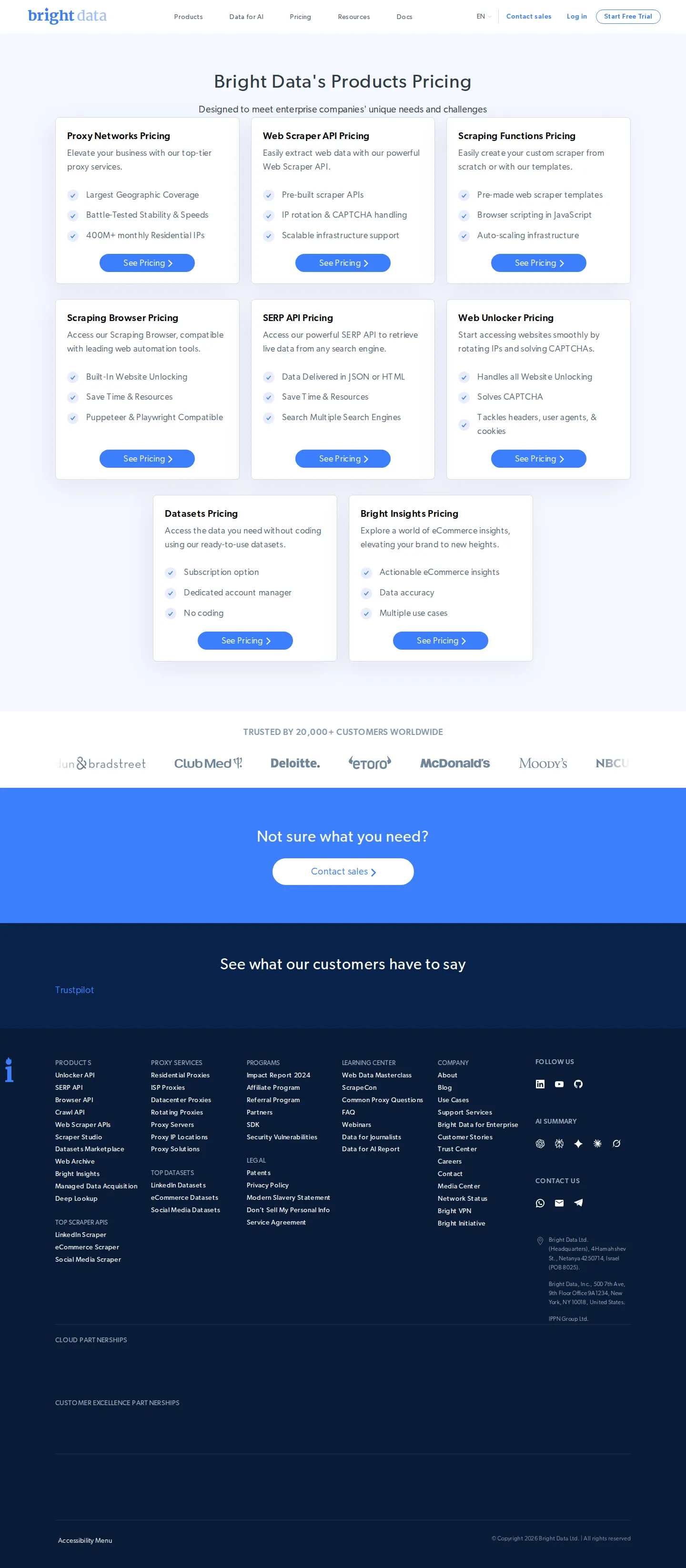
AI-data pivot: 400M+ IPs, agentic surfaces, 50% residential promo
By the 2026-05-01 snapshot the hub advertises 400M+ residential IPs (up from 72M in 2024) and a reorganized lineup oriented around AI: Discover API, Browser API, Scraper Studio, a +50PB Web Archive, Deep Lookup, Agent Browser, Search & Extract, and Data-for-AI packages (incl. video feeds for VLA/robotics). A '50% OFF' residential promo runs alongside.
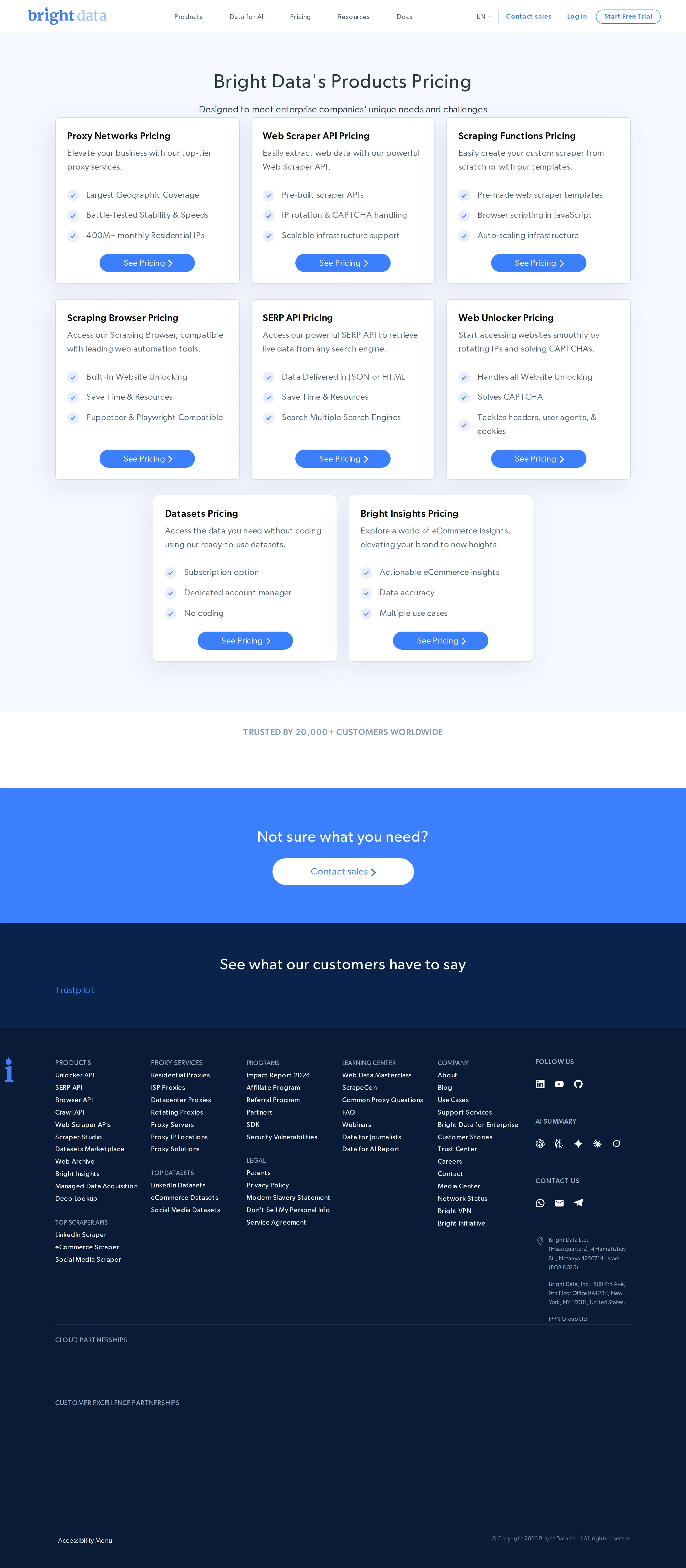
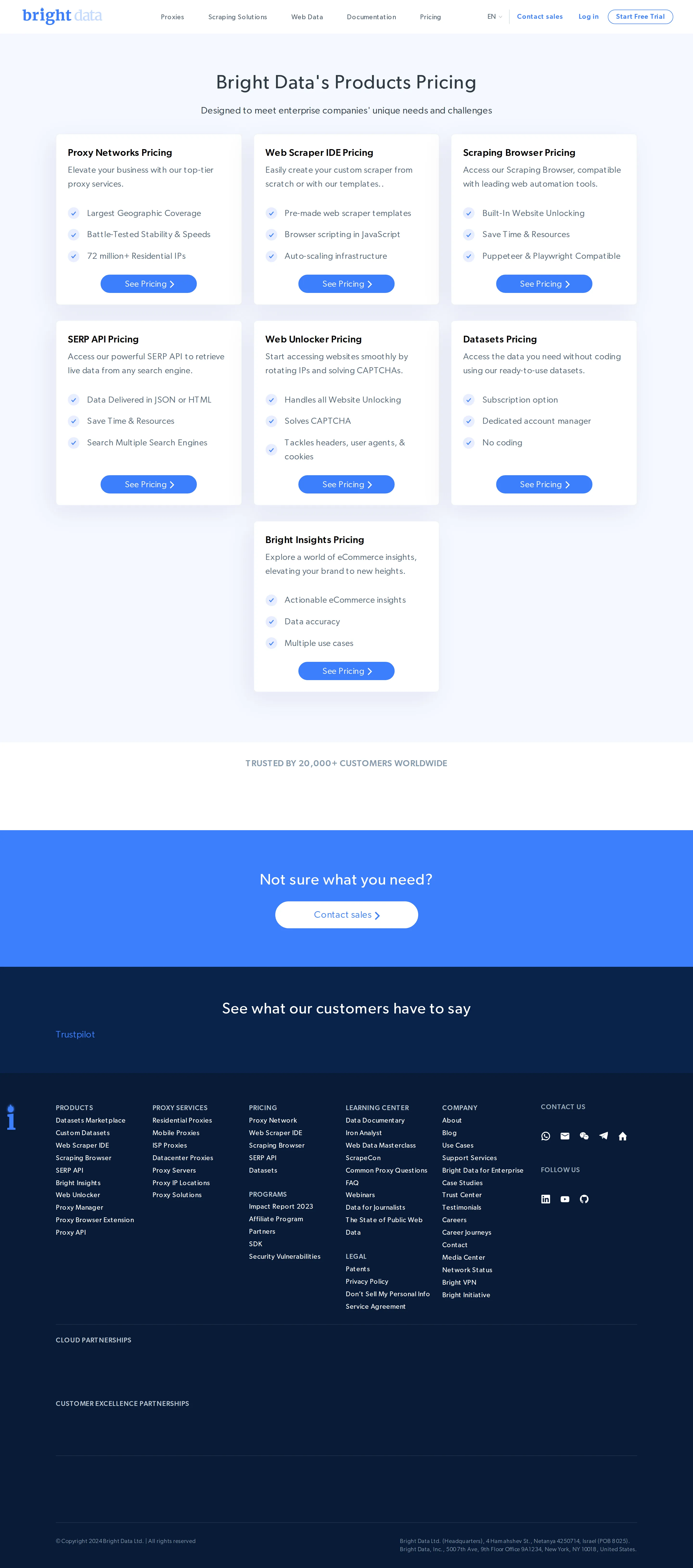
Products-hub pricing page; 72M residential IPs
The brightdata.com/pricing hub (2024-06-07 snapshot) is a product directory linking out to per-product pricing — no per-GB rates on the hub itself. Residential network advertised at 72M+ IPs; '20,000+ customers worldwide.'
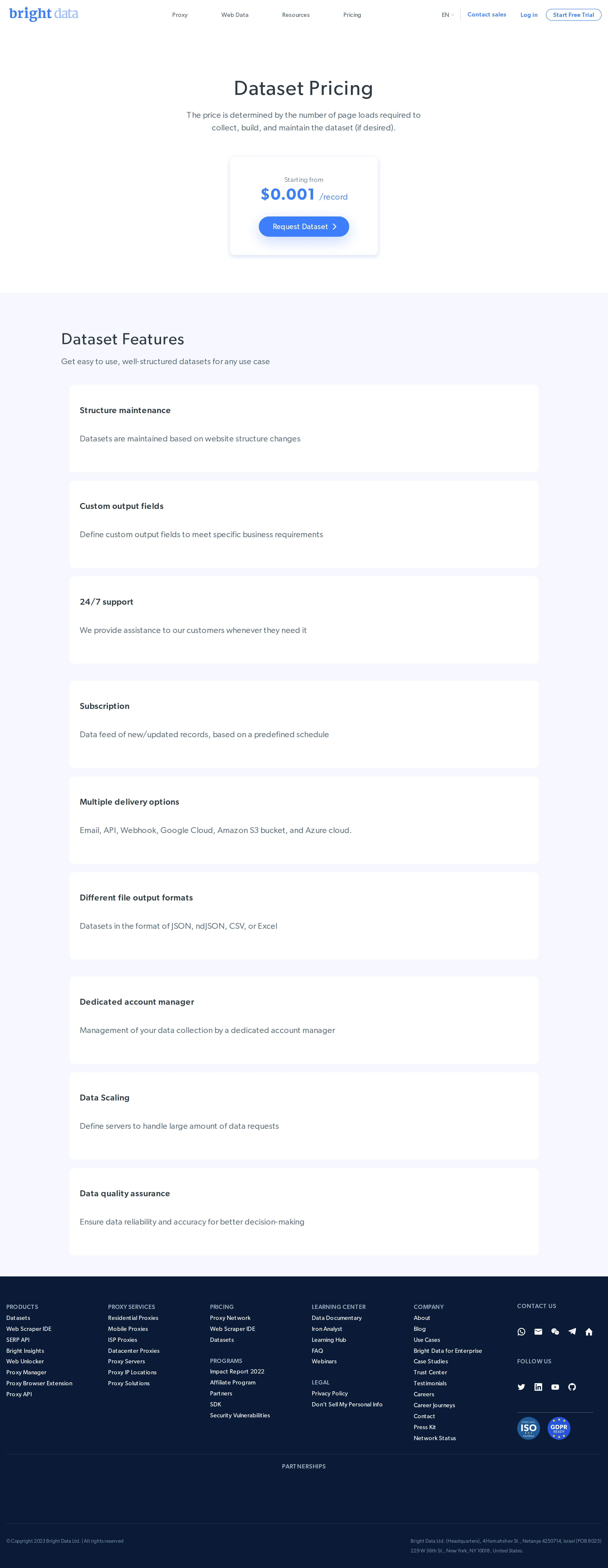
Datasets priced at $0.001/record, page-load driven
A Wayback snapshot (2023-02-06) shows the Datasets page 'Starting from $0.001/record' ($1.00 per 1,000 records), with price 'determined by the number of page loads required to collect, build, and maintain the dataset.' Custom Datasets (managed) started at $1,000/mo annual or $1,500 one-time. Scale shown then: 72M residential, 7M mobile, ~770K datacenter IPs.
Luminati Networks rebrands to Bright Data
The company dropped the 'Luminati' name (which invited unwanted 'Illuminati' associations) and rebranded to Bright Data, leaning into 'web transparency' positioning. The product/meter structure was unchanged; the change was identity and compliance-led.
EMK Capital acquires Luminati (~$200M)
London PE fund EMK Capital bought Luminati Networks out of Hola at a ~$200M valuation, separating the B2B proxy business from the consumer VPN. This set up the eventual rebrand and the compliance/KYC posture.
Hola/Luminati era — residential bandwidth resold from a VPN userbase
The residential proxy network launched as Luminati, monetizing the idle bandwidth of Hola VPN's free users as exit nodes. A 296-point Hacker News thread (2015-05-27) exposed the model; contemporary reporting put early residential bandwidth around $20/GB. (Secondary-sourced; original Luminati pricing pages were not captured in this pass.)
- · Bright Data prices proxies four different ways at once — per-GB for rotating residential ($8 → $2.50/GB), per-IP for static datacenter ($1.40 → $0.90/IP) and ISP ($1.8 → $1.3/IP) — so the right meter depends entirely on which IP type the use case needs.
- · Residential and Mobile IP access require passing a KYC (know-your-customer) compliance review — sometimes including an intro video call — before the network can be used, an unusual gate for a self-serve usage-based product.
- · Datasets are sold like a subscription on a sliding refresh dial: paying for fresher data is cheaper per record, with Monthly refresh discounted 80% versus a One-time pull at $2.50/1k records.
Questions & answers
- How does Bright Data price its residential proxies?
- Rotating residential proxies are billed per gigabyte of bandwidth. Pay-as-you-go is $8/GB with no commitment, dropping to $7, $6, and $5/GB on the $499, $999, and $1,999 monthly committed tiers (each with included GB). A 50% promo was running at capture, halving these rates.
- What is the difference between ISP, datacenter, and residential proxy pricing?
- Residential proxies are billed per GB; ISP and datacenter proxies are billed per dedicated IP. ISP runs $1.8/IP (10 IPs) down to $1.3/IP (1,000 IPs); datacenter runs $1.40/IP down to $0.90/IP across the same 10–1,000 IP tiers.
- How much does Bright Data's Web Unlocker or SERP API cost?
- As of the July 2026 capture both are billed per 1,000 successful results on a Free / PAYG / Scale / Enterprise ladder: a free tier of 5,000 results per month, then $1.5/1k pay-as-you-go, then a $499/mo Scale tier (~380,000 results included, $1.3/1k overage), with Enterprise by quote. This replaced the earlier four-tier $1.5 → $1.0 committed ladder.
- Is there a free way to try Bright Data?
- Yes. As of July 2026 the Web Scraper API, Web Unlocker, and SERP API each include a recurring free tier of 5,000 records/results per month with no credit card, and Bright Data runs a deposit-match promotion (it matches a first deposit dollar-for-dollar up to $500). Residential and mobile networks additionally require a KYC compliance review before use.
- How are Bright Data datasets priced?
- Datasets are sold per 1,000 records — a base of $2.50/1k (so $250 per 100k records) — with discounts for higher refresh cadence: One-time 0%, Biannual 25%, Quarterly 50%, and Monthly 80% off.
- How does Bright Data price the Browser API and Managed Services?
- As of the August 2026 capture, the Browser API (Bright Data's managed scraping browser) is billed per GB on a Free / PAYG / Scale / Enterprise ladder: a free tier of 5,000 credits per month (about 1GB), then $8/GB pay-as-you-go, then a $499/mo Scale tier that defaults to 71GB included and is adjusted with a slider rather than fixed tiers — replacing the product's earlier fixed four-tier ladder of $8 to $5 per GB. Separately, Managed Services (formerly Managed Data Acquisition) now has its own pricing page with two tiers: a Standard Project from $1,000/mo minimum (250,000 data records included) and a Strategic Annual Project from $2,500/mo minimum starting the second month (adds a dedicated project manager and Data Concierge Service), plus a $500 one-time setup fee and $4 per 1,000 requests of usage on both tiers — a more detailed structure than the single $1,500/mo figure previously on record.