AI Summary
About
Cognition is the company behind Devin, marketed as the first autonomous AI software engineer — an agent that plans, writes, tests, and ships code largely on its own rather than autocompleting inside your editor. Founded in 2023 and led by Scott Wu, Cognition raised at a multi-billion-dollar valuation on the strength of Devin’s autonomous-agent demos and has since pushed the product from a gated waitlist into broad self-serve availability.
The defining corporate event is the July 2025 acquisition of Windsurf — the AI IDE (formerly Codeium’s editor) doing roughly $82M ARR with 350+ enterprise customers and hundreds of thousands of daily active users. That deal gave Cognition a human-in-the-loop editor and a scaled go-to-market motion to sit alongside Devin’s fully autonomous agent. The combined positioning is explicit: Devin for autonomous, background engineering work; the editor for the interactive, in-editor experience. That editor now ships as Devin Desktop, and the pricing page reflects it — the plan comparison is split into a Devin Desktop block (Tab completions, inline edits, fast context, the in-house SWE 1.7 model) and a Devin Cloud block (cloud agents, DeepWiki, Devin API, Ask Devin), with the Free plan’s call to action a plain “Download.” For pricing, it means Cognition now sells across the whole spectrum — from a $0 downloadable editor to enterprise ACU contracts.
For the latest rates, see Devin’s pricing page and the billing docs.
Pricing summary : How Cognition’s pricing model works
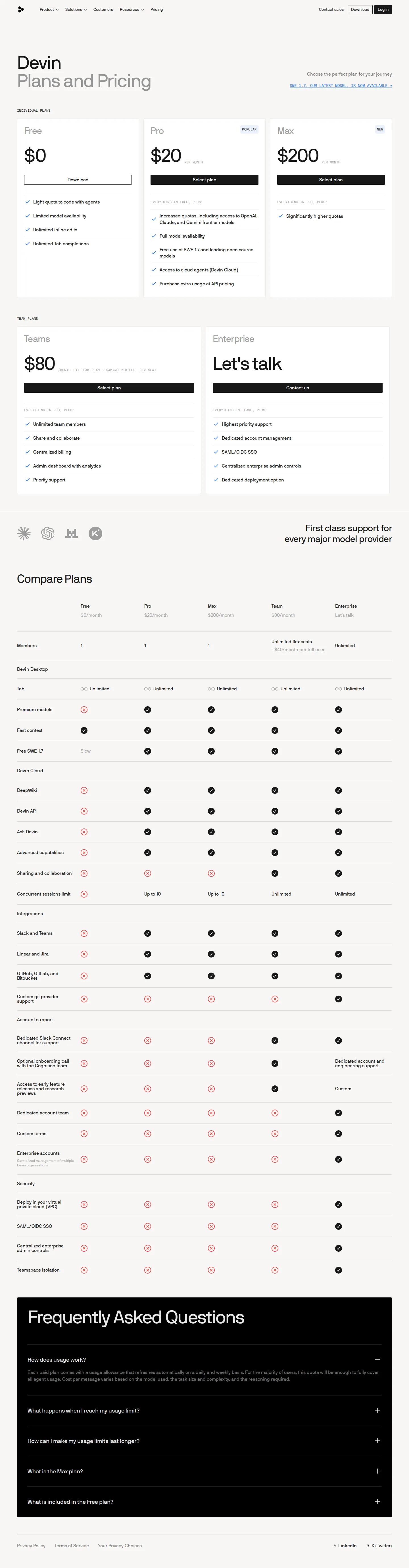
Devin’s pricing has two layers stacked on top of each other. The subscription layer sets your monthly access and baseline quota: Free at $0, Pro at $20/month, Max at $200/month (all single-seat), and Teams at $80/month minimum plus $40/month per full dev seat, with Enterprise shown as “Let’s talk.” The consumption layer governs how much actual agent work you can do: each paid plan and each Teams full seat includes a usage allowance that refreshes daily and weekly, and when you exceed it you spend on-demand credits that are “the same dollar value as the ACUs you’re used to.”
The dimensions that actually move the bill:
- Subscription tier — $0 / $20 / $200 per month for individuals; Teams starts at an $80/month floor.
- Full dev seats — $40/month each on Teams, each carrying a Pro-equivalent daily + weekly quota and Devin Desktop access. Flex seats are free and unlimited but draw entirely from shared credits.
- On-demand credits — prepaid, roll over month-to-month, never expire, consumed at API pricing; the same dollar value as legacy ACUs.
- ACUs (Agent Compute Units) — the enterprise meter. Cognition’s docs define an ACU as “the amount of agent effort required to complete a given task,” with consumption scaling with “the inference used and the model selected”; enterprise contracts bill ACUs at the rate set in the order form.
- Product surface — the plan table now splits Devin Desktop (Tab completions, inline edits, fast context) from Devin Cloud (cloud agents, DeepWiki, Devin API, Ask Devin), and the free tier only carries the Desktop half.
Devin meters work in ACUs — a unit of agent effort, not a fixed block of time. The docs are explicit that usage “accrues based on the work Devin actually performs in a session,” driven by the “number and complexity of actions Devin takes (planning, context gathering, task execution, browser actions, code execution, and so on)” plus VM time and bandwidth as “a small fraction of total usage,” and that ACU burn “scales with the inference used and the model selected.” Enterprise customers are billed purely in ACUs at a rate set in their order form. Self-serve customers don’t see ACUs on the price card anymore, but they’re still the underlying unit: your subscription buys quota, and overflow is paid for in credits priced at the ACU dollar value. That makes this a textbook hybrid pricing model settled in a single credit currency — the real cost of Devin is driven less by your seat and more by how much autonomous work you push through it.
What makes this different: most coding tools charge per seat or per month and let you use them as much as you want. Devin charges for agent compute — you are effectively paying an autonomous engineer for the work each task takes, on a meter that moves with model choice as well as task size. The subscription tiers are mostly a way to bundle a starting quota and unlock features; the meter that actually scales your bill is ACU/credit consumption.
Pricing by product
Devin (Individual plans)
| Tier | Price | Included | Key mechanics |
|---|---|---|---|
| Free | $0 | Light quota to code with agents, limited model availability, unlimited inline edits, unlimited Tab completions | CTA is “Download” — a Devin Desktop tier. Premium models and every Devin Cloud row (DeepWiki, Devin API, Ask Devin, concurrent sessions) are marked not included; SWE 1.7 runs in “Slow” mode |
| Pro | $20 per month | Everything in Free, plus increased quotas including access to OpenAI, Claude and Gemini frontier models; full model availability; free use of SWE 1.7 and leading open source models; access to cloud agents (Devin Cloud) | Labelled POPULAR. Single-user plan — cannot invite members. Daily + weekly allowance across Devin sessions, Devin CLI and Devin Desktop; extra usage purchased at API pricing. Up to 10 concurrent sessions |
| Max | $200 per month | Everything in Pro, plus significantly higher quotas | Labelled NEW. Weekly allowance only, no daily cap. Still a single-user plan; up to 10 concurrent sessions |
Devin (Team plans)
| Tier | Price | Included | Key mechanics |
|---|---|---|---|
| Teams | $80 /month for team plan + $40/mo per full dev seat | Everything in Pro, plus unlimited team members, sharing and collaboration, centralized billing, admin dashboard with analytics, priority support | Unlimited flex seats (free, no Devin Desktop, draw from shared credits); each full seat carries a Pro-equivalent quota plus Devin Desktop. On-demand credits are shared team-wide with no per-member balance. Unlimited concurrent sessions |
| Enterprise | ”Let’s talk” (contact us) | Everything in Teams, plus highest priority support, dedicated account management, SAML/OIDC SSO, centralized enterprise admin controls, dedicated deployment option | Billed in Agent Compute Units (ACUs) at the rate set in the order form; VPC deployment, teamspace isolation, custom terms and custom-git-provider support are Enterprise-only |
The $80 Teams minimum
Every Teams subscription costs at least $80/month, and the floor can be met in any combination of full seats and prepaid on-demand credits:
| Full seats | On-demand credits included | Monthly total |
|---|---|---|
| 0 | $80 | $80 |
| 1 | $40 | $80 |
| 2 | $0 | $80 |
| 3 | $0 | $120 |
| N ≥ 2 | $0 | N × $40 |
Below two full seats, the remainder of the minimum is automatically charged as prepaid on-demand credits the whole team can draw from. At two or more full seats you’ve cleared the minimum and no extra credits are bundled, though credits can still be topped up at any time.
Devin Review and Automations
Automations and Devin Review are available on self-serve plans. On Teams they draw directly from the shared on-demand credit pool and do not consume full-seat quota. If credits run out, Automations stop running and Devin Review falls back to its smart diff viewer until credits are topped up. Reviewing a public GitHub PR at devinreview.com is free — no Devin account, no credits consumed.
Sales motions across products: self-serve / PLG for Free, Pro, Max and Teams (sign up at app.devin.ai and pay by card); sales-led for Enterprise, which is ACU-contracted with a custom order form. Teams blends both — self-serve sign-up with seat and credit expansion that scales into a quote.
On-demand usage is consumed at API pricing: per Cognition’s FAQ, “cost per message varies based on the model used, the task size and complexity, and the reasoning required.” There is no flat per-task rate published for self-serve — the dollar value tracks the ACU rate. Note one inconsistency between surfaces: the billing docs still list “Access to Devin Review” and “Access to DeepWiki” under the Free plan, while the pricing page’s comparison table marks DeepWiki as not included on Free.
Hidden costs : What Cognition users actually pay
The headline $20 Pro price is the floor, not the bill. Because real spend is driven by ACU/credit consumption, a developer who runs Devin on large, reasoning-heavy tasks can blow through the included quota quickly and pay for on-demand credits on top. The model used matters too — premium models burn more per task. Here’s an illustrative monthly construction for an active Pro user:
| Line item | Monthly cost |
|---|---|
| Pro subscription | $20/mo |
| On-demand credits (beyond quota) | Variable — billed at ACU/API value |
| Premium-model overhead (heavier tasks) | Variable — higher per-task spend |
| Estimated total (active Pro user) | $20/mo + consumption |
For teams, the floor is the $80/mo minimum plus $40/mo per full seat, and on-demand credits are shared — so the bill scales with both headcount and aggregate agent usage. The genuinely uncapped variable is ACU burn: there’s no published flat per-ACU number for self-serve, so usage-heavy teams need the admin dashboard to avoid surprises.
Want to estimate your own Devin bill? Use the Cognition pricing calculator to model your costs based on seats and agent usage.
Pricing evolution : Cognition pricing history and changes
Cadence
| Quarter | Price changes | Product / SKU additions | Notes |
|---|---|---|---|
| 2024 Q4 | 1 | 1 | Devin GA; high enterprise-style entry, ACU-billed |
| 2025 Q2 | 1 | 2 | Devin 2.0 — $20 entry, ACU pay-as-you-go + Team plan |
| 2025 Q3 | 0 | 1 | Windsurf acquisition adds the IDE product line |
| 2026 Q2 | 1 | 2 | Self-serve subscription tiers (Free / Pro / Max / Teams) |
| 2026 Q3 | 0 | 1 | Devin Desktop enters the plan card; Free becomes a download, cloud agents go paid-only |
Tracked range: 2024–present. Sourced from the Cognition blog, Devin docs, and the live pricing page.
Notable changes
- 2024-12 — Devin reaches general availability. Early access was positioned at an enterprise-grade entry point with usage billed in Agent Compute Units (ACUs).
- 2025-04-03 — Devin 2.0 drops the entry price to $20/mo and formalizes ACUs (
15 min each) as the meter: a Core/pay-as-you-go tier ($2.25 per ACU per third-party reporting) and a Team plan (~$500/mo) bundling a block of ACUs, seats, and API access. - 2025-07-14 — Cognition acquires Windsurf, adding an AI IDE ($82M ARR, 350+ enterprise customers) to sit beside the autonomous Devin agent.
- 2026-06 — Public pricing is restructured into clean subscription tiers — Free $0, Pro $20/mo, Max $200/mo, Teams $80/mo + $40/seat — with quota + on-demand credits replacing the visible ACU rate card for self-serve. Enterprise stays ACU-contracted.
- 2026-07-21 — A packaging move with no price change: every headline number holds, but the comparison table splits into Devin Desktop (Tab completions, inline edits, fast context, SWE 1.7) and Devin Cloud (cloud agents, DeepWiki, Devin API, Ask Devin). Free keeps only the Desktop half behind a “Download” call to action, so the acquired editor becomes the free product and every ACU-burning capability sits behind Pro. Two smaller entitlement moves ride along: SWE 1.7 replaces SWE 1.6 as the bundled free model (in “Slow” mode on Free), and Max’s concurrent-session limit drops from unlimited to “Up to 10”, the same ceiling as Pro.
What’s unique : Cognition’s distinctive pricing mechanics
1. You buy agent work, not seats. The ACU makes the value metric literal: a unit of autonomous engineering effort, sized by the actions a task takes and the model it runs on. Even after the subscription redesign, Cognition kept the ACU as the dollar anchor for on-demand credits — so the pricing philosophy is unchanged even where the label disappeared.
2. Quota + credits hybrid, not pure usage. Rather than metered-from-zero, Devin bundles a usage quota into each subscription tier and only charges consumption above it. That gives individuals a predictable floor ($0/$20/$200) while letting heavy users pay for what they burn — a deliberate hedge against the bill-shock reputation of pure-usage AI tools.
3. The same meter spans $0 to enterprise. Free individuals, $40 team seats, and six-figure enterprise contracts all settle in the same ACU/credit currency. That lets Cognition move customers up the value ladder without re-teaching the pricing — and lets enterprise negotiate an ACU rate while self-serve takes the rack rate.
4. The free tier is drawn along cost-to-serve, not feature count. Since 2026-07-21 the plan table separates Devin Desktop from Devin Cloud, and the line falls exactly where Cognition’s marginal cost falls. Tab completions and inline edits — short, cheap, in-editor inference — are unlimited on every tier including Free, while everything that spends real agent compute (cloud sessions, DeepWiki, the Devin API, Ask Devin) is paid-only. The model row makes the logic explicit: Free still gets the in-house SWE 1.7, but marked “Slow.” Cognition is rationing latency and compute rather than capability, which is a cheaper way to run a free tier than capping features.
Strengths & weaknesses
| Strengths | Weaknesses |
|---|---|
| Clear, public self-serve tiers ($0 / $20 / $200) with a real free plan | Real cost is ACU/credit consumption, which isn’t a published flat rate for self-serve |
| Value metric (the ACU, a unit of agent effort) maps to actual engineering output | ”Cost per message varies” makes per-task spend hard to predict before you run it |
| Quota-plus-credits hybrid softens bill shock vs. pure usage | Max plan ($200) is a 10x jump from Pro, and since 2026-07-21 quota is its only edge — concurrency reads “Up to 10” on both tiers |
| Teams supports free flex seats so non-power users cost nothing in seat fees | Enterprise ACU rate is fully gated to the order form |
| Devin Desktop and Devin Cloud now sit in one plan table (2026-07-21), so the acquired editor is priced rather than merely bundled | Free no longer includes a single cloud agent run, so the autonomous product — the reason to buy Devin — can’t be trialled without paying |
| Unlimited Tab completions on the free download make the editor a cheap, always-on acquisition channel | Free’s value now comes mostly from the editor, which invites comparison with free-tier editors rather than with agent platforms |
Billing UX : Cognition billing controls and transparency
- Settings › Plans — the single place admins upgrade or downgrade between Free, Pro, Max and Teams, add or cancel Teams full seats, purchase on-demand credits or configure auto-reload, and download past invoices.
- Settings › Usage — admins set auto-reload thresholds and default session spending limits, the two controls that cap runaway credit burn before it happens.
- Settings › Members — admins pick a member’s seat type at invite time and can convert between full seat ($40/month) and free flex seat later, which is the main lever on the fixed portion of a Teams bill.
- Settings › Review (Trigger Modes) — per-repository or per-user control over how often auto-review fires (every commit, only when a PR is first opened, or manual only), used to keep Devin Review’s credit draw predictable.
- Admin dashboard with analytics — bundled on Teams and Enterprise; shared on-demand credits are pooled team-wide with no per-member balance, so the dashboard is the only view of who is burning what.
- Auto-reload for on-demand credits — credits are prepaid, roll over month-to-month and never expire; auto-reload refills them automatically so Automations and Devin Review don’t silently stop.
- Payment options — card / self-serve for individuals and Teams at app.devin.ai; Enterprise runs off an order form with a contracted ACU rate, with consumption tracked on the Enterprise Consumption and Consumption Analytics pages.
Strategic wins : Why Cognition’s pricing decisions worked
1. Dropping the entry price to $20 opened the funnel
Devin launched expensive and enterprise-coded. The Devin 2.0 move to a $20 entry turned an exclusive agent into something any developer could try, dramatically widening the top of the funnel while keeping ACU consumption as the upsell. See how AI companies are shifting away from per-user licenses.
2. Pricing the value metric as agent time
By metering in ACUs — units of agent effort rather than seat-months — Cognition charges for the thing customers actually care about — autonomous engineering output — instead of seats. That alignment is textbook value-based pricing. Related: choosing the right usage metric and outcome-based pricing trends.
3. Buying Windsurf to own both ends of the workflow
The Windsurf acquisition let Cognition monetize both the autonomous (Devin) and interactive (IDE) modes of AI coding under one roof, defending against editor-native competitors and giving enterprise buyers a single vendor for the full agent-plus-editor stack.
The packaging finally caught up on 2026-07-21: the editor ships as Devin Desktop inside the Devin plan table rather than as a separate product with its own price card. That turns a portfolio move into a pricing one. Buyers now compare one ladder instead of two, the editor becomes the free rung of the Devin funnel rather than a competing SKU, and Cognition gets a zero-marginal-cost download to distribute — with the ACU-metered cloud agent sitting one click above it as the paid upgrade.
Areas to improve : Gaps in Cognition’s pricing approach
1. Publish a self-serve ACU/credit rate
The biggest gap is that self-serve users can’t see a flat dollar-per-ACU number — they’re told consumption is at “API pricing” and “varies.” A published credit rate (the way enterprise gets one) would make Pro and Max far easier to budget. See bill shock and cost unpredictability.
2. Fill the gap between Pro and Max
Jumping from $20 to $200 is a 10x cliff with nothing in between. A mid-tier (or transparent credit top-ups) would catch developers who outgrow Pro but don’t need Max’s larger quota. The 2026-07-21 table makes the cliff harder to justify: Max’s concurrent-session limit now reads “Up to 10,” identical to Pro, so the entire 10x premium rests on an unpublished quota multiple. Naming that multiple — or giving Max a structural benefit buyers can see before subscribing — would do more for conversion than the “significantly higher quotas” line does today.
3. Give the free tier a way to meet the actual agent
The Devin/Windsurf narrative problem largely resolved itself on 2026-07-21: one plan table, one currency, Devin Desktop and Devin Cloud side by side. The new gap is the opposite one. Free is now a download that never runs a cloud agent, so the capability Cognition is famous for is invisible until a card is on file — an odd funnel for a product whose whole pitch is “watch it work autonomously.” A small one-off cloud-session allowance, or a credit grant that expires rather than a permanent entitlement, would let Free demonstrate the thing being sold without reopening an uncapped compute liability. The surfaces also still disagree: the billing docs list Devin Review and DeepWiki access under Free while the pricing table marks DeepWiki as not included, and that contradiction is now load-bearing rather than cosmetic.
Monetization stack & signals : how Cognition builds & buys its revenue engine
Buys 0 Builds 1 10 open roles
Cognition meters on its own ACU (Agent Compute Unit) currency, documented in first-party billing docs rather than an off-the-shelf metering vendor. Hiring points to a high-touch enterprise ACU-contract motion — Deployed Engineers, GTM Operations and enterprise Account Management dominate the open revenue/lifecycle roles.
-
“Devin Enterprise customers are billed in Agent Compute Units (ACUs) at the rate set in their order form.”
- Subscription billing platform (vendor unnamed) Billing inferred Job post May 2026
“Familiarity with subscription billing platforms such as Stripe, Chargebee, or similar”
- GTM Operations RevOps seen May 29, 2026
- GTM Operations - APAC RevOps seen May 29, 2026
- Senior Accountant RevOps seen May 29, 2026
- Support Specialist, Subscriptions & Billing Billing engineering seen May 27, 2026
- Deployed Engineer Retention seen May 20, 2026
- Deployed Engineer - Europe / APAC / ANZ / LATAM Retention seen May 20, 2026
- Account Manager, Enterprise Customer success seen Feb 19, 2026
- Technical Engagement Manager, Federal Customer success seen Feb 19, 2026
- Partner Deployed Engineer Monetization seen Feb 10, 2026
- Partner Marketer Monetization seen Feb 10, 2026
Signals reviewed · derived from public job posts, product docs
Job postings fill and close over time — once a posting is filled we keep it as a dated citation (the quoted evidence remains); use View open roles for current listings.
Key takeaways
- Devin sells agent compute, not seats. The ACU — a unit of agent effort, not a block of time — is the real value metric, and on-demand credits are priced at the ACU dollar value even on subscription tiers.
- The public price card is a floor. Free $0, Pro $20, Max $200, Teams $80 + $40/seat set baseline access; consumption above quota drives the actual bill.
- Quota-plus-credits is a deliberate hedge. Bundling usage into each tier softens the bill-shock risk that plagues pure-usage AI tools.
- Enterprise stays gated. Big customers negotiate an ACU rate in an order form — the only place a hard per-ACU number lives.
- Windsurf is now inside the price card, and it is the free rung. Since 2026-07-21 the acquired editor sells as Devin Desktop on the same ladder as the agent: unlimited Tab completions are free because they’re cheap to serve, while cloud agents, DeepWiki and the Devin API are paid-only — so Free buys distribution rather than a trial of the autonomous product.
UBP implications
- Pick a value metric that maps to output. Devin’s ACU — the agent effort a task requires, scaling with the actions taken and the model selected — is a clean example of metering the result (engineering effort) rather than the seat.
- Bundle a quota, meter the overflow, and keep one currency. The quota-plus-credits hybrid gives customers a predictable floor and you the upside — a strong pattern for agentic products where usage is spiky. Settling Free, self-serve and enterprise in the same ACU/credit unit then lets you move customers up-market without re-teaching pricing, provided you publish the rate at every tier and not just in the enterprise order form. See the introduction to usage-based pricing for how credit currencies and quotas fit together.
- Draw the free line along cost-to-serve, and ration speed before capability. Cognition’s 2026-07-21 split gives away the near-zero-marginal-cost surface (Tab completions, inline edits) and gates the surface that burns agent compute, which keeps a generous-looking free tier from becoming a compute liability. The model row shows the gentler version of the same lever: Free gets the same in-house SWE 1.7 as Pro, just in “Slow” mode — degrading latency preserves the “you get the good model” story while still creating a reason to upgrade.
Sources
- Devin pricing page (accessed 2026-08-27)
- Devin docs — self-serve plans (accessed 2026-08-27)
- Devin docs — billing & ACUs (accessed 2026-08-27)
- Devin docs — Enterprise ACU billing (accessed 2026-07-21)
- Devin docs — usage & metering (accessed 2026-07-21)
- Devin docs — Devin Desktop plans and usage (accessed 2026-07-21)
- Cognition blog — Windsurf acquisition (accessed 2026-06-16)
- Cognition blog — Devin 2.0 launch (accessed 2026-07-21)
Bottom line
Cognition’s Devin prices like what it is: an autonomous engineer you pay by the task. The public tiers — Free $0, Pro $20/mo, Max $200/mo, Teams $80/mo + $40/seat — are an accessible on-ramp, but the meter that scales your bill is ACU/credit consumption (an ACU is a unit of agent effort, sized by the actions and the model a task consumes), and enterprise pricing stays gated to a custom ACU rate. The July 2026 repackaging didn’t move a single price; it moved the free line, so the acquired editor (Devin Desktop, with unlimited Tab completions) is what you get for $0 and every cloud agent run starts at $20. Budget for Devin as compute, not as a seat — and expect to pay before you see the agent work. Browse the pricing blueprint for more fully-researched company profiles.
Want to compare Devin against other AI coding tools? Browse the pricing blueprint.
Pricing timeline : Major events on a vertical axis
Each milestone below corresponds to a public pricing change, product launch, or material adjustment. Major events use a filled marker; minor adjustments use a faded one.
Devin Desktop folded into the plan card; Free becomes a download
Prices held ($0 / $20 / $200 / $80 + $40 per full dev seat), but the plan comparison is now split into Devin Desktop and Devin Cloud, moving the free line from features to cost-to-serve. Free's CTA is 'Download' with unlimited inline edits and unlimited Tab completions, while Devin Cloud features (DeepWiki, Devin API, Ask Devin, cloud sessions) are marked paid-only; SWE 1.7 replaces SWE 1.6 as the free bundled model (in 'Slow' mode on Free), and Max's concurrent-session limit reads 'Up to 10' rather than unlimited.
Self-serve subscription tiers (Free / Pro / Max / Teams)
Devin's public pricing now leads with subscription tiers — Free $0, Pro $20/mo, Max $200/mo, Teams $80/mo + $40/seat — with usage on quotas plus on-demand credits (same dollar value as ACUs). Enterprise stays ACU-billed.
Cognition acquires Windsurf
Cognition acquired the Windsurf AI IDE ($82M ARR, 350+ enterprise customers), pairing Devin's autonomous agent with Windsurf's IDE and go-to-market motion.
Devin 2.0 — $20 entry + ACU pay-as-you-go
Devin 2.0 launched a flexible plan starting at $20/mo. ACUs (~15 min of work each) became the core meter, with a Core/pay-as-you-go tier (~$2.25 per ACU) and a Team plan (~$500/mo including a block of ACUs, seats and API access).
Devin general availability
Devin left waitlist and went generally available, initially positioned around a high enterprise-style entry point billed against Agent Compute Units (ACUs).
- · Devin prices work in ACUs (Agent Compute Units) — a unit of agent effort that scales with the inference and the model a task needs — so you're effectively buying agent work, not seats.
- · Even after moving to subscription tiers, Cognition told users 'on-demand credits are the same dollar value as the ACUs you're used to' — the ACU meter never really left, it just moved under the hood.
- · Cognition bought Windsurf in July 2025 — an AI IDE doing $82M ARR with 350+ enterprise customers — stitching the autonomous agent (Devin) to a human-in-the-loop editor.
Questions & answers
- How much does Devin cost?
- Devin has a Free plan ($0), a Pro plan at $20/month, and a Max plan at $200/month — all single-seat individual plans. The Teams plan starts at $80/month minimum plus $40/month per full developer seat. Enterprise is custom-quoted and billed in Agent Compute Units (ACUs).
- What is a Devin ACU (Agent Compute Unit)?
- An ACU is Devin's consumption unit. Cognition's docs define it as the amount of agent effort a task requires, with consumption scaling with the inference used and the model selected — the early-2025 rule of thumb of roughly 15 minutes of Devin work per ACU no longer appears in the docs. Enterprise contracts are billed in ACUs at the rate set in the order form. On self-serve plans you spend plan quota plus 'on-demand credits,' which Cognition says are the same dollar value as ACUs.
- Does Devin have a free tier?
- Yes. The Free plan is $0 and its call to action is now 'Download' — it covers Devin Desktop with a light quota to code with agents, limited model availability, unlimited inline edits and unlimited Tab completions. The pricing page's comparison table marks Devin Cloud features (DeepWiki, Devin API, Ask Devin, cloud sessions) as not included on Free, so heavier work needs Pro ($20/mo), Max ($200/mo) or Teams.
- What is the difference between Devin Desktop and Devin Cloud?
- Devin Desktop is the downloadable editor — Tab completions, inline edits, fast context and the in-house SWE 1.7 model — and it is included on every plan including Free. Devin Cloud is the hosted agent layer: cloud sessions, DeepWiki, Ask Devin and the Devin API. Since the July 2026 plan-table split, Devin Cloud is paid-only, so running an autonomous agent starts on the $20/month Pro plan.
- What happens when I run out of Devin quota?
- You can purchase extra usage (on-demand credits) that is consumed at API pricing — the cost per task varies by model, task size, complexity, and reasoning required. On Teams, on-demand credits are shared across the team and seats can be added as full ($40/mo) or free flex seats.