AI Summary
About
Copy.ai is a GTM (go-to-market) AI platform — but it didn’t start that way. It launched in 2020 as a consumer-grade AI copywriting tool that let marketers crank out blog intros, ad copy and product descriptions, and it rode the generative-AI wave to 17 million-plus users. That was the easy part. The hard part was that a self-serve writing toy is a brutal business: Copy.ai paid OpenAI a fee for every word a user generated, capping gross margin, and the tool sat in a crowded, low-switching-cost market against Jasper, Writesonic, and eventually ChatGPT itself.
So in 2024 the company pivoted hard: same brand, new product. Copy.ai rebuilt around Workflows — multi-step AI processes (prospecting, account research, content systems, CRM enrichment) that codify a GTM team’s repeatable work. The repositioning paid off on the top line: revenue grew 480% in 2024 to $23.7M ARR, up from roughly $12M in 2023, on only ~$13.9M total raised. The company is backed by Sequoia Capital, Wing Venture Capital, Craft Ventures, and K5, with founder/CEO Paul Yacoubian and ~183 employees.
The pricing follows the product. The legacy word-metered copywriting plans are gone; today the meter that matters is the workflow credit, and the rate card is built to push teams from a cheap Chat entry point up into four- and five-figure GTM commitments.
For current rates, see Copy.ai pricing.
Pricing summary : How Copy.ai’s pricing model works
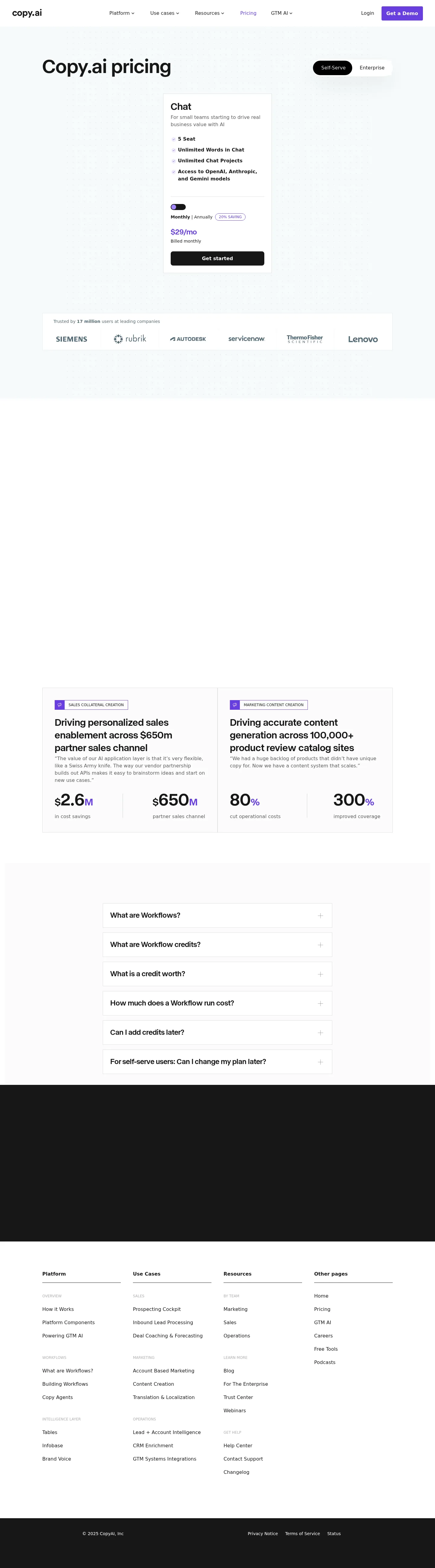
Copy.ai runs a two-layer pricing model. The entry layer is pure seat-based subscription: the Chat plan is $29/mo (or $24/mo billed annually, a 20% saving) for 5 seats with unlimited words in Chat and access to OpenAI, Anthropic and Gemini models. No usage meter, no credits — just chat with frontier models behind one bill.
The GTM layer is seat-plus-usage. Three published tiers bundle a large seat count with a monthly allotment of workflow credits: Growth at $1,000/mo (75 seats, 20K credits), Expansion at $2,000/mo (150 seats, 45K credits), and Scale at $3,000/mo (200 seats, 75K credits) — all billed annually. Above that, Enterprise is custom-quoted and adds API access, bulk workflow runs, 20+ integrations and a dedicated team.
A workflow credit is the unit of computational work to run a step inside a workflow — generating content, web research, scraping sites, or API calls. A single workflow run consumes a variable number of credits depending on how many steps it has and how much it generates, so two teams on the same tier can have very different effective per-run costs. Credits don’t roll over month to month, and you can buy more if you run dry.
What makes this different: Copy.ai sells chat on seats and automation on credits — two genuinely different value metrics in one product. Words are explicitly unlimited everywhere, which signals the company no longer wants to be priced as a word factory. The meter has moved up the stack to the workflow, where the value (and the cost) actually lives.
Pricing by product
| Tier | Price (annual) | Seats | Included credits | Key mechanics |
|---|---|---|---|---|
| Chat | $29/mo ($24/mo annual) | 5 | None (unlimited chat words) | Seat-only subscription; frontier models in chat |
| Growth | $1,000/mo | 75 | 20K workflow credits/mo | Seat-plus-credit; credits meter automation |
| Expansion | $2,000/mo | 150 | 45K workflow credits/mo | More seats + credits; same mechanics |
| Scale | $3,000/mo | 200 | 75K workflow credits/mo | Top published tier |
| Enterprise | Custom | Custom | Scoped | API, bulk runs, 20+ integrations, dedicated team |
Sales motions across products: the Chat tier is fully self-serve (sign up and pay $29). The GTM tiers are published but lead with “Get a demo,” and the jump from $29/mo to $1,000/mo is a deliberate sales handoff — there is no small-team workflow plan. Enterprise is sales-led, scoped around credit consumption.
Hidden costs : What Copy.ai users actually pay
The headline prices are clean, but the real bill on the GTM tiers is governed by how fast you burn workflow credits. Copy.ai is explicit that a credit’s value depends on task complexity and that each run can consume a different amount — so the included allotment (20K / 45K / 75K) is the number to model against your actual workflow library, not the seat count. A team that runs deep, multi-step research-and-generation workflows daily can exhaust an allotment well before a team that runs simple ones.
| Line item | Monthly cost (illustrative, Growth tier) |
|---|---|
| Base plan (Growth, annual) | $1,000 |
| Included workflow credits | 20K (in base) |
| Additional credits if you run dry | Quoted / add-on (variable) |
| Estimated total | $1,000+ depending on credit burn |
The other quiet cost is the seat-to-value gap: Growth ships 75 seats whether or not you fill them, so under-utilization is a real risk — you may pay for an org-wide seat count to unlock a credit allotment a smaller team actually needs.
Want to estimate your own Copy.ai bill? Use the Copy.ai pricing calculator to model your costs based on usage patterns.
Pricing evolution : Copy.ai pricing history and changes
Cadence
| Period | Price changes | Product / SKU additions | Notes |
|---|---|---|---|
| 2020–2023 | Per-word, declining-rate | Free + Pro writing tiers | Self-serve copywriting tool |
| 2024–early 2025 | Restructure | Workflow credits introduced; Starter/Advanced | GTM pivot; Advanced $186/mo at 2K credits |
| 2026 Q2 | Restructure | Chat $29 + Growth/Expansion/Scale + Enterprise | Seat-and-credit ladder; words made unlimited |
Tracked range: 2020–present. History assembled from the live pricing page plus Sacra and Contrary Research second-sources.
Notable changes
- 2022 — Word-metered model. Free + Pro tiers; Pro carried 5 seats, 25+ languages, unlimited words on the cost-per-word-declines-with-usage curve. Hit $10M ARR in October 2022.
- Early 2025 — Workflow credits introduced with the GTM pivot. Lineup was Free (2,000 words/mo in Chat), Starter $36/mo (unlimited words), Advanced $186/mo (2,000 workflow credits/mo), Enterprise custom.
- 2026 — Seat-and-credit GTM ladder. Chat $29/mo, Growth $1,000/mo, Expansion $2,000/mo, Scale $3,000/mo, Enterprise custom. Words are now unlimited across paid tiers; the credit allotment and seat count became the differentiators.
The throughline: Copy.ai has steadily moved the meter up the value stack — from per-word (raw output) to per-workflow-credit (codified GTM process) — and raised the ceiling from tens of dollars to thousands.
What’s unique : Copy.ai’s distinctive pricing mechanics
1. Two value metrics in one product. Chat is sold on seats with unlimited words; automation is sold on workflow credits. Most tools pick one axis — Copy.ai prices the cheap, predictable thing (chat) flatly and the expensive, variable thing (multi-step workflows) on consumption.
2. Deliberately unlimited words. Having built its brand (and its margin problem) on per-word billing, Copy.ai now makes words explicitly unlimited everywhere. That’s a pricing statement: it no longer wants to be valued as a word generator, and it removes the metric customers most resented.
3. A built-in sales cliff. The $29/mo Chat plan to the $1,000/mo Growth tier is a 35x jump with no rung in between. There is no $99 or $299 small-team workflow plan — the gap itself is the funnel, routing any serious automation buyer straight into a demo and an annual commitment.
Strengths & weaknesses
| Strengths | Weaknesses |
|---|---|
| Cheap, transparent $29 entry point with frontier models | No free tier on the live page anymore; lowest rung is paid |
| Unlimited words removes the most-resented legacy meter | 35x cliff from $29 to $1,000 leaves small automation teams unserved |
| Workflow credit ties price to codified GTM value, not raw output | Credit value is variable and per-run — hard to forecast spend |
| Annual GTM tiers create predictable, committed revenue | Large fixed seat counts (75/150/200) can mean paying for unused seats |
| Pivot proven on the top line (480% growth, $23.7M ARR) | Workflow-credit complexity adds a learning curve vs. flat per-seat tools |
Billing UX : Copy.ai billing controls and transparency
- Billing controls — Self-serve users can upgrade or downgrade at any time; upgrades are prorated for the rest of the month, downgrades are credited on the next bill. Monthly vs. annual is a clear toggle on the Chat plan (annual saves 20%).
- Usage visibility — Credit consumption is surfaced per run: opening the side panel on any workflow shows “Credits used” for that run, so teams can see what each workflow actually costs before scaling it.
- Payment options — Self-serve Chat is card-based and instant. GTM and Enterprise tiers are annual and quote-driven; Copy.ai scopes credit needs with you and lets you add credits to your balance as usage grows.
Strategic wins : Why Copy.ai’s pricing decisions worked
1. Re-pricing the pivot instead of just re-marketing it
Plenty of companies “go enterprise” by adding a Contact Sales button. Copy.ai changed the unit of value: from words to workflow credits. That let it charge $1,000–$3,000/mo for outcomes (codified GTM processes) that it could never have justified at a per-word rate, and it’s the mechanism behind the 480% revenue jump. See how AI companies are shifting away from per-user licenses.
2. Solving its own margin problem in the meter
Per-word billing meant per-word OpenAI COGS — a margin cap baked into the price metric. Credits abstract the underlying model spend into a unit Copy.ai controls and can reprice, decoupling list price from raw token cost. Related: outcome-based pricing trends.
3. Keeping a cheap top-of-funnel
Rather than abandon self-serve, Copy.ai kept a clean $29 Chat plan as a low-friction entry and brand-continuity play for its 17M-user base, then used the price gap to qualify and route real automation buyers to sales. See choosing the right usage metric.
Areas to improve : Gaps in Copy.ai’s pricing approach
1. The missing middle
The 35x jump from $29 to $1,000 leaves a large band of small-but-serious teams with nowhere to land. A $149–$399 starter-workflow tier with a modest credit allotment would capture buyers who want automation but can’t justify $12,000/yr. See bill shock and cost unpredictability.
2. Credit value opacity
Copy.ai is honest that “a credit’s value depends on complexity” and “each run might consume different credits” — but that makes budgeting hard. Buyers can’t easily translate “20K credits” into “X workflow runs” without running them first. Published per-workflow credit benchmarks would reduce purchase anxiety.
3. Seat-allotment mismatch
Tying a credit allotment to a fixed 75/150/200-seat block forces some buyers to pay for seats they won’t use just to reach the credits they need. Decoupling seats from credits — or letting teams buy credits independently — would price closer to actual value.
Monetization stack & signals : how Copy.ai builds & buys its revenue engine
Copy.ai no longer owns its own monetization question: RevOps vendor Fullcast completed its acquisition on 15 October 2025 and relaunched the product as "Fullcast Propel (powered by Copy.ai)" inside Fullcast's "Plan-to-Pay" platform, so the revenue engine now runs on the acquirer's stack.
Signals reviewed · derived from public sources
Key takeaways
- Move the meter to where the value is. Copy.ai went from per-word to per-workflow-credit and unlocked four- and five-figure deals it could never have charged for raw output.
- Your price metric is also your margin structure. Per-word billing capped margin via per-word COGS; switching to credits gave Copy.ai a unit it controls and can reprice.
- Cheap entry + a deliberate cliff can be a funnel. The $29-to-$1,000 gap isn’t a bug — it qualifies serious buyers into sales without a small-team tier diluting ACV.
- Unlimited can be a positioning weapon. Making words explicitly unlimited reframed the product away from the metric customers resented most.
- Repricing a pivot beats rebranding one. The 480% revenue growth tracks the credit model, not just the GTM messaging.
UBP implications
- Credits abstract volatile COGS. For any AI product paying per-token upstream, a credit unit decouples list price from model cost and protects margin — Copy.ai’s central UBP lesson.
- Hybrid seat-plus-usage fits GTM tools. Predictable seats (chat) plus consumption (workflows) lets you sell stability and upside in one SKU; see hybrid pricing patterns.
- Forecastability is the tax on consumption pricing. Variable per-run credit burn is the main buyer objection — publish run-level benchmarks or your usage meter creates purchase friction.
Sources
- Copy.ai pricing page (accessed 2026-06-15)
- Copy.ai: GTM AI platform sees 480% revenue growth in 2024 (accessed 2026-06-15)
- Sacra — Copy.ai revenue, funding & growth (accessed 2026-06-15)
- Contrary Research — Copy.ai business breakdown (accessed 2026-06-15)
- Getlatka — CopyAI revenue $23.7M ARR (accessed 2026-06-15)
Bottom line
Copy.ai is the rare AI company that pivoted its product and its pricing at the same time — from a per-word copywriting tool with 17M users and a capped margin, to a GTM AI platform metered on workflow credits with $23.7M ARR and 480% growth. Today that means a clean $29/mo Chat entry point, a seat-and-credit GTM ladder from $1,000 to $3,000/mo, and custom Enterprise above it. The credit meter is smart pricing — it moves value up the stack and protects margin — but the 35x gap above Chat and the opacity of credit value are the two things a serious buyer should pressure-test.
Want to compare Copy.ai against other GTM and content-AI companies? Browse the pricing blueprint.
Pricing timeline : Major events on a vertical axis
Each milestone below corresponds to a public pricing change, product launch, or material adjustment. Major events use a filled marker; minor adjustments use a faded one.
Seat-and-credit GTM tier ladder
Self-serve now leads with Chat at $29/mo (5 seats) and adds three GTM tiers — Growth $1,000/mo (75 seats, 20K credits), Expansion $2,000/mo (150 seats, 45K credits), Scale $3,000/mo (200 seats, 75K credits) — plus custom Enterprise. Annual billing saves 20% on Chat.
Workflow credits introduced alongside the GTM pivot
Pricing restructured for the GTM repositioning: Free (2,000 words/mo in Chat), Starter $36/mo (unlimited words), Advanced $186/mo (2,000 workflow credits/mo), and Enterprise custom. Workflow credits became the usage meter for automation.
Word-metered Free + Pro copywriting tool
Copy.ai priced as a self-serve AI writing tool: a Free tier plus a Pro tier with 5 seats, 25+ languages and unlimited words. Cost-per-word decreased as usage rose. Reached $10M ARR in October 2022 ($11.6M for the year).
- · Copy.ai grew to 17 million+ users as a self-serve AI copywriting tool, then pivoted to enterprise GTM AI — keeping the brand but rebuilding the product and the price tags.
- · The GTM bet worked on the top line: revenue grew 480% in 2024 to $23.7M ARR, up from ~$12M in 2023, on just ~$13.9M total raised.
- · Copy.ai's gross margin was structurally capped in its copywriting era because it paid OpenAI per word generated — a direct COGS-on-every-output problem the credit model now passes through.
Questions & answers
- How much does Copy.ai cost per month?
- The entry Chat plan is $29/mo (or $24/mo billed annually) for 5 seats and unlimited chat words. GTM workflow tiers are Growth $1,000/mo, Expansion $2,000/mo, and Scale $3,000/mo (billed annually), each bundling more seats and monthly workflow credits. Enterprise is custom-quoted.
- What are Copy.ai workflow credits?
- A workflow credit represents the computational work to run a step inside a Copy.ai workflow — generating content, web research, scanning sites, or API calls. A single workflow run consumes a variable number of credits depending on its complexity and number of steps. Growth includes 20K credits/mo, Expansion 45K, and Scale 75K.
- Does Copy.ai have a free tier?
- Not on the current self-serve page — the lowest paid entry is the $29/mo Chat plan. Copy.ai historically offered a free tier (2,000 words/mo in Chat as recently as early 2025), but the live pricing page now leads with paid Chat. You can request a demo for the GTM tiers.
- Is Copy.ai usage-based or subscription pricing?
- It's a hybrid. The Chat plan is pure seat-based subscription with unlimited words. The GTM tiers are seat-plus-usage: a fixed monthly subscription that includes a workflow-credit allotment, with credits as the consumption meter. Enterprise can scope and add credits as usage grows.