AI Summary
About
Dust is an enterprise AI agent platform: companies build custom agents connected to their internal data (Notion, Google Drive, Slack, GitHub, Zendesk, Salesforce) and deploy them across departments, on top of frontier models from OpenAI, Anthropic, Google, and Mistral. Founded in Paris in 2022 by Gabriel Hubert and Stanislas Polu — who previously co-founded TOTEMS (acquired by Stripe in 2014), spent five years at Stripe, and in Polu’s case did AI reasoning research at OpenAI — Dust bet early that companies need many specialized agents rather than one monolithic assistant.
The bet has compounded: a $16M Series A led by Sequoia in June 2024, then a $40M Series B co-led by Abstract and Sequoia (with Snowflake Ventures and Datadog) in May 2026, bringing total funding past $60M. By the Series B, Dust reported 3,000+ organizations, ~41,000 monthly active users, 300,000+ agents deployed, and zero churn in 2025.
For the most current information, visit Dust.
Pricing summary : How Dust’s pricing model works
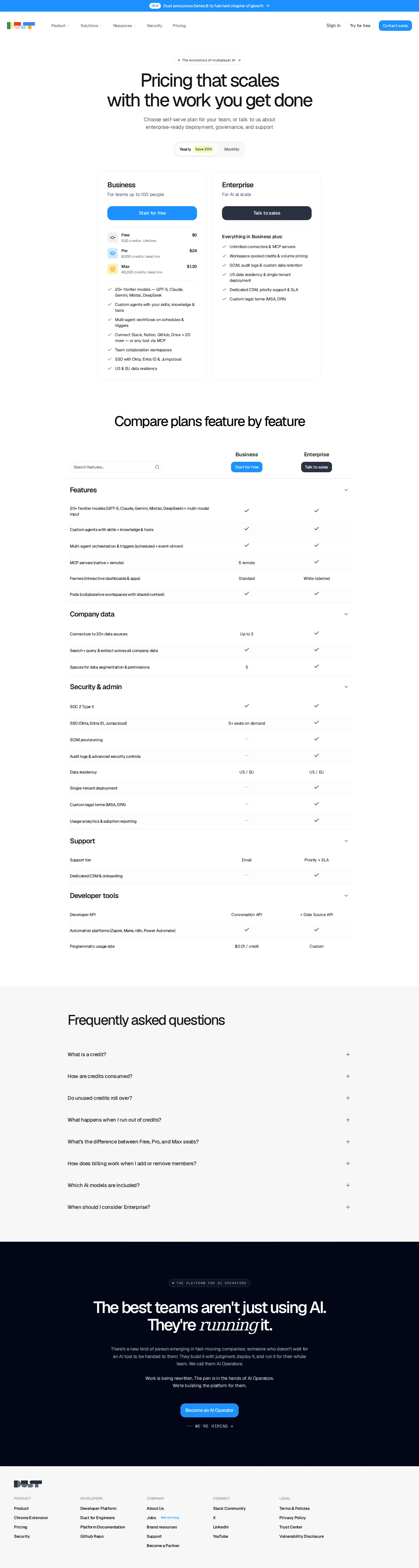
As of mid-2026 Dust sells a self-serve Business plan (teams up to 100) and a sales-led Enterprise plan — and the Business plan is built from three mix-and-match seat types, each bundling a monthly credit allowance. Free is $0 with a one-time 500-credit lifetime allocation; Pro is $30/seat/month ($24 billed yearly) with 8,000 credits/seat/month; Max is $150/seat/month ($120 billed yearly) with 40,000 credits/seat/month. Yearly billing saves 20%. Admins assign a seat type per user and reassign anytime. Enterprise is custom-quoted “for AI at scale,” adding workspace-pooled credits with volume pricing, unlimited connectors/MCP servers, SCIM, audit logs, single-tenant deployment, dedicated CSM, and custom legal terms.
The whole model now runs on credits — Dust’s credit-based billing unit for AI work. Every interaction consumes token credits + action credits: token credits scale with model and context, while action credits are fixed per tool use across three published tiers — Free tools (0 credits): memory, agent routing, most orchestration helpers, skills management, most file and Pods management; Basic tools (1 credit): run agent/schedule, web search, Frames editing, Pods creation, analytics; Advanced tools (3 credits): knowledge & retrieval, frame/output generation, and all 3rd-party MCP integrations (Gmail, Slack, GitHub, Notion, Drive, Jira, HubSpot, Salesforce, Zendesk, and more). Credits are tied to the user, reset monthly (Free’s are one-time, never reset), and never roll over. Programmatic/API usage on Business is billed at $0.01 per credit; Enterprise gets a custom rate plus a workspace credit pool. Pro/Max users can continue past their allowance via admin-enabled, capped workspace overage; Free users are prompted to upgrade.
What makes this different: Dust replaced its old flat-seat “unlimited fair-use messages” model with a tiered, credit-metered hybrid seat-plus-usage structure — every message now draws down a quantified per-seat credit budget, with all 20+ frontier models available on every seat (higher-capability models simply burn more credits).
Pricing by product
Business plan — seat types (self-serve, teams up to 100)
| Tier | Price | Included | Key mechanics |
|---|---|---|---|
| Free | $0 | 500 credits (one-time lifetime), all 20+ models, custom agents, 20+ connectors, up to 3 data-source connectors, 5 spaces | Prompted to upgrade when credits run out; best for occasional users |
| Pro | $30/seat/mo ($24 yearly) | 8,000 credits/seat/mo, everything in Free + multi-agent workflows, team workspaces, US/EU residency | ”Best for most team members”; admin-enabled capped overage; prorated seat adds |
| Max | $150/seat/mo ($120 yearly) | 40,000 credits/seat/mo, everything in Pro | ”Best for power users” (Deep research, tool-heavy automations); admin-enabled capped overage |
Enterprise (sales-led, for AI at scale)
| Tier | Price | Included | Key mechanics |
|---|---|---|---|
| Enterprise | Custom | Everything in Business + workspace-pooled credits & volume pricing, unlimited connectors & MCP servers, SCIM, audit logs, custom data retention, single-tenant deployment, US data residency, dedicated CSM, custom legal terms (MSA, DPA) | Contact sales; custom programmatic rate; SSO; white-labelled Frames |
Credits — the shared usage meter
| Dimension | Detail | Key mechanics |
|---|---|---|
| Credit formula | total = token credits + action credits | Token credits scale with model/context; action credits fixed per tool use |
| Action credit tiers | Free = 0 credits (memory, agent routing, most orchestration helpers, skills/file/Pods management); Basic = 1 credit (run agent, web search, Frames editing, Pods, analytics); Advanced = 3 credits (knowledge & retrieval, frame/output generation, all 3rd-party MCP integrations) | Sub-agent costs add to the chain total; cost shown per message |
| Programmatic / API rate | $0.01 per credit (Business); Custom (Enterprise) | Sidekick + common platform tools are credit-free; credits never roll over |
Sales motions across products: self-serve signup and per-seat checkout for the Business plan (Free / Pro / Max seat types); sales-led for Enterprise (contact sales, custom quote with pooled credits and volume pricing).
Hidden costs : What Dust users actually pay
The seat sticker is the floor, not the ceiling. The new model adds two cost vectors the old flat-message plan didn’t have. First, the credit allowance is a hard budget per seat: a Pro seat’s 8,000 credits/month can be exhausted by tool-heavy or multi-agent work, since each message costs token credits + action credits (Advanced tools like data retrieval, connectors, and file generation cost 3 credits each, and sub-agent chains stack). Past the allowance, Pro/Max users only continue if an admin enabled (capped) workspace overage; otherwise they hit a wall. Second, seat-type mix matters: a team that misjudges power users either over-buys Max seats ($150/mo) or starves them on Pro (8,000 credits). Programmatic/API workloads are billed separately at $0.01/credit on Business.
| Line item | Monthly cost (illustrative, 10-person team, yearly billing) |
|---|---|
| 7 × Pro seats ($24 yearly) | $168 |
| 2 × Max seats ($120 yearly) | $240 |
| 1 × Free seat | $0 |
| Programmatic/API usage (10,000 credits × $0.01) | $100 |
| Estimated total | ~$508/mo |
The other cost is exit risk rather than spend: downgrading deletes aggressively — historically Dust removed all users except one admin, deleted connections, and deleted larger data sources, so the migration cliff is real if a workspace lapses.
Want to estimate your own Dust bill? Use the Dust pricing calculator to model your costs based on usage patterns.
Pricing evolution : Dust pricing history and changes
Cadence
| Period | Price changes | Product / SKU additions | Notes |
|---|---|---|---|
| 2023 | — | Platform launch | No archived pricing page; product in early access |
| 2024 | 0 | Pro 29€ / Enterprise structure archived | Earliest snapshot 2024-05; Series A (Jun) |
| 2025 | 0 | Model lineup refreshes only | Same 29€ across all snapshots |
| 2026 H1 | 1 (overhaul) | Credit-metered Free/Pro/Max seat types; first free tier; $0.01/credit programmatic | 29€ held through 2026-06-10, then full repricing on 2026-06-24, weeks after Series B |
Tracked range: 2024–present via Wayback Machine snapshots (2024-05, 2024-09, 2025-03, 2025-09, 2026-03), a live 2026-06-10 capture, and the 2026-06-24 overhaul capture. No 2023 pricing page is archived.
Notable changes
- 2024-05 — Earliest archived pricing page already shows the prior shape: Pro 29€/month/user excl. tax, fair-use unlimited messages, programmatic usage line items, 1GB/user data sources, custom Enterprise.
- 2024-06 — $16M Series A led by Sequoia (with XYZ, GG1, Connect Ventures, Seedcamp, Motier Ventures). Pricing unchanged.
- 2025 — Snapshots in March and September show the same two-tier structure; only the advertised model lineup rotates as frontier models ship.
- 2026-05-18 — $40M Series B co-led by Abstract and Sequoia, with Snowflake Ventures and Datadog; total funding passes $60M. Pricing page still 29€ Pro.
- 2026-06-10 — Live capture confirms Pro 29€/user (now listing GPT-5), Enterprise custom on active users from 100 members — the last snapshot of the flat-seat era.
- 2026-06-24 — Full pricing overhaul. Dust retired the flat €29/seat unlimited-fair-use Pro plan and replaced it with a USD, credit-metered Business plan (teams up to 100) built from three seat types: Free $0 (500 credits, one-time lifetime), Pro $30/seat/mo ($24 yearly, 8,000 credits/mo), and Max $150/seat/mo ($120 yearly, 40,000 credits/mo). Every message now draws down a quantified credit budget (
token credits + action credits; Basic tools 1 credit, Advanced 3), credits reset monthly and never roll over, and programmatic/API usage is billed at $0.01/credit. Enterprise shifts from active-user quoting to workspace-pooled credits with volume pricing. The change introduces Dust’s first public free tier and lands just weeks after the $40M Series B.
The 2026-06-24 repricing in detail
This is the first headline price move in Dust’s archived history, and it is a thesis change rather than a tweak. Three things flipped at once. The meter moved from machines to everyone: under the old model human chat was unlimited under fair use and only programmatic (API/Sheets/Zapier) usage burned credits — now every message, human or machine, decrements a per-seat credit budget. The free promise became a quantified budget: “unlimited fair-use messages” gave way to 8,000 credits on Pro / 40,000 on Max, with higher-capability models burning more credits per message, so the buyer’s cost now tracks model choice and tool intensity instead of a flat anchor. The currency and packaging changed: EUR → USD, and a single 29€ seat became a three-way Free/Pro/Max mix admins assign per user. The net effect for buyers is more upfront predictability lost (you must now size seat types and watch credit burn) but a genuine free on-ramp gained — Dust traded a clean flat story for a consumption-aligned one just as agent/automation workloads became its growth narrative.
What’s unique : Dust’s distinctive pricing mechanics
1. One credit meter for every actor. As of the 2026-06-24 overhaul, both human chat and programmatic (API/Sheets/Zapier) usage decrement the same per-seat credit budget — token credits + action credits, where Basic tools cost 1 credit and Advanced tools (data retrieval, connectors, file/image gen, external MCP) cost 3. This is the inverse of where Dust started: it used to meter only the machine and leave humans on flat fair-use. Unifying the meter ties price to actual model + tool intensity for every interaction, not seat count.
2. Mix-and-match seat types, not a single SKU. A workspace blends Free ($0), Pro ($30/seat/mo, 8,000 credits) and Max ($150/seat/mo, 40,000 credits) seats, assigned and reassigned per user as usage changes — and credits follow the user, not the seat slot. Most AI-app vendors sell one team plan; Dust lets admins right-size each head’s credit budget, turning the credit allowance (5× from Pro to Max) into the real lever rather than the seat price.
3. Every model on every seat — capability is priced by burn, not by tier. All 20+ frontier models (GPT-5, Claude, Gemini, Mistral, DeepSeek) are available on Free, Pro, and Max alike; higher-capability models simply consume more credits per message. There is no “GPT-5 is Enterprise-only” gate. That collapses the usual model-gating ladder into a single consumption axis — buyers pay for how heavily they use the frontier, not for the right to touch it.
4. Enterprise pools the credits instead of metering each seat. The new Enterprise tier replaces active-user quoting with workspace-pooled credits and volume pricing — one shared credit pool across the org plus a custom programmatic rate, rather than per-seat allowances. That smooths uneven usage across a large rollout (heavy users draw from the same pool as light ones) and gives procurement a single negotiated rate to underwrite.
Strengths & weaknesses
| Strengths | Weaknesses |
|---|---|
| Genuine free on-ramp ($0 Free seat, 500 credits) — new self-serve top-of-funnel since 2026-06-24 | Lost the dead-simple flat-seat story; buyers must now size three seat types and watch credit burn |
| Every frontier model on every seat — no model gating, capability priced by credit burn | Per-model credit burn rates live in docs, not the pricing page, so overage is hard to estimate up front |
| Mix-and-match Free/Pro/Max seats let admins right-size each user’s credit budget | Credits don’t roll over and reset monthly — under-used Pro/Max allowances are forfeited |
| Credits never auto-overspend: Pro/Max overage is admin-enabled and capped; Free users are blocked | A team that misjudges power users over-buys $150 Max seats or starves them on Pro’s 8,000 credits |
| USD pricing + clearer published programmatic rate ($0.01/credit) | Downgrade path is destructive (users removed, connections and 50MB+ data deleted) |
Billing UX : Dust billing controls and transparency
- Monthly / Yearly toggle — The pricing page has a Yearly (Save 20%) vs Monthly switch; yearly drops Pro from $30 to $24/seat/mo and Max from $150 to $120/seat/mo. Monthly seats can be cancelled anytime; annual seats stay available for reassignment until the commitment ends.
- Per-message credit cost display — After each message, Dust shows the credit cost of that interaction inline in the conversation (main agent + any background sub-agents), so members track usage in real time without opening the Usage page.
- Seat-type assignment & mixing — Admins assign Free / Pro / Max per user and reassign anytime as usage changes; credits are tied to the individual user (changing or unassigning a seat does not revoke already-allocated credits). Seat-management and Usage/credits dashboards live in the admin area.
- Workspace overage cap — Pro/Max users can continue past their monthly allowance only if an admin enables overage, up to a capped amount; Free users are blocked and prompted to upgrade — bill-shock protection is the default.
- Proration & billing — Adding a member mid-cycle is prorated (they get their full credit allocation immediately; you’re charged only for remaining days on the next invoice). Removing a member frees the seat for reassignment.
- Credit reset cadence — Individual seat credits reset monthly on the subscription anniversary and never roll over; Free’s 500 credits are a one-time lifetime allocation that does not reset.
Strategic wins : Why Dust’s pricing decisions worked
1. Holding 29€ flat for two years, then repricing from strength
From GPT-4 to GPT-5, Dust absorbed frontier-model cost swings inside a fixed seat price and reported zero churn in 2025 — buying two years of stability and trust. It then repriced (2026-06-24) only after the $40M Series B, from a position of traction rather than distress. Timing a model overhaul to a fundraise gives the change a growth narrative (“pricing that scales with the work you get done”) instead of a cost-recovery one. See usage-based pricing strategy for when flat anchors beat pure meters.
2. Aligning price with frontier-model burn via a single credit meter
The 2026-06-24 move ties revenue to the one cost driver that was previously absorbed silently: model + tool intensity. By putting every interaction on token credits + action credits and letting higher-capability models burn more credits, Dust no longer eats the gap when a Pro seat runs Deep research on the most expensive model all day. The credit meter is the margin-protection mechanism the flat seat lacked — and it scales naturally as agent/automation workloads grow. Related: how AI companies are shifting from per-user licenses.
3. A free tier that finally opens the self-serve funnel
For two years Dust relied on a 14-day trial and product depth to fill the pipeline, with no freemium on-ramp. The new $0 Free seat (500 lifetime credits, full model access) lets a single curious user inside an org start building agents before any commitment — a low-cost, land-and-expand wedge into the teams-up-to-100 Business plan, with the credit wall doing the upgrade prompting. See choosing the right usage metric.
Areas to improve : Gaps in Dust’s pricing approach
1. Show what a credit actually buys
The 2026-06-24 overhaul replaced unquantified “fair-use messages” with concrete credit allowances (8,000 Pro / 40,000 Max) — but the page still doesn’t translate credits into work a buyer recognizes. How many chats, deep-research runs, or connector pulls does 8,000 credits cover? Without an example budget or a per-action burn table on the pricing page, prospects can’t tell whether Pro fits their team or whether they’ll hit the wall in week two — exactly the ambiguity that produces bill shock and cost unpredictability complaints elsewhere.
2. Put per-model credit burn rates on the pricing page
Credits decrement by model token consumption plus fixed action credits, and “higher-capability models burn more” — but the actual per-model rates live in the credits docs, not the pricing page. Now that every message (human and machine) draws the same budget, an automation- or research-heavy team can’t estimate its monthly credit draw from the pricing page alone — a transparency gap that matters more under the new metered model than it did when human chat was flat.
3. Soften the exit cliff
Downgrading removes every user but one, deletes connections, and deletes 50MB+ data sources after 7 days. For an enterprise platform selling trust, a gentler off-ramp (read-only grace period, export tooling) would reduce perceived lock-in at the exact moment procurement evaluates the deal.
Monetization stack & signals : how Dust builds & buys its revenue engine
Buys 3 Builds 1 8 open roles
Dust buys the edges (Stripe checkout, HubSpot, a Snowflake growth warehouse) but runs its own credit/token usage meter in-house. Hiring tilts to post-sales and adoption — deployment strategists, CSMs, post-sales solutions engineers — not a billing-platform team, matching its active-user, adoption-priced model.
-
“100 messages per day × number of active seats (200 messages per day on Enterprise plans)”
-
“To pay as a company on Dust with Stripe: 1. At checkout, choose "I'm purchasing as a business".”
-
“Design and implement end-to-end outbound workflows using our GTM stack (Dust, CommonRoom, Clay, Lemlist, HubSpot)”
-
“Own our marketing and growth data stack: instrument events, build dashboards, and ensure data is clean, reliable, and actionable across PostHog, Snowflake, and Metabase”
- Founding AI Deployment Strategist Customer successRetention Jun 18, 2026
- Customer Success Manager Customer successRetention Jun 18, 2026
- Solutions Engineer Post-Sales Customer successRetention Jun 18, 2026
- Founding Solutions Engineer, Post-Sales Customer success Jun 18, 2026
- Growth Engineer Growth Jun 18, 2026
- Growth Marketer - Demand Gen GrowthRevOps Jun 18, 2026
- Founding Partnerships Lead (UK) Growth Jun 18, 2026
- GTM Engineer RevOps Jun 18, 2026
Signals reviewed · derived from public job posts, product docs
Job postings fill and close over time — once a posting is filled we keep it as a dated citation (the quoted evidence remains); use View open roles for current listings.
Key takeaways
- Stability first, then reprice from strength. Dust held 29€/user for 2+ years (zero churn in 2025), then overhauled pricing on 2026-06-24 — weeks after its $40M Series B — so the change reads as a growth move, not cost recovery.
- Unify the meter on credits. The new model puts every interaction — human and machine — on
token credits + action credits, so price tracks model + tool intensity rather than seat count. This reverses Dust’s old “meter only the machine” stance. - Mix-and-match seats are the lever. A Business workspace blends Free / Pro / Max seats (assigned per user, credits follow the user); the 5× credit jump from Pro to Max — not the seat sticker — is where buyers actually size cost.
- Caps make hybrid pricing safe. Credits never auto-overspend: Pro/Max overage is admin-enabled and capped, Free users are blocked and prompted to upgrade — bill-shock protection is the default behavior.
- A free tier finally opens the funnel. Dust’s first $0 seat (500 lifetime credits, full model access) replaces a trial-only top-of-funnel, giving a single user a no-commitment on-ramp into the teams-up-to-100 Business plan.
UBP implications
- Seat-plus-credits is becoming the default for agent platforms. Dust’s 2026-06-24 move — a per-seat anchor that bundles a monthly credit allowance, with overage past it — prices the human relationship and the AI consumption on the same line. The seat sets the floor; the credit budget (and how fast frontier models burn it) sets the real spend. See usage-based pricing strategy.
- Token pass-through hides inside credits. Dust’s credits decrement by model token consumption, insulating the price sheet from per-model rate changes — but trust requires publishing the burn rates where buyers can see them, which Dust still does not do on the pricing page.
- Tiered credit allowances replace model-gating. Rather than locking frontier models behind higher tiers, Dust gives every seat all 20+ models and meters by credit burn — so capability is priced by usage intensity, not by access. As agent workloads dominate cost, expect more platforms to drop the feature ladder in favor of a single consumption axis with a free on-ramp. Related: outcome-based pricing trends.
Sources
- Dust pricing page — live capture (accessed 2026-06-24)
- Dust docs — Credits (accessed 2026-06-24)
- Dust docs — Subscriptions & payments (accessed 2026-06-10)
- TechCrunch — Dust grabs another $16M for its enterprise AI assistants (accessed 2026-06-10)
- Tech.eu — Dust raises $40M Series B (accessed 2026-06-10)
- Dust blog — Series A announcement (accessed 2026-06-10)
- Wayback Machine snapshots: dust.tt/pricing and dust.tt/home/pricing — 2024-05, 2024-09, 2025-03, 2025-09, 2026-03 (accessed 2026-06-10)
Bottom line
Dust is a Paris-built enterprise AI agent platform from ex-Stripe/ex-OpenAI founders. After holding a flat €29/seat unlimited-message plan for two years, it overhauled pricing in mid-2026 to a USD, credit-metered structure: a self-serve Business plan with three mix-and-match seat types — Free ($0, 500 credits), Pro ($30/mo or $24 yearly, 8,000 credits), Max ($150/mo or $120 yearly, 40,000 credits) — plus a custom Enterprise tier with workspace-pooled credits and volume pricing. The shift from “unlimited fair use” to a quantified per-seat credit budget (token + action credits, $0.01/credit programmatic) makes Dust a live case study in repricing an AI platform around metered consumption. Browse the pricing blueprint for more fully-researched company profiles.
Want to compare Dust against other AI platform companies? Browse the pricing blueprint.
Pricing timeline : Major events on a vertical axis
Each milestone below corresponds to a public pricing change, product launch, or material adjustment. Major events use a filled marker; minor adjustments use a faded one.
Pricing overhaul — credit-metered Free/Pro/Max seats replace flat €29 Pro
Dust replaced the flat €29/seat unlimited-fair-use model with a USD, credit-metered structure. The Business plan (teams up to 100) now has three seat types: Free ($0, 500 credits one-time), Pro ($30/seat/mo or $24 yearly, 8,000 credits/mo), and Max ($150/seat/mo or $120 yearly, 40,000 credits/mo). Credits = token credits + action credits (Basic 1, Advanced 3); programmatic/API usage billed at $0.01/credit. Enterprise gains workspace-pooled credits + volume pricing. First public free tier.
Pro holds at 29€/user; Enterprise custom on active users
Live capture: Pro 29€/month/user excl. tax (14-day free trial, from 1 user) with GPT-5/Claude/Gemini/Mistral, fair-use unlimited messages, free programmatic credits, and 1GB/user storage. Enterprise (from 100 members) is custom-priced on active users with SSO, SCIM, US/EU hosting, and SEPA payment.
Price stability through 2025
Snapshots across 2025 show the same 29€ Pro / custom Enterprise structure; only the advertised frontier-model lineup and feature copy refresh as new models ship. No headline price movement.
Earliest archived pricing — Pro 29€/user established
Wayback's earliest dust.tt/pricing snapshot already shows today's structure: Pro at 29€/month/user excl. tax with fair-use unlimited messages, programmatic usage line items, 1GB/user data sources, and a custom Enterprise tier.
- · Founders Gabriel Hubert and Stanislas Polu met at Stanford in 2007, co-founded TOTEMS (acquired by Stripe in 2014), spent five years at Stripe, and Polu then joined OpenAI as a research engineer on Greg Brockman's team, co-authoring AI reasoning papers with Ilya Sutskever.
- · After holding a flat 29€/user/month Pro price from at least May 2024, Dust overhauled pricing in mid-2026 — switching to USD, credit-metered Free/Pro/Max seat types ($0 / $30 / $150 monthly) and introducing its first public free tier.
- · Dust reported zero churn in 2025 and serves 3,000+ organizations with roughly 41,000 monthly active users and 300,000+ agents deployed (as of the May 2026 Series B announcement).
Questions & answers
- What is Dust's pricing model?
- Dust bills per seat with credit-metered AI usage. The self-serve Business plan (teams up to 100) has three seat types — Free ($0, 500 credits one-time), Pro ($30/seat/mo or $24 billed yearly, 8,000 credits/mo), and Max ($150/seat/mo or $120 yearly, 40,000 credits/mo). Enterprise is custom-quoted with workspace-pooled credits and volume pricing.
- Does Dust offer a free tier?
- Yes. The Business plan includes a Free seat type at $0 with a one-time 500-credit lifetime allocation — best for occasional users or trying Dust. When the credits run out, Free users are prompted to upgrade.
- How much does Dust cost per month?
- A Pro seat is $30/month, or $24/month billed yearly (8,000 credits/month). A Max seat is $150/month, or $120/month billed yearly (40,000 credits/month). Yearly billing saves 20%. You can mix seat types across a workspace. Programmatic/API usage on Business is billed at $0.01 per credit; Enterprise pricing is custom.
- Is Dust pricing usage-based or subscription?
- It is a hybrid. You pay a per-seat subscription, but each seat bundles a monthly credit allowance and every AI interaction consumes credits (token credits + action credits) based on the model used and tools invoked. Credits reset monthly and don't roll over; Pro/Max can exceed the allowance only via admin-enabled, capped workspace overage.
- How are Dust credits calculated?
- Each message costs total credits = token credits + action credits. Token credits scale with the model and context length; action credits are fixed per tool use — Basic tools (web search, routing, memory) cost 1 credit, Advanced tools (data retrieval, connectors, file/image generation, external MCP servers) cost 3 credits. Sub-agent costs add to the total. Sidekick and common platform tools are credit-free.