AI Summary
About
HubSpot is a publicly traded (NYSE: HUBS) AI-native customer platform built around a Smart CRM, spanning six product Hubs — Marketing, Sales, Service, Content, Data (Operations), and Revenue (CPQ, billing & payments). Founded in 2006 on the “inbound marketing” thesis, HubSpot now serves well over 200,000 customers across SMB, mid-market, and enterprise segments, with annual revenue above $2B. It competes with Salesforce at the up-market end and with point tools (Mailchimp, Pipedrive, Zendesk, Intercom) at the low end, differentiating on an all-in-one platform sold with a genuinely free entry tier.
The company’s strategic pivot in 2024-2026 was its AI layer — launched as Breeze in 2024 and rebranded Agent Hub as of 2026-07-30 — paired with HubSpot Credits as a usage meter, a deliberate move to monetize AI consumption separately from seats. Alongside it, HubSpot has moved its previously internal Commerce Hub build out into a customer-facing Revenue Hub product (CPQ, billing, payments), extending the platform’s monetizable surface area beyond the original five Hubs. This makes HubSpot a useful case study in how an incumbent seat-based SaaS bolts usage-based and transaction-based dimensions onto a mature per-user subscription without abandoning the seat model that anchors its revenue.
HubSpot’s go-to-market blends product-led self-serve (Free and Starter tiers sign up online) with a sales-led motion for Professional and Enterprise, plus a large partner/agency ecosystem. Because its pricing spans six Hubs and multiple axes — seats, credits, marketing-contact tiers, and now payments transaction fees on Revenue Hub — HubSpot’s bill is genuinely multi-dimensional, which is why buyers routinely under-estimate total cost.
Pricing summary : How HubSpot’s per-seat plus credits model works
HubSpot uses a hybrid, seat-plus-usage model with up to four cost dimensions depending on the Hub:
- Per-seat subscription tiers: Each of the five core Hubs (Marketing, Sales, Service, Content, Data) is sold at four tiers — Free, Starter, Professional, Enterprise. Starter is $20/seat/mo billed monthly or $7/seat/mo billed annually across every Hub. Above Starter the Hubs diverge: Sales and Service Hub charge $90/seat/mo annual ($100 monthly) for Professional and from $150/seat/mo for Enterprise, bundling included Core Seats and billing additional seats on top; Marketing, Content and Data Hub instead price Professional/Enterprise as a flat monthly platform fee (e.g. Marketing Pro from $800/mo annual, $890/mo monthly; Enterprise from $3,600/mo) that includes a fixed number of Core Seats, with extra seats from $45/mo (Pro) or $75/mo (Enterprise).
- HubSpot Credits (usage): AI-powered Agent Hub features (rebranded from Breeze on 2026-07-30) draw down HubSpot Credits, a single consumption pool, and the Agent Hub agents are additionally outcome-priced — the Customer Agent at $0.50 per resolution, the Prospecting Agent at $1.00 per lead, and the Data Agent at $0.10 per answer. Paid tiers include a monthly credit allowance that scales by Hub and tier; capacity packs cost $10 per 1,000 credits/mo ($9 per 1,000 when billed annually) and pay-as-you-go overage is $0.010 per credit (10-credit increments), with a spend cap governing overage.
- Marketing-contact tiers (Marketing Hub only): Marketing Hub additionally scales price by the number of stored marketing contacts, a dimension independent of seat count.
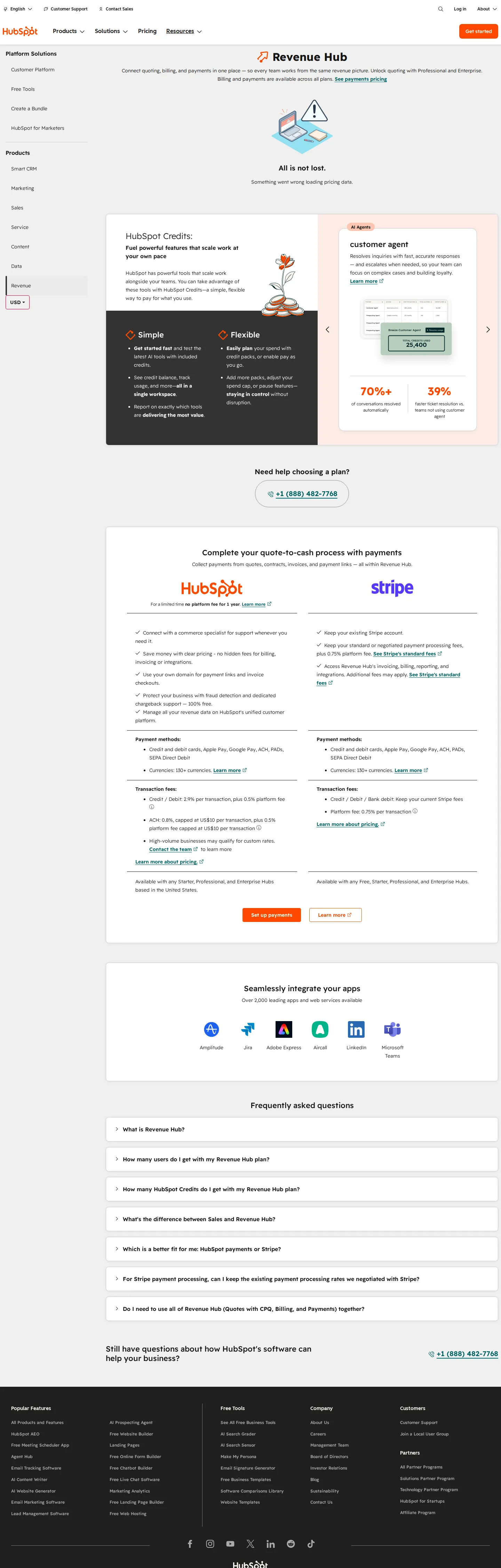
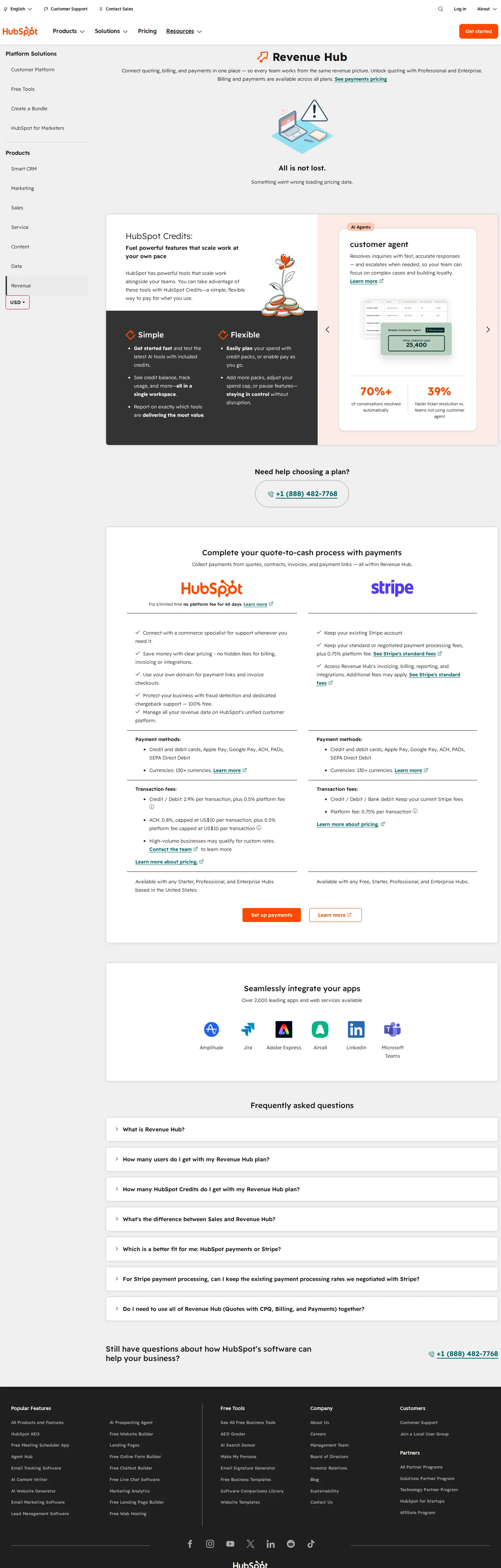
- Payments transaction fees (Revenue Hub, new): Revenue Hub — HubSpot’s newly launched CPQ, billing and payments product (“the evolution of Commerce Hub”) — is priced per Revenue Seat, like Sales Hub, on top of which it adds a transaction-based dimension: Free / Professional ($85/seat/mo annual, $95/seat/mo monthly) / Enterprise ($140/seat/mo) tiers, plus HubSpot Payments charging 2.9% + a 0.5% platform fee per card transaction (0.8% + 0.5%, each capped at $10, for ACH), with a no-platform-fee introductory promo now advertised as 1 year (extended from 60 days as of 2026-08-04), while sellers who keep Stripe pay a flat 0.75% platform fee on top of their existing Stripe rates.
What makes this different: HubSpot separates headcount (paid seats vs. free core/view-only seats), AI consumption (credits), audience size (marketing contacts), and now transaction volume (Revenue Hub payments) into independent axes, so an incumbent seat-based CRM captures AI and payments upside without repricing its core subscription. Choosing credits (rather than seats) as the AI meter is a deliberate answer to the value-metric problem in AI pricing — the metric that scales with delivered value, not headcount.
Pricing by product
Note on evidence: HubSpot’s public price grid at
/pricing/crmis rendered client-side from a Cloudflare-gated data API and, as recently as 2026-08-04, returned HTTP 200 but failed with “Something went wrong loading pricing data” under both standard and stealth capture — and that same failure was confirmed again on every per-Hub pricing page too (sales, service, marketing, content, operations, revenue), not just the main grid, in a fresh capture pass on 2026-08-04. The seat/tier dollar figures below were independently second-sourced from HubSpot’s own per-Hub pricing pages (/pricing/sales,/pricing/service,/pricing/marketing,/pricing/content,/pricing/operations,/pricing/revenue) and, on 2026-07-30, cross-checked a second time against a bot-neutral fetch of each live page plus HubSpot’s own blog pricing breakdowns (blog.hubspot.com/sales/hubspot-sales-hub-pricing,blog.hubspot.com/marketing/hubspot-marketing-hub-pricing) — this second pass caught and corrected a monthly/annual inversion on Marketing Hub Professional and a flat-fee mischaracterization of Revenue Hub (see below). The Agent Hub outcome prices and Revenue Hub payment transaction fees below are directly screenshot-confirmed from/products/artificial-intelligence(now the Agent Hub product page) and/pricing/revenue, whose payments content renders outside the gated tier-grid widget; a 2026-08-04 re-capture of/pricing/revenuealso caught the no-platform-fee promo’s duration changing from 60 days to 1 year (see below and Pricing evolution). The HubSpot Credits capacity-pack price ($10 per 1,000 credits/mo, or $9 per 1,000 when billed annually) and pay-as-you-go rate ($0.010/credit, 10-credit increments) are published in HubSpot’s Products & Services catalog. Figures still marked unknown below — the per-additional-marketing-contact overage rate — are genuinely unpublished on any reachable HubSpot surface, not merely bot-walled.
Sales & Service Hub (per-seat tiers)
| Tier | Price | Included | Key mechanics |
|---|---|---|---|
| Free Tools | Free | Free CRM for up to two users; foundational tools; Agent Hub assistant included | Top of the seat funnel; no card required |
| Starter | $20/seat/mo · $7 annual | Paid essentials per seat; base HubSpot Credits pool; HubSpot branding removed | Self-serve; lowest paid step |
| Professional | $90/seat/mo annual ($100 mo) | Per-seat tier with included Core Seats; larger credit pool; automation & reporting | One-time $1,500 onboarding fee; sales-assisted |
| Enterprise | From $150/seat/mo | Highest per-seat tier with included Core Seats; largest credit pool; governance & SSO | One-time $3,500 onboarding; sales-led, quoted |
Marketing Hub (flat platform fee + contact-tier dimension)
| Tier | Price | Included | Key mechanics |
|---|---|---|---|
| Free | Free | Baseline marketing tools; up to 2 users | Contact cap is the upgrade trigger |
| Starter | $20/seat/mo · $7 annual | Per-seat; includes 1,000 marketing contacts | Price rises with both seats and contact tier |
| Professional | From $800/mo annual ($890 mo monthly) | 3 Core Seats + 2,000 marketing contacts; one-time $3,000 onboarding | Flat monthly platform fee; contacts scale on top |
| Enterprise | From $3,600/mo | 5 Core Seats + 10,000 marketing contacts; one-time $7,000 onboarding | Marketing-contact overage billed on top (rate unpublished) |
Content & Data (Operations) Hub (flat platform fee at Pro/Enterprise)
| Tier | Price | Included | Key mechanics |
|---|---|---|---|
| Starter | $20/seat/mo · $7 annual | Per-seat; Data Hub Starter includes 500 HubSpot Credits | Self-serve |
| Professional | Content $450/mo annual ($500 mo) · Data $720/mo annual ($800 mo) | Includes Core Seats + credit pool (Data Pro: 5,000 credits); extra seats from $45/mo | Flat monthly platform fee |
| Enterprise | Content $1,500/mo · Data $2,000/mo | Includes Core Seats + credit pool (Data Ent: 10,000 credits); extra seats from $75/mo | Sales-led, quoted |
Revenue Hub (CPQ, billing & payments — new, launched by 2026-07-30)
Unlike the flat-fee Marketing/Content/Data Hubs, Revenue Hub is priced per Revenue Seat — the same per-seat structure as Sales and Service Hub, confirmed by HubSpot’s own FAQ copy (“Paid Revenue Hub plans are priced per seat”).
| Tier | Price | Included | Key mechanics |
|---|---|---|---|
| Free | Free | Invoices, payment links, subscriptions | Billing and payments available on every plan |
| Professional | $85/seat/mo annual ($95/seat/mo monthly) | Adds quotes, contracts, e-signature (25/user/mo), revenue analytics suite, automated sales tax | Unlocks CPQ quoting; 14-day trial |
| Enterprise | $140/seat/mo | Everything in Professional, plus advanced quote approvals, e-signature (50/user/mo) | Sales-led, quoted; 14-day trial |
| Payments item | Price | Mechanic |
|---|---|---|
| HubSpot Payments — card | 2.9% + 0.5% platform fee | Per transaction; no platform fee for the first year (limited-time promo, extended 2026-08-04 from 60 days) |
| HubSpot Payments — ACH | 0.8% (capped at $10) + 0.5% platform fee (capped at $10) | Per transaction |
| Keep Stripe | Existing Stripe rates + 0.75% platform fee | Available on Free, Starter, Professional and Enterprise Hubs |
Revenue Hub is described on-page as “the evolution of Commerce Hub” — the CPQ/billing/payments stack this page’s monetization signals previously tracked only as an internal HubSpot engineering build (see “Monetization stack & signals” below). HubSpot also runs a bundled cross-sell promo — existing Sales Hub customers billed annually can add Revenue Hub Professional for $57/seat/mo (down from $95) or Enterprise for $98/seat/mo (down from $140) — a new-customer/new-Hub-combination offer, not the standing list price.
HubSpot Credits (Agent Hub AI usage meter)
| Item | Price | Included / mechanic |
|---|---|---|
| Included credits | Bundled | Each paid tier includes a monthly credit allowance that scales by Hub and tier (e.g. Starter 500 → Enterprise 5,000–10,000) |
| Agent Hub Customer Agent | $0.50 / resolution | Outcome-priced (since 2026-04-14); 50 credits per resolved conversation; 28-day free trial |
| Agent Hub Prospecting Agent | $1.00 / lead | Outcome-priced (since 2026-04-14); 100 credits per recommended lead; 28-day free trial |
| Agent Hub Data Agent | $0.10 / answer | Outcome-priced Agent Hub agent; billed per answer |
| Credit packs | $10 / 1,000 credits / mo ($9 / 1,000 billed annually) | Prepaid capacity packs added on top of the included allowance (HubSpot Products & Services catalog) |
| Pay-as-you-go | $0.010 / credit | Optional overage per credit, invoiced in 10-credit increments, governed by an account spend cap |
Sales motions across products: PLG / self-serve for Free and Starter; sales-assisted for Professional; sales-led and quoted for Enterprise; a large partner/agency channel spans all tiers.
How Agent Hub AI (formerly Breeze) is priced
HubSpot retired the Breeze brand between 2026-07-14 and 2026-07-30 and now calls its AI agent layer Agent Hub (currently in Beta), which adds HubSpot AEO (Beta) and Agent Builder alongside the existing Customer, Prospecting, and Data Agents plus Smart Deal Progression. Agent Hub is monetized on two tracks. The in-app AI assistant/copilot functionality is included at no cost across all plans, alongside 100+ embedded AI features available even in the free edition. The named agents are billed on an outcome-based model — “you pay when work gets done” — at published per-action rates: the Customer Agent at $0.50 per resolution, the Prospecting Agent at $1.00 per lead, and the Data Agent at $0.10 per answer — figures unchanged from the Breeze era. These outcome charges draw against the account’s monthly HubSpot Credits allowance and, beyond it, its pay-as-you-go pool. This means AI value scales with delivered outcomes, not seats — a customer adds AI throughput by consuming credits, not by adding users.
Hidden costs : seats, credits, contacts, and onboarding fees stack up
HubSpot’s headline tier price understates the real bill because several dimensions stack: additional Core Seats beyond the included allotment, HubSpot Credits / Breeze Agent outcome charges once the bundled allowance is exhausted, marketing-contact-tier jumps on Marketing Hub, and one-time onboarding fees on Professional and Enterprise. The archetype below uses second-sourced figures (2026-07-06, HubSpot per-Hub pricing pages); only the unpublished dimensions (marketing-contact overage rate, per-credit pay-as-you-go rate) remain as unknown.
Archetype: a 12-person mid-market team on Professional Marketing + Sales (annual billing)
| Line item | Monthly cost |
|---|---|
| Marketing Hub Professional base (3 Core Seats incl., annual-billed rate) | $800 |
| Sales Hub Professional — 9 paid seats @ $90/seat (3 incl. + 6) | $810 |
| Marketing-contact tier above the included 2,000 contacts | unknown (rate unpublished) |
| Breeze Agent outcomes / credit overage (e.g. 1,000 extra credits @ $10, or PAYG $0.010/credit) | from $10/pack |
| One-time onboarding (Marketing $3,000 + Sales $1,500), amortized over 12 mo | ~$375 |
The seat-and-onboarding floor alone is roughly ~$1,985/mo in year one — before any marketing-contact overage or Breeze Agent outcome charges. Those AI charges are now quantifiable: at $0.50 per resolved conversation, a team fielding 2,000 monthly resolutions beyond its included credits adds ~$1,000/mo (≈100,000 credits ≈ 100 packs at $10) — so at moderate agent volumes the outcome fees can rival the seat spend. The lesson: a HubSpot bill is the sum of a platform fee, extra seats, a contact tier, credit/outcome overage, and an amortized onboarding fee — so the advertised per-seat number is a floor, not the total.
Want to estimate your own HubSpot bill? Use the HubSpot pricing calculator to model your monthly cost across seats, HubSpot Credits, and marketing-contact tiers.
Pricing evolution : from flat per-seat CRM to seats-plus-AI-credits
HubSpot’s monetization has moved in three deliberate steps: a free-CRM funnel (2014), an audience-based contact axis on Marketing Hub (2020), a platform-wide seats model (2024), and — most consequentially — an AI-usage meter (Breeze + Credits, 2024) that in 2026 shifted its flagship agents to outcome-based pricing. On 2026-07-30 HubSpot added a fourth monetizable axis — Revenue Hub’s payments transaction fee — shipping its previously internal Commerce Hub build as a priced product, while separately rebranding Breeze to Agent Hub with per-outcome prices held flat. Wayback’s CDX endpoint was unreachable during this pass, so the milestones below are dated from HubSpot’s own company-news / IR posts and corroborating press; historical entries are image-less by necessity.
Cadence
| Quarter | Price changes | Product / SKU additions | Notes |
|---|---|---|---|
| 2014 Q3 | 0 | 1 | Free CRM + Sidekick launched at INBOUND14 (2014-09-16), establishing the free-forever entry tier. |
| 2020 Q4 | 1 | 1 | Marketing Contacts pricing model introduced (Oct 2020): pay only for contacts you actively market to. |
| 2024 Q1 | 1 | 1 | Seats-based pricing rolled out across all Hubs (2024-03-05): Core Seats + free View-Only Seats; ~5% or less migration uplift at renewal. |
| 2024 Q3 | 0 | 2 | Breeze AI brand + HubSpot Credits launched at INBOUND 2024 (2024-09-18); packs $10/1,000 credits, PAYG $0.010/credit. |
| 2026 Q2 | 2 | 0 | Breeze Agents move to outcome-based pricing (2026-04-14): Customer Agent $1.00/conversation → $0.50/resolution; Prospecting Agent monthly-per-contact → $1.00/lead. |
| 2026 Q3 | 1 | 3 | Warmly acquisition (2026-07-01, terms undisclosed) folds a buyer-intent signal tool into the CRM — no packaging change yet; snapshot on 2026-07-06 found five Hubs at Free/Starter/Professional/Enterprise + credits, price grid Cloudflare-gated under capture; 2026-07-30 HubSpot launched Revenue Hub, priced per seat (Free / $85 seat/mo annual, $95 monthly / $140 seat/mo Enterprise, plus HubSpot Payments transaction fees) as “the evolution of Commerce Hub,” and separately retired the Breeze brand for Agent Hub (Beta), adding HubSpot AEO (Beta) and Agent Builder with per-outcome prices unchanged; 2026-08-04 a re-capture caught Revenue Hub’s no-platform-fee promo extended from 60 days to 1 year (transaction rates and Agent Hub per-outcome prices unchanged). |
Tracked range: 2014-09–2026-08. Quarters not listed were not independently verified during this pass (Wayback CDX unreachable).
Notable changes
- 2014-09-16 — Free CRM and the Sidekick sales tool launched at INBOUND14, creating the free entry point that still tops the seat funnel (HubSpot company-news).
- 2020-10 — Marketing Contacts model introduced: Marketing Hub prices scale with actively-marketed contacts, and up to 1M non-marketing contacts store free (HubSpot company-news).
- 2024-03-05 — Seats-based pricing replaced seat minimums across all Hubs (2024-03-06 APAC); paid Core Seats gain edit + AI access, free unlimited View-Only Seats for the rest; existing customers saw ≤~5% migration uplift at renewal (HubSpot company-news).
- 2024-09-18 — Breeze AI (Copilot, Agents, Intelligence) + HubSpot Credits launched at INBOUND 2024; capacity packs priced at $10 per 1,000 credits/mo and pay-as-you-go at $0.010/credit (HubSpot IR / BusinessWire).
- 2026-04-14 — Breeze Customer Agent and Prospecting Agent moved to outcome-based pricing (announced 2026-04-02): $0.50 per resolved conversation and $1.00 per recommended lead, each billed in credits, with a 28-day complimentary trial (HubSpot company-news; MarTech; CMSWire; SiliconANGLE).
- 2026-07-01 — HubSpot acquired Warmly, a signal-based buyer-intent tool, to close a CRM visibility gap around buyer intent (terms undisclosed; single-outlet report). No pricing or packaging change accompanied the deal: an intent-signal capability is a plausible future HubSpot Credits consumer, but as of this review it has not been productized or metered as a separate SKU (CX Today).
- 2026-07-30 — HubSpot launched Revenue Hub, described on its own pricing page as “the evolution of Commerce Hub” — the CPQ/billing/payments build this page had tracked since June 2026 only as an internal engineering hiring signal (see Monetization stack & signals below). Priced per Revenue Seat like Sales Hub: Free / Professional $85/seat/mo annual ($95/seat/mo monthly) / Enterprise $140/seat/mo, with HubSpot Payments charging 2.9%+0.5% per card transaction (0.8%+0.5%, capped at $10, for ACH) or a flat 0.75% platform fee for sellers who keep Stripe (HubSpot Revenue Hub pricing page).
- 2026-07-30 — HubSpot retired the Breeze AI brand (last confirmed 2026-07-14) in favor of Agent Hub (Beta), adding HubSpot AEO (Beta) and Agent Builder alongside the existing Customer, Prospecting, and Data Agents; per-outcome prices are unchanged at $0.50/resolution, $1.00/lead, and $0.10/answer (HubSpot Agent Hub product page).
- 2026-08-04 — A routine re-capture of
/pricing/revenuefound HubSpot’s introductory no-platform-fee promo for HubSpot Payments now reads “For a limited time no platform fee for 1 year,” up from “no platform fee for 60 days” on the same page just five days earlier (2026-07-30) — a 6x extension of the launch-discount window. Card (2.9%+0.5%), ACH (0.8%+0.5%, capped at $10) and Stripe-keep (0.75% flat) transaction rates, Revenue Hub’s seat tiers, and Agent Hub’s per-outcome prices ($0.50/resolution, $1.00/lead, $0.10/answer) are all unchanged; the CRM and per-Hub tier grids remain gated under both standard and stealth capture (HubSpot Revenue Hub pricing page, screenshot-confirmed).
The 2026 shift to outcome-based agent pricing in detail
HubSpot’s most editorially significant pricing move was not the 2024 Breeze launch (renamed Agent Hub on 2026-07-30) but the 2026-04-14 repricing of its two flagship agents to pay-per-result. Before the change, the Breeze Customer Agent billed $1.00 per conversation — a usage meter that charged whether or not the agent actually resolved the ticket — and the Prospecting Agent carried a recurring monthly charge for every enrolled contact. Both were replaced with outcome units: $0.50 per resolved conversation (50 credits) and $1.00 per recommended lead (100 credits), plus a 28-day complimentary trial so buyers can validate resolution rates before spend starts. HubSpot’s framing — “you pay when it works, full stop” — makes it the clearest incumbent example of the shift toward outcome-based AI pricing the whole category is testing.
The contrast with peers is the point:
- Salesforce Agentforce meters per conversation (historically ~$2/conversation, later Flex Credits) — HubSpot’s “per resolution” unit charges only on success, a stricter value alignment.
- Freshworks runs a per-session Freddy AI hybrid — a bounded-interaction unit that sits between conversation-metered and outcome-metered.
- The AI-bundled-in-seats camp — Pipedrive, Close, Copper, and Zoho — folds AI features into the seat price with no separate meter, trading upside capture for simplicity. HubSpot deliberately took the opposite path: a separate credit meter that lets the outcome unit exist at all.
What’s unique : four independent cost axes on one CRM platform
1. Four-axis pricing on a single platform. HubSpot separates seats, HubSpot Credits (AI usage), marketing-contact tiers, and — as of the 2026-07-30 Revenue Hub launch — payments transaction volume into independent dimensions. Most CRM incumbents scale on seats alone; HubSpot’s hybrid model lets it grow revenue on consumption, audience size, and now transaction volume without touching the seat price.
2. Free view-only and core seats. By distinguishing paid seats from free core and view-only seats, HubSpot removes the classic per-seat tax on read-only stakeholders — a packaging choice that lowers the objection to rolling the platform out org-wide.
3. Credits as an AI abstraction layer. HubSpot Credits sit between the customer and the underlying AI cost, so Agent Hub’s agents can be repriced or added without renegotiating contracts, and customers get a single spend cap instead of per-feature AI meters. This mirrors the industry-wide shift from entitlements to credits in AI billing that lets vendors expose AI at variable rates.
4. Internal infrastructure shipped as a priced product. Revenue Hub is explicitly positioned as “the evolution of Commerce Hub” — the CPQ/billing/payments build this page had tracked since June 2026 only through an internal engineering hiring signal (see Monetization stack & signals). Turning that build into a monetized, transaction-fee product rather than leaving it as pure cost-center infrastructure shows HubSpot treats platform investment as a future SKU pipeline, not just an operating expense.
Strengths & weaknesses
| Strengths | Weaknesses |
|---|---|
| Genuine free tier funnels a huge top-of-funnel into paid seats | Multi-axis bill (seats + credits + contacts + Revenue Hub payments) is hard for buyers to predict |
| AI monetized via credits without repricing the core seat subscription | One-time onboarding fees on Professional/Enterprise inflate year-one cost |
| All-in-one platform reduces point-tool sprawl | Marketing-contact tiers can escalate cost independently of team size |
| Free view-only seats lower org-wide rollout friction | Public price grid is Cloudflare-gated, hurting transparency for buyers |
| Revenue Hub converts a previously internal Commerce Hub build into a monetized payments product, adding transaction-based revenue independent of seats | HubSpot has renamed its AI brand twice in under two years (Breeze → Agent Hub, 2026-07-30), adding buyer-facing churn even though per-outcome prices haven’t changed |
Billing UX : credit balance, packs, pay-as-you-go, and spend caps
- HubSpot Credits workspace — a single view to see credit balance, track usage, and report on which tools consume the most credits.
- Credit packs — prepaid credit bundles added on top of each tier’s included pool to plan spend in advance.
- Pay-as-you-go — optional overage mode that bills per credit consumed once the included pool and packs are exhausted.
- Spend cap — an account-level ceiling that lets admins add packs, adjust the cap, or pause features to stay in control without disruption.
- Currency selector — the pricing page exposes a currency picker (e.g. USD) so buyers can view region-appropriate pricing.
- Seat management (Core vs. view-only) — paid Core/Hub seats are managed separately from free core and view-only seats, so read-only users can be added without per-seat charges.
Strategic wins : how HubSpot monetized AI without repricing seats
1. Credits decouple AI upside from the seat model
By routing Breeze AI through a credit pool, HubSpot captures AI consumption revenue without touching its anchor per-seat subscription. This is the textbook incumbent play covered in our introduction to usage-based pricing and our playbook for migrating a SaaS product to usage-based pricing: add a metered dimension alongside — not instead of — the recurring fee.
2. Free tier as a growth engine
A genuinely free CRM for up to two users seeds HubSpot into small teams that later convert to Starter and Professional. The free entry point is a deliberate product-led growth wedge that most enterprise CRM incumbents refuse to offer.
3. Free view-only seats reduce rollout friction
Charging only for active Core/Hub seats while leaving view-only seats free removes a common blocker to org-wide adoption, expanding the account footprint that later justifies higher tiers — a packaging lesson explored in our billing and invoicing guide.
4. Shipping Commerce Hub as Revenue Hub validates the roadmap bet
HubSpot’s own June 2026 hiring for a “Principal Software Engineer - Commerce” explicitly named CPQ, Billing, Payments, and Revenue OS as the build’s scope — and on 2026-07-30 that same build shipped as Revenue Hub, a priced, transaction-fee product (“the evolution of Commerce Hub”). Converting an internal engineering investment into a customer-facing revenue line, rather than treating it as pure cost-center infrastructure, mirrors the broader incumbent playbook in our guide to migrating a SaaS product to usage-based pricing: build the metering rails first, monetize second. HubSpot then moved fast to seed adoption of that new take rate: just five days after launch, it stretched Revenue Hub’s introductory no-platform-fee window from 60 days to a full year (2026-08-04) — a buyer-favorable trade that defers HubSpot’s own platform-fee revenue on every early Revenue Hub merchant in exchange for lowering the switching cost off Stripe or a standalone CPQ tool during the window that matters most for habit formation.
Areas to improve : transparency and bill predictability
1. Make the public price grid machine-readable
Serving prices client-side behind Cloudflare means the grid frequently fails to render for crawlers, comparison tools, and AI search engines — hurting HubSpot in exactly the AI-search surfaces buyers now use. A static, server-rendered price table (or JSON-LD Offer markup) would restore transparency.
2. Simplify the four-axis bill
Seats + credits + contact tiers + Revenue Hub payment fees + onboarding fees make total cost hard to predict. A published “typical total” calculator or bundled all-in tiers would reduce the sticker-shock risk that our usage-based pricing guide warns about.
3. Clarify credit-to-feature rates
Because credit consumption per Agent Hub action is opaque, buyers can’t forecast AI spend. Publishing per-action credit costs would make the credit model as legible as Cursor’s transparent $1-credit variant.
4. Reduce AI brand churn
HubSpot has renamed its flagship AI product twice in under two years — Breeze (launched 2024-09-18) to Agent Hub Beta (2026-07-30) — with per-outcome prices held constant across the rename. Even when pricing doesn’t move, frequent renaming forces buyers, analysts, and comparison tools to re-map vendor terminology; a public brand-continuity note mapping old SKU names to new ones alongside the outcome-based pricing shift would reduce that friction.
Monetization stack & signals : how HubSpot builds & buys its revenue engine
Buys 1 Builds 2 2 signal roles
HubSpot builds its own quote-to-cash stack (Commerce Hub: CPQ, billing, payments, revenue OS) rather than buying one, and its Principal-Commerce and pricing-strategy hires reveal a deliberate seat-to-credits migration — Breeze's outcome pricing is the leading edge, not a one-off.
- Commerce Hub (CPQ / Billing / Payments / Revenue OS) In-house build Job post Jun 2026
“Commerce Hub is building the backbone for businesses to sell, bill, get paid, and manage revenue inside HubSpot... you'll write code, dive into services, review tough designs, debug messy systems, and directly own the architecture behind some of the most critical surfaces in CPQ, Billing, Payments, and Revenue OS.”
-
“Having such an extensive infrastructure layer lets us seamlessly integrate with and benefit from all of HubSpot's internal tooling, including tracing, cost tracking, rate limiting, and scaling”
-
“HubSpot uses the Qdrant vector database for all semantic search operations. Qdrant is an open-source vector database that can be deployed on-premises.”
- Senior Corporate Strategy Manager - Pricing Monetization seen Jun 10, 2026
A dedicated pricing-strategy hire owns migrating customers off legacy seat pricing onto HubSpot Credits/usage models, confirming Breeze's outcome pricing is the leading edge of a broader seat-to-usage transition, not a one-off SKU experiment.
“Lead pricing for our AI-first platform and the evolution of HubSpot Credits to support scalable, usage-based growth... deep expertise in monetization, specifically usage-based or credit models, to navigate high-complexity strategic shifts.”
- Principal Software Engineer - Commerce Billing engineering seen Jun 8, 2026
HubSpot is building its own quote-to-cash stack (CPQ, billing, payments, revenue OS) in-house rather than buying a Zuora/Stripe Billing-style platform outright — the same engineering org that would own the metering behind Breeze's per-resolution and per-lead outcome pricing.
“Commerce Hub is building the backbone for businesses to sell, bill, get paid, and manage revenue inside HubSpot... directly own the architecture behind some of the most critical surfaces in CPQ, Billing, Payments, and Revenue OS.”
2 more matched roles — supporting evidence
- Senior Anaplan Model Builder, GTM Strategy & Operations RevOps Jun 24, 2026
- Senior Product Marketer, Pricing Strategy & Monetization Monetization seen Jun 8, 2026
Signals reviewed · derived from public job posts, engineering blogs
Job postings fill and close over time — once a posting is filled we keep it as a dated citation (the quoted evidence remains); use View open roles for current listings.
Key takeaways
- Add new revenue axes alongside seats, not instead of them. HubSpot bolted a credit meter onto its per-seat CRM in 2024, then on 2026-07-30 shipped Revenue Hub’s payments take rate as a fourth axis — capturing AI and payments upside without repricing its anchor per-seat subscription.
- A free tier can be a seat funnel. Even at enterprise scale, a genuinely free CRM seeds accounts that later convert to paid seats.
- Free read-only seats expand footprint. Separating paid seats from free view-only seats removes a rollout objection and grows the account.
- Abstract AI cost behind credits. A single credit pool with a spend cap is easier to sell — and reprice — than per-feature AI meters.
- Client-side price grids cost you transparency. Rendering prices behind a bot wall hides them from crawlers and AI search, undermining buyer trust.
UBP implications
- Credits are the incumbent’s bridge to usage-based pricing. A credit pool lets a seat-based vendor add a consumption dimension without a disruptive migration, keeping seat revenue intact while metering AI.
- Spend caps make usage-based pricing enterprise-safe. An account-level ceiling converts open-ended consumption into a bounded, budget-friendly commitment — a prerequisite for large-org adoption.
- Multi-axis pricing needs transparent forecasting. When seats, credits, contact tiers, and now Revenue Hub’s payments take rate (added 2026-07-30) all stack, the vendor’s obligation shifts from a single price to a predictable total; opacity here is a competitive liability that compounds with every new monetizable axis.
Sources
- HubSpot CRM pricing page (accessed 2026-08-04) — still gated, “Something went wrong loading pricing data”
- HubSpot Marketing Hub pricing (accessed 2026-08-04) — still gated
- HubSpot Sales Hub pricing (accessed 2026-08-04) — still gated
- HubSpot Service Hub pricing (accessed 2026-08-04) — still gated
- HubSpot Content Hub pricing (accessed 2026-08-04) — still gated
- HubSpot Operations / Data Hub pricing (accessed 2026-08-04) — still gated
- HubSpot Revenue Hub pricing (accessed 2026-08-04) — caught the no-platform-fee promo extending from 60 days to 1 year
- HubSpot Sales Hub Starter pricing (accessed 2026-07-06)
- HubSpot Agent Hub (formerly Breeze AI) (accessed 2026-08-04) — per-outcome prices unchanged
- HubSpot Products & Services catalog — HubSpot Credits capacity-pack ($10 / 1,000 credits/mo, $9 / 1,000 billed annually) and pay-as-you-go ($0.010/credit, 10-credit increments) rates; also confirms Smart CRM and Marketing Hub Starter/Professional/Enterprise figures (accessed 2026-07-30)
- HubSpot blog: “How Much Does HubSpot Sales Hub Cost?” — independent second source confirming Sales Hub Professional ($90/seat annual, $100/seat monthly) and Enterprise ($150/seat) rates (accessed 2026-07-30)
- HubSpot blog: “How Much Does HubSpot Marketing Hub Cost?” — independent second source that caught and corrected a monthly/annual inversion on Marketing Hub Professional ($800/mo annual, $890/mo monthly) (accessed 2026-07-30)
- HubSpot blog (accessed 2026-07-06)
Compare HubSpot against other CRM and customer-platform pricing in the pricing blueprint.
Bottom line
HubSpot is the clearest incumbent example of grafting usage-based and transaction-based pricing onto a seat-based CRM: Free/Starter/Professional/Enterprise across six Hubs (Starter $20/seat, or $7 annual; Sales/Service Pro $90/seat), a HubSpot Credits pool plus outcome-priced Agent Hub agents (renamed from Breeze on 2026-07-30) that meter AI, marketing-contact tiers, and — as of that same date — a Revenue Hub payments take rate (2.9%+0.5% per card transaction) that turns its formerly internal Commerce Hub build into a fourth monetizable axis. The model is smart, but the growing multi-axis bill and a Cloudflare-gated price grid make it harder than it should be to know what you’ll actually pay — the seat, Agent Hub, and Revenue Hub figures here had to be second- or screenshot-sourced from HubSpot’s per-Hub pages because the /pricing/crm grid never rendered under capture on 2026-07-30.
Pricing timeline : Major events on a vertical axis
Each milestone below corresponds to a public pricing change, product launch, or material adjustment. Major events use a filled marker; minor adjustments use a faded one.
Revenue Hub's no-platform-fee promo extended from 60 days to 1 year
HubSpot's Revenue Hub payments page now reads "For a limited time no platform fee for 1 year," up from "no platform fee for 60 days" confirmed on the same page five days earlier (2026-07-30) — a 6x extension of the introductory waiver window for HubSpot Payments. The underlying transaction rates (2.9%+0.5% card, 0.8%+0.5% capped-at-$10 ACH, 0.75% flat for sellers keeping Stripe) and Agent Hub's per-outcome prices ($0.50/resolution, $1.00/lead, $0.10/answer) are unchanged; the CRM and per-Hub tier grids remain gated ('Something went wrong loading pricing data') under both standard and stealth capture.
Breeze rebranded to Agent Hub
HubSpot retired the "Breeze" AI brand between 2026-07-14 and 2026-07-30 and repositioned the same agents as "Agent Hub" (Beta), adding HubSpot AEO (Beta), Agent Builder, and Smart Deal Progression to the lineup alongside the existing Customer, Prospecting, and Data Agents. Per-outcome prices are unchanged: $0.50/resolution, $1.00/lead, $0.10/answer, still billed against HubSpot Credits.

Revenue Hub launched (evolution of Commerce Hub)
HubSpot shipped Revenue Hub — CPQ, billing, and payments in one product — as "the evolution of Commerce Hub," the in-house build previously tracked only as an internal engineering signal on this page. Priced per Revenue Seat like Sales Hub: Free / Professional ($85/seat/mo annual, $95/seat/mo monthly) / Enterprise ($140/seat/mo); HubSpot Payments carries a 2.9%+0.5% (card) or 0.8%+0.5% (ACH, each capped at $10) transaction fee, with a 60-day no-platform-fee introductory promo, or sellers can keep Stripe at a flat 0.75% platform fee on top of their existing rates.
Pricing second-sourced (grid bot-walled)
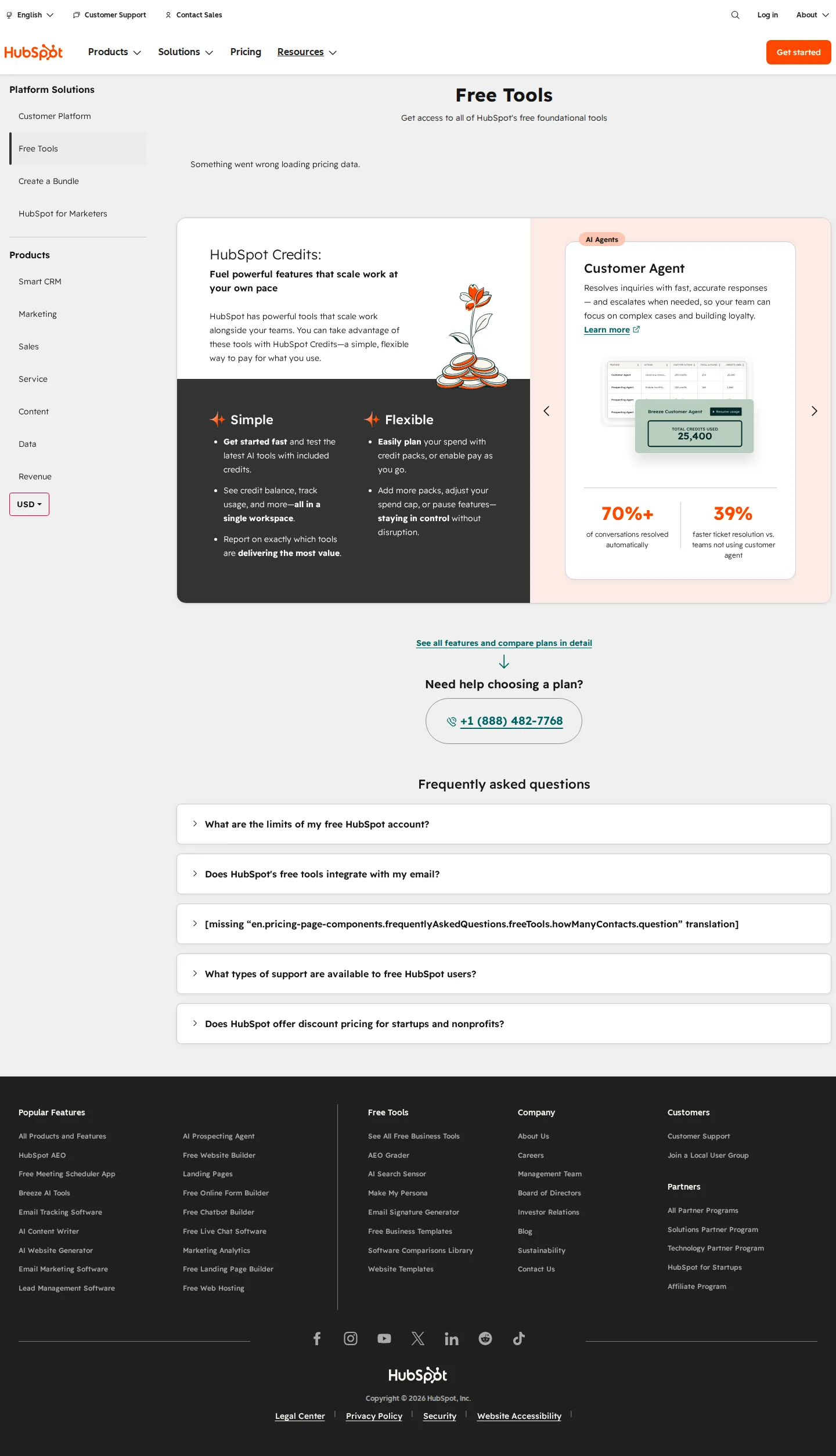
The live /pricing/crm grid is Cloudflare-gated and did not render under automated capture, so figures were second-sourced from HubSpot's per-Hub pages: Starter $20/seat/mo ($7 annual) across all Hubs; Sales/Service Pro $90/seat/mo annual, Enterprise from $150; Marketing/Content/Data Pro & Enterprise as flat monthly platform fees; Breeze Agents outcome-priced ($0.50/resolution, $1.00/lead, $0.10/answer).
Breeze Agents moved to outcome-based pricing
Effective 2026-04-14 (announced 2026-04-02), HubSpot repriced two agents to pay-per-result: Customer Agent from $1.00/conversation to $0.50 per resolved conversation (50 credits); Prospecting Agent from a recurring per-enrolled-contact charge to $1.00 per recommended lead (100 credits); a 28-day complimentary trial is included. (HubSpot company-news; MarTech; CMSWire; SiliconANGLE.)
Breeze AI + HubSpot Credits launched at INBOUND 2024
HubSpot unified its AI under the Breeze brand (Copilot, Agents, Intelligence) and introduced HubSpot Credits as the consumption meter that funds them, decoupling AI spend from seat count. Capacity packs: $10 per 1,000 credits/mo; PAYG $0.010/credit. (HubSpot IR/BusinessWire, 2024-09-18; archive unreachable.)
Seats-based pricing rolled out across all Hubs
HubSpot replaced seat minimums with a seats model (Core Seat = paid edit access; free/unlimited View-Only Seat) across every Hub and tier, effective 2024-03-05 for new customers (2024-03-06 APAC); existing customers saw ~5% or less migration uplift at renewal. (HubSpot company-news; archive unreachable.)
Marketing Contacts pricing model introduced
HubSpot moved Marketing Hub to a marketing-contacts model: customers pay only for contacts they actively market to (email/ads) and can store up to 1M non-marketing contacts free — adding a contact-tier axis independent of seats. (HubSpot company-news, Oct 2020; archive unreachable.)
Free CRM launched at INBOUND14
HubSpot released a genuinely free CRM (plus the Sidekick sales tool) at INBOUND 2014, establishing the free-forever entry tier that still anchors its seat funnel today. (HubSpot company-news, 2014-09-16; Wayback CDX unreachable this pass — sourced from dated press.)
- · HubSpot's public /pricing/crm grid is Cloudflare-gated and failed automated capture on 2026-07-06, but its per-Hub pricing pages render server-side: Starter is $20/seat/mo (or $7 billed annually) across every Hub, while Sales/Service Professional is $90/seat/mo annual and Marketing/Content/Data switch to a flat monthly platform fee.
- · HubSpot only moved its Breeze Agents to outcome-based pricing on 2026-04-14: the Customer Agent went from $1.00 per conversation to $0.50 per RESOLVED conversation (50 credits), and the Prospecting Agent from a recurring per-enrolled-contact charge to $1.00 per recommended lead (100 credits) — a deliberate 'you pay when it works' repackaging that undercuts Salesforce Agentforce's per-conversation meter.
- · HubSpot Credits do have a published price after all: capacity packs cost $10 per 1,000 credits per month and pay-as-you-go overage is $0.010 per credit (invoiced in 10-credit increments), per HubSpot's own Products & Services catalog — so a $0.50 Customer Agent resolution is literally 50 credits.
Questions & answers
- Does HubSpot have a free plan?
- Yes. HubSpot offers a free CRM tier with foundational tools for up to two users, positioned as the entry point to its paid Starter, Professional, and Enterprise seat tiers.
- How does HubSpot charge for AI (Agent Hub, formerly Breeze)?
- HubSpot renamed its AI layer from Breeze to Agent Hub (Beta) on 2026-07-30. The in-app Agent Hub Assistant (Copilot) is included free on every plan. Agent Hub's named agents are outcome-priced — $0.50 per resolution (Customer Agent), $1.00 per lead (Prospecting Agent), and $0.10 per answer (Data Agent) — billed against the account's monthly HubSpot Credits allowance and pay-as-you-go pool, with a spend cap for cost control.
- When did HubSpot switch to outcome-based AI pricing?
- HubSpot moved its Breeze Customer Agent and Prospecting Agent (renamed Agent Hub on 2026-07-30) to outcome-based pricing on 2026-04-14 (announced 2026-04-02). The Customer Agent went from $1.00 per conversation to $0.50 per resolved conversation, and the Prospecting Agent from a recurring per-enrolled-contact charge to $1.00 per recommended lead, each with a 28-day complimentary trial.
- What are HubSpot Credits and how much do they cost?
- HubSpot Credits are a single consumption unit that funds AI features across the platform. Each paid tier includes a monthly allowance; additional capacity packs cost $10 per 1,000 credits per month, and pay-as-you-go overage is $0.010 per credit (invoiced in 10-credit increments), all bounded by an account spend cap.
- Does HubSpot charge per seat, per contact, or per transaction?
- All three, depending on the Hub. Every Hub charges per paid seat by tier; Marketing Hub additionally scales by marketing-contact tier; and Revenue Hub, launched 2026-07-30, adds a payments transaction fee (2.9%+0.5% per card charge, or 0.8%+0.5% capped at $10 for ACH) on top of its own Free/Professional/Enterprise tiers — so headcount, contact volume, and transaction volume are three separate cost dimensions.
- How much does HubSpot Starter cost?
- HubSpot Starter is $20 per seat per month billed monthly, or $7 per seat per month billed annually, and that Starter rate is consistent across all five Hubs (Marketing, Sales, Service, Content, Data).