AI Summary
About
Lorikeet builds an AI customer-support agent that resolves tickets across chat, email, SMS, and voice channels. The company positions itself for support teams that want automation tied to a measurable business outcome — a resolved ticket — rather than to seats or raw message volume. Its core promise is incentive alignment: “We only charge for successfully resolved tickets. If you’re unhappy with how Lorikeet handled a ticket, you don’t pay for that ticket.”
The product is sold up-market by ticket volume. Lorikeet targets SMBs and startups handling under 5,000 monthly tickets on its Start plan, high-growth companies at 5,000–20,000 monthly tickets on Scale, and enterprises with 20,000+ monthly tickets or complex implementations on a custom Enterprise tier. Across all tiers it integrates with the major ticketing platforms — Zendesk, Intercom, HubSpot, Front, and Salesforce — and ships data integrations, custom guardrails, and concierge actions.
Lorikeet is an early-stage Australian company founded by Steve Hind (CEO, ex-Stripe) and Jamie Hall (CTO, ex-Google Brain). It raised a $9M round led by Blackbird in February 2025 (with Square Peg and Skip Capital), then a $35M Series A led by QED Investors in August 2025, taking total funding past $50M. Its pitch is a “workflows-first” agent that resolves complex, account-specific tickets — moving money, handling patient data — rather than the FAQ-deflection that retrieval-only chatbots handle.
Lorikeet competes in the AI customer-support category against incumbents like Intercom’s Fin and Zendesk’s AI agents, where outcome-based, per-resolution pricing has become the bellwether model. Its differentiator is transparency: where most sales-led peers gate every number behind a demo, Lorikeet publishes hard per-credit resolution rates on its pricing page.
Pricing summary : How Lorikeet’s per-resolution credit model works
Lorikeet uses an outcome-based credit model with two dimensions:
- Annual credit commitment (the plan fee): Start is $1,500/mo for 18,000 credits per year; Scale is $4,000/mo for 48,000 credits per year; Enterprise is a custom pool. Both published tiers are paid annually. There are no per-seat charges on any plan; implementation/platform access is listed as included on Start and Scale, and custom-quoted on Enterprise.
- Per-resolution credit draw (the usage): Each successfully resolved ticket consumes credits from the pool. A chat, email, or SMS resolution costs 0.95 credits on Start and 0.80 on Scale; a voice resolution costs 1.50 on Start and 1.20 on Scale, footnoted “*Voice resolution price is for resolutions up to 3 minutes long.” Non-resolution work also draws credits — routing or analytics tagging and automated QA each cost 0.30 per ticket on Start and 0.25 on Scale.
This is a pure outcome-based model priced in resolutions rather than seats, putting it alongside Intercom’s Fin in the customer-support AI pricing category.
What makes this different: the entire bill is a credit pool plus usage — Lorikeet charges nothing for seats, bundles implementation/platform access into Start and Scale, and explicitly does not bill for tickets it fails to resolve.
Pricing by product
Lorikeet AI support agent (annual plans)
| Tier | Price | Included | Key mechanics |
|---|---|---|---|
| Start | $1,500 / mo | 18,000 credits/year; Zendesk, Intercom, HubSpot, Front, Salesforce integrations; SOC2 Type 2 + ISO27001; standard USA-geo, zero-data-retention inference | Best for SMBs/startups with <5,000 monthly tickets; paid annually |
| Scale | $4,000 / mo | 48,000 credits/year; all ticket-platform integrations; standard-form DPA incl. HIPAA BAA; engineering support across contract life; inference same as Start | ”Most popular tier” — high-growth 5,000–20,000 monthly tickets |
| Enterprise | Custom | Custom credit pool; custom integrations; custom security reviews and custom DPA; dedicated engineering team; geo-specific data storage and inference | Sales-led, quoted; 20,000+ monthly tickets or complex builds |
Sales motions across products: sales-led (“Get a demo”) for every tier, including the two published-price plans; Enterprise is fully quoted.
Per-resolution credit rates inside the pool
Credits are consumed per ticket. Rates fall as you move up tiers:
| Credit draw | Start | Scale | Enterprise |
|---|---|---|---|
| Chat, email, SMS resolution | 0.95 | 0.80 | Custom |
| Voice resolution* | 1.50 | 1.20 | Custom |
| Routing or analytics tagging, per ticket | 0.30 | 0.25 | Custom |
| Automated QA, per ticket | 0.30 | 0.25 | Custom |
| Per-seat charges | None | None | None |
| Implementation or platform fees | Included | Included | Custom |
*Voice resolution price is for resolutions up to 3 minutes long — the page footnotes this caveat on all three plan cards but does not publish a rate for calls beyond 3 minutes.
The same rate card is published in a machine-readable file at lorikeetcx.ai/pricing.md, linked from the pricing page as “Pricing also available in machine-readable format.” As of the 2026-08-26/2026-08-28 captures, this file has drifted from the rendered page: it still lists per-seat charges and implementation/platform fees as “None” on all three tiers (the HTML page shows “Included” on Start/Scale and “Custom” on Enterprise), and it omits the newer “Inference and data locality” comparison row and the expanded DPA wording (“standard form DPA incl. HIPAA BAA” on Scale; “custom DPA” on Enterprise) that the HTML page’s full plan comparison now shows.
Lorikeet no longer publishes an explicit per-credit overage rate for consumption beyond the annual pool — its 2024 pricing page did (see Pricing evolution), but the 2026 page handles pool sizing and overage terms through the demo/sales motion. Lorikeet states it only charges for successfully resolved tickets.
Hidden costs : What a real Lorikeet support bill looks like
Because the bill is a credit pool, the real question is how fast your ticket mix burns credits — and voice resolutions burn the fastest. Two worked examples against the published rates:
A growing SMB on the Start plan
A startup resolving roughly 1,200 chat/email/SMS tickets and 100 voice tickets per month sits inside the Start pool.
| Line item | Monthly cost (credits) |
|---|---|
| Start plan base ($1,500/mo, 18,000 credits/yr) | $1,500 (≈1,500 credits/mo) |
| 1,200 chat/email/SMS resolutions × 0.95 | 1,140 credits |
| 100 voice resolutions × 1.50 | 150 credits |
| Total credits drawn / month | ≈1,290 credits |
At ≈1,290 credits/month the team fits comfortably inside the 18,000-credit annual pool (1,500/mo equivalent), so the bill is effectively the $1,500/mo plan fee — voice barely moves the needle at this volume.
A high-growth team on the Scale plan
A company resolving 3,500 chat/email/SMS tickets and 600 voice tickets monthly, plus running automated QA on every ticket.
| Line item | Monthly cost (credits) |
|---|---|
| Scale plan base ($4,000/mo, 48,000 credits/yr) | $4,000 (≈4,000 credits/mo) |
| 3,500 chat/email/SMS resolutions × 0.80 | 2,800 credits |
| 600 voice resolutions × 1.20 | 720 credits |
| 4,100 automated QA runs × 0.25 | 1,025 credits |
| Total credits drawn / month | ≈4,545 credits |
Here monthly draw (≈4,545 credits) exceeds the 4,000-credit monthly equivalent of the annual pool, so QA and voice push this team toward the top of — and potentially over — its commitment. The lesson: voice resolutions and per-ticket QA are the dimensions that turn a flat-looking plan fee into a variable one.
Want to estimate your own Lorikeet bill? Use the Lorikeet pricing calculator to model your monthly cost based on resolution channel mix and credit consumption.
Pricing evolution : From $500 self-serve to $1,500 sales-led in under two years
Cadence
| Quarter | Price changes | Product / SKU additions | Notes |
|---|---|---|---|
| 2024 Q3 | 0 | 0 | Earliest snapshot: Start $500/mo, Scale $2,000/mo, FAQ-vs-complex-workflow credit model, self-serve “Get started” pay-by-card. |
| 2024 Q4 | 0 | 1 | Explicit credit-overage rate published ($100/100 credits); HelpScout + Sunshine Conversations integrations added; blog launched. |
| 2025 Q1 | 0 | 1 | ”Maximum unique agents” row (1/2/Unlimited) and HIPAA BAA on Enterprise added; Stripe/Shopify/Twilio/Sendgrid called out by name. |
| 2025 Q2 | 0 | 0 | CTAs switched from “Get started” to “Book a demo” — self-serve checkout removed. Prices still $500/$2,000. |
| 2026 Q2 | 2 | 1 | Repriced: Start $500 to $1,500/mo, Scale $2,000 to $4,000/mo, both annual-only; credit meter switched to channel-based (chat/email/SMS vs voice); voice added as a paid channel on published tiers. |
| 2026 Q3 | 0 | 0 | Packaging-only: 2026-07-21 the voice resolution line gained an asterisk on all three plan cards scoping the rate to calls up to 3 minutes; machine-readable rate card published at /pricing.md. No list price or credit rate moved. |
Tracked range: 2024-09 to 2026-07. The 2025-06 Wayback snapshot rendered as an empty JS skeleton (no pricing text archived); quarters between mid-2025 and 2026 were not independently archived with legible pricing, so the exact date of the repricing within that window is unknown.
Notable changes
- 2024-09 — Earliest archived pricing: Start $500/mo / Scale $2,000/mo, credits priced by resolution complexity (0.67/0.50 FAQ vs 1.25/1.00 complex workflow), self-serve online click-through checkout.
- 2024-10 — Added explicit credit-overage rate ($100 per 100 credits or part thereof) and rollover/reset semantics; expanded integrations (HelpScout, Sunshine Conversations).
- 2025-02 — Raised $9M led by Blackbird (Square Peg, Skip Capital); the founders’ own blog frames this as ~$11M with strategic angels.
- 2025-05 — Self-serve “Get started” checkout removed; all tiers now route to “Book a demo”.
- 2025-08 — Raised a $35M Series A led by QED Investors, with Blackbird, Square Peg, Skip Capital, Airtree and others; total funding past $50M.
- 2026-06 — Repriced to channel-based per-resolution credits with a 2–3x list increase and an annual-only commitment.
- 2026-07-21 — Voice resolutions scoped by call length for the first time: an asterisk on all three plan cards resolves to “*Voice resolution price is for resolutions up to 3 minutes long.” The 1.50/1.20 credit rate itself did not move and no list price changed.
- 2026-07-21 — Published a machine-readable rate card at lorikeetcx.ai/pricing.md, linked from the plan cards as “Pricing also available in machine-readable format”.
The 2025–26 repricing in detail
Between the September 2024 launch pricing and the June 2026 capture, Lorikeet’s list price and its entire metering logic changed. Both shifts are visible in the Wayback screenshots:
- List price: 2–3x. Start went from $500/mo to $1,500/mo (3x); Scale from $2,000/mo to $4,000/mo (2x). Neither move exceeds the 5x threshold that would demand outside corroboration, and the direction matches a company that raised a $35M Series A in August 2025 and moved decisively up-market.
- Meter logic: complexity to channel. The 2024–2025 page charged 0.67–0.50 credits for an FAQ/help-center resolution and 1.25–1.00 for a complex-workflow resolution — the unit was how hard the ticket was. The 2026 page instead charges 0.95/0.80 for any chat/email/SMS resolution and 1.50/1.20 for voice — the unit is now which channel the ticket came in on. Voice, previously an Enterprise-only channel, became a billed line on the published tiers.
- Motion: self-serve to sales-led. The 2024 Start plan was an online click-through, pay-by-card purchase. By May 2025 every tier routed to “Book a demo”, and the 2026 page is fully sales-led — consistent with the move up-market and away from the long tail.
This is a clean case study in how an outcome-based pricing startup re-bases as it matures: raise the floor, simplify the meter to the cost driver that actually scales (voice automation), and trade self-serve breadth for sales-led depth.
What’s unique : Outcome-based credits with published per-channel rates
1. Published per-resolution credit rates in a gated category. Most AI customer-support vendors quote everything through a demo. Lorikeet prints the actual numbers — 0.95 credits per chat/email/SMS resolution, 1.50 per voice, dropping to 0.80/1.20 on Scale — which lets buyers model their bill before talking to sales.
2. Channel-differentiated resolution pricing — now scoped by call length. Lorikeet charges more for voice resolutions than for text channels (1.50 vs 0.95 on Start), reflecting the higher cost of voice automation. Since 2026-07-21 that voice rate is also bounded in time: the asterisk on every plan card resolves to “*Voice resolution price is for resolutions up to 3 minutes long,” so the published unit is no longer “a resolution” but “a resolution that fits inside three minutes.” That is a sharper version of the per-resolution billing unit than a flat resolution price — and the first sign that Lorikeet’s outcome-based meter is acquiring a consumption dimension underneath the outcome.
3. A machine-readable rate card built for LLMs and procurement. Alongside the footnote on 2026-07-21, Lorikeet began publishing its whole rate card as plain Markdown at lorikeetcx.ai/pricing.md, linked from the plan cards as “Pricing also available in machine-readable format.” Very few sales-led vendors ship a parseable price list at all; doing it in a category where most competitors gate every number behind a demo turns Lorikeet’s pricing into something an AI assistant or a procurement script can quote without a human in the loop.
4. Zero seats, zero platform fees. There are no per-seat charges and no implementation or platform fees on any tier. The entire bill is the annual credit commitment plus usage, which removes the seat-vs-usage tension common in hybrid customer-support pricing.
5. A “you don’t pay if we fail” guarantee. Lorikeet only charges for successfully resolved tickets and explicitly waives the charge when a customer is unhappy with how a ticket was handled — pushing outcome alignment further than a standard resolution meter.
Strengths & weaknesses
| Strengths | Weaknesses |
|---|---|
| Publishes hard per-resolution credit rates in a gated category | No self-serve checkout — every tier routes to “Get a demo” |
Machine-readable rate card at /pricing.md (added 2026-07-21) | Voice rate covers only resolutions up to 3 minutes; no published rate past that (2026-07-21) |
| No seat, implementation, or platform fees on any plan | Overage rate removed since 2024; no per-credit price for over-pool usage |
| Channel-differentiated rates (voice priced above text) | Annual-only commitment; no monthly-billing or pay-as-you-go option |
| Outcome guarantee — no charge for tickets it fails to resolve | No free tier or trial published; entry point is $1,500/mo |
| Volume discounts baked in (rates drop Start → Scale) | “Resolution” definition not spelled out on the pricing page |
Billing UX : Credit pools, channel rates, and a comparison tool
- Annual credit pool — each plan is sized as a yearly credit allotment (18,000 for Start, 48,000 for Scale, custom for Enterprise) billed monthly, so usage is metered against a single pre-committed balance.
- Per-channel credit rate card — the pricing page lists exact credit costs per resolution type (chat/email/SMS, voice) and per non-resolution action (routing/analytics tagging, automated QA), making credit burn predictable by channel. The voice line carries an asterisk on every plan card: “*Voice resolution price is for resolutions up to 3 minutes long.”
- Machine-readable pricing file — a “Pricing also available in machine-readable format” link under the plan cards opens lorikeetcx.ai/pricing.md, a plain-Markdown rate card with the plan table, per-ticket credit rates, worked billing examples, and the full plan comparison — built for LLM and procurement ingestion rather than browsing.
- Full plan comparison table — an expandable side-by-side compares integrations, custom guardrails, concierge actions, testing/simulations (unlimited), evaluations & reporting (unlimited), dedicated engineering, security posture, and contracting across all three tiers.
- “Are you overpaying for AI support?” calculator — an on-page Calculate tool that compares pay-per-ticket vs pay-per-resolution pricing to estimate what an existing AI vendor is really costing.
- No seat-fee line item — billing surfaces explicitly show “None” for per-seat charges on every plan; the “Implementation or platform fees” row (as of the 2026-08-26 capture) reads “Included” on Start and Scale and “Custom” on Enterprise, a wording change from the prior “None” shown on all three tiers.
- Per-tier inference and data-locality disclosure — the full plan comparison table lists inference/data-residency terms per tier (Start: “Standard, USA geo, zero data retention inference”; Scale: “Same as Start”; Enterprise: “Geo-specific data storage and inference”) alongside expanded DPA scope (Scale: standard-form DPA incl. HIPAA BAA; Enterprise: custom DPA plus custom security reviews).
Strategic wins : Transparency and incentive alignment as wedges
1. Publishing prices is a trust wedge in a gated category
By printing actual per-resolution credit rates while peers hide them behind demos, Lorikeet lowers the buyer’s research cost and signals confidence in its pricing. This is the same transparency play that makes outcome-based pricing credible — buyers can verify the math before committing.
2. Channel-differentiated rates match price to cost
Charging 1.50 credits for a voice resolution versus 0.95 for text ties the meter to the underlying cost of automation. This avoids the classic flat-resolution-price problem where cheap text channels subsidize expensive voice ones — a refinement many customer-support AI vendors skip. The 3-minute qualifier added on 2026-07-21 extends the same logic one layer down: a 20-minute voice resolution costs Lorikeet far more inference and telephony than a 90-second one, and capping the published rate stops the short calls from underwriting the long ones without forcing a headline price rise.
3. Removing seat and platform fees simplifies the buying decision
With no seats and no implementation fees, the buyer evaluates a single number — credits — instead of negotiating multiple line items. As covered in our guide to choosing the right usage metric, a single clean meter is easier to forecast and sell against.
4. Shipping a machine-readable rate card gets Lorikeet quoted where buyers now research
Publishing the full plan table and credit rates as plain Markdown at /pricing.md on 2026-07-21 makes Lorikeet’s pricing trivially ingestible by LLM assistants, procurement tooling, and comparison sites — the surfaces where a shortlist is increasingly formed before a demo is ever booked, and where a self-serve pricing calculator normally does the convincing. It costs nothing to maintain alongside a page whose numbers are already public, and it compounds the transparency wedge in win 1: rivals who gate pricing behind a demo simply cannot be cited by a research assistant, which is a distribution disadvantage as much as a trust one.
Areas to improve : Overage clarity, the 3-minute voice cap, and self-serve entry
1. Publish what a voice resolution costs past 3 minutes
The 2026-07-21 footnote scopes the 1.50/1.20 voice rate to “resolutions up to 3 minutes long” but publishes no rate above it, so the one channel with genuinely open-ended cost is also the one buyers can no longer model. For a support team, call length is not a rounding error — refunds, identity checks and account changes are exactly the long, complex calls Lorikeet markets itself on, so the unpriced tail sits on top of the highest-value tickets. A published second band (or a per-minute rate beyond three minutes) would close the gap without giving up the cap, and it should be mirrored into the /pricing.md rate card, which currently lists the voice rate with no duration qualifier at all — a mismatch that matters precisely because that file is built to be quoted by machines. Until then, the cap reintroduces the same modelling blind spot as the missing overage line below, in a category where unpredictable AI costs are the main procurement objection.
2. Bring back the published overage rate
Lorikeet’s 2024 pricing page listed an explicit overage rate ($100 per 100 credits or part thereof); the 2026 page lists annual credit pools but no per-credit price for consumption beyond them. Buyers can no longer model what happens when they exceed the commitment, which is a classic setup for bill shock. Re-publishing that line — which the company has done before — would complete the usage-based billing picture.
3. Define “resolution” on the pricing page
The whole model hinges on what counts as a successfully resolved ticket, yet the definition isn’t on the page. Spelling out the resolution criteria (and the unhappy-ticket waiver mechanics) would pre-empt the single biggest objection to outcome-based billing.
4. Offer a lower-friction entry point
The cheapest published plan is $1,500/mo on an annual commitment, with no trial or free tier. A self-serve or pay-as-you-go starter — even capped — would let smaller teams adopt without a sales conversation, widening the top of funnel — the kind of low-friction entry that usage-based pricing for SaaS and AI is built to enable.
Monetization stack & signals : how Lorikeet builds & buys its revenue engine
2 signal roles
No sourceable monetization stack and no published checkout — a sales-led, outcome-priced vendor whose only open roles (Ashby) are generalist product engineers. The signal is the absence below: the per-resolution meter sits inside the core product team, not a dedicated revenue-engineering function.
- Senior Software Engineer Data platform seen Apr 24, 2026
All four open Ashby roles are generalist product engineers (Sydney + NYC) owning 'the capabilities, the data models' end-to-end — none is a dedicated billing/metering, RevOps, deal-desk or monetization-PM hire. For a sales-led vendor billing per resolved ticket, that the per-resolution meter still lives inside the core product team rather than a standalone revenue-engineering function is itself the signal.
“Together we'll be defining what AI-first product development looks like in practice — the UI/UX, the capabilities, the data models.”
- Software Engineer Data platform seen Apr 24, 2026
All four open Ashby roles are generalist product engineers (Sydney + NYC) owning 'the capabilities, the data models' end-to-end — none is a dedicated billing/metering, RevOps, deal-desk or monetization-PM hire. For a sales-led vendor billing per resolved ticket, that the per-resolution meter still lives inside the core product team rather than a standalone revenue-engineering function is itself the signal.
“Together we'll be defining what AI-first product development looks like in practice — the UI/UX, the capabilities, the data models.”
Signals reviewed · derived from public job posts
Job postings fill and close over time — once a posting is filled we keep it as a dated citation (the quoted evidence remains); use View open roles for current listings.
Key takeaways
- Transparency can be a differentiator on its own — and it now has a machine-readable form. In a category where competitors gate every number, simply publishing per-resolution credit rates lowers buyer friction and builds trust before the first sales call. Lorikeet’s
/pricing.mdfile (2026-07-21) takes the same asset one step further, making the rate card quotable by the AI assistants buyers now use to build a shortlist. - Differentiate the meter by cost driver — but price the whole distribution. Pricing voice resolutions above text resolutions matches revenue to the real cost of automation, and the 2026-07-21 3-minute cap shows the next refinement: within a channel, duration drives cost too. The lesson for other teams is that a qualifier like this tightens margin quietly, without a headline price rise, so long as you also publish what happens past the cap.
- A single value metric simplifies the sale. Stripping out seats, implementation, and platform fees leaves one number to forecast and negotiate, which shortens the buying decision.
- Outcome guarantees raise the credibility ceiling. “You don’t pay for tickets we fail to resolve” is a stronger alignment signal than a meter alone — but it only works if the resolution definition is airtight.
- Pre-committed pools need published overage terms. Selling an annual credit pool without a stated overage rate leaves buyers unable to model the downside, which can stall deals at procurement.
UBP implications
- Pure outcome units are drifting back toward consumption. Lorikeet’s split between text and voice rates already fragmented the per-resolution unit by cost driver; the 2026-07-21 “up to 3 minutes long” qualifier adds a duration boundary inside the outcome itself. Outcome pricing that sits on variable inference cost tends to acquire consumption caveats over time, which is how a clean outcome meter quietly becomes a hybrid one.
- Transparency is becoming a competitive axis — and machine-readability is its next rung. When a sales-led vendor publishes hard rates, it pressures peers to follow; pricing-page opacity is increasingly a liability rather than a negotiating advantage. Publishing a parseable rate card, as Lorikeet did on 2026-07-21, extends that from human buyers to the AI agents and procurement tools doing the first pass of vendor research.
- Commitment-plus-outcome is a viable hybrid for AI services. Pairing an annual credit pool with per-outcome draw gives vendors revenue predictability while preserving the buyer-aligned outcome meter — a template other AI-services categories may adopt.
Sources
- Lorikeet pricing page (accessed 2026-07-21)
- Lorikeet machine-readable pricing (pricing.md) (accessed 2026-07-21)
- Lorikeet website (accessed 2026-06-07)
- Lorikeet blog (accessed 2026-06-07)
Bottom line
Lorikeet is one of the few AI customer-support vendors to put real outcome-based pricing in the open: annual credit pools, per-resolution rates that differ by channel, no seats or platform fees, and an explicit promise not to bill for tickets it fails to resolve — now also published as a machine-readable rate card that an assistant can quote. The July 2026 3-minute voice qualifier is the first visible crack in the flat outcome unit, and it lands on the same soft spot as the missing overage line: everything Lorikeet prices, it prices clearly, but the edges beyond the cap are still a sales conversation.
Want to compare Lorikeet against other customer-support pricing? Browse the pricing blueprint.
Pricing timeline : Major events on a vertical axis
Each milestone below corresponds to a public pricing change, product launch, or material adjustment. Major events use a filled marker; minor adjustments use a faded one.
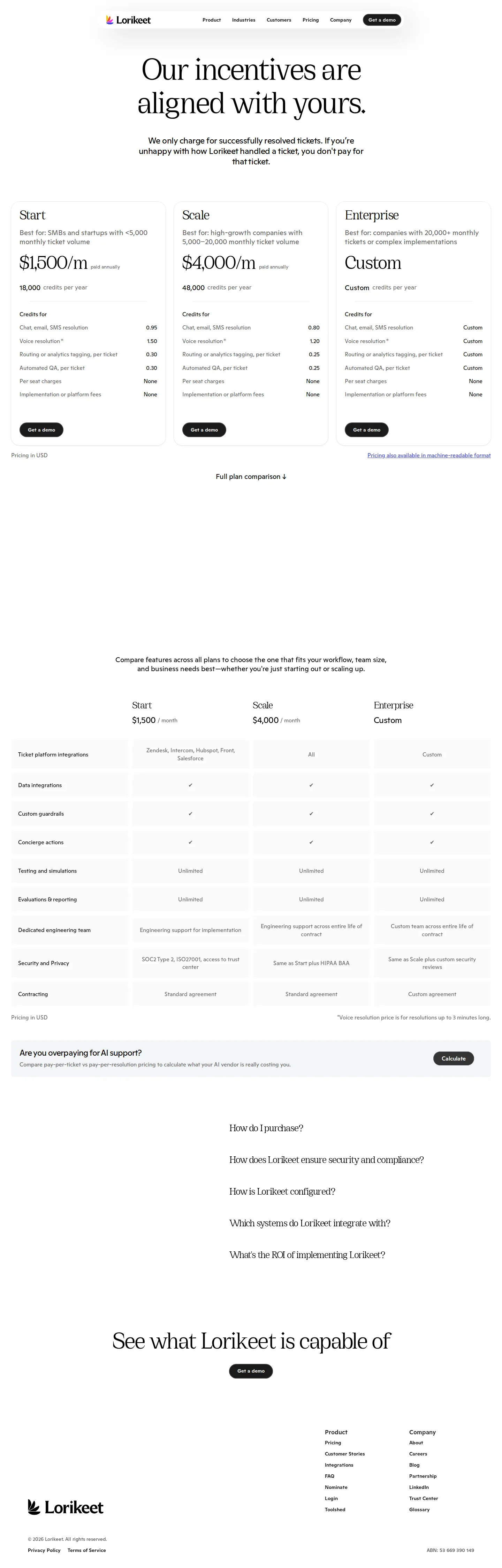
Voice resolutions capped at 3 minutes; machine-readable pricing published
List prices held ($1,500/mo Start, $4,000/mo Scale, Custom Enterprise) and every credit rate was unchanged, but the voice resolution line gained an asterisk on all three plan cards with the footnote 'Voice resolution price is for resolutions up to 3 minutes long' — scoping the 1.50/1.20 voice credit rate by call duration for the first time. Lorikeet also published a machine-readable pricing file at lorikeetcx.ai/pricing.md, linked from the pricing page as 'Pricing also available in machine-readable format'. Source: 2026-07-21 capture of lorikeetcx.ai/pricing.
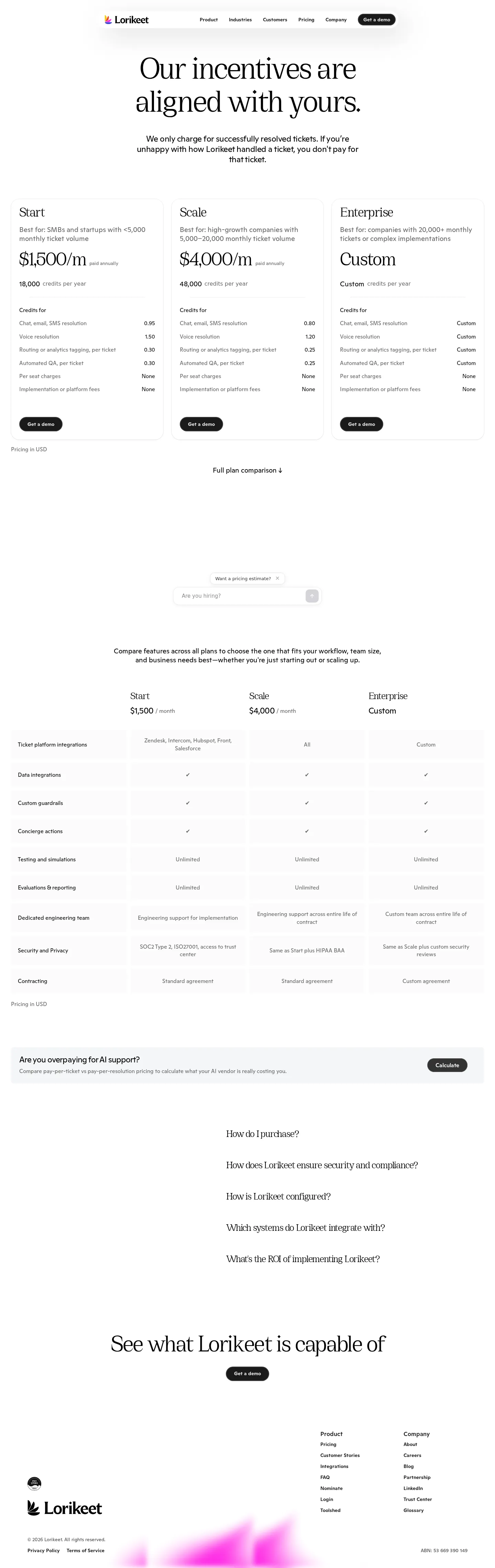
Repriced to channel-based per-resolution credits; 2–3x list increase
Major restructure between mid-2025 and 2026: Start rose $500 to $1,500/mo (3x) and Scale $2,000 to $4,000/mo (2x), both now annual-only credit pools (18,000 and 48,000 credits/yr). The credit meter switched from FAQ-vs-complex-workflow to channel-based — chat/email/SMS 0.95, voice 1.50 on Start (0.80/1.20 on Scale), with routing/analytics tagging and automated QA each 0.30 (0.25 on Scale). Voice became a paid channel on the published tiers; no seat or platform fees. Source: 2026-06-07 capture of lorikeetcx.ai/pricing.
Self-serve checkout removed — every tier routes to a demo
By May 2025 all three tiers' CTAs changed from 'Get started' to 'Book a demo', ending the self-serve online click-through. Prices and the FAQ-vs-workflow credit model held at $500/$2,000; a 'Maximum unique agents' row (1/2/Unlimited) and HIPAA BAA on Enterprise had been added since launch. Source: Wayback 2025-05 snapshot.
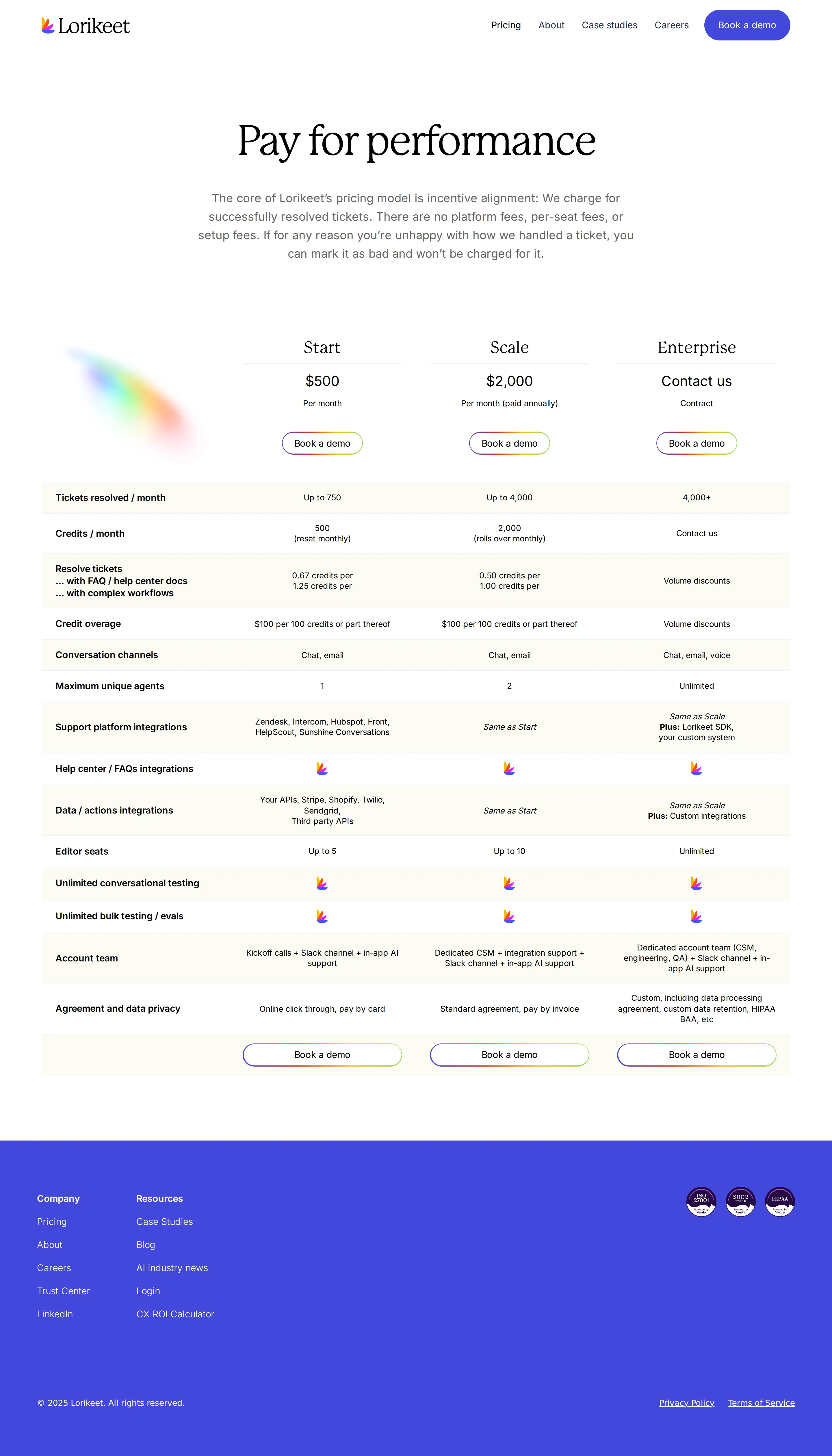
Credit overage rate and rollover semantics published
Added an explicit credit-overage line ($100 per 100 credits or part thereof) and clarified credit behaviour — Start credits reset monthly, Scale credits roll over monthly. Added HelpScout and Sunshine Conversations integrations and launched the blog. Prices unchanged at $500/$2,000. Source: Wayback 2024-10 snapshot.
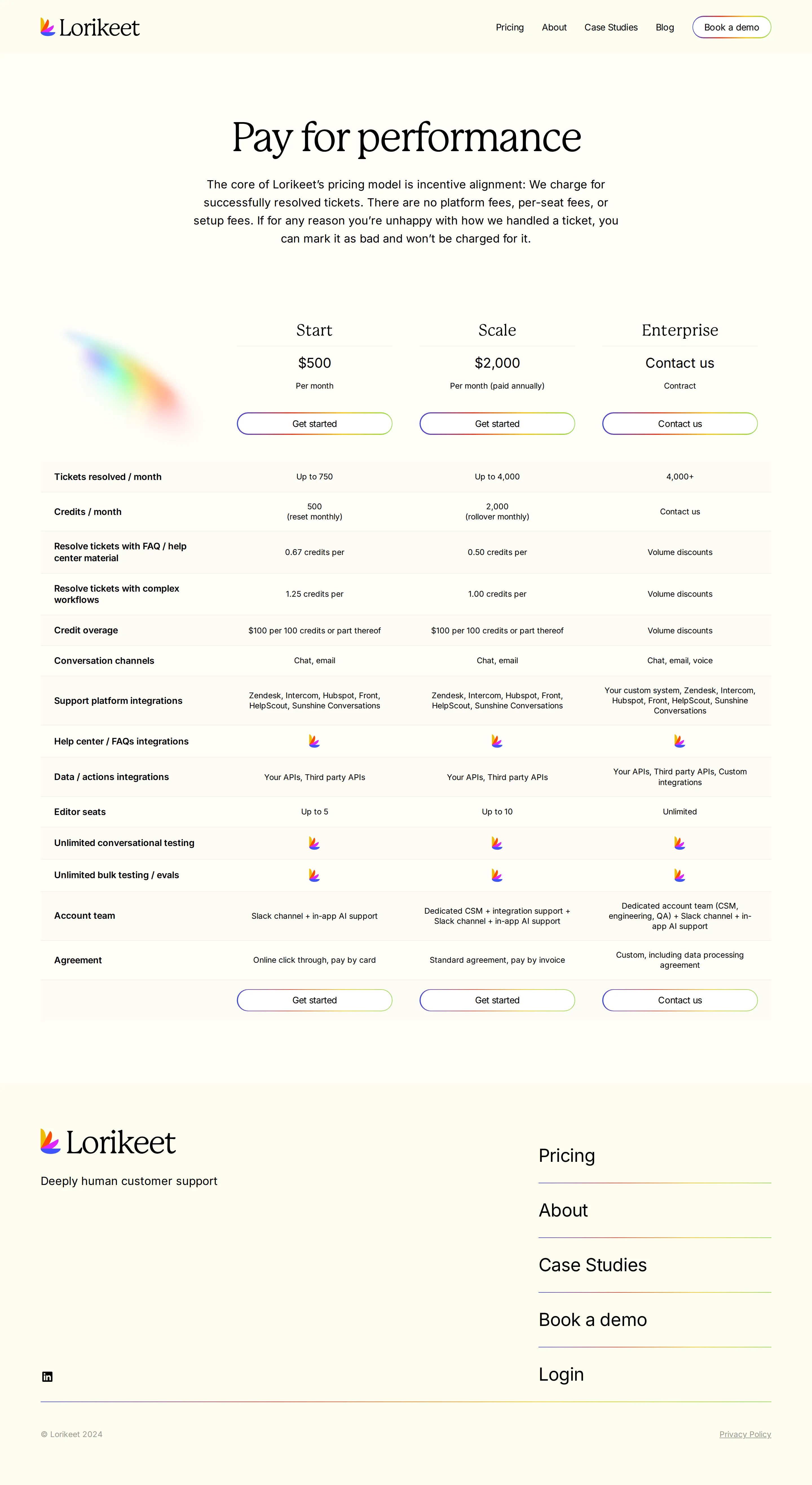
Workflow-vs-FAQ credit model with self-serve checkout
Earliest archived pricing: Start $500/mo (500 credits/mo, up to 750 tickets) and Scale $2,000/mo (2,000 credits/mo, up to 4,000 tickets), plus Contact-us Enterprise. Credits priced by resolution complexity — 0.67/0.50 per FAQ-resolved ticket vs 1.25/1.00 per complex-workflow ticket — with self-serve 'Get started' online click-through, pay-by-card. Source: Wayback 2024-09 snapshot of lorikeetcx.ai/pricing.
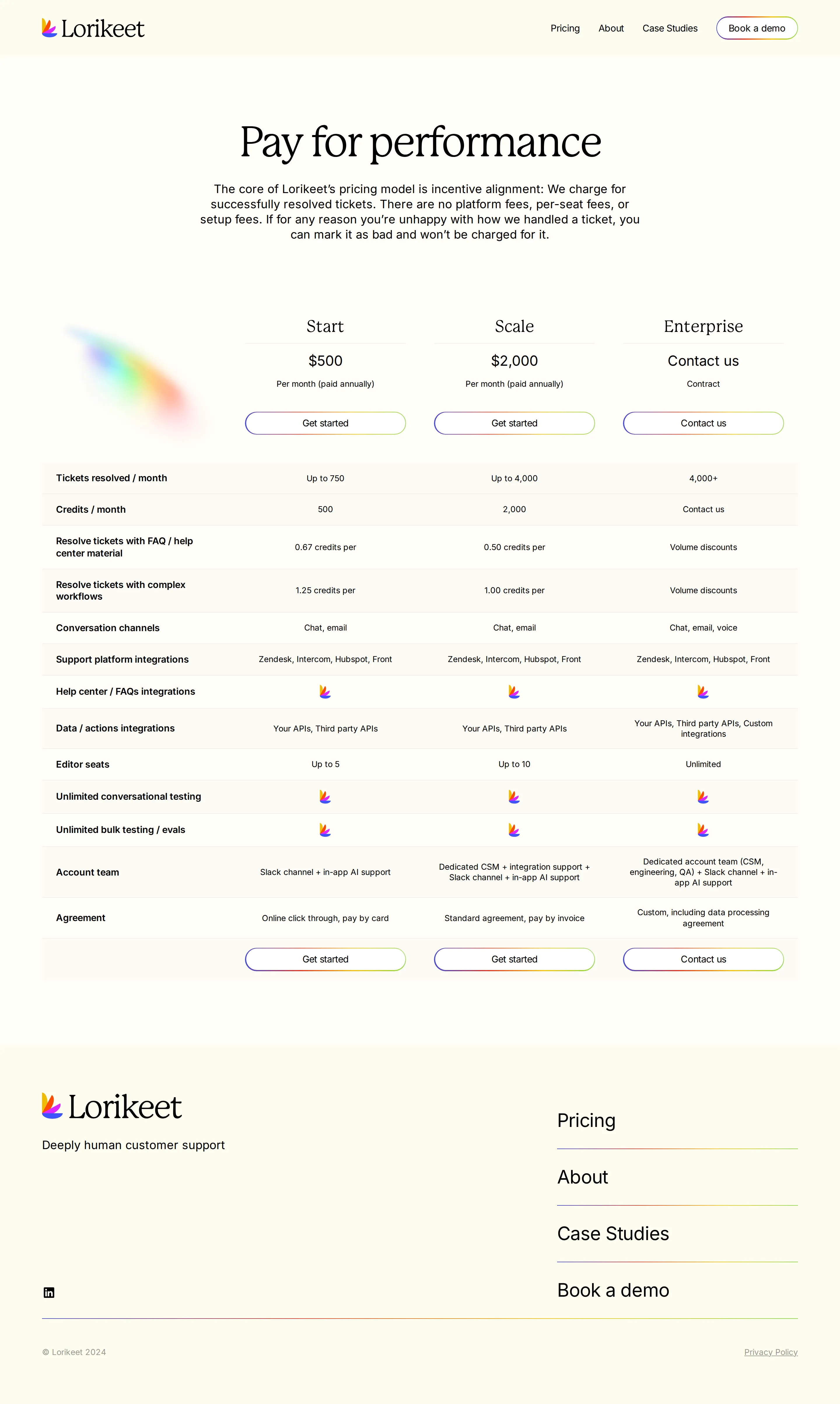
- · Lorikeet's entry price tripled in under two years: the Start plan was $500/mo in the September 2024 Wayback snapshot and is $1,500/mo by 2026, while Scale doubled from $2,000 to $4,000.
- · The credit meter was re-architected entirely — early pricing charged by resolution complexity (FAQ-resolved vs complex-workflow tickets), but the 2026 page charges by channel instead (chat/email/SMS vs voice).
- · Lorikeet quietly dropped self-serve: 2024 plans had 'Get started' online click-through, pay-by-card checkout, but by May 2025 every tier routes to 'Book a demo'.
Questions & answers
- How much does Lorikeet cost?
- Lorikeet's Start plan is $1,500/mo (18,000 credits per year) and the Scale plan is $4,000/mo (48,000 credits per year), both paid annually. Enterprise pricing is custom. All prices are in USD.
- How does Lorikeet's credit-based billing work?
- Each plan includes an annual pool of credits. A resolved chat, email, or SMS ticket consumes 0.95 credits on Start and 0.80 on Scale; a resolved voice ticket consumes 1.50 on Start and 1.20 on Scale, and Lorikeet footnotes that the voice resolution price is for resolutions up to 3 minutes long. Routing/analytics tagging and automated QA each draw 0.30 credits per ticket on Start and 0.25 on Scale.
- What happens if a Lorikeet voice call runs longer than 3 minutes?
- Lorikeet's pricing page footnotes that the published voice resolution rate (1.50 credits on Start, 1.20 on Scale) covers resolutions up to 3 minutes long, and it does not publish a rate for calls beyond that — so longer voice resolutions have to be priced through sales. The footnote appeared on 2026-07-21; the credit rate itself did not change.
- Does Lorikeet charge per seat?
- No. Lorikeet lists no per-seat charges on any plan. Implementation or platform fees are shown as included on Start and Scale, and custom-quoted on Enterprise — the bill is otherwise the annual credit commitment plus usage.
- Do I pay for tickets Lorikeet does not resolve?
- Lorikeet states it only charges for successfully resolved tickets: 'If you're unhappy with how Lorikeet handled a ticket, you don't pay for that ticket.'
- Which plan should I choose?
- Lorikeet positions Start for SMBs and startups under 5,000 monthly tickets, Scale for high-growth companies handling 5,000–20,000 monthly tickets, and Enterprise for companies with 20,000+ monthly tickets or complex implementations.