AI Summary
About
Metronome is usage-based billing and metering infrastructure for software companies. It ingests raw usage events in real time, lets teams construct billable metrics with SQL over those events, and powers usage-based, seat-based, subscription, and hybrid pricing models — so a vendor can change packaging and prices without re-engineering its billing stack. The platform centralizes rate cards, commits, and credit models as reusable building blocks and syncs to downstream finance systems (Stripe, cloud marketplaces, CRMs, ERPs, data warehouses).
Metronome serves AI and infrastructure companies that bill on consumption, with a customer list that includes OpenAI, Anthropic, Hugging Face, Together AI, Replicate, Anyscale, and Cribl. OpenAI publicly credits Metronome with replacing a homegrown, manual billing solution with an automated platform that let it launch new products and manage pricing quickly. As of 2026, Metronome is part of Stripe, positioning it as Stripe’s metering-and-monetization-infrastructure layer while it continues to operate its own pricing page and plans.
Metronome’s own pricing is now partly public. As of August 2026 the pricing page advertises a free-to-start entry plan billed at 0.8% of billing volume and $0.04 per 1,000 events — alongside a sales-quoted Custom plan (CTA now reads “Contact sales”) whose rates remain undisclosed. This reverses a long-standing no-published-rates posture, though the disclosure has already shifted: from 2026-07-14 through at least 2026-07-22 the entry-tier bullets stated an included allotment ($100,000 in billing volume and 10 million events per month) before those numbers disappeared from the page; as of 2026-08-04 the bullets showed only the flat metered rates with no included-volume language, and that remains the case as of 2026-08-27. Between 2026-08-04 and 2026-08-27 the plan card itself was also relabeled from “Starter” to “Startup” (the underlying rates and features did not change; the Custom card’s bullet still reads “Everything in Starter, plus” verbatim, an apparent copy inconsistency on Metronome’s own page). This blueprint records exactly what is visible and marks every undisclosed Custom figure as gated.
Pricing summary : a rate-published Startup plan and a sales-quoted Custom plan
Metronome packages its own product into two families — a Startup plan (relabeled from “Starter” between 2026-08-04 and 2026-08-27) with published usage rates and a sales-quoted Custom plan for its top end (a sales-led motion):
- Startup — free to start. “For teams launching usage-based products.” Bills 0.8% of billing volume and $0.04 per 1,000 events. As of 2026-08-27 the page states no included billing-volume or event allotment (unchanged since 2026-08-04) — a specific included-volume allotment was briefly listed from 2026-07-14 through at least 2026-07-22 (see Pricing evolution for the prior figure) before that allotment language was dropped. Also includes real-time usage metering and alerting; usage-based, seat-based, subscription, and hybrid pricing; support for scaled self-serve and custom enterprise contracts; native Stripe integration; and embeddable billing dashboards. The plan’s own card title reads “Startup” as of 2026-08-27, though the card was named “Starter” as recently as 2026-08-04.
- Custom — sales-quoted (“Contact sales”). “For companies scaling revenue or transforming pricing.” Everything in Starter, plus invoicing integrations (Salesforce, NetSuite, and AWS/Azure/GCP marketplaces), data exports to your warehouse and BI tools, a dedicated account manager, and enhanced SLAs and priority support. No Custom rates are published. (Bullet text “Everything in Starter, plus” is verbatim from the page as of 2026-08-27, despite the entry plan’s own card now being labeled “Startup” — an apparent internal copy inconsistency on Metronome’s page. The CTA button itself was also relabeled from “Talk to an expert” to “Contact sales” between 2026-08-04 and 2026-08-27.)
The Startup plan now meters on two dimensions — billing volume (a percentage of dollars processed) and events (per 1,000) — so Metronome’s own cost maps directly to usage-based pricing on billing volume and metered events rather than flat seats. The Custom plan’s rates remain sales-quoted.
What makes this different: A billing-infrastructure vendor that, for years, published none of its own prices surfaced explicit usage rates on its entry plan in July 2026 — and then, within weeks, quietly removed the included-allotment numbers from that same plan while keeping the metered rates themselves and the Custom tier fully sales-quoted. Between the 2026-08-04 and 2026-08-27 checks, the entry plan’s card label and the Custom plan’s CTA button text were also both renamed, with no change to any rate.
Pricing by product
Metronome platform (plan families)
| Tier | Price | Included | Key mechanics |
|---|---|---|---|
| Startup (card labeled “Starter” through at least 2026-08-04) | Free to start | Billed at 0.8% of billing volume and $0.04 / 1k events — no included allotment stated as of 2026-08-27 (unchanged since 2026-08-04; a specific included-volume allotment was briefly shown 2026-07-14 to at least 2026-07-22; see Pricing evolution); real-time usage metering and alerting; usage/seat/subscription/hybrid pricing; scaled self-serve and custom enterprise contracts; native Stripe integration; embeddable billing dashboards | Usage-metered self-serve entry; two metered dimensions (billing volume %, events per 1k); no stated free allotment as of 2026-08-27 |
| Custom | Contact sales (CTA read “Talk to an expert” through at least 2026-08-04) | Everything in Starter, plus marketplace/CRM/ERP invoicing (Salesforce, NetSuite, AWS/Azure/GCP), warehouse & BI data exports, dedicated account manager, enhanced SLAs and priority support | Sales-quoted for companies scaling revenue or transforming pricing |
The Startup plan (its card was relabeled from “Starter” between 2026-08-04 and 2026-08-27, with no change to any rate) publishes explicit metered rates — 0.8% of billing volume and $0.04 per 1,000 events — but as of 2026-08-27 the page still does not state an included billing-volume or event allotment (that has been true continuously since 2026-08-04). From 2026-07-14 through at least 2026-07-22 the bullets named a specific included allotment (see Pricing evolution for the prior figure); that allotment language remains gone, leaving only the flat rates. The Custom plan’s rates are not published — it is quoted entirely through a demo-request flow whose CTA button now reads “Contact sales” (it read “Talk to an expert” through at least 2026-08-04). Undisclosed Custom figures are recorded as gated, not estimated.
Sales motions across products: self-serve / PLG for the free Startup tier; sales-led for the Custom plan (quoted via the “Contact sales” demo flow).
Hidden costs : what a Metronome bill actually contains
Because Metronome publishes no public rates, a precise bill cannot be reconstructed from list prices — every Custom-plan figure is quoted through the “Talk to an expert” flow. What is knowable are the cost categories a buyer should budget for, and the indirect costs that come from how the platform is built. The biggest hidden cost with a developer-first metering platform is rarely the line item on the invoice; it is the engineering time to set it up and keep it running.
A representative mid-market SaaS vendor evaluating the Custom plan should expect the following cost shape (dollar values are gated and shown as quoted/unknown — this table sets the categories, not the prices):
| Line item | Monthly cost |
|---|---|
| Platform fee (Custom plan, volume-tiered on processed usage) | Quoted by sales |
| Usage-volume scaling (more billable events → higher tier) | Quoted by sales |
| Invoicing-integration enablement (Salesforce, NetSuite, AWS/Azure/GCP marketplace) | Included in Custom (scope-dependent) |
| Engineering time to model billable metrics in SQL | Internal cost (not on invoice) |
| Finance/ops dependence on engineering for pricing changes | Internal cost (not on invoice) |
| Estimated total | Gated — depends on processed-usage volume + integration scope |
The recurring complaint in third-party comparisons is the second-to-last row: because Metronome is a developer-first metering engine, setting up usage events and billable metrics requires coding and SQL, so finance and operations users typically cannot change pricing logic without pulling in engineering. That implementation-and-maintenance overhead is the true “hidden cost” — and it is the lever competitors like Orb use when they pitch a “less engineering” alternative. See how usage-based pricing reshapes the finance team’s workload for how that dependence compounds.
Want to estimate your own Metronome bill? Use the Metronome pricing calculator to model your costs based on processed-event volume and integration scope.
Pricing evolution : Metronome pricing history and changes
For most of its history Metronome published no dollar amounts at all on its own pricing surfaces. Across the archived range through mid-2026, the only thing that changed was how the gated pricing was presented — from a single custom-pricing contact form to an explicit Starter/Custom two-family layout — and the acquisition banner. That posture broke on 2026-07-14, when the free Starter tier surfaced explicit usage rates for the first time ($100,000 billing volume + 10M events included/mo, then 0.8% of billing volume and $0.04/1k events) — but the disclosure did not hold. By 2026-08-04, the included-volume numbers were gone from the same bullets, leaving only the flat metered rates (0.8% of billing volume, $0.04 per 1,000 events). The Custom plan has remained sales-quoted throughout.
Cadence
| Quarter | Price changes | Product / SKU additions | Notes |
|---|---|---|---|
| 2022 Q2 | 0 | 0 | /talk-to-an-expert is a sales-led “Talk to an Expert” form (employee-size selector, work email); no prices. This was the entry point as early as 2022-05. |
| 2024 Q4 | 0 | 0 | /pricing reads “Billing built to grow with you — custom pricing designed for your size and stage of business” with a contact/sandbox-request flow; no tier families, no rates. |
| 2025 Q4 | 0 | 1 | 2025-12-02: pricing-page banner changes to “Metronome has signed a definitive agreement to join Stripe”; layout otherwise unchanged. |
| 2026 Q1 | 0 | 1 | 2026-01-14: Stripe completes the acquisition; the 2026-01-08 snapshot still shows the “definitive agreement” banner and the contact-form layout. |
| 2026 Q1–Q2 | 0 | 1 | Between 2026-01 and 2026-02 the page is restructured into an explicit free Starter tier + sales-quoted Custom plan, and the banner updates to “Metronome is now part of Stripe.” Still no dollar amounts. |
| 2026 Q3 | 2 | 0 | 2026-07-14: the free Starter tier publishes explicit usage rates for the first time — $100,000 billing volume + 10M events included/mo, then 0.8% of billing volume and $0.04/1k events; the Custom plan stays sales-quoted and drops its “tailored pricing for high-volume usage and scale” bullet. 2026-08-04: those included-volume numbers disappear from the same Starter bullets, leaving only the flat metered rates (0.8% of billing volume, $0.04/1k events); the underlying rates are unchanged. |
Tracked range: 2022-05–2026-08 (Wayback /talk-to-an-expert from 2022, /pricing from 2024-12). Quarters not listed showed no presentation or banner changes. Published rates first appeared on 2026-07-14 (Starter tier) and were partially withdrawn on 2026-08-04, when the included-volume language was removed; no Custom dollar amounts have ever been published.
Notable changes
- 2025-12-02 — Stripe announces it will acquire Metronome; the pricing-page banner is updated to “Metronome has signed a definitive agreement to join Stripe” the same day (Wayback snapshot 2025-12-02; Metronome blog “Important Company Update”).
- 2026-01-14 — Stripe completes the acquisition (Stripe newsroom). Terms were not officially disclosed; multiple outlets reported a price of roughly $1 billion.
- 2026-02 — Pricing page is restructured into the explicit free Starter + sales-quoted Custom plan families, and the banner becomes “Metronome is now part of Stripe. Together, we’re building the future of monetization infrastructure” (Wayback snapshot 2026-02-13).
- 2026-07-14 — Metronome publishes usage rates on the free Starter plan for the first time: $100,000 in billing volume and 10M events included per month, then 0.8% of billing volume and $0.04 per 1,000 events. This ends a years-long no-published-rates posture. The Custom plan remains sales-quoted and drops its former “tailored pricing for high-volume usage and scale” bullet (captured from metronome.com/pricing).
- 2026-08-04 — Metronome removes the included-volume allotment language from the Starter plan bullets, three weeks after first publishing it. The card now reads “Billing volume billed at 0.8%” and “Events volume billed at $0.04/1k ingest events” with no included-allotment figures; the underlying metered rates are unchanged and the Custom plan remains fully sales-quoted (captured from metronome.com/pricing).
The Starter rate publication in detail
For years the defining fact about Metronome was that a billing company — one whose entire product is metering consumption and pricing on it — published none of its own rates. On 2026-07-14 that reversed, but only halfway. The free Starter tier now names two metered dimensions with explicit numbers: $100,000 in billing volume and 10 million events are included each month, after which Metronome charges 0.8% of billing volume and $0.04 per 1,000 events. The mechanic is worth reading closely — Metronome now bills its own customers the same way its platform bills their customers: a percentage of processed dollars plus a per-event fee, with a generous free allotment that doubles as the product-led on-ramp.
The reversal is partial and deliberate. The tier that actually matters for scale — Custom — is still quoted entirely through “Talk to an expert,” and it quietly dropped the “tailored pricing for high-volume usage and scale” line it used to carry, so there is now no pricing signal on the Custom plan at all. So the page has inverted its own information gradient: the entry plan a small team can estimate down to the dollar, and the enterprise plan a serious buyer needs is darker than before. For pricing-strategy readers the notable detail is timing — the disclosure lands roughly six months after the Stripe acquisition closed, aligning Metronome’s entry plan with the largely transparent published rates of its new parent while preserving full sales control at the top.
The Starter allotment removal in detail
The Starter disclosure did not last. From 2026-07-14 through at least 2026-07-22, the plan’s own bullets named a specific free allotment — “$100,000 in billing volume included, billed at 0.8% after that” and “10M events included, billed at $0.04 / 1k events after that.” By 2026-08-04, those same two bullets read only “Billing volume billed at 0.8%” and “Events volume billed at $0.04/1k ingest events” — the included-volume numbers are gone, and the card now states nothing but the flat metered rates.
The underlying rates did not change: Metronome still charges 0.8% of billing volume and $0.04 per 1,000 events. What disappeared is the number that told a prospect how much of that they could use for free. The page’s headline copy — “Start free, scale confidently. Never outgrow your billing infrastructure.” — is unchanged, so a visitor has no on-page explanation for why the allotment vanished only three weeks after it first appeared. It isn’t possible to tell from the page alone whether Metronome quietly pulled a real free allotment, corrected marketing copy that had overstated an internal figure, or moved the allotment somewhere this capture doesn’t cover (a contract or docs page). Whatever the cause, the practical effect for a self-serve buyer is the same: the Starter plan that briefly let a prospect estimate a specific free-usage ceiling can no longer be estimated below the point where metered billing starts.
The Stripe acquisition in detail
The acquisition is the single most important inflection point in Metronome’s history, and the only one that left a visible mark on the pricing surface. Stripe announced the deal on December 2, 2025 (mirrored by Metronome’s “Important Company Update” blog post, which surfaced on Hacker News at 20 points) and completed it on January 14, 2026 (Stripe newsroom). Neither company officially disclosed the price; several secondary outlets (PYMNTS, Payments Dive, and others) reported terms were not released, while a number of trade write-ups characterized it as a roughly $1 billion deal. Per this blueprint’s verification rules, the deal value is treated as reported-but-unconfirmed, and only the two dated, first-party-corroborated events (announcement and completion) are stated as fact.
Strategically, Stripe framed the move as building “the foundational monetization infrastructure for the next generation of software,” with Metronome’s metering engine — already used by OpenAI, Anthropic, and NVIDIA — slotting alongside Stripe Billing to cover complex usage-based models, thousand-SKU catalogs, and sales-led motions. For pricing-strategy readers, the notable detail is the lag: the acquisition did not make Metronome’s own pricing more transparent right away — the page gained an explicit free Starter tier shortly after the close but no rates — and it took until 2026-07-14, roughly six months post-close, for the Starter plan to publish actual usage rates. The Custom plan remains entirely sales-quoted with no published rates.
What’s unique : the billing vendor that finally published a rate
1. The cobbler’s-children pattern — half-fixed, then half-unfixed. Metronome’s entire product is the ability to meter raw usage events and bill on them, yet for years its own pricing carried no per-event rate, no seat price, and no processed-volume table. That broke on 2026-07-14, when the Starter plan surfaced explicit rates — $100,000 billing volume + 10M events included, then 0.8% and $0.04/1k events — so Metronome briefly metered itself the same way it meters its customers. The reversal didn’t hold: by 2026-08-04 the included-allotment numbers were gone from the same bullets, leaving only the flat 0.8%-and-$0.04/1k rates with no stated free volume. The Custom plan is still fully sales-gated and even dropped the “tailored pricing for high-volume usage and scale” line it used to show — so three weeks after the Starter plan looked like the more transparent tier, both tiers now withhold the one number a self-serve buyer needs most: how much they can use before they’re billed.
2. Free at the bottom, fully quoted at the top — and nothing in between. The two-family structure is a $0 self-serve Starter and a contact-sales Custom plan, with no published mid-market step. The free tier is unusually complete for an infrastructure product (real-time ingestion, hybrid pricing models, native Stripe integration, embeddable dashboards), which functions as a product-led on-ramp that converts into a sales conversation once a customer’s processed volume — and therefore Metronome’s own cost to serve — climbs.
3. SQL-defined billable metrics as the core mechanic. Rather than predefining a fixed list of meterable units, Metronome lets customers write SQL queries directly over raw events to construct billable metrics, with streaming low-latency alerting layered on top to guard against runaway bills. This is what makes it a developer-first platform and also what makes finance teams dependent on engineering — the metering definition lives in code, not in a no-code pricing console.
4. Rate cards, commits, and credits as reusable building blocks. Metronome centralizes pricing primitives — rate cards, commitments, and credit models — so a vendor can run self-serve, enterprise, marketplace, and reseller motions off one source of truth and schedule contract amendments to take effect instantly, in the future, or retroactively. The differentiation is operational flexibility for complex, multi-motion businesses, not headline price.
Strengths & weaknesses
| Strengths | Weaknesses |
|---|---|
| Genuinely capable free Starter tier (real-time ingestion, hybrid pricing models, native Stripe integration, embeddable dashboards); metered rates (0.8% of billing volume, $0.04/1k events) have been public since 2026-07-14 | As of 2026-08-04, Starter no longer states an included free allotment — only the flat metered rates are shown, so a buyer can no longer tell how much usage is free before billing starts, and the Custom plan (the tier serious scale needs) still publishes no rates at all |
| SQL-defined billable metrics give engineering precise, code-level control over what gets metered | That same SQL-first design makes finance/ops dependent on engineering to change pricing logic |
| Proven at the largest scale in AI — metering for OpenAI, Anthropic, and NVIDIA | Sales-led-only at the top end; no self-serve path to mid-market pricing once a team outgrows the free tier |
| Now backed by Stripe’s infrastructure (post-Jan 2026 acquisition), including five-nines uptime and global financial rails | Acquisition adds platform-consolidation and lock-in questions; future independence of the standalone product is uncertain |
| Centralized rate cards, commits, and credit models support self-serve, enterprise, marketplace, and reseller motions from one source of truth | Implementation and maintenance overhead is the real cost — competitors (e.g., Orb) explicitly pitch “less engineering” as their wedge |
Billing UX : real-time alerting, embeddable dashboards, and SQL billable metrics
The pricing page and feature grid name the following controls (descriptions verbatim from metronome.com):
- SQL-based billable metrics — construct billing queries directly on raw events without pre-aggregating, so the metering definition lives in one place.
- Streaming billable metrics with real-time alerting — ultra-low-latency alerts that safeguard against fraud and abuse before a bill runs away.
- Embeddable billing dashboards — drop-in dashboards that give customers in-product visibility into their own usage and spend.
- Rate cards, commits, and credit models — modular, centralized pricing building blocks that are fully configurable per contract term.
- Per-customer contract customization — flexible discounts, overwrites, and amendments scheduled to take effect instantly, in the future, or retroactively.
- Webhooks and APIs — programmatic spend visibility and control surfaced into the customer’s own product experience.
- Native payment & finance integrations — Stripe and cloud-marketplace payment hookups, plus CRM/ERP sync for quote-to-cash workflows.
Strategic wins : why Metronome’s pricing posture worked
1. Owning the metering layer for AI’s biggest spenders
Metronome positioned itself as the metering engine for consumption-heavy AI companies and won OpenAI, Anthropic, and NVIDIA as reference customers. By being the system of record for how much was consumed, it embedded itself in the part of the stack that is hardest to rip out — and turned the AI industry’s shift to usage-based pricing into direct demand for its product. That reference list is what made the company acquisition-grade.
2. A free tier that does real work as a sales funnel
Rather than gating everything behind sales, Metronome ships a free Starter tier with genuinely useful capability (real-time ingestion, hybrid pricing models, embeddable dashboards). It lets teams launch a usage-based product before talking to sales, then converts to the quoted Custom plan as processed volume climbs — a clean product-led-to-sales-led motion where the free tier de-risks adoption and the cost-to-serve naturally triggers the upgrade conversation.
3. Selling flexibility, then becoming infrastructure for Stripe
Metronome’s pitch was operational flexibility — rate cards, commits, credits, and SQL-defined metrics that let a vendor change packaging without re-engineering billing. That flexibility is precisely what Stripe lacked in its own Billing product, and is the stated reason Stripe acquired rather than rebuilt. Selling “change your pricing without re-platforming” turned out to be valuable enough that the largest payments company bought the capability outright. See why billing tools are becoming analytics platforms for the broader category trend.
Areas to improve : where the gated model leaves buyers guessing
1. Finish the job — put a rate or a worked example on the Custom plan
The 2026-07-14 Starter disclosure is the right first move — a prospect can now estimate entry cost down to the dollar (0.8% of billing volume + $0.04/1k events past the included allotments). But the tier a scaling buyer actually lands on, Custom, went the other way: it dropped its “tailored pricing for high-volume usage and scale” line and now shows nothing at all. A billing vendor of all companies could publish a “starting at” Custom figure or a sample bill for a stated volume, which would qualify more buyers and reduce bill-shock anxiety before the first conversation — and would finish aligning Metronome with the largely transparent published rates of its new parent, Stripe.
2. Close the self-serve-to-mid-market gap
The structure jumps straight from $0 Starter to contact-sales Custom, with nothing for the team that has outgrown free but isn’t ready for an enterprise quote. A published mid-tier with usage bands — even a narrow one — would give growing customers a predictable upgrade path and reduce the friction of a forced sales conversation at exactly the moment a customer is scaling.
3. Reduce the engineering dependency for pricing changes
The SQL-first metering model is a strength for control but a weakness for agility: finance and ops cannot adjust pricing logic without engineering, which is the exact wedge Orb and others use against Metronome. Shipping more no-code or low-code pricing controls — so a revenue or finance team can change a rate card or add a metric without a code deploy — would blunt the most common competitive criticism.
4. Don’t quietly walk back a disclosure — explain it or reverse it visibly
Publishing the Starter allotment on 2026-07-14 was a genuine trust-building move; removing it three weeks later, on 2026-08-04, with no changelog note, banner, or on-page explanation undoes more trust than it saves. Whether the allotment was intentionally withdrawn or the copy was simply corrected, a billing-transparency vendor should say so — a one-line changelog entry or an explicit “included volume: contact us” field would keep the page from reading like a quiet retraction. Buyers who bookmarked the July numbers and return to a page that now shows less information will reasonably wonder what else moved without notice — precisely the kind of pricing unpredictability Metronome exists to help its own customers avoid inflicting on their users.
Monetization stack & signals : how Metronome builds & buys its revenue engine
Buys 0 Builds 1 2 open roles
Metronome is the usage-metering-and-billing infrastructure other companies buy to avoid building their own meter — the "buy" answer for the metering layer that Cursor and OpenAI build in-house. It became a Stripe company in May 2026; its own job board now lists only a handful of roles (two billing-engineering), consistent with absorption into Stripe's larger billing org.
- Metronome usage-based billing platform (own product) Metering Job post 1 Job post 2 Jun 2026
“Metronome is the leading usage-based billing platform built for modern software companies.”
Signals reviewed · derived from public job posts
Key takeaways
- A strong free tier can carry a product-led funnel even before you publish rates — but a disclosure only builds trust if it sticks. For years Metronome drove self-serve adoption through a genuinely capable free Starter plan while publishing no rates at all; the free experience did the qualifying work a price list normally would. In July 2026 it finally put explicit rates — and a specific free allotment — on that Starter tier, only to quietly remove the allotment numbers three weeks later, on 2026-08-04. The lesson: a real free tier buys you the option to stay gated, but once you publish a number, walking it back silently costs more credibility than staying gated would have in the first place.
- Sell the cost of change, not the cost of usage. Metronome’s differentiation is “change your packaging without re-engineering billing,” not a cheaper per-event rate. Positioning around pricing agility rather than pricing level is what made it strategically valuable enough to acquire.
- Owning the metering layer is owning the relationship. Becoming the system of record for consumption embeds you in the hardest-to-replace part of a customer’s stack. The lesson for infra vendors: instrument the dimension your customer bills on, and you become structurally sticky.
- A free-to-quoted, two-step structure leaves a visible gap. Jumping from $0 to “contact sales” with nothing in between maximizes sales control but loses self-serve mid-market buyers. Teams copying this model should decide deliberately whether that gap is worth the lost conversions.
- Developer-first metering trades agility for control. Defining billable metrics in SQL gives engineering precision but makes finance dependent on engineering for every pricing change — a recurring competitive vulnerability that the whole usage-based billing category is racing to solve with no-code tooling.
UBP implications
- The metering layer is consolidating into the payments layer. Stripe acquiring Metronome signals that usage-based billing is no longer a standalone category — it is becoming a feature of the core payments platform. UBP practitioners should expect metering, rate cards, and invoicing to converge with payment rails rather than living in separate tools.
- Pricing-model flexibility is now the buying criterion, not the pricing model itself. The value Metronome captured was the ability to run usage, seat, subscription, and hybrid models from one engine and change between them quickly. For UBP strategy, the durable advantage is infrastructure that lets you re-price without re-platforming — agility beats picking the “right” model upfront.
- AI’s consumption economics are pulling the whole market toward metered billing. Metronome’s growth and acquisition were driven by AI companies that must bill on tokens, compute, and events. As AI cost structures push more software toward consumption, the metering infrastructure that handles raw-event aggregation at scale becomes foundational rather than optional.
Sources
- Metronome pricing page (accessed 2026-06-03)
- Metronome “Talk to an expert” (accessed 2026-06-03)
- Metronome documentation (accessed 2026-06-03)
- Metronome changelog (accessed 2026-06-03)
- Metronome blog (accessed 2026-06-03)
Acquisition dates (announced 2025-12-02, completed 2026-01-14) are cited inline in Pricing evolution against the Stripe newsroom announcement and Metronome’s company-update post. The reported ~$1B deal value appears in trade coverage but was not officially disclosed, so it is recorded as unconfirmed.
Bottom line
Metronome is the metering engine behind some of AI’s heaviest billers — OpenAI, Anthropic, NVIDIA — and in July 2026 it finally answered its own long-running open question, putting explicit usage rates on the free Starter tier ($100,000 billing volume + 10M events included, then 0.8% and $0.04/1k events) after years of publishing nothing. That clarity didn’t last: by 2026-08-04 the included-allotment numbers were gone from the same bullets, leaving only the flat 0.8%-and-$0.04/1k metered rates with no stated free volume, while the sales-quoted Custom plan still shows no rates at all and even dropped its old high-volume-pricing line. Its real value was never a cheap per-event price; it was the ability to change pricing without re-engineering billing, which is precisely what made it worth acquiring. The open question now is whether Metronome restores or explains the Starter allotment it just pulled — or whether both of its plans settle into the same sales-gated opacity that defined the company for most of its history.
Want to compare Metronome against other billing and monetization infrastructure companies? Browse the pricing blueprint.
Pricing timeline : Major events on a vertical axis
Each milestone below corresponds to a public pricing change, product launch, or material adjustment. Major events use a filled marker; minor adjustments use a faded one.
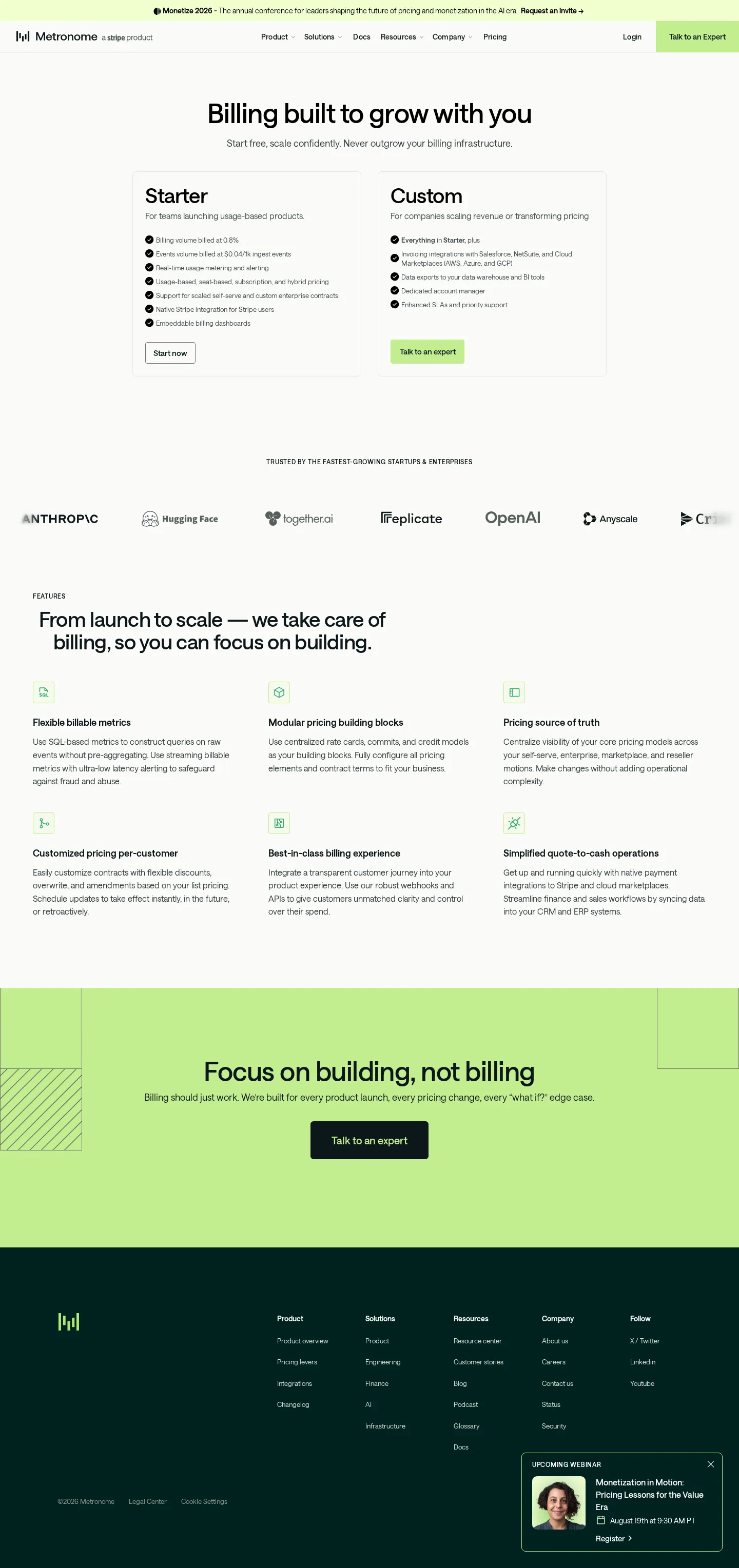
Starter plan drops its included-volume allotment
Three weeks after first publishing usage rates, the Starter plan's bullets stop stating an included billing-volume or event allotment. The card now reads 'Billing volume billed at 0.8%' and 'Events volume billed at $0.04/1k ingest events' — the $100,000-billing-volume and 10M-event figures published from 2026-07-14 through at least 2026-07-22 are gone. The underlying metered rates (0.8% of billing volume, $0.04/1,000 events) are unchanged; the Custom plan remains fully sales-quoted.
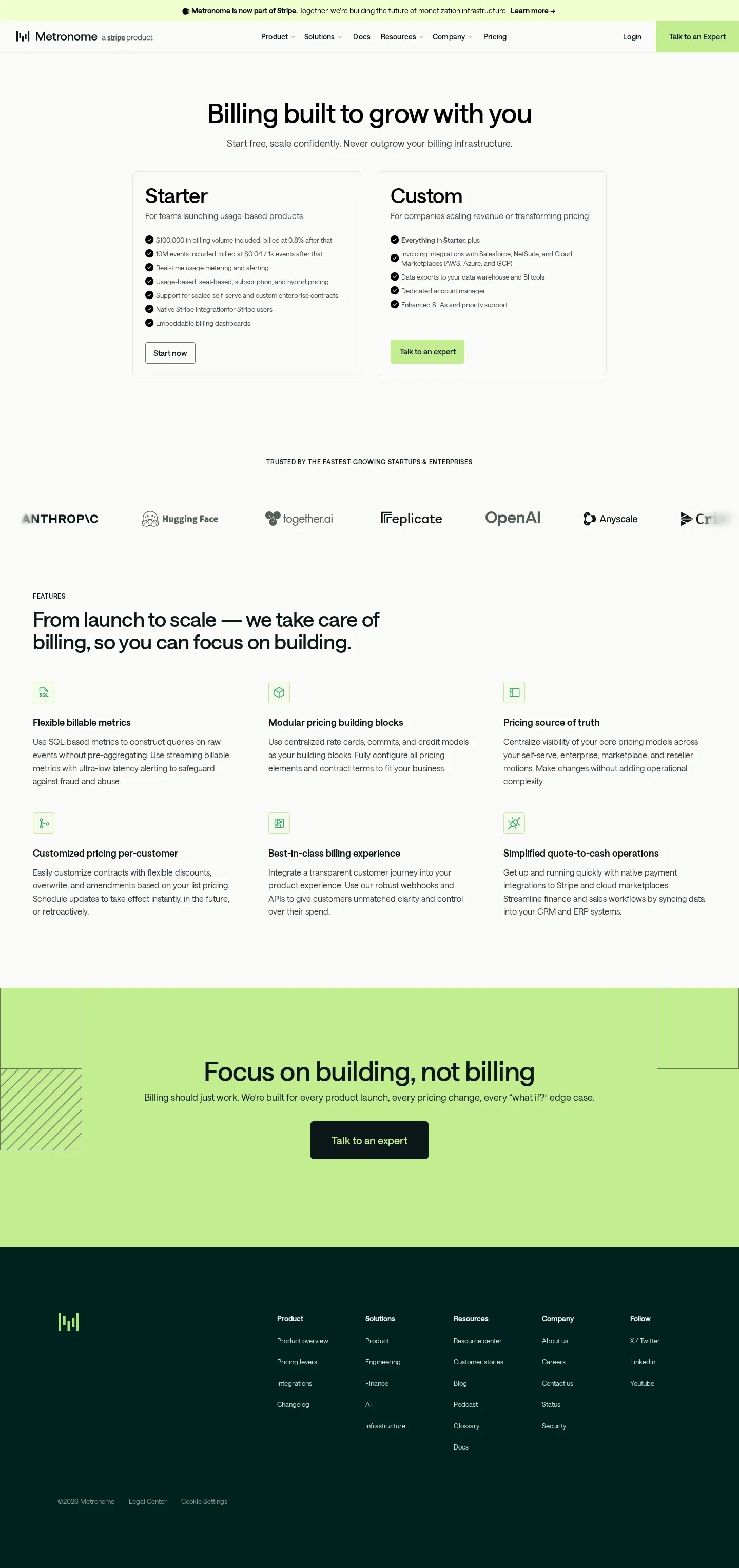
Starter plan gains published usage rates
For the first time, the free-to-start Starter tier shows explicit rates: $100,000 in billing volume and 10M events are included per month, then Metronome bills 0.8% of billing volume and $0.04 per 1,000 events beyond those allotments. This ends Metronome's long-standing no-published-rates posture. The Custom plan remains sales-quoted ('Talk to an expert') and no longer lists the 'tailored pricing for high-volume usage and scale' bullet; the 'Metronome is now part of Stripe' banner persists. (Captured 2026-07-14.)
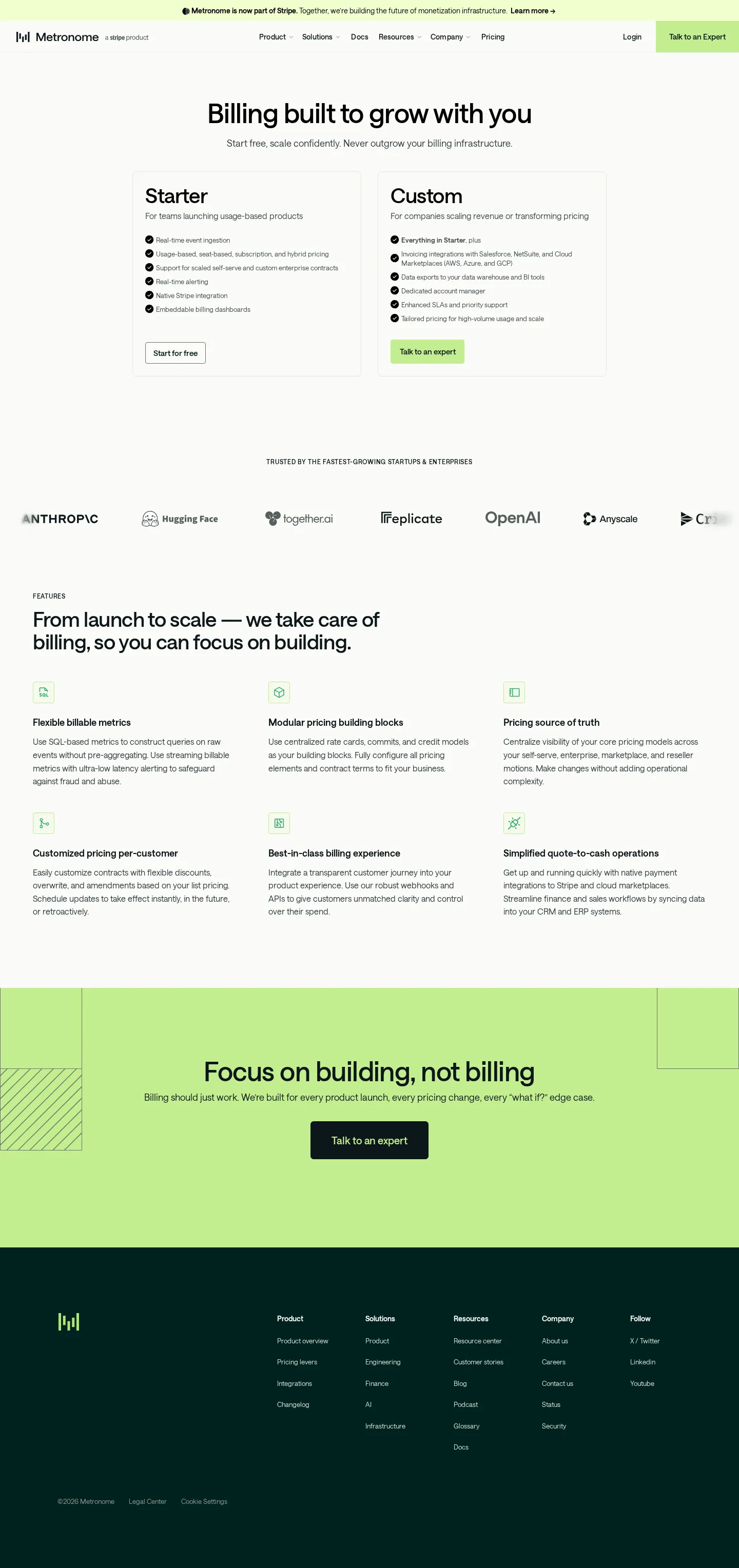
Free Starter + sales-quoted Custom (no public rates)
Pricing page presents two families with no dollar amounts: a free Starter tier (real-time event ingestion, alerting, native Stripe integration, embeddable dashboards) and a Custom plan quoted by sales (marketplace/CRM/ERP invoicing, warehouse exports, dedicated account manager, enhanced SLAs, tailored high-volume pricing). Page carries the 'Metronome is now part of Stripe' banner.
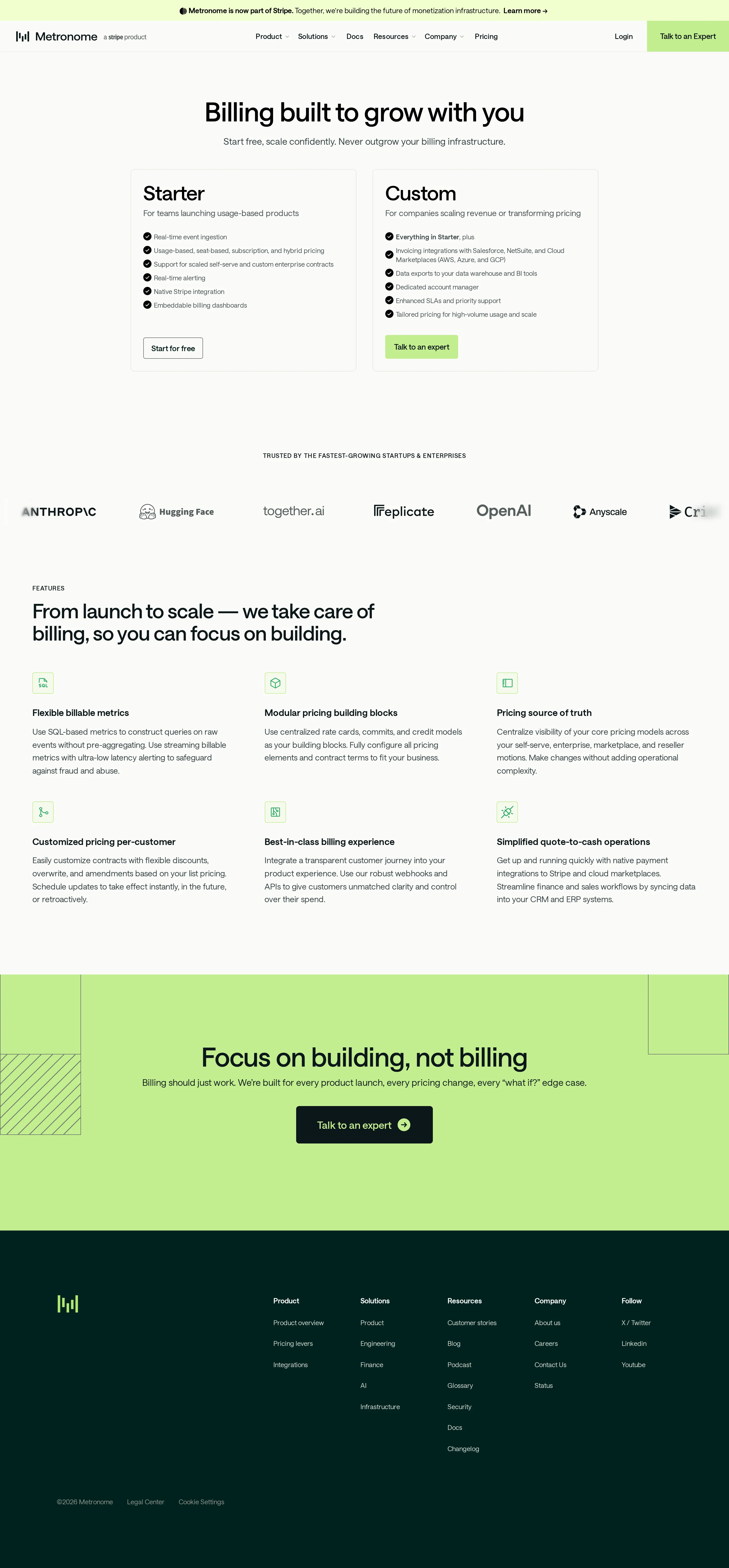
Starter (free) + Custom plan families published
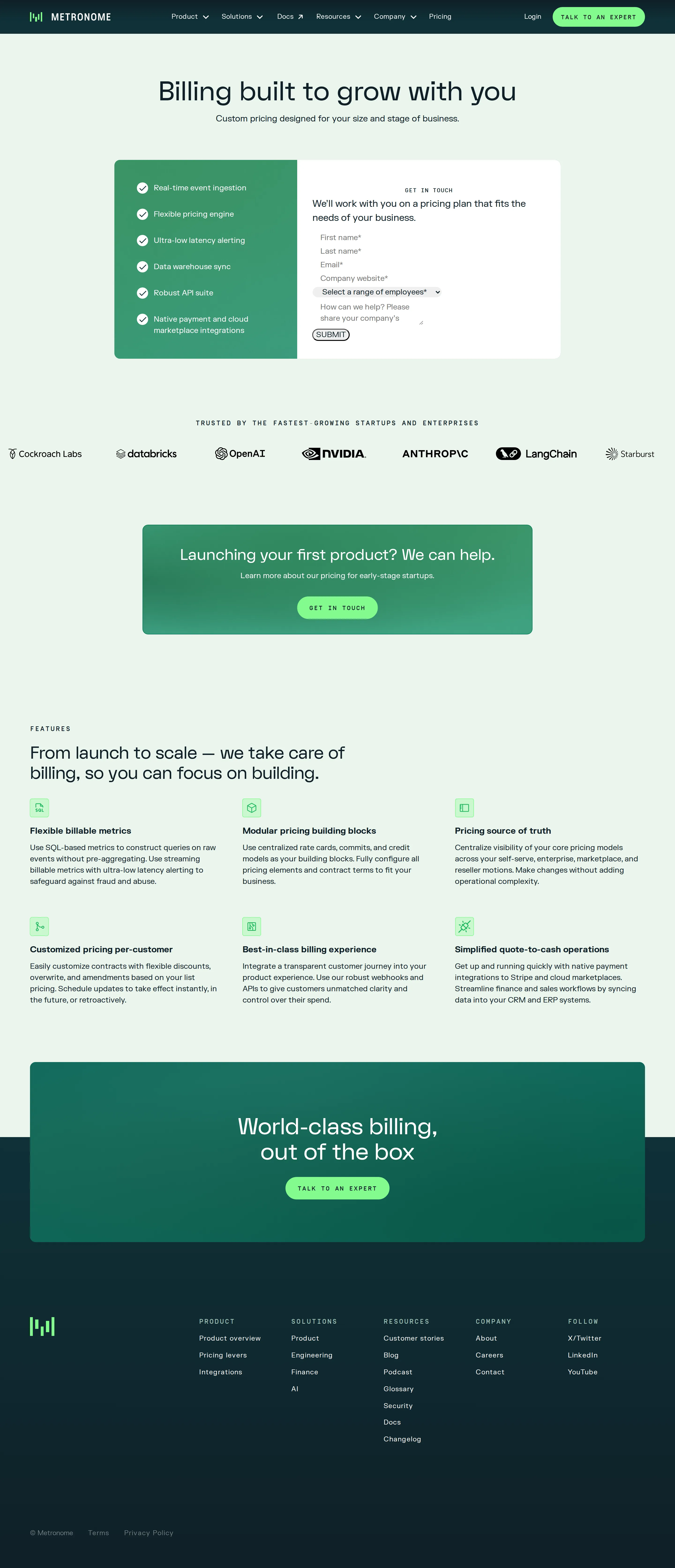
Pricing page restructured to two explicit families with no dollar amounts: a free Starter tier (real-time event ingestion; usage/seat/subscription/hybrid pricing; native Stripe integration; embeddable dashboards; real-time alerting) and a sales-quoted Custom plan (marketplace/CRM/ERP invoicing, warehouse exports, dedicated account manager, enhanced SLAs, 'tailored pricing for high-volume usage and scale'). Banner now reads 'Metronome is now part of Stripe.' (Wayback snapshot 2026-02-13.)
Acquisition completed; 'definitive agreement' banner persists
Stripe completed the Metronome acquisition (Stripe newsroom, 2026-01-14). The 2026-01-08 pricing snapshot still showed the 'signed a definitive agreement to join Stripe' banner and the contact-form layout — no tier families, no rates.
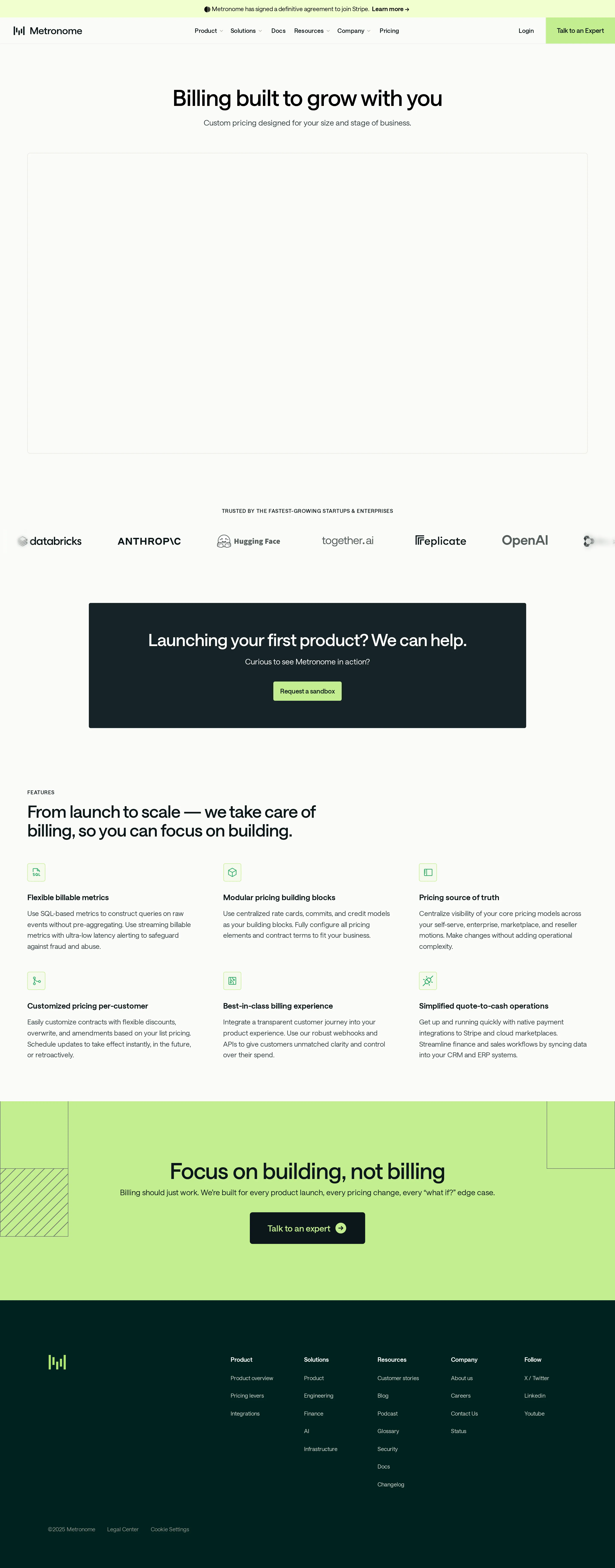
Stripe acquisition announced — banner added
Pricing page adds a banner: 'Metronome has signed a definitive agreement to join Stripe.' Page layout unchanged (still the custom-pricing contact form, no published rates). Stripe announced the acquisition on the same day; terms were not officially disclosed, with press reporting roughly $1 billion. (Wayback snapshot 2025-12-02.)
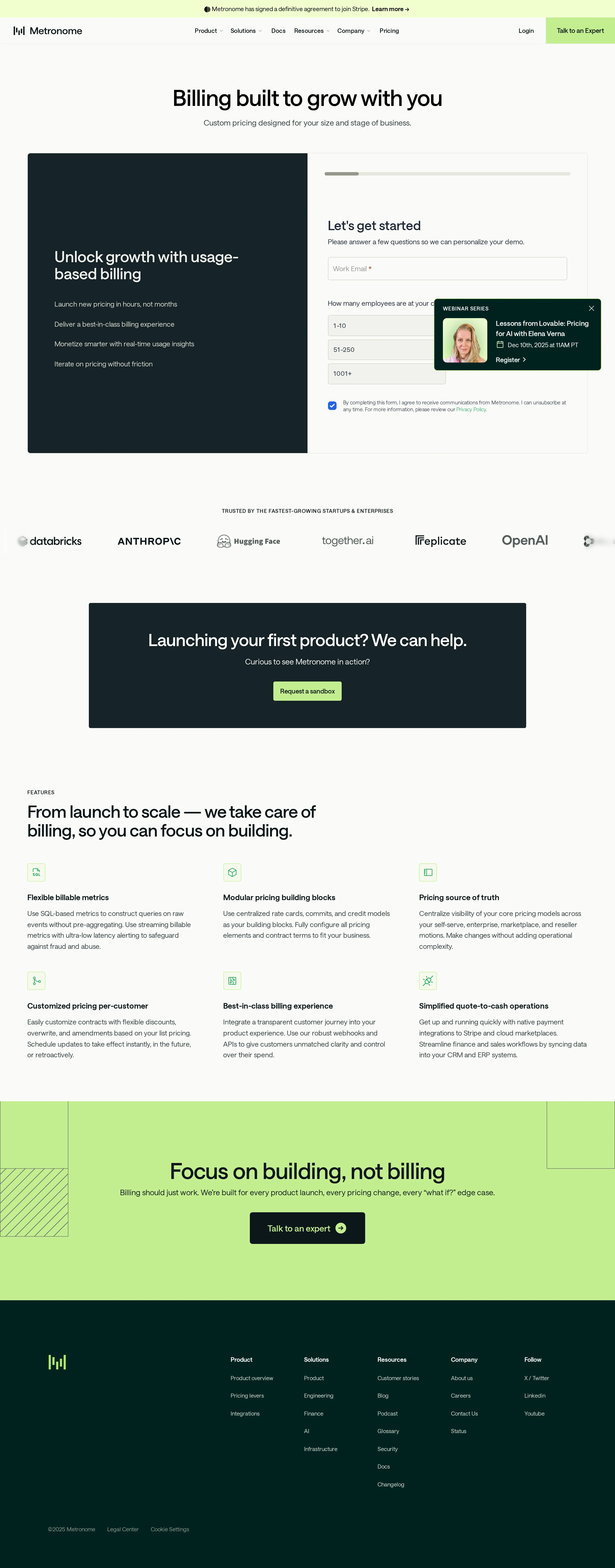
Contact-form pricing — no published tiers
The /pricing page reads 'Billing built to grow with you — custom pricing designed for your size and stage of business' and offers only a 'Launching your first product? We can help' contact/sandbox-request flow. No Starter/Custom tier families and no dollar amounts. The /talk-to-an-expert sales form (employee-size selector) had been the entry point since at least May 2022. (Wayback snapshot 2024-12-29.)
- · For years Metronome published zero dollar amounts, despite being a billing company that sells the ability to meter and price on consumption — but by mid-2026 its Starter plan finally showed real rates: $100,000 in billing volume and 10M events included per month, then 0.8% and $0.04 per 1,000 events. The Custom plan is still sales-quoted.
- · Metronome's free Starter and Custom plan families only appeared between January and February 2026 — for years before that the pricing page was a single 'custom pricing' contact form with no tiers at all.
- · Stripe completed its acquisition of Metronome on January 14, 2026; the deal was announced December 2, 2025 and press reported a price of roughly $1 billion, though terms were not officially disclosed.
Questions & answers
- How much does Metronome cost?
- Metronome's Starter plan is free to start (no monthly base fee) and bills 0.8% of billing volume and $0.04 per 1,000 events. As of 2026-08-04 the pricing page no longer states an included billing-volume or event allotment for Starter — it briefly showed $100,000 in billing volume and 10 million events included per month from 2026-07-14 through at least 2026-07-22, before that allotment language disappeared from the bullet copy. The Custom plan is quoted by sales ('Talk to an expert') for companies scaling revenue or transforming pricing.
- Does Metronome offer a free tier?
- The Starter plan is free to start — no monthly subscription fee — and includes real-time usage metering and alerting, native Stripe integration, and embeddable billing dashboards. As of 2026-08-04 the page no longer states an included free allotment of billing volume or events before usage rates apply (0.8% of billing volume, $0.04/1,000 events); a $100,000-volume-plus-10M-event allotment was briefly published from 2026-07-14 to at least 2026-07-22.
- What is the difference between Starter and Custom?
- Custom includes everything in Starter plus invoicing integrations (Salesforce, NetSuite, AWS/Azure/GCP marketplaces), data exports to your warehouse and BI tools, a dedicated account manager, and enhanced SLAs with priority support. Custom rates are sales-quoted, whereas Starter now publishes explicit usage rates.
- Is Metronome pricing usage-based or subscription?
- Metronome's own pricing is usage-based. The Starter plan meters two dimensions — billing volume (0.8%) and events ($0.04 per 1,000) — with no included allotment stated on the page as of 2026-08-04 (an earlier version, 2026-07-14 through at least 2026-07-22, included the first $100,000 of billing volume and first 10 million events before rates applied). The Custom plan is sales-quoted. Separately, the platform itself supports usage-based, seat-based, subscription, and hybrid pricing for its customers' products.
- Is Metronome part of Stripe?
- Yes. Stripe announced it would acquire Metronome on December 2, 2025 and completed the deal on January 14, 2026. Terms were not officially disclosed; press reported a price of roughly $1 billion. Metronome continues to operate its own pricing page and Starter/Custom plans.
- When did Metronome add its Starter and Custom plans?
- The explicit free Starter and sales-quoted Custom plan structure appeared between January and February 2026, after the Stripe acquisition closed. Before that, archived snapshots from December 2024 through January 2026 show a single 'Billing built to grow with you' page with a custom-pricing contact form and no published tiers.