AI Summary
About
Oxylabs is a Lithuania-based (Vilnius) web data collection company founded in 2015, one of the largest proxy and public-web-scraping infrastructure providers in the market. It is part of the Tesonet business-incubator group — the same Vilnius cluster behind Nord Security (NordVPN/Surfshark), Hostinger and the Smartproxy successor brand Decodo — and reported roughly €45M revenue in 2023 serving 4,000+ clients including Fortune 500 names. Its catalog spans seven distinct product lines: Residential Proxies, Datacenter Proxies, Dedicated Datacenter Proxies, ISP Proxies, Mobile Proxies, a Web Scraper API, and a Web Unblocker — plus an AI-controlled Headless Browser. The company markets a 175M+ residential IP pool and 2M+ dedicated datacenter proxies, with coverage across 195 locations.
Oxylabs sells to data, market-research, cybersecurity and e-commerce teams that need to gather public web data reliably and at scale — review monitoring, ad verification, price and brand monitoring, travel-fare aggregation, and SEO tracking are the recurring use cases on its product pages. Buyers range from individual developers running self-service entry plans to enterprises negotiating custom contracts through an account manager.
The company positions itself at the premium, compliance-forward end of the proxy market: main business areas carry ISO/IEC 27001:2022 certification (with SOC 2 Type 2 on the Web Scraper API and Web Unblocker), a multi-stage KYC process gates sensitive targets, residential IPs are sourced with documented end-user consent, and a published fair-usage and refund policy governs self-service plans. Oxylabs is a founding member of the Ethical Web Data Collection Initiative (EWDCI). Its closest competitors are Bright Data, Smartproxy/Decodo (now a Tesonet sibling) and Zyte; Oxylabs differentiates on pool size, location breadth, and a success-based scraper API that does not bill failed requests. The Oxylabs–Bright Data rivalry has spilled into a multi-year patent “proxy wars” saga since 2018 — Oxylabs has obtained invalidity findings against twelve Bright Data patents, most recently affirmed by the U.S. Federal Circuit on 2025-08-01. The group has also been acquisitive, buying ScrapingBee in June 2025 to push into direct-to-consumer scraping. In July 2026 Oxylabs raised $130M at a $3.6B valuation in a growth round led by Warburg Pincus (reported by Pulse 2.0) — outside capital that, on the evidence so far, reads as fuel for its in-house repricing and packaging push rather than a signal of any near-term rate change.
Pricing summary : per-GB and per-IP proxy tiers plus success-based scraper APIs
Oxylabs runs a usage-based model with two different value metrics depending on the product, wrapped in monthly plan tiers that set the included volume and the effective unit rate:
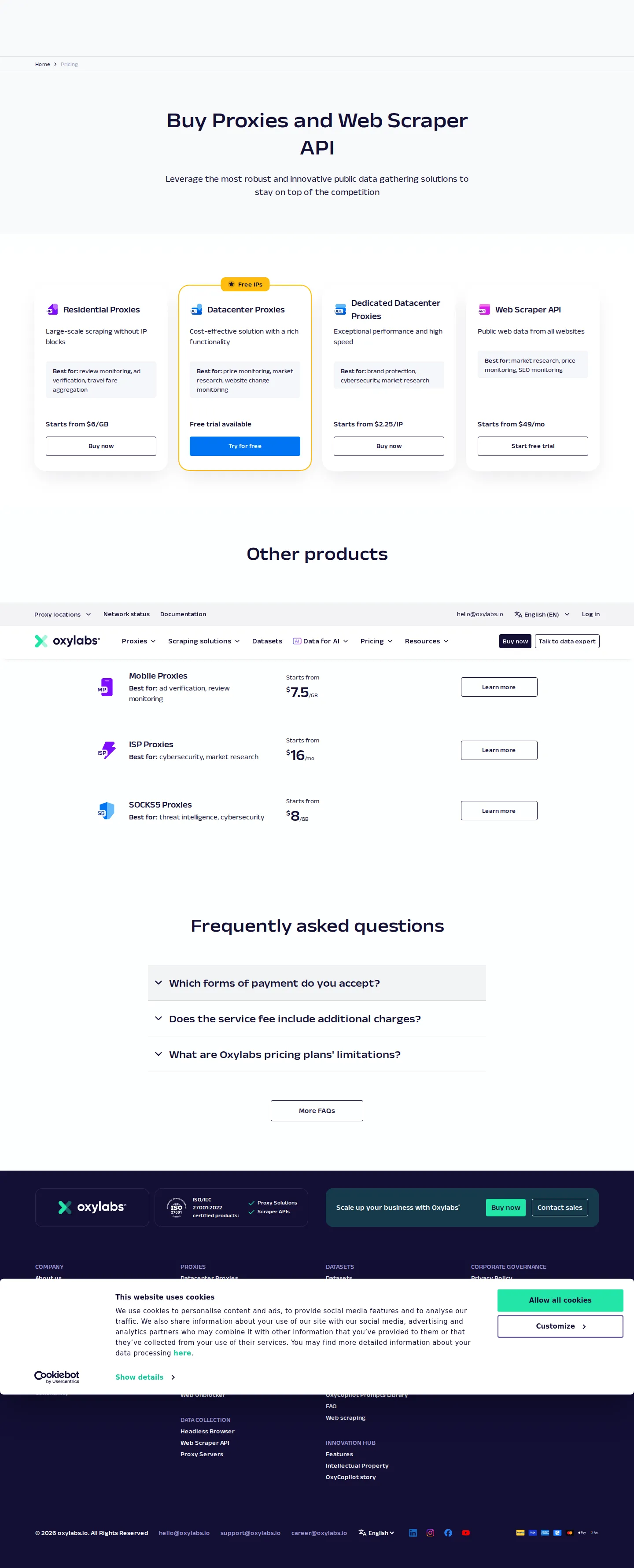
- Per-GB bandwidth (Residential, Mobile, Web Unblocker, Headless Browser): Residential Proxies start at $6/GB ($30/mo, 5GB) and scale down to $2.50/GB on the $2,500/mo Corporate tier. Mobile starts at $7.50/GB, Headless Browser at $6/GB, and Web Unblocker at $9.40/GB list (with a 40%-off WU40 promo).
- Per-IP (ISP, Dedicated Datacenter, and the Datacenter pay-per-IP option): ISP Proxies from $1.60/IP ($16/mo, 10 IPs), Dedicated Datacenter from $2.25/IP ($6.75/mo, 3 IPs). Standard Datacenter Proxies offer both $1.20/IP and $0.59/GB pay-per-traffic options.
- Per-1,000 successful results (Web Scraper API): success-based billing from $0.50/1K results ($49/mo Micro), with rates that vary by target (Amazon, Google, other) and by whether JavaScript rendering is used — and no charge for 5xx/6xx system failures.
What makes this different: Oxylabs deliberately matches the meter to the product — per-GB bandwidth pricing where traffic is the cost driver, IP count where dedicated capacity is, and successful results where the customer’s value is — rather than forcing one usage-based billing unit across the whole catalog. The structure closely mirrors arch-rival Bright Data’s pricing (the two have litigated proxy patents for years), and both sit under our hybrid pricing model theme; see how they compare across the pricing blueprint.
Pricing by product
Residential Proxies (per-GB)
| Tier | Price | Included | Key mechanics |
|---|---|---|---|
| Starter | $6 /GB | 5GB ($30/mo) | Top up to 100GB; 24/7 support (no dedicated AM at this tier) |
| Basic | $5 /GB | 20GB ($100/mo) | “Most popular” tier; dedicated AM included |
| Advanced | $4 /GB | 125GB ($500/mo) | Top up to 2TB; dedicated AM included |
| Corporate | $2.50 /GB | 1TB ($2,500/mo) | Lowest self-service per-GB rate; dedicated AM included |
Datacenter Proxies (per-IP or per-GB, includes Dedicated Datacenter as of 2026-08-04)
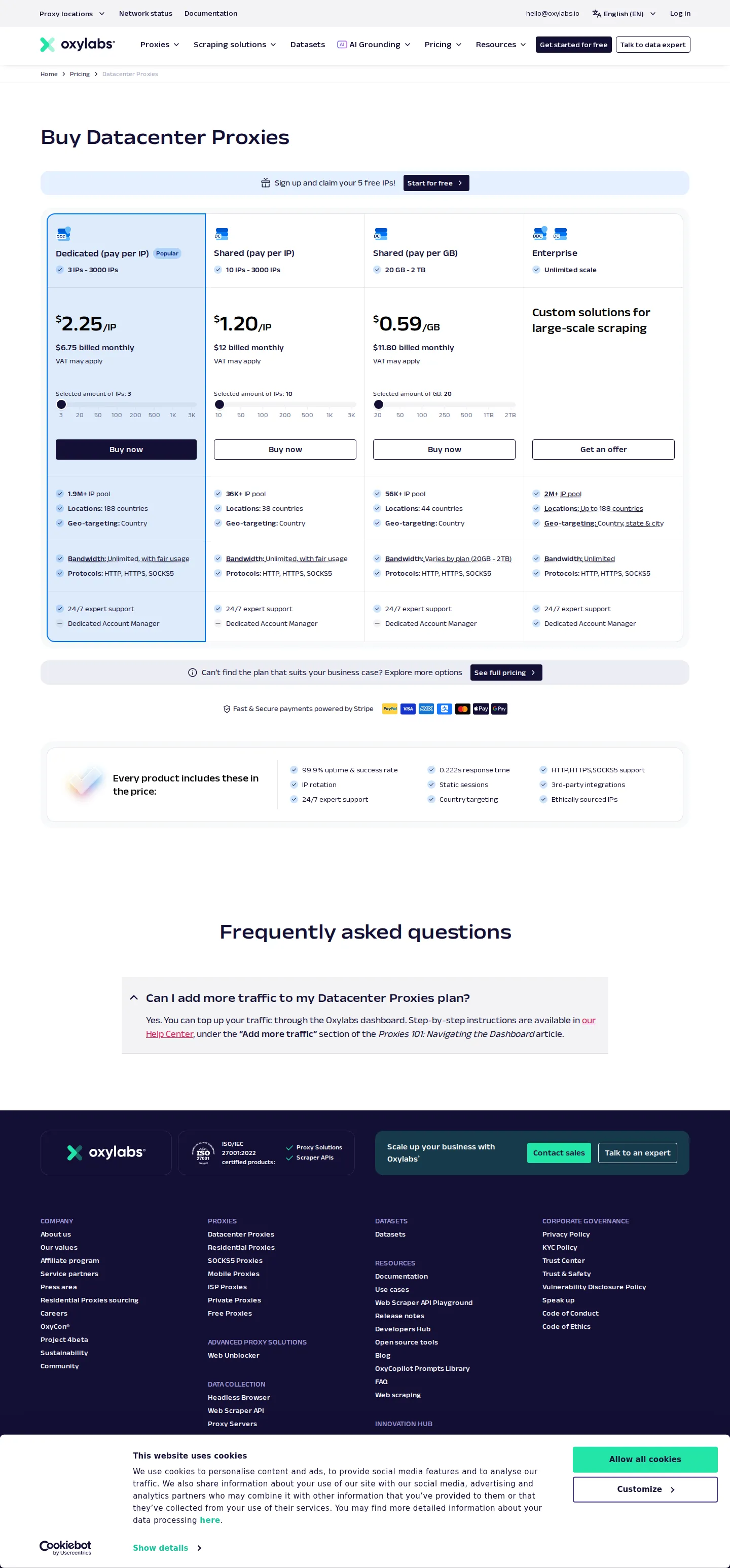
As of the 2026-08-04 capture, /pricing/dedicated-datacenter-proxies 301-redirects into /pricing/datacenter-proxies — Dedicated Datacenter Proxies is no longer a standalone pricing page. The former standalone “Pay per IP” tier now appears as the “Dedicated (pay per IP)” card below at the same $2.25/IP rate; its advertised location count changed from 30 (standalone page, as of 2026-07-06) to 188 countries in the merged card, and the tier no longer surfaces a “Concurrent sessions: 10,000” figure. The Free Trial is now a “claim your 5 free IPs” top banner rather than a priced plan card.
| Tier | Price | Included | Key mechanics |
|---|---|---|---|
| Dedicated (pay per IP) | $2.25 /IP | 3–3000 IPs ($6.75/mo at 3) | 1.9M+ IP pool; 188 countries; unlimited bandwidth (fair use); no dedicated AM (Enterprise only) |
| Shared (pay per IP) | $1.20 /IP | 10–3000 IPs ($12/mo at 10) | 36K+ IP pool; 38 countries; unlimited bandwidth (fair use) |
| Shared (pay per GB) | $0.59 /GB | 20GB–2TB ($11.80/mo at 20GB) | 56K+ IP pool; 44 countries |
| Enterprise | Custom | Unlimited scale | 2M+ IP pool; up to 188 countries; country/state/city geo-targeting; dedicated AM included; “Get an offer” |
ISP Proxies (per-IP)
| Tier | Price | Included | Key mechanics |
|---|---|---|---|
| Starter | $1.60 /IP | 10 IPs ($16/mo) | 22 locations; unlimited bandwidth |
| Advanced | $1.30 /IP | 100 IPs ($130/mo) | Premium ASN providers |
| Premium | $1.20 /IP | 500 IPs ($600/mo) | “Best value” |
| Enterprise | Custom | 2000+ IPs | Sales-led, custom quote |
Mobile Proxies (per-GB)
| Tier | Price | Included | Key mechanics |
|---|---|---|---|
| Starter | $7.50 /GB | 4GB ($30/mo) | Real mobile IPs; 140+ countries |
| Basic | $6.67 /GB | 15GB ($100/mo) | “Most popular” |
| Advanced | $5 /GB | 100GB ($500/mo) | Top up to 2TB |
| Corporate | $3.50 /GB | 715GB ($2,500/mo) | Static 24-hour sessions |
Headless Browser (per-GB)
| Tier | Price | Included | Key mechanics |
|---|---|---|---|
| Starter | $6 /GB | 50GB ($300/mo) | “Get an offer”; Puppeteer/Playwright |
| Advanced | $5.50 /GB | 100GB ($550/mo) | AI-controlled browsing |
| Premium | $4.70 /GB | 300GB ($1,410/mo) | “Best value” |
| Enterprise | Custom | 400GB+ | Sales-led, custom quote |
Web Scraper API (success-based, per-1K results)
As of the 2026-08-11 capture, the Web Scraper API pricing page has flattened back to a single four-column grid — the two-tab Regular/Enterprise layout that was restored on 2026-08-04 is gone again after roughly one week, and the Advanced ($249/mo), Venture ($499/mo) and Corporate ($2,000/mo) named tiers are once more off the page. This is the third packaging flip on this page in five weeks (flatten 2026-07-06 → restore 2026-08-04 → flatten 2026-08-11). Every per-1K rate on the surviving tiers is byte-for-byte identical to both the pre-flattening and the briefly-restored numbers — a pure packaging change, not a price change.
| Tier | Price (from) | Included | Key mechanics |
|---|---|---|---|
| Micro | $0.50 /1K ($49/mo) | Up to 98,000 results | Amazon $0.50 / Google $1.00 / other $1.15 per 1K (no JS); $1.35/1K with JS; media $3/GB; top up to $249; 50 req/s |
| Starter | $0.45 /1K ($99/mo) | Up to 220,000 results | ”Most popular” highlight; Amazon $0.45 / Google $0.90 / other $1.10; $1.30/1K with JS; media $2.50/GB; top up to $499; 50 req/s |
| Business | $0.30 /1K ($999/mo) | Up to 3,330,000 results | Amazon $0.30 / Google $0.60 / other $0.75; $1.00/1K with JS; media $1/GB; top up to $499; 100 req/s |
| Custom+ | Custom (from $0.25/1K) | Custom / high-volume | ”Get an offer”; Amazon $0.25 / Google $0.50 / other $0.70; $0.95/1K with JS; media $0.95/GB; top up to $2,000; 100 req/s |
A “Get started with a free trial” banner (Start free trial, up to 2,000 results) sits above the grid rather than occupying a priced plan card. No Regular/Enterprise tab toggle is present on this capture — the Advanced, Venture and Corporate tiers are not currently reachable from this page.
Web Unblocker (per-GB, WU40 promo)
| Tier | List price | WU40 price (40% off, 6 months) | Included | Key mechanics |
|---|---|---|---|---|
| Free Trial | Free | Free | 1GB (up to 10k results) | No card |
| Micro | $9.40 /GB ($75/mo) | $5.64 /GB ($45/mo) | 8GB | 50 req/s |
| Starter | $8.60 /GB ($325/mo) | $5.16 /GB ($196/mo) | 38GB | Top up to 143GB |
| Advanced | $7.50 /GB ($660/mo) | $4.50 /GB ($396/mo) | 88GB | 50 req/s |
| Venture | $7 /GB ($900/mo) | $4.20 /GB ($538/mo) | 128GB (“Most popular”, Enterprise tab) | 50 req/s |
| Business | $6 /GB ($2,000/mo) | $3.60 /GB ($1,199/mo) | 333GB (Enterprise tab) | 100 req/s |
| Corporate | $5 /GB ($3,500/mo) | $3 /GB ($2,100/mo) | 700GB (Enterprise tab) | Top up to 816GB |
Sales motions across products: PLG / self-serve checkout (Stripe) for proxy and scraper entry tiers; sales-led for Enterprise tiers and the Headless Browser (“Get an offer”).
Hidden costs : top-ups, overage, and the per-GB cliff between tiers
The advertised entry prices understate what a team running steady scraping volume actually pays, because the effective per-GB rate is set by which monthly tier you sit in — and overflow is billed via dashboard top-ups at the plan’s rate.
Archetype: a mid-volume residential scraping team
| Line item | Monthly cost |
|---|---|
| Residential Advanced plan (125GB @ $4/GB) | $500 |
| Top-up: 75GB extra at the plan’s per-GB rate | $300 |
| Web Scraper API Micro (parsing layer, $49/mo) | $49 |
| Total | $849 |
Because the per-GB rate drops sharply at higher tiers ($6/GB Starter vs $2.50/GB Corporate), a team that consistently tops up is often better off jumping a tier than paying overflow at the lower tier’s rate — the pricing rewards committing to volume up front.
Want to estimate your own Oxylabs bill? Use the Oxylabs pricing calculator to model your monthly cost based on proxy type, GB or IP volume, and scraper results. See also our guide to usage thresholds and overage alerting.
Pricing evolution : how residential per-GB rates have roughly halved since 2022
The headline story across the proxy market is steadily falling residential bandwidth prices, and Oxylabs is a clean example. Reconstructing the embedded pricing data from archived Next.js page payloads shows the premium residential line dropping from $12/GB entry in late 2022 to $8/GB in 2024 to $6/GB in 2026 — while the Web Scraper API entry point fell from $99/mo to $49/mo and its unit was relabelled from “1K requests” to “1K results.”
Cadence
| Quarter | Price changes | Product / SKU additions | Notes |
|---|---|---|---|
| 2022 Q4 | — | — | Earliest reconstructable point: premium “Next-Gen” residential at $12/GB entry ($15 pay-as-you-go), Web Scraper API at $99/mo, Web Unblocker at $13/GB. |
| 2023 Q1 | 1 | 0 | Web Scraper API relabels its unit from “1K requests” to “1K results”; residential ladder spans $12→$4/GB. |
| 2024 Q3 | 1 | 0 | Residential entry rate drops to $8/GB (ladder $8→$4); the top-of-funnel price has fallen ~33% since 2023. |
| 2025 Q2 | 1 | 1 | OXYLABS50 50%-off coupon era; ScrapingBee acquired (2025-06-19) for an eight-figure sum, adding a D2C scraping brand to the group. |
| 2026 Q2 | 1 | 0 | Residential entry at $6/GB ($30/mo Starter) → $2.50/GB Corporate; Web Scraper API at $49/mo Micro; Web Unblocker carries an active WU40 40%-off-for-six-months promo. |
| 2026 Q3 | 0 | 0 | 2026-07-06 — Web Scraper API page flattened from a Regular/Enterprise tab split to a single four-column grid (Micro $49 · Starter $99 · Business $999 · Custom+ from $0.25/1K); Advanced ($249), Venture ($499) and Corporate ($2,000) tiers pulled from the page and the free trial moved to a top banner. Packaging-only — per-1K rates unchanged. Also 2026-07-12: a $130M raise at a $3.6B valuation led by Warburg Pincus — a funding/ownership event, not a pricing change. Then 2026-08-04: Dedicated Datacenter Proxies’ standalone page merged into Datacenter Proxies via a 301 redirect, and the Web Scraper API’s Regular/Enterprise tabs (and all eight named tiers) were restored — two packaging moves, no rate changes. Then 2026-08-11: the Scraper API page flattened a second time, one week after the restoration — the third packaging flip on that single page in five weeks, again with no rate change. |
Tracked range: 2022-11–2026-08. Reconstructed from archived page payloads at roughly annual intervals through 2026-06, then from direct captures; intermediate quarters not listed had no detectable headline change in the captured snapshots.
Notable changes
- 2022-11 — Premium residential (“Next-Gen Residential Proxies”) priced at $15 pay-as-you-go then $12/GB → $9/GB; Web Scraper API entry $99/mo at $1.30/1K requests; Web Unblocker $13/GB entry (archived
/pricing/residential-proxy-poolpayload, 2022-11-30). - 2023-03 — Web Scraper API unit relabelled from “requests” to “results” (success-counted framing); residential per-GB ladder spans $12→$4/GB; Web Unblocker $13/$11/$10 per GB.
- 2024-09 — Residential entry rate down to $8/GB across the ladder ($8→$4/GB).
- 2025-06-19 — Oxylabs’ company group acquires ScrapingBee for an eight-figure, all-cash sum, expanding beyond enterprise into the direct-to-consumer scraping segment.
- 2025-08-01 — The U.S. Court of Appeals for the Federal Circuit affirms invalidation of two more Bright Data patents in the long-running “proxy wars”, bringing Oxylabs’ tally to twelve invalidated patents.
- 2026-06 — Residential entry at $6/GB → $2.50/GB Corporate; Web Scraper API $49/mo Micro; Web Unblocker $9.40/GB list with the WU40 40%-off-for-six-months promotion active.
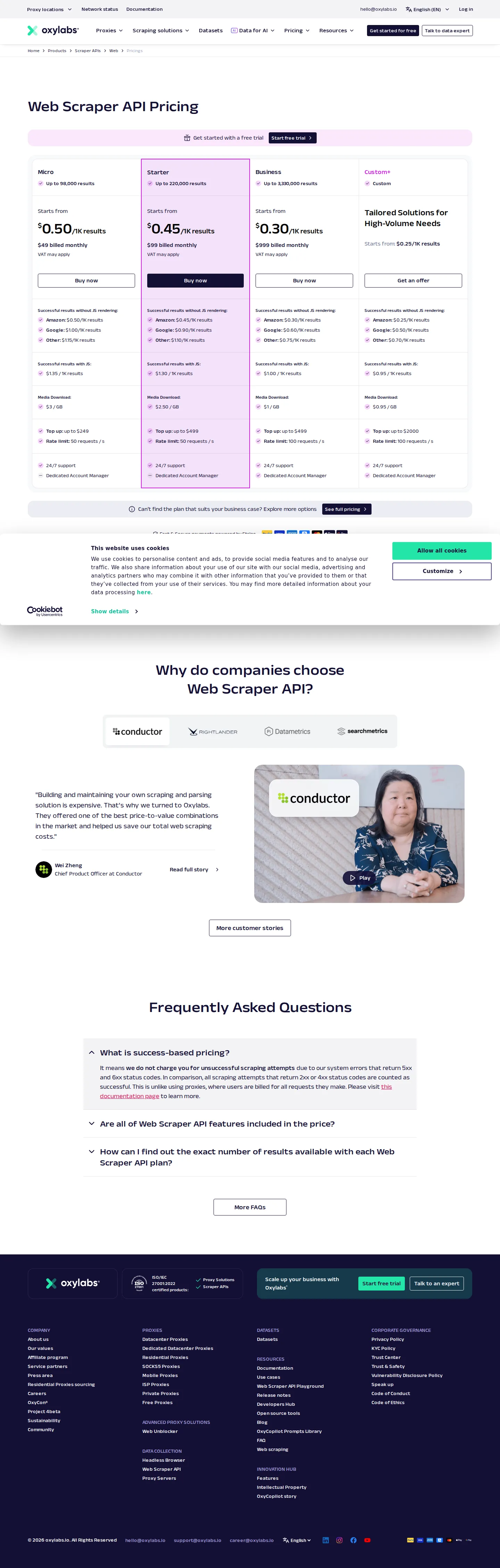
- 2026-07-06 — Web Scraper API pricing page flattened from a Regular/Enterprise tab split into a single four-column grid (Micro $49/mo · Starter $99/mo · Business $999/mo · Custom+ from $0.25/1K); the Advanced ($249), Venture ($499) and Corporate ($2,000) named tiers were removed from the page and the free trial moved to a top banner. Per-1K rates on surviving tiers unchanged.
- 2026-07-12 — Oxylabs raised $130M at a $3.6B valuation in a growth round led by Warburg Pincus (reported by Pulse 2.0). No pricing change accompanied the raise; growth capital of this scale typically funds the ongoing in-house repricing/packaging work — the Web Scraper API flattening above being the most recent example — rather than reversing it, so the near-term read is continuity of the current rate cards.
- 2026-08-04 — Oxylabs merges the standalone Dedicated Datacenter Proxies pricing page into the general Datacenter Proxies page via a 301 redirect; the $2.25/IP entry tier now surfaces as a “Dedicated (pay per IP)” card there, with its advertised location count rising from 30 to 188 countries and its free trial demoted from a plan card to a banner.
- 2026-08-04 — The Web Scraper API pricing page reverts to its two-tab Regular/Enterprise layout, restoring the Advanced ($249/mo), Venture ($499/mo) and Corporate ($2,000/mo) named tiers it had dropped on 2026-07-06; every per-1K rate on both tabs is unchanged from before the July flattening.
- 2026-08-11 — The Web Scraper API pricing page flattens back to a single four-column grid (Micro $49/mo · Starter $99/mo · Business $999/mo · Custom+ from $0.25/1K) just one week after the 2026-08-04 restoration — the third packaging flip on this page in five weeks (flatten 2026-07-06 → restore 2026-08-04 → flatten 2026-08-11). Every per-1K rate on the surviving tiers is unchanged.
The residential price decline in detail
Across the four reconstructable snapshots, the entry per-GB rate for Oxylabs’ flagship residential pool fell from $12/GB (2022) → ~$8/GB (2024) → $6/GB (2026) — a roughly 50% drop in three and a half years. This is not an Oxylabs-specific cut; it mirrors a market-wide collapse in residential bandwidth pricing as IP supply expanded and competition (Bright Data, Decodo/Smartproxy, Zyte, NetNut) intensified. The interesting pricing-design choice is that Oxylabs preserved its tier spread even as absolute prices fell: the ~2.4x gap between entry ($6/GB) and top self-service ($2.50/GB) keeps rewarding volume commitment, so the discount curve does the same conversion work it always did, just anchored to a lower headline.
The Web Scraper API’s three-flip packaging cycle, in detail
The 2026-07-06 packaging move landed with no per-1K price change — every surviving tier’s rate card (Amazon/Google/other splits, JS-rendering surcharge, media-download fee) was byte-for-byte what the two-tab page carried, so nobody’s effective rate moved. What moved was the shape of the visible ladder. The old page toggled between a “Regular” tab (Free Trial · Micro $49 · Starter $99 · Advanced $249) and an “Enterprise” tab (Venture $499 · Business $999 · Corporate $2,000 · Custom+); the new page showed a single row — Micro $49 · Starter $99 · Business $999 · Custom+ — and dropped the Advanced, Venture and Corporate rungs entirely.
The effect was a deliberately steeper self-service ladder. A buyer stepped from Starter ($99/mo, 220k results) straight to Business ($999/mo, 3.33M results) — a ~10x jump in both price and included volume with no intermediate priced stop. That did two things at once: it made the page radically easier to read (four legible columns beat an eight-tier tab dance), and it routed anyone whose real volume sat between ~220k and ~3.33M results into either topping up on Starter or opening a “Get an offer” conversation on Custom+. The free trial moving from a dedicated plan card to a persistent top-of-page banner reinforced the same logic: it stayed a prominent CTA without occupying a column in the priced comparison, so the grid read purely as a paid-tier ladder.
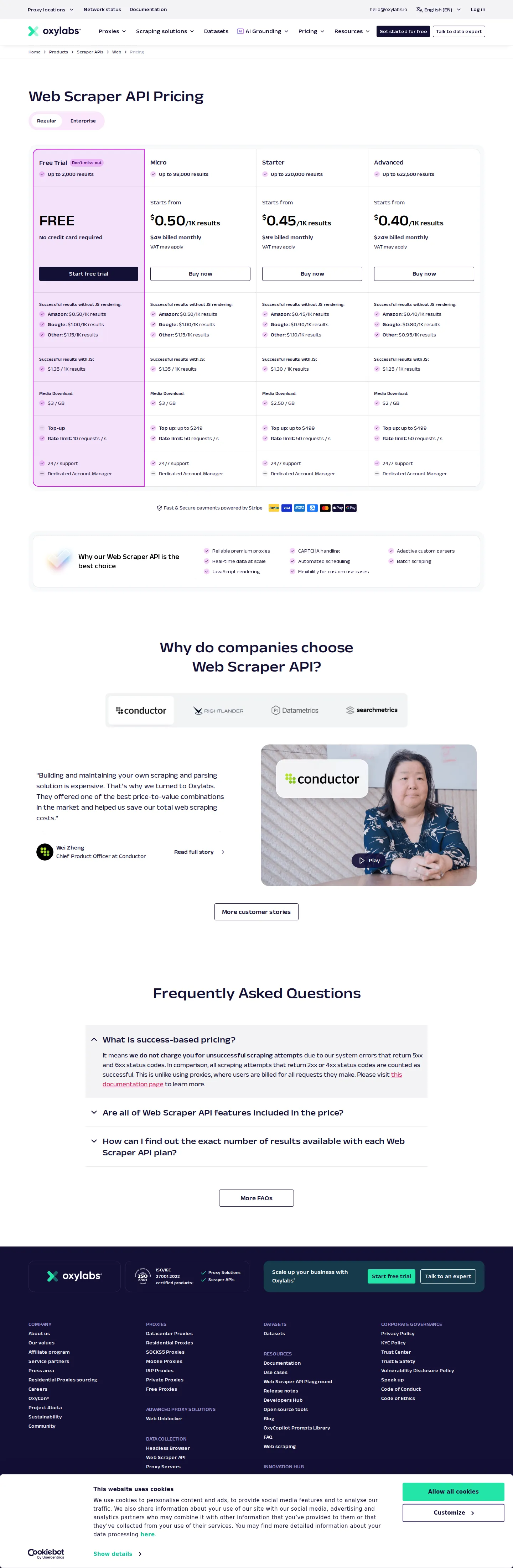
Then, on 2026-08-04 — a little over four weeks later — the page reverted to the original two-tab, eight-tier structure. The Regular tab came back with Free Trial, Micro ($49/mo), Starter ($99/mo) and Advanced ($249/mo); the Enterprise tab came back with Venture ($499/mo), Business ($999/mo), Corporate ($2,000/mo) and Custom+. Every per-1K rate — including the target splits, JS-rendering surcharge and media-download fee — is identical to what both the pre- and post-flattening pages carried, so the reversal is a pure packaging walk-back, not a second pricing change. Practically, it also undoes the mid-volume gap the flattening created: a buyer whose real volume sits between Starter’s 220k results and Business’s 3.33M results once again has a priced Advanced (622.5k results) or Venture (1.35M results) rung to land on, instead of being pushed to top-ups or a sales conversation. Whether this was a deliberate test or an internal reversal of a UX call that hurt conversion isn’t disclosed — and as the next flip shows, it wasn’t the end of the story.
Then, on 2026-08-11 — just one week after the restoration — the page flattened for a second time, landing back on the same four-column grid (Micro $49 · Starter $99 · Business $999 · Custom+) it carried in July, with the free trial once again a top banner rather than a plan card. As before, every per-1K rate on the surviving tiers — target splits, JS-rendering surcharge, media-download fee, top-up ceilings — is byte-for-byte identical across all three states. Three flips in five weeks (flatten 2026-07-06 → restore 2026-08-04 → flatten 2026-08-11) rules out the “one-off UX correction” reading from four weeks ago: this now reads less like a settled decision and more like Oxylabs actively testing — or simply not having converged on — how the Scraper API ladder should be presented. For a buyer, the practical takeaway is that anything screenshotted or quoted off this specific page — the tier count and tab structure, not the underlying rates — currently has roughly a one-week-to-one-month half-life.
What’s unique : meter-per-product and success-based scraping
1. One catalog, three value metrics. Oxylabs bills bandwidth (per GB) for residential, mobile, web-unblocker and headless products; IP count (per IP) for ISP and dedicated datacenter; and successful results (per 1K) for the scraper API. Each meter tracks where the cost — and the customer’s value — actually sits.
2. Success-based scraper billing. The Web Scraper API does not charge for requests that fail with 5xx/6xx system errors, and it varies the per-1K-result rate by target (Amazon cheaper than Google) and by whether JavaScript rendering is needed — pricing the actual difficulty of the scrape rather than a flat request count.
3. Service graduates with spend, not with sign-up. 24/7 support is included from the $30/mo entry tier up, but a dedicated account manager is reserved for the highest-volume self-service plans (Residential Corporate at $2,500/mo, for example) and Enterprise — it is not, as a quick skim of the plan cards might suggest, bundled into every tier. It is still a deliberate packaging lever: gating the white-glove relationship behind committed volume turns account-manager access into a growth incentive rather than a flat perk that would otherwise get diluted by being on every card.
Strengths & weaknesses
| Strengths | Weaknesses |
|---|---|
| Meter matched to each product (GB / IP / results) | Seven product lines + multiple meters make total cost hard to model |
| Success-based scraper pricing (no charge for system failures) | Enterprise tiers across every product are custom / opaque |
| Transparent published tiers with self-service Stripe checkout | Per-GB rate varies ~2.4x across tiers — overflow penalises low tiers |
| Free trials on most lines; 24/7 support included at every tier | Promo-dependent headline pricing (WU40) can obscure list cost |
| Fast page-consolidation via clean redirects (no dead pricing URLs) | Packaging churn — the Scraper API’s tab layout has flattened, restored, then flattened again within five weeks — makes the public page a moving target |
Billing UX : dashboard top-ups, tier selectors, and Stripe checkout
- Dashboard top-ups — self-service plans (Starter, Advanced, Premium, Venture, Business, Corporate) can increase pre-set GBs, IPs or results directly from the Oxylabs dashboard without contacting sales; each plan lists an explicit top-up ceiling (e.g. Residential Starter “Top up: up to 100GB”, Web Unblocker Business “up to 816GB”).
- In-plan IP / GB selector — Datacenter and Dedicated Datacenter plans expose a live amount selector (10 / 50 / 100 / 200 / 500 / 1K / 3K IPs; 20GB / 50GB / … / 2TB) that recomputes the monthly price as you move between volumes.
- Stripe self-service checkout — entry and mid tiers buy online via “Buy now” / “Get subscription” powered by Stripe; Enterprise routes to “Get an offer” / “Talk to an expert.”
- Regular vs Enterprise tabs — the Web Unblocker pricing page splits self-service (“Regular”) tiers from higher-volume (“Enterprise”) tiers behind a tab toggle. The Web Scraper API page carried the same toggle intermittently — dropped for a single flattened grid (2026-07-06), reinstated (2026-08-04), then flattened again (2026-08-11) — and as of the latest capture has no tab toggle at all.
- Promo code field — Web Unblocker checkout accepts the WU40 coupon for 40% off for six months, with both list and discounted prices shown side by side.
- Interactive IP/GB slider merged across product lines — the Datacenter Proxies page now surfaces the former standalone Dedicated Datacenter Proxies tier (“Dedicated (pay per IP)”) as a fourth card alongside Shared (pay per IP), Shared (pay per GB) and Enterprise, each with its own live volume slider;
/pricing/dedicated-datacenter-proxies301-redirects here as of 2026-08-04.
Strategic wins : why matching the meter to the product works
1. Pricing each product on its true cost driver
By billing residential traffic per GB but dedicated IPs per IP, Oxylabs aligns price with the resource that actually costs it money to provide. This avoids the distortion of forcing a single value metric across products with very different cost structures, and it makes each line’s pricing legible to the buyer.
2. Success-based scraping de-risks adoption
Not charging for system-error failures removes a classic objection to scraper APIs — paying for the vendor’s downtime. It signals confidence in reliability and shifts risk onto Oxylabs, a pattern that maps cleanly onto outcome-based pricing thinking.
3. Gating the account manager behind volume, not the sign-up form
Reserving a dedicated account manager for the top self-service tier and Enterprise — while keeping 24/7 support universal from the first dollar — keeps the perk meaningful instead of diluting it across every plan card. It functions as an upsell engine: a growing account earns its way to a human relationship, making the eventual move to a custom Enterprise contract feel like a continuation rather than a cold sales cycle, while newer accounts still have a support safety net via chat and email.
Areas to improve : opacity and cross-product modelling
1. Total-cost modelling across seven lines is hard
A buyer combining residential proxies, a scraper API and a web unblocker faces three different meters and several tiers. Oxylabs could ship a unified cost estimator that spans products — the kind of clarity our Oxylabs pricing calculator aims to provide.
2. Promo-anchored headline pricing obscures list cost
Web Unblocker leads with WU40-discounted prices; once the six-month promo lapses, customers face the full list rate. Publishing the steady-state price as the primary number (with the promo as a clearly time-boxed saving) would reduce post-promo bill shock.
3. Enterprise pricing stays fully opaque — and packaging churn adds its own friction
Every product’s Enterprise tier is “custom.” Even an indicative per-GB or per-IP floor for high-volume commitments would help large buyers self-qualify before engaging sales — publishing a starting price band for Custom+ (it already lists a $0.25/1K floor) would be a low-cost first step. Separately, the Web Scraper API’s pricing page has now flipped three times in five weeks: flattened from eight tiers to four on 2026-07-06, reverted to the original eight-tier, two-tab layout on 2026-08-04, then flattened again on 2026-08-11 — undoing, a week later, the mid-volume pricing gap that the 2026-08-04 restoration had just fixed. That third flip is the tell that this isn’t a one-off correction being ironed out; it means a buyer who bookmarked, screenshotted, or built an internal comparison off the page at any point in the last five weeks was working from stale information within days to weeks, not months. Settling on a stable tier structure — rather than visibly iterating on the public pricing page itself — would reduce the risk of eroding confidence in the published numbers, especially for enterprise buyers already wary of the custom-quote lines elsewhere in the catalog.
Monetization stack & signals : how Oxylabs builds & buys its revenue engine
Buys 3 Builds 1 3 signal roles
Buys the commodity spine — Stripe checkout, Salesforce CRM — but builds the money layer itself: the self-service dashboard carries its own payments/billing database. The tell is the Dashboard backend-lead req below.
-
“Dual DB: Dashboard DB (users, products) + Payments DB (transactions, billing)”
-
“Fast & Secure payments powered by Stripe”
-
“Tech Stack: Salesforce”
-
“Google Cloud Platform (GCS, BQ) for storage and warehousing; dbt and SQL for data modelling; Python for automation; Jupyter for ad-hoc analysis; PowerBI and Superset for data visualisation; Airflow for orchestration.”
-
The platform that charges every self-service customer is built and staffed in-house — a Symfony/Kafka dashboard with its own Payments DB (transactions, billing) alongside the product DB, mid-way through a V3 re-architecture across two squads. Payments here is an internal architecture problem, not a vendor procurement one.
“Our Dashboard team owns the self-service platform every Oxylabs customer uses - the product that directly moves company revenue.”
- Head of Product & Growth Growth seen Jun 1, 2026
A newly built product line gets one owner for both go-to-market and monetisation, with funnel experimentation run in-house — packaging for new lines is set product-side, not by a central pricing team.
“Define and execute product growth strategies by identifying new revenue streams, market expansion opportunities, and lead initiatives across the full user lifecycle (acquisition, activation, retention, and monetisation).”
- Product Manager (Web Scraper APIs) Monetization seen May 18, 2026
Pricing and packaging ownership sits with the API product manager rather than a central pricing or billing function — on the exact product line whose tier layout flipped three times in five weeks.
“Commercial Acumen: Proven ability to connect technical product decisions to business outcomes—pricing, packaging, adoption, and revenue growth.”
2 more matched roles — supporting evidence
- Technical Customer Success Specialist (Day shift) Customer success Aug 26, 2026
- Mid-Senior Account Manager Customer success Aug 26, 2026
Signals reviewed · derived from public job posts, product docs
Job postings fill and close over time — once a posting is filled we keep it as a dated citation (the quoted evidence remains); use View open roles for current listings.
Key takeaways
- Match the meter to the cost driver. Oxylabs proves a single vendor can run per-GB, per-IP and per-result meters simultaneously when each tracks a genuinely different resource — coherence comes from the logic, not from forcing one unit.
- Success-based billing is a trust lever. Not charging for failed requests turns a pricing detail into a reliability claim, lowering the barrier to trying a metered API.
- Tiered unit rates reward commitment. A ~2.4x per-GB spread between entry and top tiers nudges steady-volume buyers to commit upward rather than pay overflow — design the curve so the right choice is obvious.
- Service can be a pricing feature. Gating a dedicated account manager to top-volume self-service and Enterprise tiers — while keeping 24/7 support universal — differentiates a commodity (proxies) without touching the headline rate, and turns AM eligibility into a growth incentive rather than a flat freebie.
- Promos need a visible baseline. Discount-anchored headline prices win clicks but risk churn at renewal unless the list price stays equally visible.
UBP implications
- Multiple value metrics can coexist under one brand. Oxylabs shows that “usage-based” need not mean one meter — a product portfolio can carry per-GB, per-IP and per-outcome pricing as long as each is the honest cost driver for its line.
- Outcome-aligned billing is spreading beyond AI. Success-based, result-counted pricing in a proxy/scraping business signals that “only pay for what works” is becoming a general usage-based expectation, not just an AI-agent talking point.
- Tier design is the real lever in metered pricing. With a published per-unit rate, the included-volume tiers — and the overflow/top-up mechanics — do the actual price discrimination; that’s where margin and conversion are won.
Sources
- Oxylabs pricing hub (accessed 2026-08-04)
- Oxylabs Residential Proxies pricing (accessed 2026-08-04)
- Oxylabs Datacenter Proxies pricing (accessed 2026-08-04)
- Oxylabs Dedicated Datacenter Proxies pricing (accessed 2026-08-04) — now 301-redirects to the Datacenter Proxies page above
- Oxylabs ISP Proxies pricing (accessed 2026-08-04)
- Oxylabs Mobile Proxies pricing (accessed 2026-08-04)
- Oxylabs Headless Browser pricing (accessed 2026-08-04)
- Oxylabs Web Scraper API pricing (accessed 2026-08-04)
- Oxylabs Web Unblocker pricing (accessed 2026-08-04)
Bottom line
Oxylabs is a textbook example of metering each product on its true cost driver — bandwidth where traffic is the cost, IP count where dedicated capacity is, and successful results where the customer’s value lies — wrapped in transparent monthly tiers, with 24/7 support universal from the first dollar and a dedicated account manager reserved for its highest-volume self-service and Enterprise tiers. The catch is complexity: seven lines and three meters make total cost genuinely hard to model, Enterprise pricing stays opaque, and the Web Scraper API’s three packaging flips in five weeks (flatten 2026-07-06, restore 2026-08-04, flatten 2026-08-11) show the page itself is still unsettled — actively iterated, not stabilized, even though every underlying rate has held steady throughout.
Want to compare Oxylabs against other web-data and infrastructure pricing? Browse the pricing blueprint.
Pricing timeline : Major events on a vertical axis
Each milestone below corresponds to a public pricing change, product launch, or material adjustment. Major events use a filled marker; minor adjustments use a faded one.
Web Scraper API flattens again — third flip in five weeks
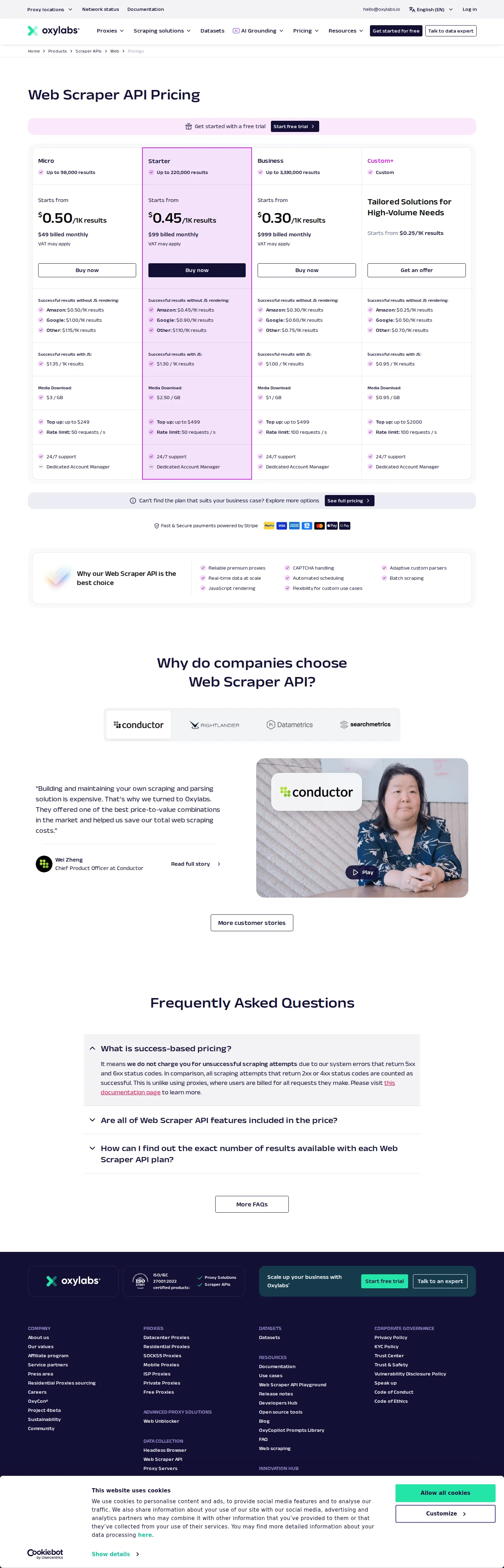
One week after the 2026-08-04 restoration, the Web Scraper API pricing page flattened for a second time back into a single four-column grid (Micro $49/mo, Starter $99/mo, Business $999/mo, Custom+ from $0.25/1K); the Regular/Enterprise tab toggle and its Advanced ($249/mo), Venture ($499/mo) and Corporate ($2,000/mo) named tiers are off the page once more. This is the third packaging flip on this single page in five weeks (flatten 2026-07-06 → restore 2026-08-04 → flatten 2026-08-11); every per-1K rate on the surviving tiers is byte-for-byte unchanged across all three states. All other proxy lines (residential $6/GB, datacenter $0.59/GB, ISP $1.60/IP, dedicated $2.25/IP, mobile $7.50/GB, headless $6/GB, Web Unblocker $9.40/GB with WU40) held steady.
Dedicated Datacenter Proxies merged into the Datacenter Proxies page
The standalone /pricing/dedicated-datacenter-proxies page now 301-redirects into /pricing/datacenter-proxies, where the former $2.25/IP entry tier surfaces as a 'Dedicated (pay per IP)' card alongside Shared (pay per IP), Shared (pay per GB) and Enterprise. Its advertised location count changed from 30 to 188 countries and its 'Concurrent sessions: 10,000' figure no longer appears; the $2.25/IP rate itself is unchanged. Packaging-only — no underlying price move.
Web Scraper API's Regular/Enterprise tabs restored
A little over four weeks after flattening into a single four-column grid, the Web Scraper API pricing page reverted to its two-tab Regular (Free Trial, Micro $49/mo, Starter $99/mo, Advanced $249/mo) + Enterprise (Venture $499/mo, Business $999/mo, Corporate $2,000/mo, Custom+) layout. Every per-1K rate on both tabs is unchanged from before the July flattening — a pure packaging walk-back.
Web Scraper API tiers flattened to Micro/Starter/Business/Custom+
The Web Scraper API pricing page dropped its Regular/Enterprise tab split for a single four-column grid — Micro ($49/mo), Starter ($99/mo), Business ($999/mo) and Custom+ (from $0.25/1K). The Advanced ($249/mo), Venture ($499/mo) and Corporate ($2,000/mo) named tiers are no longer surfaced, and the free trial moved from a plan card to a top banner. Per-1K rates on the surviving tiers are unchanged; all other proxy lines (residential $6/GB, datacenter $0.59/GB, ISP $1.60/IP, dedicated $2.25/IP, mobile $7.50/GB, headless $6/GB, Web Unblocker $9.40/GB with WU40) held steady.
Current snapshot: residential $6→$2.50/GB, Scraper API $49/mo
Residential Proxies from $6/GB ($30/mo Starter) to $2.50/GB ($2,500/mo Corporate), Datacenter pay-per-traffic from $0.59/GB or $1.20/IP, Dedicated Datacenter from $2.25/IP, ISP from $1.60/IP, Mobile from $7.50/GB, Headless Browser from $6/GB, Web Scraper API from $49/mo Micro (success-based per-1K results), and Web Unblocker from $9.40/GB list with an active WU40 40%-off-for-six-months promo. Residential entry has roughly halved since 2022 ($12 → $6/GB).
OXYLABS50 discount era; Unblocker at $9.40/GB
By 2025-09-23 the pricing hub carries an OXYLABS50 50%-off coupon, Web Unblocker entry is $9.40/GB (down from $13), Datacenter pay-per-traffic $0.59/GB and per-IP $1.20, ISP $1.60/IP, Dedicated $2.25/IP, residential still ~$8 entry. Same year: ScrapingBee acquired (2025-06-19) and the Federal Circuit affirms invalidation of two more Bright Data patents (2025-08-01).
Residential entry falls to $8/GB
Wayback __NEXT_DATA__ for /products/residential-proxy-pool (2024-09-26) shows the residential per-GB ladder at $8 (entry) → $7.75 → $7.5 → $6.98 → $6.02 → $5.5 → $4, i.e. the top-of-funnel rate dropped from ~$12/GB (2023) to $8/GB.
Per-result rename; residential ladder $12→$4/GB
By 2023-03-03 the residential product page lists pricePerAmount $12/$10/$8/$7/$6/$4 per GB across tiers, and the Web Scraper API relabels its unit from '1K requests' to '1K results' ($1.30 → $0.60/1K). Web Unblocker shows $13/$11/$10 per GB.
Next-Gen Residential at $12/GB; Scraper API at $99/mo
Wayback __NEXT_DATA__ for /pricing/residential-proxy-pool (2022-11-30) shows the premium 'Next-Gen Residential Proxies' line at $15 pay-as-you-go then $12/GB ($300/mo) → $10/GB → $9/GB, with a cheaper legacy 'Residential Proxies' line at $15 entry. The Web Scraper API entry was $99/mo Starter at $1.30/1K requests → $0.60/1K, billed per request. Web Unblocker entry was $13/GB.
- · Oxylabs prices every proxy line on a meter that fits the product: residential and mobile proxies bill per GB of traffic, while ISP, datacenter and dedicated-datacenter proxies bill per IP — so the same vendor runs two completely different value metrics side by side.
- · Its Web Scraper API uses success-based billing: requests that return 5xx/6xx system errors are not charged, and per-1K-results rates even vary by target (Amazon $0.50, Google $1.00, other $1.15 per 1K without JS rendering).
- · The cheapest residential entry plan ($30/mo Starter at $6/GB) and the cheapest datacenter pay-per-traffic plan ($11.80/mo at $0.59/GB) differ roughly 10x in per-GB price — a clean illustration of how IP type, not just volume, drives proxy pricing.
Questions & answers
- How much do Oxylabs Residential Proxies cost?
- Residential Proxies start at $6/GB on the $30/mo Starter plan (5GB), drop to $5/GB on the $100/mo Basic plan, $4/GB on the $500/mo Advanced plan, and $2.50/GB on the $2,500/mo Corporate plan.
- Does Oxylabs charge per GB or per IP?
- It depends on the product. Residential and Mobile Proxies bill per GB of traffic, ISP and Dedicated Datacenter Proxies bill per IP, and standard Datacenter Proxies offer both pay-per-IP ($1.20/IP) and pay-per-traffic ($0.59/GB) options.
- What is Oxylabs Web Scraper API pricing?
- The Web Scraper API starts at $49/mo (Micro, up to 98,000 results) with success-based billing from $0.50/1K results, scaling through Starter ($99/mo, 220,000 results) and Business ($999/mo, 3.33M results) to a custom-quoted Custom+ tier from $0.25/1K. As of the latest capture the page shows this single four-tier grid with no Regular/Enterprise tab split; Oxylabs has flipped between this layout and an eight-tier two-tab version (adding Advanced, Venture and Corporate rungs) three times since July 2026. Rates vary by target and whether JavaScript rendering is needed.
- Does Oxylabs offer a free trial?
- Yes. Datacenter Proxies offer a free trial via a 'claim your 5 free IPs' banner (no card required; as of August 2026 it's a banner rather than a dedicated plan card), the Web Scraper API offers a 'Start free trial' banner above its pricing grid (no card required; a dedicated Free Trial plan card appears only when the Regular/Enterprise tab split is live, which as of the latest capture it is not), and Web Unblocker offers a 1GB (up to 10k results) free trial. ISP and Headless Browser free trials are available on request.
- Is Oxylabs pricing usage-based?
- Yes. Every Oxylabs line is metered — per GB of bandwidth, per IP, or per 1,000 successful results — with monthly plan tiers setting the included quantity and effective unit rate, plus dashboard top-ups for self-service plans.