AI Summary
About
Playground (playground.com, formerly Playground AI) is a consumer and prosumer image-generation and graphic-design studio. The product lets users generate images from text prompts, edit and AI-extend them, apply premium templates, upscale, and remove backgrounds — all inside a browser-based design canvas. Its 2026 surface routes generation across multiple underlying models, including Nano Banana, Nano Banana Pro, GPT Image 2 and Seedream, with the home page citing “over 13,000,000 creators.”
The company positions Playground against other text-to-image studios such as Midjourney, Ideogram and Recraft, but leans harder into the graphic-design and templating use case (logos, social assets, product imagery) than the pure art-generation peers. It sits in the individual-and-SMB band of the market: self-serve sign-up, no sales motion on the published plans, and a hard line that gates worldwide royalty-free commercial licensing behind the paid tiers.
Playground was founded in 2022 by Suhail Doshi, who co-founded the analytics company Mixpanel at 20 and previously ran the cloud-browser startup Mighty. After winding Mighty down in late 2022, Doshi redirected resources into Playground and raised a $40M round in 2023 (announced by Y Combinator’s Garry Tan as funding “to advance the field of computer graphics”). The company also publishes its own image models — Playground v2.5 and the “deep-fusion” Playground v3 (PGv3), whose technical report landed in September 2024 — alongside the third-party models it routes to in product. Playground is private; precise ARR, valuation and headcount are not disclosed on the pricing surfaces captured here.
playground.com had aggressively blocked automated access through at least 2026-06 (the live /pricing and /design/pricing URLs returned HTTP 403 to direct fetches and headless browsers alike), so the historical facts on this page were read from Wayback Machine snapshots of the /design/pricing surface sampled monthly from 2024-09 to 2026-06, plus the legacy two-tier /pricing page as of 2024-10-06. A live capture on 2026-07-29 encountered no block, and /pricing now renders content identical to /design/pricing — the legacy two-tier surface appears to have been consolidated into the single credit-pool page. For how Playground’s model fits the wider market, see our explainers on usage-based pricing models and the value-metric problem in AI pricing.
Pricing summary : a freemium subscription over a shared monthly credit pool
Playground uses a freemium subscription priced over a shared monthly model-credit pool. There is one free plan and two paid plans, each billed monthly or annually (annual saves 20%), and all three draw generations from a single pool of credits that spans every model. The dimensions are:
- Plan fee: Free is $0; Pro is $15/mo ($12/mo billed annually, $144/year); Pro Plus is $45/mo ($36/mo billed annually, $432/year).
- Monthly credit pool: 3 credits on Free, 150 on Pro, 1,000 on Pro Plus. Every standard model (Nano Banana, GPT Image 2, Seedream) costs 1 credit per generation; Nano Banana Pro costs 4 credits.
- Throughput cap: a rolling 3-hour generation window on the base PGv3 model sits on top of the credit pool — 75 images on Pro and unlimited on Pro Plus. Free’s cap is inconsistent on Playground’s own live page as of 2026-07-29: the plan card advertises “up to 10 images,” but the compare-plans table lists 5.
- Commercial license: a worldwide royalty-free commercial license is included on Pro and Pro Plus only; Free is non-commercial.
What makes this different: the true billing unit is a model-agnostic credit, not an image, so a single premium generation (Nano Banana Pro) quietly burns 4× a standard one against the same monthly pool. For background on this pattern, see our guide to prepaid credit models and choosing the right usage metric.
Pricing by product
Playground Design — current plans (from /design/pricing, live capture 2026-07-29)
| Tier | Price | Included | Key mechanics |
|---|---|---|---|
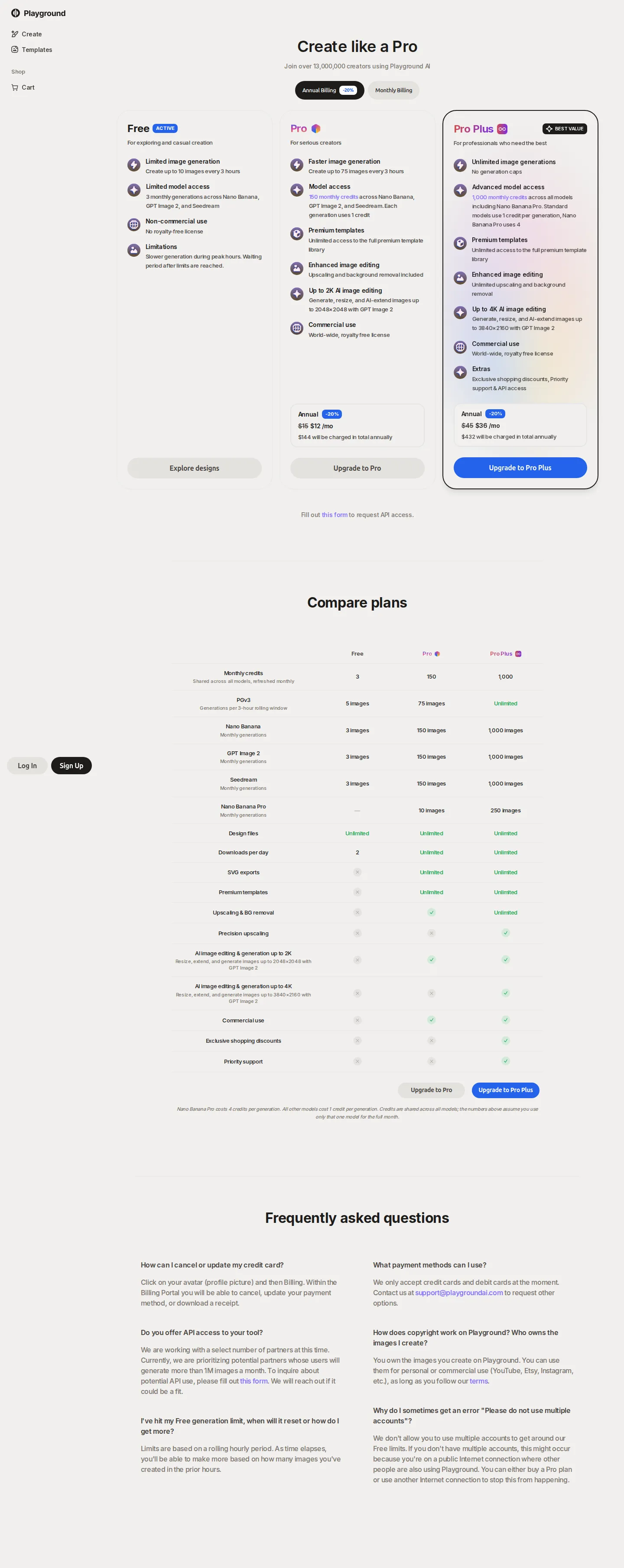
| Free | $0 | 3 monthly credits; plan card says “up to 10 images every 3 hours” but the compare-plans table lists 5 (unresolved discrepancy as of 2026-07-29); unlimited design files; 2 downloads/day (cut from 10); non-commercial, no royalty-free license | Slower generation during peak hours; waiting period after limits |
| Pro | $15/mo ($12/mo annual, $144/yr) | 150 monthly credits; up to 75 images every 3 hours; faster generation; premium templates; up to 2K AI editing; SVG exports; commercial use | ”Serious creators” tier; worldwide royalty-free license |
| Pro Plus | $45/mo ($36/mo annual, $432/yr) | 1,000 monthly credits; unlimited generations; Nano Banana Pro; up to 4K AI editing; unlimited upscaling & BG removal; priority support; API access | ”Best value” / professional tier; zero generation caps |
As of 2026-07-29, Free’s daily download cap fell from 10 (2026-06-04 capture) to 2, and the compare-plans table’s PGv3 rolling-window figure for Free fell from 10 to 5 images — while the Free plan card’s marketing bullet still reads “up to 10 images every 3 hours.” Pro and Pro Plus figures are unchanged from the prior capture.
Per-model credit cost inside the pool
Credits are shared across all models and refresh monthly. The plan’s “images per model” figures below assume the entire monthly pool is spent on a single model.
| Model | Credits per generation | Free (3 cr) | Pro (150 cr) | Pro Plus (1,000 cr) |
|---|---|---|---|---|
| Nano Banana | 1 | 3 images | 150 images | 1,000 images |
| GPT Image 2 | 1 | 3 images | 150 images | 1,000 images |
| Seedream | 1 | 3 images | 150 images | 1,000 images |
| Nano Banana Pro | 4 | — | 37 images | 250 images |
For roughly two quarters (visible 2025-06 to 2025-11) Playground also sold a B2B-flavoured Team tier — the only sales-assisted plan in the tracked window — offering 2 seats, unified billing, a shared workspace, SSO and an org brand kit on top of Pro, behind a “Contact Us” CTA. It was discontinued when Pro Plus arrived in late 2025; its pricing and full feature list are documented in Pricing evolution below.
Legacy image-generation plans (from /pricing, 2024-10-06)
The older /pricing surface metered images per day rather than credits, and granted commercial use on both tiers.
| Tier | Price | Included | Key mechanics |
|---|---|---|---|
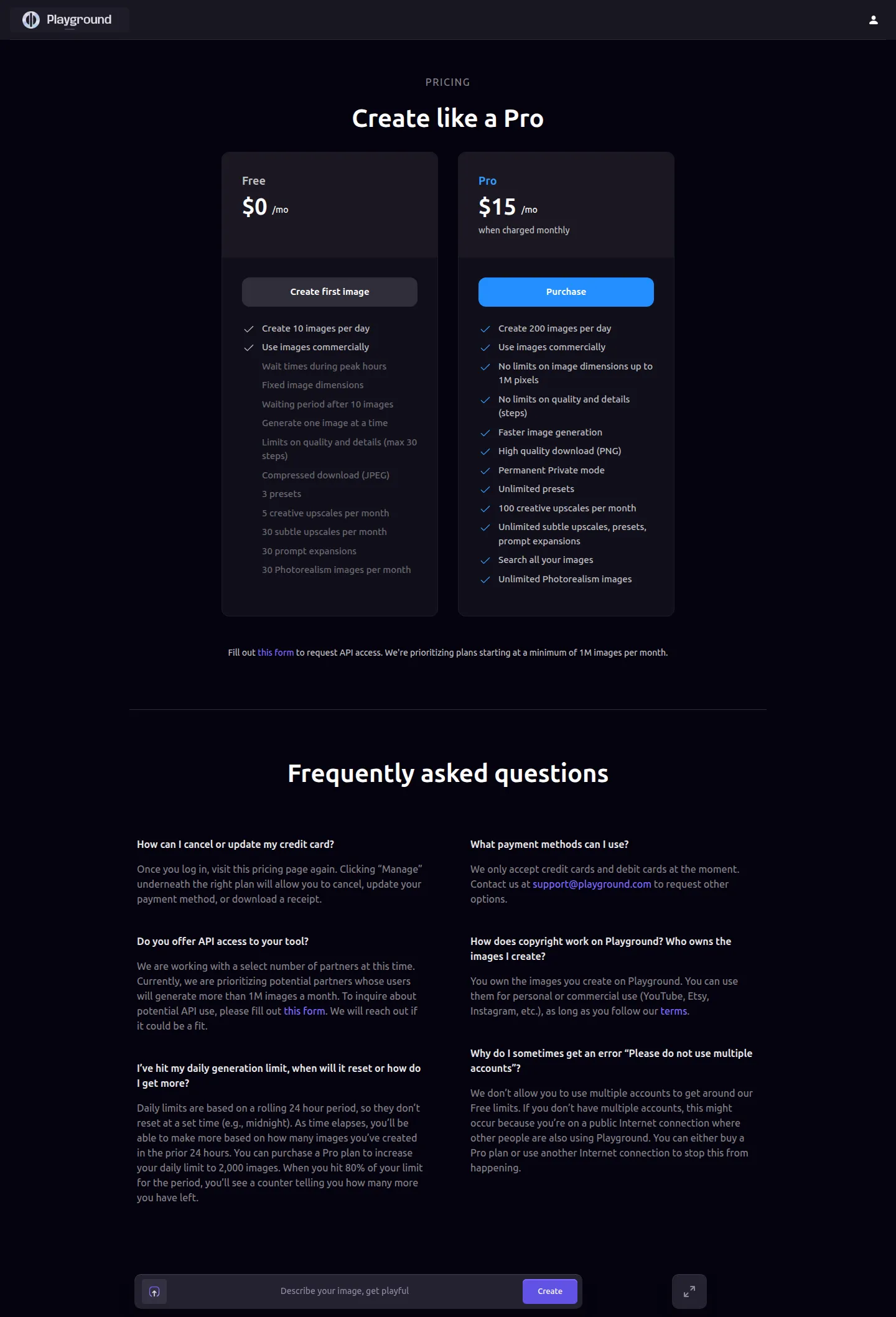
| Free | $0/mo | 10 images/day; commercial use; fixed dimensions; max 30 steps; JPEG download; 5 creative + 30 subtle upscales/month | Wait times at peak; one image at a time |
| Pro | $15/mo | 200 images/day (2,000/day per FAQ); no dimension limits up to 1M px; PNG; Permanent Private mode; 100 creative upscales/mo | Faster generation; unlimited subtle upscales |
Sales motions across products: PLG / self-serve for all current published plans (Free, Pro, Pro Plus); the now-discontinued Team tier used a “Contact Us” CTA, and API access is gated behind a partner request form (sales-assisted, prioritizing >1M images/month).
Hidden costs : what real users actually pay
The headline plan fee understates how fast the credit pool empties for a user who favors the premium model. A Pro Plus subscriber ($45/mo) gets 1,000 monthly credits, but Nano Banana Pro costs 4 credits per generation — so a heavy premium-model month looks like this:
Pro Plus user generating mostly with Nano Banana Pro
| Line item | Monthly cost |
|---|---|
| Pro Plus plan fee | $45 |
| 1,000 credits ≈ 250 Nano Banana Pro generations | included |
| Need beyond 250 premium generations | hard cap — wait for monthly refresh |
| Effective total | $45 |
Because credits are capped per month rather than billed as overage, the “hidden cost” here is throughput, not dollars: at 4 credits per premium generation the 1,000-credit pool yields only ~250 Nano Banana Pro images before refresh. Playground has no published overage rate and no top-up SKU — when the pool empties, the only options are to wait for the monthly refresh or upgrade a tier. That makes the credit pool a hard ceiling rather than a metered tap, so the real risk is a stalled workflow mid-project, not a surprise invoice.
Pro user who underestimates the premium-model cost
The trap on the Pro tier ($15/mo, 150 credits) is the 4× multiplier. A user who assumes “150 credits = 150 good images” and leans on Nano Banana Pro gets a very different result:
| Usage pattern (Pro, 150 credits) | Generations delivered | Effective cost per image |
|---|---|---|
| All standard models (1 credit each) | 150 images | $0.10 |
| All Nano Banana Pro (4 credits each) | 37 images | $0.41 |
| 50/50 split (standard / Nano Banana Pro) | ~60 images | $0.25 |
The headline “150 monthly credits” sets an expectation the premium model quietly halves to (or below). Because the multiplier is disclosed only in a footnote on the compare-plans table — “Nano Banana Pro costs 4 credits per generation” — it is easy to miss until the pool drains. For the general pattern of mapping credits to underlying model cost, see our guides on prepaid credit models and choosing the right usage metric.
Want to estimate your own Playground bill? Use the Playground pricing calculator to model your monthly cost based on the credit pool and per-model credit costs.
Pricing evolution : from per-day image caps to a shared credit pool
Across roughly two years of Wayback snapshots, Playground never moved its $15 Pro headline — but it changed how it meters three separate times and reshuffled its tier ladder twice. The constant price masks a restless metering strategy underneath.
Cadence
| Quarter | Price changes | Product / SKU additions | Notes |
|---|---|---|---|
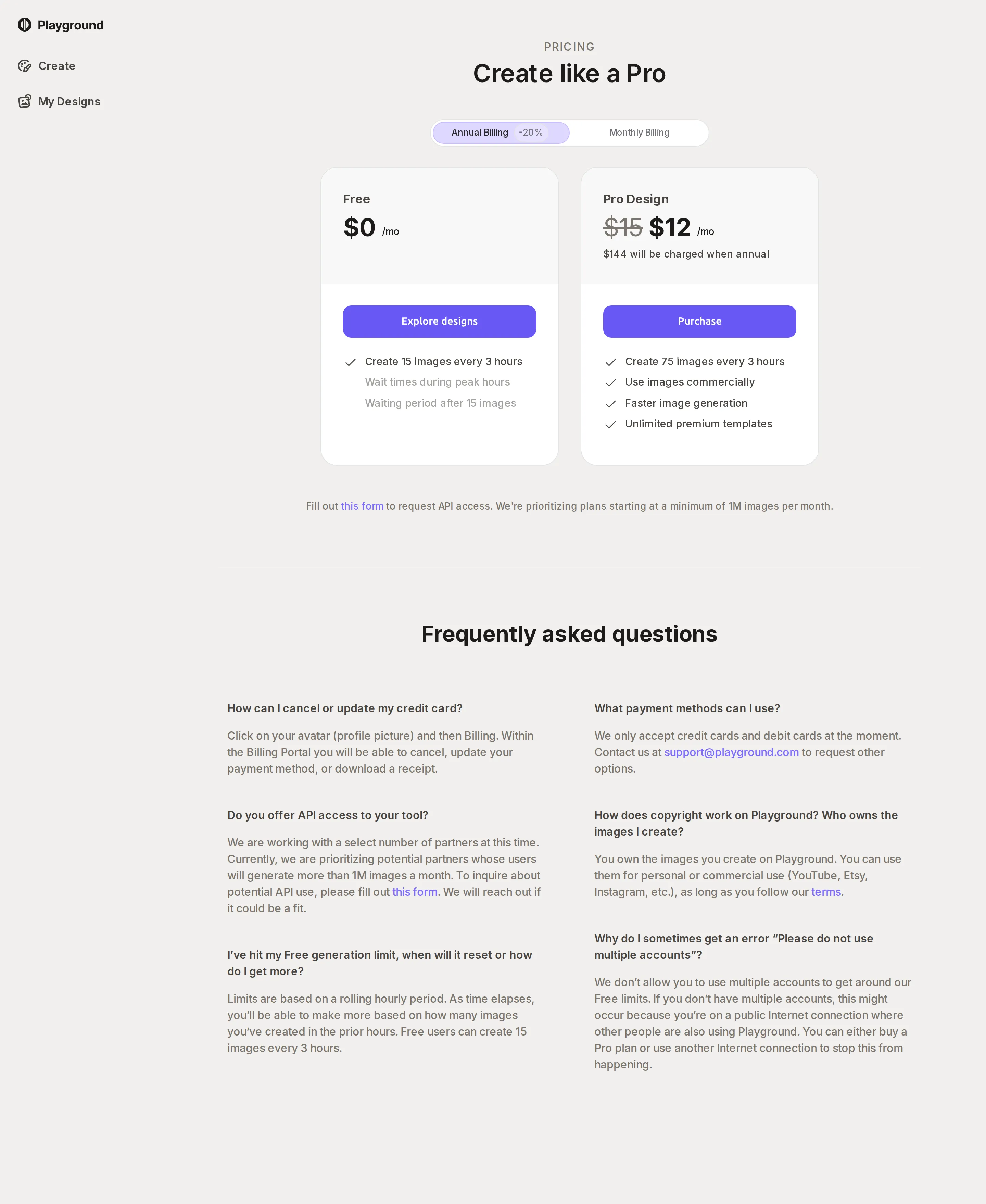
| 2024 Q3 | 0 | 1 | /design/pricing live: Free (15 images/3h) + Pro Design ($15/mo, 75 images/3h, commercial use). Image-window metering. (2024-09-10 snapshot) |
| 2024 Q4 | 0 | 0 | Legacy /pricing still up: Free (10 images/day) + Pro ($15/mo, 200 images/day). Playground v3 report (2024-09-17). (2024-10-06 snapshot) |
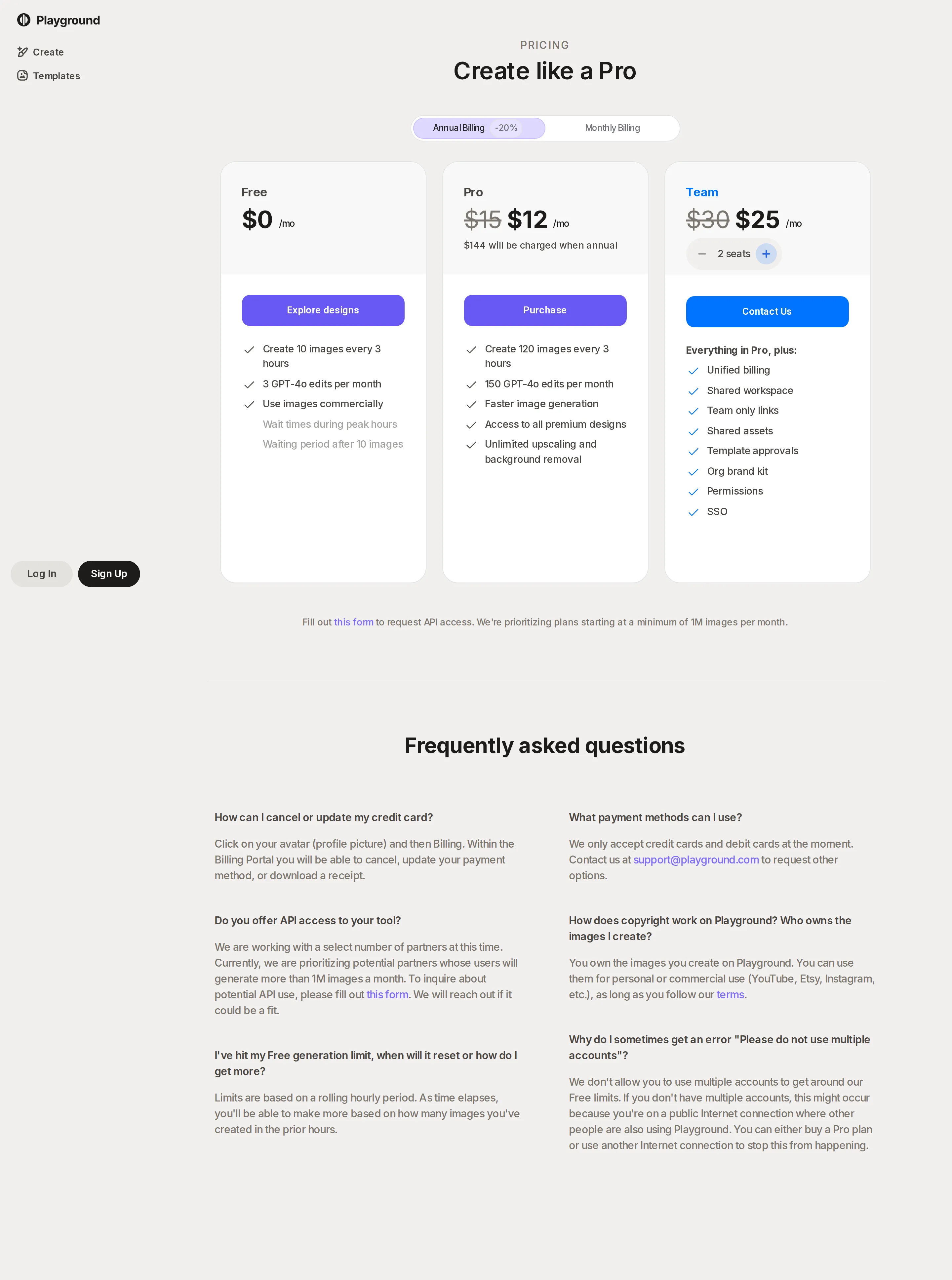
| 2025 Q2 | 0 | 1 | Team tier added ($30/mo, $25 annual, 2 seats, SSO); separate monthly “GPT-4o edits” counter introduced (3 Free / 150 Pro). (2025-06-23 snapshot) |
| 2025 Q4 | 0 | 1 | Team dropped; Pro Plus added ($45/mo, $36 annual) with unlimited images + 1,000 combined edits + Nano Banana Pro + API access. (2025-12-23 snapshot) |
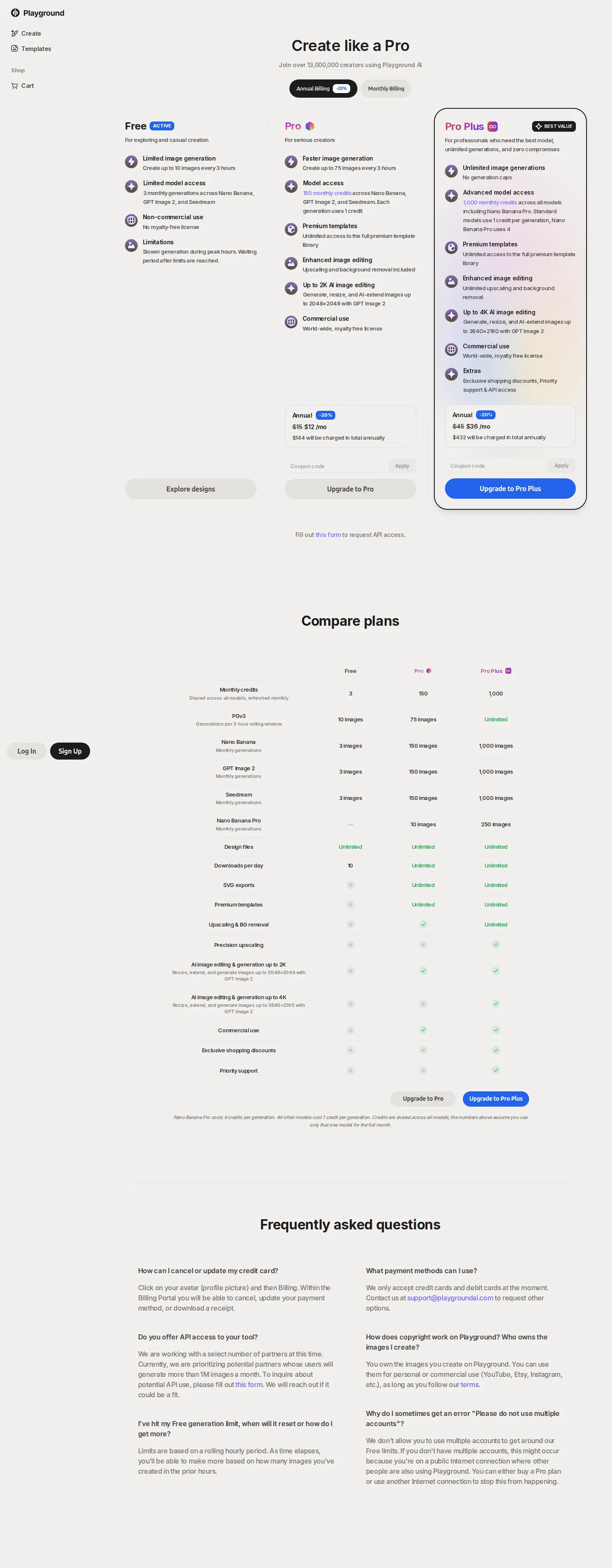
| 2026 Q2 | 0 | 0 | Edits unified into a shared monthly credit pool (3 / 150 / 1,000); Nano Banana Pro = 4 credits; Free loses commercial use. (2026-06-04 snapshot) |
| 2026 Q3 | 0 | 0 | Free tier downloads cut 10→2/day; compare-plans table’s PGv3 window cap for Free cut 10→5/3h; Coupon-code/Apply field removed from checkout. (2026-07-29 live capture) |
Tracked range: 2024-09-10 – 2026-07-29, from monthly /design/pricing snapshots plus the legacy /pricing page and a first live capture on 2026-07-29. “Price changes” counts headline plan-fee moves; the $0 entries reflect that the $15 Pro / $45 Pro Plus fees held steady even as metering, tiers and Free-tier caps changed.
Notable changes
- 2024-09-10 —
/design/pricingruns in parallel to the legacy per-day tool, metering a rolling 3-hour image window: Free (15 images/3h) + Pro Design ($15/mo, 75 images/3h, commercial use, premium templates). (Wayback snapshot) - 2025-06-23 — Team tier added ($30/mo, $25 annual, 2 seats) with unified billing, shared workspace, SSO and an org brand kit — Playground’s only attempt at a B2B motion in the tracked window. Pro’s window cap rose to 120 images/3h while Free fell to 10. A separate “GPT-4o edits” counter (3 Free / 150 Pro) appeared, the first sign of model-level metering. (Wayback snapshot)
- 2025-10-21 — The edit allowance broadened from “GPT-4o edits” to “GPT-4o, Nano Banana, and Seedream edits (combined),” foreshadowing a model-agnostic unit. (Wayback snapshot)
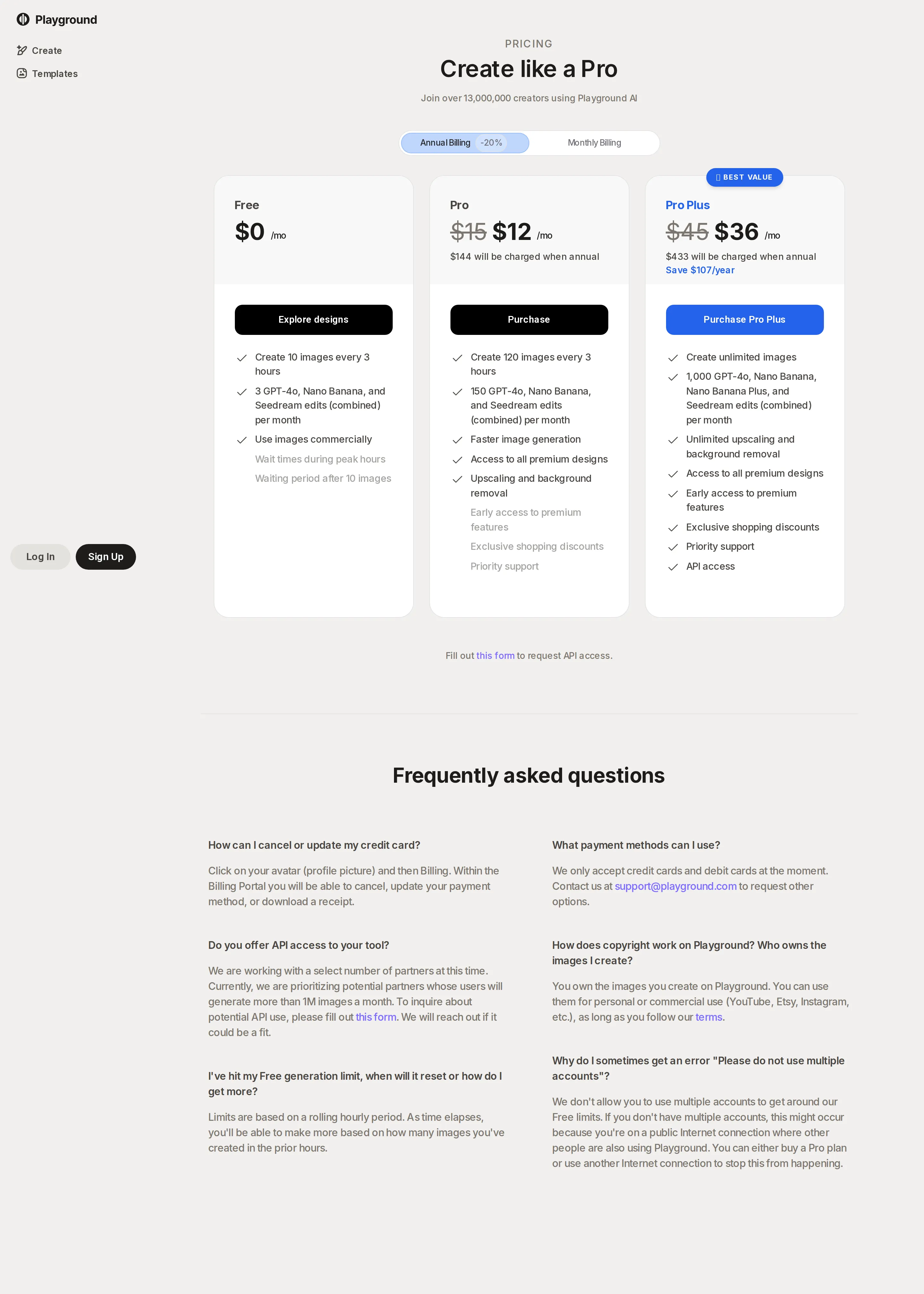
- 2025-12-23 — Team dropped, Pro Plus added ($45/mo, $36 annual, “Save $107/year”) with unlimited images, 1,000 combined edits including Nano Banana Pro, and API access — pivoting from a SMB-team ladder back to a prosumer one. Free and Pro still carried commercial use. (Wayback snapshot)
- 2026-06-04 — Per-model edit counters collapsed into a single shared monthly credit pool (3 / 150 / 1,000), with Nano Banana Pro priced at 4 credits/generation and every standard model at 1. In the same step Free lost its commercial license — relabelled “Non-commercial use, no royalty-free license” — a right it had carried in every snapshot from 2024-09 onward. (Wayback snapshot)
- 2026-07-29 — First successful live capture (the site’s automated-access block was not encountered this run);
/pricingnow serves content identical to/design/pricing. Free’s compare-plans table shows two entitlement cuts: downloads/day fell from 10 to 2, and the PGv3 rolling-window cap fell from 10 to 5 images — while the Free plan card’s own bullet copy still reads “up to 10 images every 3 hours,” an unresolved discrepancy on Playground’s live page. The Coupon-code/Apply promo field was also removed from the Pro and Pro Plus checkout cards. Pro and Pro Plus pricing/credits are unchanged. (Live capture)
The Free commercial-license removal in detail
The single sharpest change in the tracked window is not a price move — it’s a rights removal. From the first /design/pricing snapshot (2024-09) through 2026-01, the Free tier explicitly listed “Use images commercially.” The 2026-06 surface replaces that line with “Non-commercial use — no royalty-free license,” and Playground’s own help content now frames Free as “personal use only,” reserving the worldwide royalty-free license for Pro and Pro Plus. The exact switch date sits in the un-captured 2026-02 to 2026-05 window (those snapshots redirected to the site root and could not be read), so it is recorded here as occurring between 2026-01 and 2026-06. The effect is to convert the Free tier from a genuine top-of-funnel commercial hook into a strictly evaluation-only trial — a meaningful narrowing of free value covered more broadly in our note on the entitlement-to-credits billing shift.
What’s unique : model-agnostic credits and a gated commercial license
1. A shared, model-agnostic credit pool reached by evolution, not design. Rather than meter per image or per model, Playground gives each plan one monthly credit pool spent across Nano Banana, GPT Image 2 and Seedream, with Nano Banana Pro costing 4× a standard generation. What makes this distinctive in the corpus is the path: the Wayback trail shows Playground arriving at credits incrementally — from per-day images, to a rolling-window image cap, to separate “GPT-4o edits” counters, to “combined edits across three models,” and finally to a single credit unit. The credit pool is the convergence point of three years of metering experiments, which is why the underlying limits (10 / 75 / unlimited images per 3-hour window) still survive alongside the credit count rather than being replaced by it.
2. A model multiplier embedded in a flat price list. Charging 4 credits for Nano Banana Pro and 1 for everything else lets Playground absorb a premium model with very different unit economics without publishing a separate “premium” SKU or raising the headline price. The multiplier does the price discrimination quietly inside the pool — a pattern increasingly common across AI image tools and explored in our piece on the value-metric problem in AI pricing.
3. Licensing, not usage, as the upgrade trigger. Reserving the worldwide royalty-free commercial license for paid tiers — and removing it from Free in 2026 — makes the right to use the output, not throughput, the thing you actually pay for. For an Etsy seller or freelance designer, the $15 is a license fee that happens to come bundled with credits.
Strengths & weaknesses
| Strengths | Weaknesses |
|---|---|
| Simple, legible three-plan ladder with transparent annual savings (−20%) | A two-year trail of metering changes (per-day → window → edits → credits) erodes price predictability for returning users |
| Model-agnostic credit pool lets users mix models without re-buying | Free tier value keeps eroding: commercial use was dropped between 2026-01 and 2026-06, then downloads (10→2/day) and the generation window (10→5/3h) were cut again on 2026-07-29 |
| Worldwide royalty-free commercial license on both paid tiers | Nano Banana Pro at 4 credits/gen erodes the pool faster than the headline credit counts suggest |
| Self-serve, no sales friction on published plans | No overage or top-up SKU: hitting the credit cap stalls work until refresh or upgrade |
| Steady $15 Pro / $45 Pro Plus pricing despite shifting metering | API access is gated and opaque (partner form, >1M images/month); the short-lived Team tier left no SMB path |
| First successful live capture (2026-07-29) validates two years of Wayback-sourced pricing history | Free’s own plan card (“up to 10 images every 3 hours”) contradicts its compare-plans table (5 images) as of 2026-07-29 — an unresolved page-accuracy issue |
Billing UX : self-serve billing portal, credit-pool meters and coupon entry
- Annual / Monthly billing toggle — a switch at the top of
/design/pricingflips every paid plan between monthly and annual pricing, surfacing the −20% annual rate inline (Pro $15→$12, Pro Plus $45→$36) and the total annual charge ($144, $432). - Billing Portal — reached via the avatar (profile picture) → Billing; lets users cancel, update the payment method, or download a receipt. (On the legacy
/pricingsurface the same action was a “Manage” link beneath the active plan.) - “Compare plans” table — a full feature/limit matrix on the pricing page laying out monthly credits, per-3-hour generation windows, per-model monthly generations, design files, downloads/day, SVG exports, editing resolution and commercial use side by side across Free / Pro / Pro Plus.
- Coupon / “Apply” field (removed 2026-07-29) — through 2026-06-04, each paid plan card carried a promo-code entry with an Apply button before checkout; the live 2026-07-29 capture shows this field has been removed from both the Pro and Pro Plus cards.
- Rolling-window usage counter — generation limits run on a rolling time window (3 hours on the current surface; the legacy tool showed a counter once a user hit 80% of the period limit) rather than a fixed midnight reset.
- Credit-pool consumption — the only accepted payment methods are credit and debit cards; spend is metered as credits drawn from the shared monthly pool (1 credit per standard generation, 4 for Nano Banana Pro).
Strategic wins : why specific decisions worked
1. Model-agnostic credit pool insulates the price list
Pricing on a single shared credit pool across Nano Banana, GPT Image 2 and Seedream lets Playground swap or add models without re-pricing plans. The Wayback trail proves the value: between 2024 and 2026 Playground added GPT Image 2, Seedream, Nano Banana and Nano Banana Pro to the lineup, yet Pro stayed $15 and Pro Plus stayed $45 throughout. The credit unit absorbed every model addition, so the company avoided the per-model price-list churn that forces re-negotiation on competitors who meter each model separately.
2. Gated commercial licensing as the paywall
Reserving worldwide royalty-free commercial use for Pro and Pro Plus turns the license — not just throughput — into the upgrade trigger. For the core audience (Etsy/Redbubble sellers, freelance designers, social-content creators) the right to sell the output is the binary they care about, so bundling it with the paid tiers converts intent-to-monetize directly into a subscription. Tightening this in 2026 by removing commercial use from Free sharpened the trigger further, at the cost of free-tier funnel value.
3. Transparent annual discount
Surfacing the −20% annual rate inline (Pro $15→$12, Pro Plus $45→$36) with the full annual charge spelled out ($144, $432) and a “Save $107/year” badge on Pro Plus nudges users toward committed annual plans at the decision point, lifting LTV and smoothing cash flow without a separate “switch to annual” upsell flow.
Areas to improve : specific gaps with proposed fixes
1. Non-commercial free tier weakens the funnel
Dropping commercial use from Free in 2026 narrows its value as a top-of-funnel hook: a creator who can no longer sell their free output has less reason to build a habit on Playground before paying. Proposed fix: restore a limited commercial right on Free (e.g., commercial use on standard-model outputs only, capped at the existing 3-credit allowance) so the funnel keeps its monetize-then-upgrade pull while still reserving the premium model and volume for paid tiers.
2. Opaque API access
API pricing is gated behind a partner form with a >1M images/month bar, and the short-lived Team tier ($30/mo) was retired, leaving small developers and agencies with no self-serve path between consumer plans and an enterprise partnership. Proposed fix: publish a metered API rate per generation (credits already provide the natural unit) and re-introduce a low-seat team plan, capturing the SMB demand the Team experiment surfaced.
3. Hidden 4× credit cost on Nano Banana Pro
The 4-credits-per-generation cost of the premium model is disclosed only in a compare-plans footnote, so it is easy to miss against the headline “150” and “1,000” credit counts — a Pro user expecting 150 premium images actually gets ~37. Proposed fix: show a live “credits remaining” meter and a per-model cost chip in the generation UI (e.g., “Nano Banana Pro · 4 credits”) so the multiplier is visible at the moment of spend, not just on the pricing page.
4. Free plan card contradicts its own compare-plans table
As of 2026-07-29, Playground’s Free plan card advertises “up to 10 images every 3 hours” while the compare-plans table on the same page lists 5 — landing the same day the daily download cap was cut from 10 to 2. Shipping an entitlement cut without updating every surface that states the old number reads as a bait-and-switch to a free user who checked the plan card before signing up. Proposed fix: template the plan-card bullets from the same data source as the compare-plans table so a cap change updates both surfaces atomically, and treat the table as the system of record when the two disagree.
Monetization stack & signals : how Playground builds & buys its revenue engine
Buys 0 Builds 0
No sourceable vendor or hiring signal: Playground is a ~3-person YC-"Inactive" studio with no public ATS. Its only revenue-engine tell is a fully self-serve PLG spine — a model-agnostic credit meter behind a card-only checkout and self-serve billing portal — run with no sales org.
-
“A shared monthly credit pool (3 / 150 / 1,000 credits) meters generation across all models; every standard model costs 1 credit and Nano Banana Pro costs 4.”
Signals reviewed · derived from product docs
Key takeaways
- Meter on a model-agnostic credit, not the image. Playground’s pool spans every model, so adding GPT Image 2, Seedream, Nano Banana and Nano Banana Pro over two years never forced a plan re-price — Pro held at $15 throughout.
- Price premium models at a credit multiplier. Nano Banana Pro costs 4 credits versus 1 for standard models, letting a single price list absorb very different unit economics.
- Use the commercial license as the paywall. Reserving worldwide royalty-free use for paid tiers makes licensing — not just throughput — the upgrade trigger.
- Make the annual discount visible inline. Surfacing the −20% rate next to the monthly price ($15→$12, $45→$36) nudges annual commitment at the decision point.
- Cap by credits + a rolling window, not a midnight reset. A rolling 3-hour throughput cap on top of the monthly credit pool smooths demand without a daily cliff.
UBP implications
- Credits abstract away model cost volatility. A shared credit pool insulates the price list from per-model cost swings — Playground’s path from per-day images to a unified credit unit shows how a vendor can converge on credits incrementally as its model lineup grows. See understanding usage-based pricing models for where this sits among metering options.
- Multipliers let one plan span tiers of compute. Charging 4 credits for the premium model shows how a multiplier turns a single SKU into a multi-quality offering.
- Licensing can be the value metric. Gating commercial rights behind paid tiers demonstrates that the billable unit need not be usage at all — it can be the right to use the output.
Sources
- Playground Design pricing page (current surface) — live capture, no block encountered (accessed 2026-07-29); prior facts via Wayback snapshot 2026-06-04 when the live page returned HTTP 403 (accessed 2026-06-04)
- Playground pricing page (legacy surface) — as of 2026-07-29 renders content identical to /design/pricing (accessed 2026-07-29); historically via Wayback snapshot 2024-10-06 when the live page returned HTTP 403 (accessed 2026-06-04)
- Playground Design pricing — historical snapshots — monthly Wayback captures 2024-09 to 2026-01 used for the pricing-evolution chronology (accessed 2026-06-05)
- Playground blog — including “Is Playground AI Free?” (Free / Pro / Pro Plus breakdown) (accessed 2026-06-05)
- Playground (accessed 2026-06-04)
Bottom line
Playground prices image generation on a freemium subscription over a shared monthly credit pool — Free ($0), Pro ($15/mo, $12 annual) and Pro Plus ($45/mo, $36 annual) — where every standard model costs 1 credit and Nano Banana Pro costs 4, and worldwide commercial licensing is reserved for the paid tiers. The headline $15 Pro price has held steady since 2024 even as Playground cycled through per-day, rolling-window and credit-pool metering and briefly trialed a $30 Team tier — a study in keeping the price fixed while the value metric underneath it moves. The sharpest shift isn’t a price change at all: Free has been pared back twice in as many capture windows — its commercial license disappeared between 2026-01 and 2026-06, then its own daily download cap (10→2) and generation window (10→5/3h) were cut again on 2026-07-29, the same day an unresolved discrepancy surfaced between Free’s marketing bullet and its own compare-plans table. Free has moved from a monetizable hook to a strictly evaluation-only trial, and the page itself hasn’t fully caught up with its own cuts.
Want to compare Playground against other AI image-generation pricing? Browse the pricing blueprint.
Pricing timeline : Major events on a vertical axis
Each milestone below corresponds to a public pricing change, product launch, or material adjustment. Major events use a filled marker; minor adjustments use a faded one.
Free tier caps cut (downloads 10→2/day, PGv3 window 10→5/3h); promo-code field removed
First successful LIVE capture of playground.com/design/pricing (the site's automated-access block was not encountered this run). The compare-plans table now shows Free's daily download cap cut from 10 to 2 and the PGv3 rolling-window generation cap cut from 10 to 5 images per 3 hours — while the Free plan card's own bullet copy still reads 'up to 10 images every 3 hours,' an unresolved discrepancy on Playground's live page. The Coupon-code/Apply promo field was also removed from the Pro and Pro Plus checkout cards. Pro ($15/mo, $12 annual) and Pro Plus ($45/mo, $36 annual) pricing and credit pools (3/150/1,000) are unchanged.
Unified credit pool; Free loses commercial use
Per-model 'edits' are unified into a shared monthly credit pool (3 / 150 / 1,000 credits); every standard model costs 1 credit and Nano Banana Pro costs 4. The Free tier is re-labelled 'Non-commercial use — no royalty-free license,' removing the commercial rights it carried in every prior snapshot. Captured from the 2026-06-04 Wayback snapshot (live page is bot-walled).
Team tier dropped; Pro Plus ($45/mo) added with Nano Banana Pro
The consumer ladder replaces Team with Pro Plus ($45/mo, $36 annual, 'Save $107/year'), offering unlimited images and 1,000 combined GPT-4o / Nano Banana / Nano Banana Pro / Seedream edits per month plus API access. Free and Pro still grant commercial use. Captured from the 2025-12-23 Wayback snapshot.
Edit counters broaden to GPT-4o + Nano Banana + Seedream
The per-month edit allowance is rebranded from 'GPT-4o edits' to '3 / 150 GPT-4o, Nano Banana, and Seedream edits (combined) per month,' signalling the move toward a model-agnostic allowance while Team ($30/mo) still sits as the top tier. Captured from the 2025-10-21 Wayback snapshot.
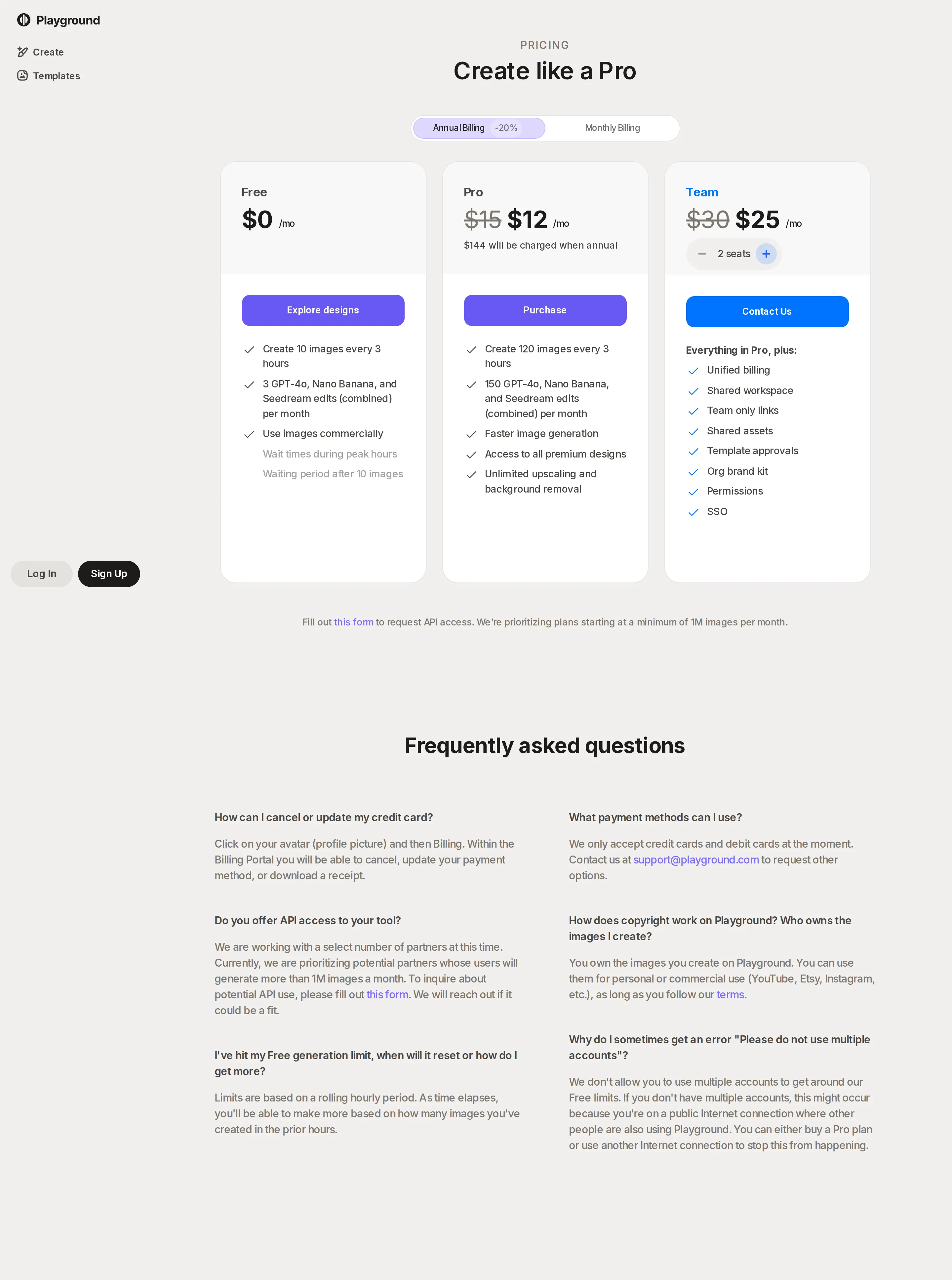
Team tier added ($30/mo) and GPT-4o edit counters introduced
The /design/pricing surface gains a third tier — Team ($30/mo, $25 annual, 2 seats, unified billing, shared workspace, SSO, org brand kit) — and introduces a separate monthly 'GPT-4o edits' counter (3 on Free, 150 on Pro). Pro's window cap rises to 120 images/3h; Free drops to 10 images/3h. Captured from the 2025-06-23 Wayback snapshot.
Legacy two-tier image-generation pricing (/pricing): Free / Pro
playground.com/pricing offered Free ($0/mo, 10 images/day, commercial use, 30-step cap, JPEG) and Pro ($15/mo, 200 images/day — 2,000/day per FAQ, PNG, no dimension limits up to 1M px, Permanent Private mode). Coincides with the Playground v3 (PGv3) model report on 2024-09-17. Captured from the 2024-10-06 Wayback snapshot.
Design product launches: Free + Pro Design ($15) on /design/pricing
The /design/pricing surface meters image generations in a rolling 3-hour window: Free ($0, 15 images/3h) and Pro Design ($15/mo, $12 annual, 75 images/3h, commercial use, premium templates). This runs in parallel to the legacy per-day /pricing surface. Captured from the 2024-09-10 Wayback snapshot.
- · Playground's Free tier dropped commercial use between the 2026-01 and 2026-06 /design/pricing snapshots: every snapshot from 2024-09 through 2026-01 told free users they could 'use images commercially,' but the current surface marks Free 'Non-commercial use — no royalty-free license.'
- · All paid plans draw from one shared monthly credit pool spanning Nano Banana, GPT Image 2 and Seedream — and Nano Banana Pro costs 4 credits per generation versus 1 for every other model, so a Pro Plus user gets 1,000 standard images but only 250 premium ones from the same pool.
- · Playground ran three different metering models in under two years: per-day image caps on the legacy /pricing surface (10/day free, 200/day Pro), then a rolling-3-hour image window with separate 'GPT-4o edits' counters, then a unified monthly credit pool — all without ever changing the $15 Pro headline price.
Questions & answers
- How much does Playground AI cost?
- Playground offers a Free plan ($0), a Pro plan at $15/mo ($12/mo billed annually, $144/year) and a Pro Plus plan at $45/mo ($36/mo billed annually, $432/year). Annual billing saves 20%.
- What is a credit on Playground AI?
- Credits are a shared monthly pool spent across all models. Every standard model (Nano Banana, GPT Image 2, Seedream) costs 1 credit per generation; Nano Banana Pro costs 4 credits. Free includes 3 credits/month, Pro 150, and Pro Plus 1,000.
- Can I use Playground AI images commercially?
- On the current /design/pricing plans, commercial worldwide royalty-free licensing is included only on Pro and Pro Plus. The Free tier is non-commercial and carries no royalty-free license.
- Does Playground AI offer an API?
- API access is gated. Playground prioritizes partners generating more than 1M images per month via a request form, and lists API access among Pro Plus extras.
- How has Playground AI's pricing changed over time?
- Playground has cycled through three metering models without changing its $15 Pro headline. The legacy /pricing surface metered images per day (10/day Free, 200/day Pro). The /design/pricing surface then metered a rolling 3-hour image window plus separate monthly 'GPT-4o edit' counters, and briefly added a Team tier ($30/mo) in mid-2025. By late 2025 Team was replaced with Pro Plus ($45/mo), and by 2026 all editing collapsed into a single shared monthly credit pool (3 / 150 / 1,000 credits). In its first successful live capture on 2026-07-29, Playground tightened Free further — daily downloads fell from 10 to 2 and the rolling-window generation cap fell from 10 to 5 images — while Pro and Pro Plus pricing and credits stayed unchanged.
- Who is behind Playground AI?
- Playground was founded in 2022 by Suhail Doshi, who previously co-founded analytics company Mixpanel and ran the cloud-browser startup Mighty. Playground raised a $40M round in 2023 and develops its own image models (Playground v2.5 and Playground v3) in addition to routing to third-party models.