AI Summary
About
Sourcegraph builds code-intelligence tooling — search, navigation, large-scale refactoring (Batch Changes), and AI-assisted understanding — for engineering organizations working in large, complex codebases. Cody began as Sourcegraph’s standalone AI coding assistant, sold on self-serve consumer tiers alongside the core code-search product.
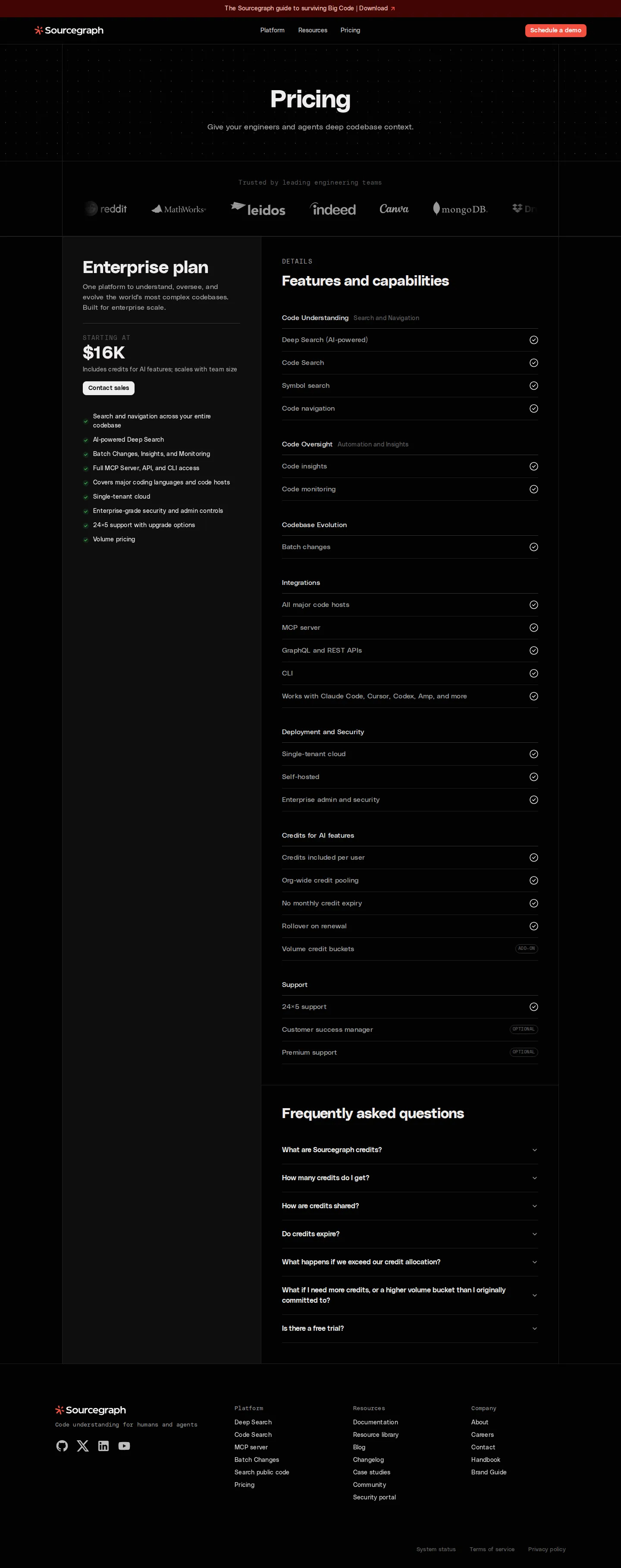
As of mid-2026 that packaging is gone. The pricing page at sourcegraph.com/pricing now markets a single Enterprise plan positioned as “one platform to understand, oversee, and evolve the world’s most complex codebases.” Cody’s coding-assistant capabilities have been folded into this platform — AI features such as Deep Search are funded by an org-wide credit pool — rather than sold as a separate consumer product. The standalone agentic successor, Amp, was spun out to its own domain (ampcode.com) and is billed independently of the Sourcegraph platform.
Founded in 2013 around universal code search, Sourcegraph raised a $125M Series D led by Andreessen Horowitz at a $2.6B valuation in July 2021 — well before the AI-coding wave. Cody arrived in 2023 as the AI layer on top of that search graph, and the pricing page lists enterprise customers including Reddit, MathWorks, Leidos, Indeed, Canva, and MongoDB. Against per-seat coding-assistant peers like GitHub Copilot, Cursor, and Codeium, Sourcegraph has taken the opposite path: instead of competing for individual developers’ $9–$20/mo, it abandoned the self-serve market entirely and repositioned as enterprise code-intelligence infrastructure — leaving its agentic, developer-facing bet to a spun-out company, Amp.
Pricing summary : seat-scaled Enterprise license plus a pooled AI credit model
Sourcegraph now sells a single Enterprise plan that starts at $16K and “scales with team size,” combining a seat-based platform license with an org-wide pool of AI credits — a hybrid pricing model where the seat count sets the base and AI usage is funded by credit-based billing. Only the $16K starting figure is published; per-seat rates and final contract pricing are gated behind Contact sales.
The model has three dimensions:
- Seats — the platform license scales with team size; AI credits are “included per user.”
- AI credit pool — credits are org-wide pooled, have no monthly expiry, and roll over on renewal; additional capacity is bought as volume credit buckets (an add-on).
- Commitment — credit capacity is committed at contract time; the pricing FAQ addresses needing “a higher volume bucket than I originally committed to.” Optional add-ons (customer success manager, premium support) are quoted on top.
What makes this different: Sourcegraph retired its self-serve Cody consumer tiers entirely and pushed all customers into one enterprise platform plan, while spinning the standalone agentic product (Amp) out to a separate domain and bill. Rather than metering AI per token, it wraps AI usage in a non-expiring, poolable credit allocation — closer to a committed capacity model than pay-as-you-go.
Pricing by product
Sourcegraph platform (Enterprise plan)
| Tier | Price | Included | Key mechanics |
|---|---|---|---|
| Enterprise | $16K starting | Deep Search (AI-powered), Code Search, symbol search and navigation; Batch Changes, Code Insights, monitoring; full MCP Server, GraphQL/REST APIs, CLI, and all major code hosts; single-tenant cloud or self-hosted; enterprise admin and security; credits for AI features included per user. | Seat-scaled platform license; “Includes credits for AI features; scales with team size”; “Volume pricing” is listed as a plan feature. Sales-led, quoted — only the starting figure is published. |
AI credits (funds AI features)
| Tier | Price | Included | Key mechanics |
|---|---|---|---|
| Included credits | Bundled in plan | Credits included per user; org-wide credit pooling; no monthly credit expiry; rollover on renewal. | Capacity model, not per-token metering. The number of credits per user is not published — the page routes it to an FAQ (“How many credits do I get?”). |
| Volume credit buckets | Add-on | Additional org-wide AI credit capacity purchased in buckets. | Marked ADD-ON on the page; committed at contract time, with an FAQ covering exceeding the allocation and moving to a higher bucket mid-term. |
Optional support add-ons
| Tier | Price | Included | Key mechanics |
|---|---|---|---|
| 24×5 support | Included | Standard enterprise support with upgrade options. | Base support tier, checked on the Enterprise plan. |
| Customer success manager | Optional | Named CSM. | Marked OPTIONAL on the feature matrix; priced in the quote. |
| Premium support | Optional | Higher-touch support. | Marked OPTIONAL on the feature matrix; priced in the quote. |
The pricing page positions the platform as agent-neutral: the integrations row reads “Works with Claude Code, Cursor, Codex, Amp, and more,” so Sourcegraph sells context to whichever coding agent a team already pays for rather than bundling one. The standalone agentic product Amp is sold separately at ampcode.com with its own billing; it is out of scope of the Sourcegraph platform plan above.
Sales motions across products: sales-led for the Enterprise platform plan and all add-ons; there is no self-serve or free tier on sourcegraph.com/pricing after the Cody consumer-plan retirement.
Hidden costs : What Sourcegraph Cody users actually pay
Because only the “$16K starting” figure is published and the rest is quoted by sales, the real cost of Sourcegraph today is shaped by three things the pricing page doesn’t put a number on: the per-seat platform rate, AI credit consumption beyond the included allocation, and the fact that the agentic tooling most developers actually want now lives on a separate bill at Amp.
Archetype 1 — a 50-engineer org on the Enterprise platform. The visible floor is $16K, but “scales with team size” means the real annual figure is set by seat count. Using the last-published self-serve Enterprise rate ($19/user/mo in 2024) and the third-party-reported enterprise rate ($59/user/mo in 2025) as bookends, a 50-seat org lands well above the $16K starting point before any volume credit buckets.
| Line item | Annual cost |
|---|---|
| Enterprise platform floor (published) | $16,000 starting |
| 50 seats at the published starting floor | quoted (scales with team size) |
| Volume credit buckets (if AI usage exceeds included credits) | add-on, committed at contract time |
| Customer success manager + premium support | optional add-ons |
| Effective annual commit | $16K floor, materially higher at 50 seats — quoted by sales |
The lesson: the $16K headline is a minimum, not a representative bill. Seat scaling and credit overage buckets are both negotiated, so two 50-seat orgs can pay very different amounts.
Archetype 2 — an individual developer or small team after July 2025. Anyone who relied on Cody Free or Pro no longer has a self-serve option. The realistic “Sourcegraph” path for them is now Amp, billed separately at pass-through LLM cost.
| Line item | Monthly cost |
|---|---|
| Sourcegraph self-serve plan | not available (discontinued 2025-07-23) |
| Amp credits (pass-through LLM API cost, zero markup) | ~$5 minimum top-up, then actual provider cost |
| Amp Enterprise (if SSO / zero-retention needed) | +50% over individual/team rate |
| Effective monthly cost | whatever your LLM usage costs on Amp — no flat seat fee |
The hidden cost here is conceptual, not just financial: a former $9/mo Pro user trades a predictable flat fee for variable, usage-metered spend on a different product and a different company.
Want to estimate your own Sourcegraph Cody bill? Use the Sourcegraph Cody pricing calculator to model your costs based on seat count, included AI credits, and volume credit buckets.
Pricing evolution : Sourcegraph Cody pricing history and changes
Sourcegraph’s pricing arc is one of the sharpest reversals in the corpus: a $0/$9/$19 self-serve coding assistant that, inside roughly 18 months, abandoned the individual-developer market entirely and re-emerged as a sales-only enterprise platform with a $16K floor.
Cadence
| Quarter | Price changes | Product / SKU additions | Notes |
|---|---|---|---|
| 2023 Q1 | 0 | 1 | Cody launches as an open-source AI coding assistant in beta, free, alongside Code Search. |
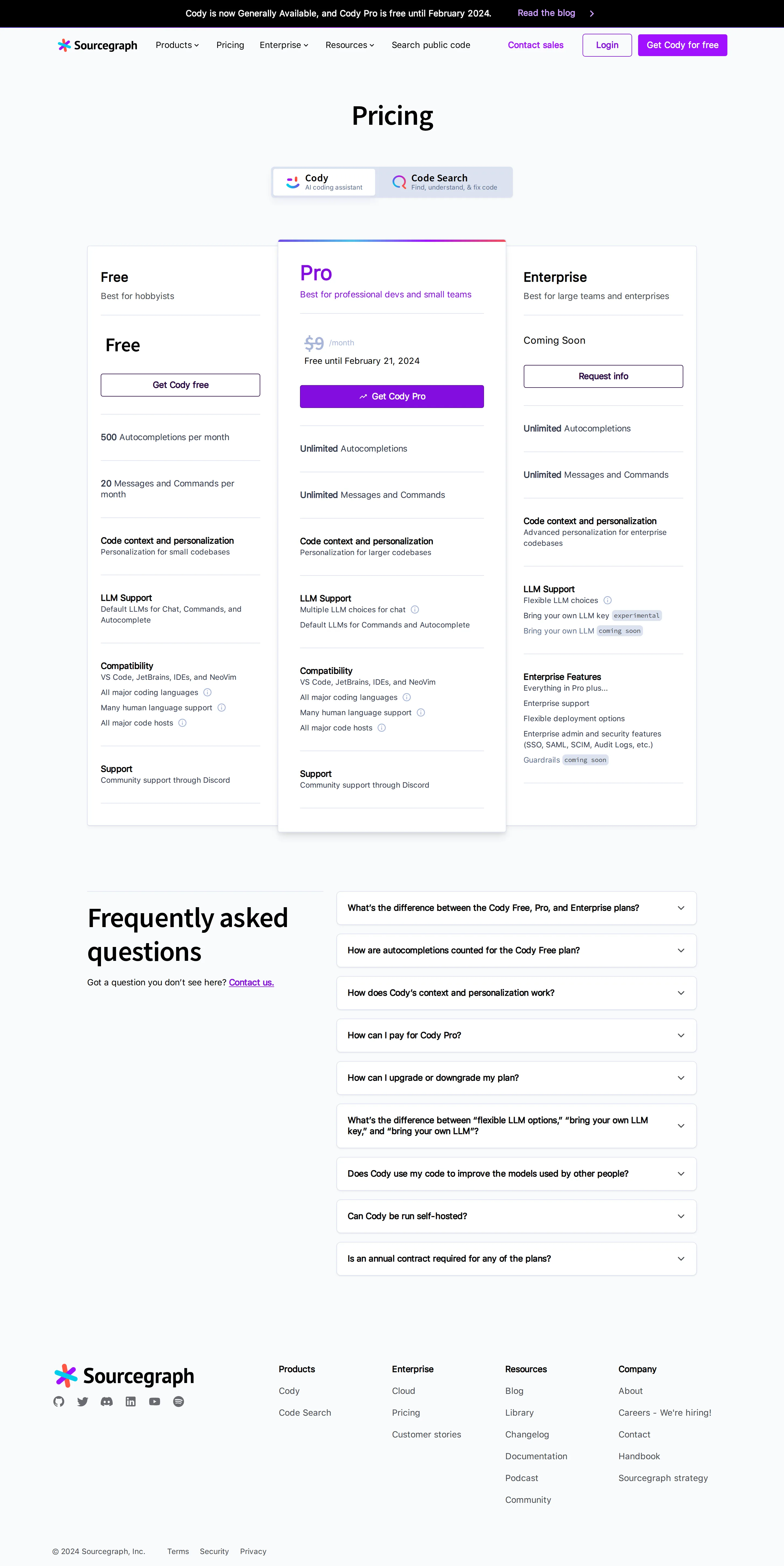
| 2023 Q4 | 1 | 1 | 2023-12-14 Cody reaches GA with self-serve Free ($0) and Pro ($9/mo, free through 2024-02-21); sales-led Enterprise alongside. |
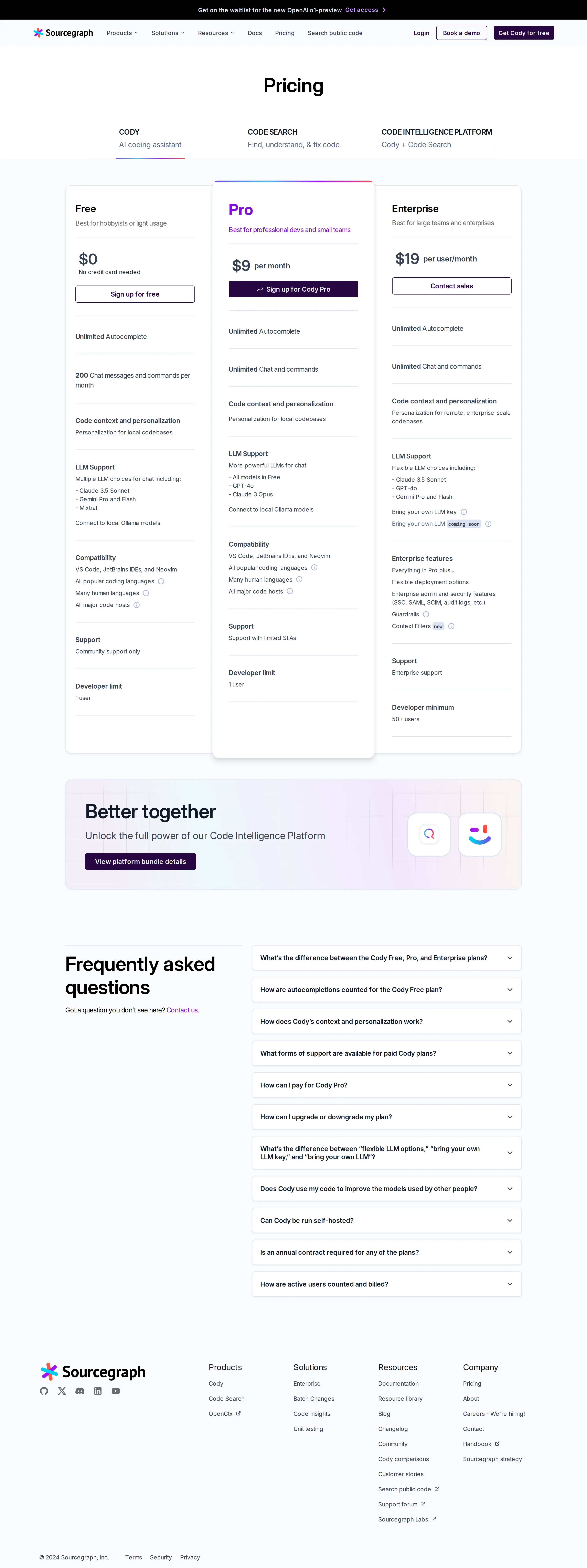
| 2024 Q3 | 1 | 0 | Three-tier structure settles: Free $0, Pro $9/mo, Enterprise $19/user/mo (BYO-LLM, SSO/SAML). Verified on 2024-08 and 2024-09 snapshots. |
| 2025 Q2 | 1 | 0 | 2025-06-25 Sourcegraph announces Cody Free, Pro, and Enterprise Starter will be discontinued on 2025-07-23; users pushed to Amp. |
| 2025 Q4 | 0 | 1 | 2025-12-02 Amp spins out as an independent company (ampcode.com); Sourcegraph keeps the enterprise platform. |
| 2026 Q2 | 1 | 0 | Pricing page collapses to a single Enterprise plan starting at $16K with org-wide pooled AI credits; no self-serve tier remains. |
Tracked range: 2023 Q1–2026 Q2. Quarters not listed were verified stable (0 price changes, 0 SKU additions) on the available Wayback snapshots. Wayback coverage runs 2023-11 through 2024-10; 2025 snapshots were not re-captured, so the 2025-06 and 2025-12 events are sourced from Sourcegraph’s own blog and changelog.
Notable changes
- 2023-03-23 — Cody open-sources as Sourcegraph’s AI editor assistant (HN: 105 points, 33 comments).
- 2023-12-14 — Cody reaches General Availability with Free and Pro $9/mo tiers (HN: “Cody Generally Available (Free and $9/month)”).
- 2024-09 — Wayback confirms the steady-state Free $0 / Pro $9 / Enterprise $19-per-user three-tier page.
- 2025-06-25 — Sourcegraph announces the shutdown of Cody Free, Pro, and Enterprise Starter effective 2025-07-23, with $10/$40 Amp-credit migration incentives (sourcegraph.com/blog/changes-to-cody-free-pro-and-enterprise-starter-plans).
- 2025-12-02 — Amp spins out as Amp Inc.; co-founders Quinn Slack and Beyang Liu depart to run it (HN: 90 points, 37 comments).
- 2026-06-08 — Live capture shows the single Enterprise plan starting at $16K with org-wide AI credit pooling; the self-serve Cody tiers are gone.
The Cody Free/Pro shutdown in detail
The defining event in this history is the June 25, 2025 announcement that Cody Free, Cody Pro, and Cody-within-Enterprise-Starter would all be discontinued on July 23, 2025. This was not a price increase — it was the removal of an entire self-serve product line. New signups for Free and Pro stopped the same day the announcement landed, and existing paying Pro users were told they “will not be charged” through the cutoff.
Rather than offer a replacement Sourcegraph plan, the company directed individual users to Amp, a different product, with migration incentives of $10 in Amp credits for Free users and $40 in Amp credits for Pro users. Cody Enterprise was explicitly carved out as “fully supported and actively developed.”
Developer reaction was mixed-to-critical: in third-party coverage, some users described the enterprise-only pivot as “a bit of a money grab” and said they would switch to other AI providers absent a self-serve quota. The decision reads cleanly in hindsight once the December 2, 2025 Amp spinout is factored in — Sourcegraph wasn’t just dropping consumer tiers, it was separating the consumer-facing agentic product into its own company so the remaining business could focus purely on enterprise code intelligence.
What’s unique : Sourcegraph Cody’s distinctive pricing mechanics
1. Code-search graph as the priced asset, not the AI assistant. Most coding-assistant vendors price the AI itself — per seat, per completion, or per token. Sourcegraph’s distinctive position is that the context is the product: its code-search and navigation graph is what makes AI answers good on large, messy codebases, and that’s what the platform license pays for. AI features like Deep Search ride on top of that graph, funded by a hybrid seat-plus-credit model rather than sold standalone.
2. A deliberate retreat from self-serve — rare in this category. Almost every peer (Cursor, Copilot, Tabnine, Codeium) is racing down-market to capture individual developers. Sourcegraph did the opposite: it killed its $0/$9/$19 tiers and went enterprise-only with a $16K floor. Choosing to shed a self-serve funnel rather than defend it is the single most unusual pricing decision on this page, and it’s the clearest expression of the shift away from per-user licenses toward platform commits.
3. Non-expiring, poolable AI credits instead of per-token metering. AI usage is funded by an org-wide credit pool with no monthly expiry and rollover on renewal — closer to committed capacity than pay-as-you-go. This is a softer take on credit-based billing: credits are shared across the whole organization, so a few heavy AI users don’t blow individual quotas, and unused capacity isn’t forfeited each month.
4. The “exit ramp to a sibling product” migration. When Sourcegraph discontinued Cody’s consumer tiers, it didn’t refund or grandfather users into a Sourcegraph plan — it handed them $10–$40 in credits for Amp, a separate product that later became a separate company. Using a competitor-adjacent sibling as the off-ramp for your own deprecated tier is a packaging move with almost no parallel in the corpus.
Strengths & weaknesses
| Strengths | Weaknesses |
|---|---|
| Clear enterprise positioning — one plan, one buyer, no funnel to defend across tiers. | No self-serve or free tier means zero bottoms-up adoption; engineers can’t try it on a personal card. |
| Org-wide pooled AI credits with no monthly expiry remove use-it-or-lose-it pressure and smooth heavy/light user mix. | Only the “$16K starting” figure is published; per-seat and final pricing are fully gated, hurting buyer self-qualification. |
| The code-search graph is a genuine moat for large-codebase context that pure LLM wrappers can’t easily replicate. | Discontinuing Cody Free/Pro burned goodwill with the very developers who evangelize tools internally. |
| Committed-capacity credit model (rollover on renewal) is friendlier to procurement than volatile per-token bills. | The $16K floor with seat scaling makes the platform inaccessible to small teams and startups. |
| Folding Cody into the platform simplifies the SKU story to one decision instead of three tiers. | Pushing departing users to Amp — then spinning Amp out — fragments the product story and the bill. |
| Enterprise logo list (Reddit, MongoDB, Canva, Indeed, Leidos) lends credibility to the enterprise-only bet. | $19 → reported $59 → $16K-floor trajectory signals steep price escalation to anyone who tracked Cody historically. |
Billing UX : org-wide credit pooling, rollover, and gated quoting
- Org-wide credit pooling — AI credits are shared across the organization rather than locked per seat, so usage is balanced across the team from a single pool.
- No monthly credit expiry — credits do not lapse month to month, removing the use-it-or-lose-it pressure typical of monthly AI quotas.
- Rollover on renewal — unused credits carry over when the contract renews, per the page’s “rollover on renewal” line.
- Volume credit buckets (add-on) — additional AI capacity is purchased in discrete buckets when the included per-user allocation is exhausted; the pricing FAQ explicitly covers moving to “a higher volume bucket than I originally committed to,” so mid-term bucket upgrades are a supported motion.
- Overage handling documented, not quantified — a dedicated FAQ (“What happens if we exceed our credit allocation?”) acknowledges the overage path, but neither the credits-per-user figure nor the overage rate is published on the page.
- Contact-sales quoting — there is no self-serve checkout; the only published number is the “$16K starting” figure, and final pricing is quoted by sales.
- Optional support upgrades — customer success manager and premium support are surfaced as optional line items on top of the included 24×5 support.
Strategic wins : Why Sourcegraph Cody’s pricing decisions worked
1. Picking a lane instead of fighting a margin war it couldn’t win
By 2025, competing for individual developers at $9–$20/mo meant absorbing rising LLM inference costs on tiny ARPU while Cursor, Copilot, and Codeium fought a brutal price war. Sourcegraph’s decision to exit self-serve entirely and anchor on a $16K enterprise floor sidesteps that war and points the business at buyers who pay for code-intelligence infrastructure, not per-seat AI. This is the shift from per-user licenses to platform value taken to its logical extreme — see usage-based pricing fundamentals for why per-seat AI margins compress.
2. Wrapping AI in committed, poolable credits instead of raw token metering
Rather than expose enterprises to volatile per-token bills, Sourcegraph funds AI through an org-wide credit pool with rollover and no monthly expiry. That converts an unpredictable cost into a committed, procurement-friendly line item, and the pooling means heavy AI users don’t trip individual caps. It’s a pragmatic application of prepaid credit models and the broader entitlement-to-credits billing shift.
3. Using Amp as a clean off-ramp — and then a clean spinout
When Cody’s consumer tiers were retired, the $10/$40 Amp-credit migration kept departing users inside the founders’ orbit without forcing Sourcegraph to keep operating a low-margin self-serve business. The December 2025 spinout then fully separated the two distribution engines, letting each company optimize a different pricing model — Sourcegraph’s committed enterprise platform vs. Amp’s pass-through usage billing. Structurally separating products with incompatible monetization is a textbook move discussed in outcome-based and agentic pricing trends.
Areas to improve : Gaps in Sourcegraph Cody’s pricing approach
1. Publish a per-seat rate, not just a $16K floor
Gating everything behind “starting at $16K” forces every prospective buyer into a sales call before they can even sanity-check fit. A published per-seat band (the way Cody Enterprise once showed $19/user/mo) would let mid-market teams self-qualify and shorten the sales cycle, without giving away negotiated discounts. Opaque floors are a known source of bill shock and cost unpredictability — even at the evaluation stage.
2. Offer a credible on-ramp for teams that aren’t ready for $16K
The all-or-nothing jump from “no self-serve option” to a five-figure enterprise commit leaves growing teams with nowhere to land. A lightweight, lower-commit tier — even a sales-assisted “team” plan with a published per-seat rate and a small included credit bucket — would recapture the seat-plus-usage middle that the Cody Pro shutdown vacated, and give those accounts a path to grow into Enterprise.
3. Make the credit model legible before contract signature
“Org-wide pooling, no monthly expiry, rollover on renewal, volume buckets” is a good model, but its actual units (how many credits a seat includes, what a Deep Search query costs) are not published. Exposing a credit-to-action conversion — even directionally — would let buyers forecast AI spend instead of discovering overage at renewal. Clear metering definitions are the foundation of trustworthy usage pricing; see choosing the right usage metric.
Monetization stack & signals : how Sourcegraph Cody builds & buys its revenue engine
3 open roles
Sourcegraph's public Greenhouse board (token sourcegraph91, 8 open roles on 2026-06-16) shows the post-Amp-spinout investment concentrated in the customer-success / retention org, not in monetization or billing engineering: a Senior Customer Success Manager (tagged retention), a remote Field Engineer, and an EMEA Support Engineer, all under the Revenue team. No open role, engineering-blog post, or press disclosure names a third-party billing, metering, CPQ or rev-rec vendor, and none discloses an in-house metering build — so the stack behind the new org-wide AI credit pool is unsourced and left blank rather than guessed. The only named tool in any posting ("companies like Stripe, Uber, and Dropbox rely on Sourcegraph") is a customer reference, not a usage disclosure, and is intentionally excluded. Worth a re-check once the credit-pool platform team starts hiring billing/metering engineers.
- Field Engineer [IC4] Customer success May 28, 2026
- Senior Customer Success Manager - US East [IC3] Customer successRetention May 28, 2026
- Support Engineer - EMEA [IC2] Customer success May 28, 2026
Signals reviewed · derived from public job posts
Job postings fill and close over time — once a posting is filled we keep it as a dated citation (the quoted evidence remains); use View open roles for current listings.
Key takeaways
- Killing a self-serve tier is a valid strategy — if your value is enterprise infrastructure. Sourcegraph proved you can walk away from the individual-developer market entirely when your real moat (the code-search graph) only pays off at enterprise scale. The discipline is knowing your low-ARPU funnel isn’t the business.
- Wrap AI cost in committed credits to make it procurement-friendly. Replacing per-token exposure with an org-wide, non-expiring, poolable credit allocation converts a scary variable into a predictable committed line item — and pooling absorbs the heavy/light user mix automatically.
- A price floor with no published per-seat rate is a friction tax. “$16K starting” qualifies who can afford it but stops everyone else from self-qualifying. If you gate pricing, gate the discount, not the existence of a number.
- Deprecating a tier is a brand event, not just a billing change. Removing Cody Free/Pro cost goodwill with the developers who evangelize tools internally; the $10/$40 Amp credits softened it but didn’t replace the lost adoption funnel.
- Separate products with incompatible monetization into separate companies. Committed enterprise platform pricing and pass-through usage billing pull in opposite directions; Sourcegraph and Amp splitting let each optimize its own model instead of forcing one P&L to straddle both.
UBP implications
- Committed credit pools are a maturing alternative to pure pay-as-you-go for AI. Sourcegraph’s no-expiry, rollover, org-wide pool shows enterprises will accept usage-based AI funding if it’s structured as committed capacity rather than open-ended metering — a key bridge between subscriptions and true UBP.
- Usage-based monetization can coexist with enterprise commits inside one bill. The seat-based platform license sets the floor while AI credits and volume buckets capture marginal usage — a hybrid where the commit de-risks the vendor and the credit pool de-risks the buyer.
- The agentic shift can break a single pricing model in two. Per-seat assistants and pass-through usage agents want fundamentally different meters; expect more vendors to split a flat-rate assistant from a consumption-billed agent, as Sourcegraph did by separating the platform from Amp.
Sources
- Sourcegraph pricing page (accessed 2026-07-22)
- Sourcegraph blog: Changes to Cody Free, Pro, and Enterprise Starter plans (accessed 2026-06-09)
- Sourcegraph blog: Why Sourcegraph and Amp are becoming independent companies (accessed 2026-06-09)
- Sourcegraph changelog (accessed 2026-06-09)
- Sourcegraph documentation (accessed 2026-06-08)
- Amp pricing manual (standalone agentic successor) (accessed 2026-06-09)
- Browse the pricing blueprint for fully-researched company profiles.
Bottom line
Sourcegraph Cody is the rare coding-assistant story that ran its pricing in reverse: from an open-source, $0/$9/$19 self-serve product into a sales-only enterprise platform starting at $16K, with its developer-facing agent (Amp) spun out to a separate company and a separate, pass-through bill. The result is a clean enterprise positioning built on a genuine code-search moat — but one that abandoned the bottoms-up adoption funnel its peers are fighting for, and hid its real per-seat economics behind a five-figure floor.
Want to compare Sourcegraph Cody against per-seat peers like Cursor and GitHub Copilot? Browse the pricing blueprint.
Pricing timeline : Major events on a vertical axis
Each milestone below corresponds to a public pricing change, product launch, or material adjustment. Major events use a filled marker; minor adjustments use a faded one.
Standalone Cody plans retired into one Enterprise platform plan
sourcegraph.com/pricing now shows a single Enterprise plan starting at $16K with AI credits included and org-wide credit pooling. Self-serve Cody tiers are gone; the agentic successor Amp lives separately at ampcode.com.
Amp spins out of Sourcegraph as an independent company
Co-founders Quinn Slack and Beyang Liu leave to found Amp Inc.; Dan Adler becomes Sourcegraph CEO. Amp moves to ampcode.com with pass-through, credit-based billing. Sourcegraph keeps the enterprise code-intelligence platform (HN: 90 points, 37 comments, 2025-12-02).
Cody Free, Pro, and Enterprise Starter discontinued
Sourcegraph announces it will shut down Cody Free, Cody Pro, and Cody-in-Enterprise-Starter on July 23, 2025. New self-serve signups stop the same day. Affected users are pushed to Amp with $10 (Free) and $40 (Pro) in Amp credits. Cody Enterprise remains. Source: sourcegraph.com/blog/changes-to-cody-free-pro-and-enterprise-starter-plans.
Three-tier Cody: Free / Pro $9 / Enterprise $19 per user
By late 2024 the page settled on Free ($0, 200 chats/mo), Pro ($9/mo, unlimited chat), and Enterprise ($19/user/mo, BYO-LLM, SSO/SAML). Verified on the 2024-08 and 2024-09 Wayback snapshots.
Cody reaches General Availability with Free and Pro $9/mo tiers
Cody goes GA with self-serve consumer plans: Free ($0) and Pro ($9/mo, introductory-free through February 21, 2024), plus a sales-led Enterprise tier. Wayback confirms the Free/$9 split on the 2023-12 and 2024-02 pricing snapshots.
Cody launches as Sourcegraph's open-source AI coding assistant
Sourcegraph open-sources Cody, an AI editor assistant that uses the company's code-search graph as context. Launched free in beta alongside the core Code Search product (HN: 105 points, 33 comments, 2023-03-28).
- · Cody once cost $9/mo: it launched GA in December 2023 with self-serve Free and Pro ($9/mo) tiers and a $19/user/mo Enterprise plan — all of which were discontinued on July 23, 2025.
- · When Sourcegraph killed Cody Free and Pro, it handed departing users a parting gift of credits on a different product — $10 (Free) or $40 (Pro) to spend on Amp at ampcode.com.
- · Sourcegraph raised a $125M Series D led by Andreessen Horowitz at a $2.6B valuation in July 2021 — built on code search, years before Cody and the AI-coding wave.
Questions & answers
- How much does Sourcegraph cost?
- Sourcegraph's pricing page shows a single Enterprise plan starting at $16K, which includes AI credits and scales with team size. All pricing is quoted via Contact sales.
- Are the standalone Cody plans still available?
- No. Sourcegraph retired its self-serve Cody consumer tiers. Cody's coding-assistant capabilities are now part of the Enterprise code-intelligence platform, and the standalone agentic successor, Amp, was spun out to ampcode.com.
- How do Sourcegraph AI credits work?
- AI features draw from an org-wide credit pool with credits included per user. Credits do not expire monthly and roll over on renewal; additional capacity is purchased through volume credit buckets as an add-on.
- Does Sourcegraph publish per-seat pricing?
- No. Only the Enterprise plan's $16K starting figure is published; per-seat and final contract pricing are gated behind a sales conversation.
- How much did Cody used to cost before it went enterprise-only?
- Cody launched generally available in December 2023 with a Free ($0) tier and a Pro tier at $9/mo, plus an Enterprise tier at $19/user/month. All three self-serve options were discontinued on July 23, 2025.
- What is Amp and how is it priced?
- Amp is the agentic coding tool that spun out of Sourcegraph as an independent company in December 2025. It bills on usage at pass-through LLM provider cost (zero markup, $5 minimum top-up), with Enterprise costing about 50% more for SSO and zero-retention features.