AI Summary
About
v0 by Vercel (v0.app, formerly v0.dev) is an AI app-builder that turns prompts, screenshots, and Figma designs into production-ready full-stack apps built on Next.js and React, with one-click deploys to Vercel’s infrastructure. It runs a family of in-house models — v0 Mini, Pro, Max, and Max Fast — and includes agentic features, a sandbox, and visual Design Mode editing.
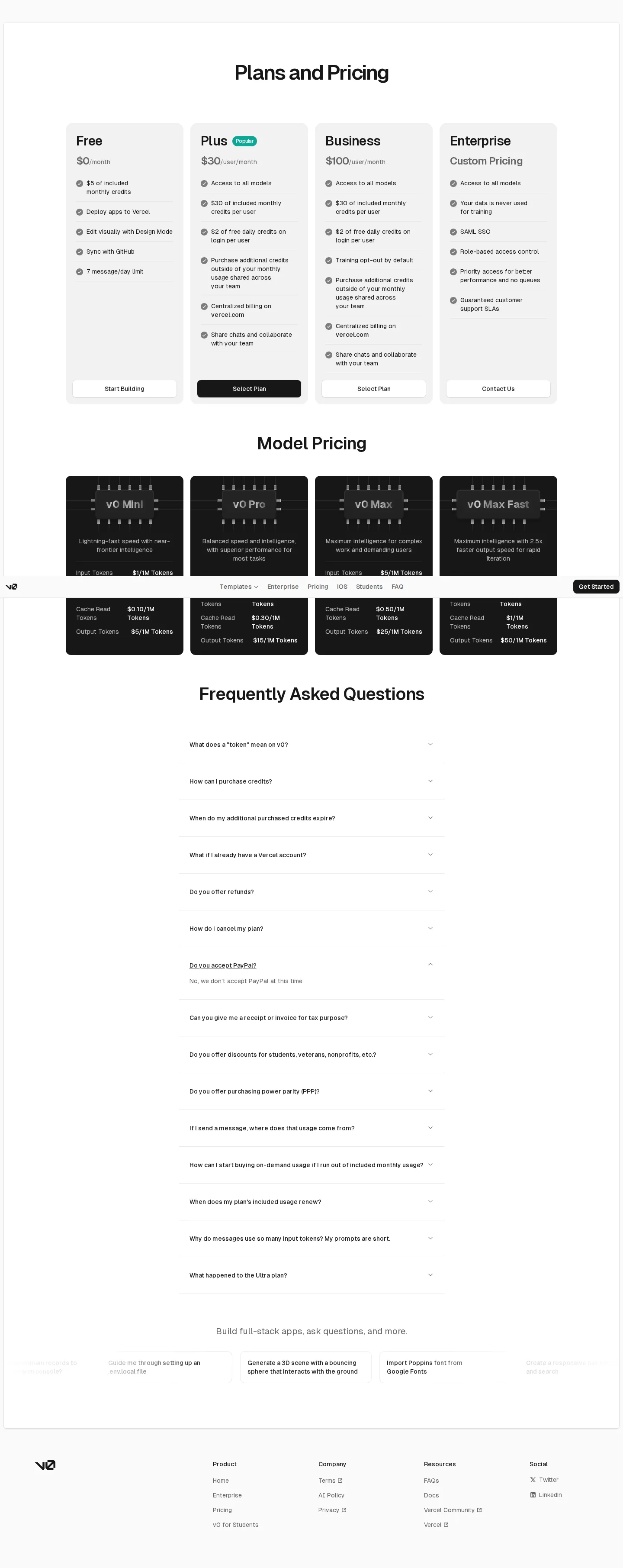
Pricing combines a per-seat subscription with a prepaid credit pool. Free is $0/month, Plus is $30/user/month, and Business is $100/user/month, with Enterprise quoted as “Custom Pricing”. The $30 tier was called Team until July 2026, when v0 renamed it Plus across the pricing page, docs, and enterprise page without changing the price. A legacy Premium plan at $20/month is being sunsetted and is no longer available to new users. Each plan includes a monthly credit allowance; generations draw down credits at per-model token rates, and paid teams can buy additional credits into a shared pool.
For the most current information on v0’s pricing and market position, visit v0 by Vercel.
Pricing summary : How V0 by Vercel’s pricing model works
v0 bills on three stacked dimensions: a per-seat subscription (Free $0/month, Plus $30/user/month, Business $100/user/month, Enterprise custom), a prepaid credit pool that each seat tops up with monthly credits ($5 on Free, $30/user on paid plans) plus $2 of free daily credits on login for paid seats, and per-model token rates that determine how fast those credits drain. Every paid tier advertises “Access to all models”, so model choice is a cost lever rather than an entitlement gate: generations consume credits priced per 1M input/output tokens and the rate depends on which model you pick.
When a seat’s individual monthly credits run out, usage falls through to a shared credit pool (Plus, Business, Enterprise) that teams pre-purchase and share. Unused monthly credits roll over to the next billing cycle and expire after 65 days; separately purchased shared-pool credits expire one year after purchase.
- Seats: Free $0/month · Plus $30/user/month · Business $100/user/month · Enterprise “Custom Pricing” (legacy Premium $20/month, sunsetting).
- Included credits: $5/month (Free), $30 per user per month (Plus & Business), plus $2 of free daily credits on login for paid seats.
- Token rates per 1M (input / output): v0 Mini $1 / $5 · v0 Pro $3 / $15 · v0 Max $5 / $25 · v0 Max Fast $10 / $50, with cache-write ($1.25 / $3.75 / $6.25 / $12.50) and cache-read ($0.10 / $0.30 / $0.50 / $1) tokens priced separately.
- Free-plan gates: $5 of included monthly credits and a 7 message/day limit.
What makes this different: Most AI coding tools meter either seats or tokens; v0 layers both, then routes overage through a team-shared, pre-purchased credit pool with explicit rollover and expiry rules — closer to a cloud-credits balance than a flat SaaS seat. See hybrid seat-plus-usage pricing and credit-based billing for the wider pattern.
Pricing by product
v0 app (Subscription plans)
| Plan | Price | Included credits | Key mechanics |
|---|---|---|---|
| Free | $0/month | $5 of included monthly credits | 7 message/day limit; deploy apps to Vercel, edit visually with Design Mode, sync with GitHub; basic usage analytics |
| Premium (legacy) | $20/month | $20 of monthly credits | ”For higher limits and power users”; the Premium plan is in the process of being sunsetted and is no longer available to new users; can still purchase additional credits |
| Plus | $30/user/month | $30 per user + $2 of free daily credits on login | Marked Popular; access to all models, shared credit pool, shared projects, basic access controls, team-wide usage analytics, centralized billing on vercel.com. Renamed from Team in July 2026 |
| Business | $100/user/month | $30 per user + $2 of free daily credits on login | Everything in Plus plus training opt-out by default and data opt-out; access to the v0 API |
| Enterprise | Custom Pricing | Custom | SAML SSO, role-based access control, advanced usage analytics and controls, priority access for better performance and no queues, guaranteed customer support SLAs, data never used for training; extra credits arranged via an Account Executive |
Docs plan-comparison matrix (v0.app/docs/pricing) draws the entitlement lines explicitly: Team features, Shared Projects and Shared Credit Pool start at Plus; Data Opt-out starts at Business; SAML SSO and Priority Access are Enterprise-only. Access controls are “Basic” on Plus and Business and RBAC on Enterprise.
v0 models (Per-1M-token credit rates)
| Model | Input tokens | Output tokens | Cache write / read | Positioning |
|---|---|---|---|---|
| v0 Mini | $1 / 1M | $5 / 1M | $1.25 / $0.10 per 1M | ”Lightning-fast speed with near-frontier intelligence” |
| v0 Pro | $3 / 1M | $15 / 1M | $3.75 / $0.30 per 1M | ”Balanced speed and intelligence, with superior performance for most tasks” |
| v0 Max | $5 / 1M | $25 / 1M | $6.25 / $0.50 per 1M | ”Maximum intelligence for complex work and demanding users” |
| v0 Max Fast | $10 / 1M | $50 / 1M | $12.50 / $1 per 1M | ”Maximum intelligence with 2.5x faster output speed for rapid iteration” |
Credit mechanics (how the two tables interact)
| Rule | Detail |
|---|---|
| Included allowance | Each plan includes a monthly credit allowance; generations draw from the credit balance |
| Exhaustion behaviour | When credits are used up, generation pauses — v0 does not auto-charge overage |
| Rollover / expiry | Unused monthly credits roll over to the next billing cycle and expire after 65 days |
| Shared Credit Pool | On Plus, Business and Enterprise: monthly credits stay individual per user, pool credits are shared across the team and are used only after individual monthly credits are exhausted |
| Purchased-credit expiry | Shared Credit Pool credits expire one year after purchase |
| Who can top up | Premium, Plus and Business can purchase additional credits at any time; Enterprise accounts contact their Account Executive |
Sales motions across products: PLG / self-serve for Free, Plus, and Business (sign up and pay on vercel.com); sales-led for Enterprise (custom quote, security review, AWS Marketplace / Bedrock options).
Hidden costs : What V0 by Vercel users actually pay
The headline seat price is the floor, not the bill. Each seat’s monthly credits ($30/user on Plus and Business) are spent against per-model token rates, and a single full-stack generation on v0 routinely consumes far more input tokens than a short prompt suggests — v0 injects chat history, source files, and Vercel-specific context as input on every turn. Once a seat’s $30 is gone, generation pauses unless the team has pre-bought shared-pool credits, so heavy users pay real overage on top of the seat.
Archetype 1 — a 3-seat Plus plan iterating heavily on v0 Pro. Three developers each prompt dozens of times a day. Assume the team burns roughly 60M input + 12M output tokens/month on v0 Pro ($3/$15 per 1M) across all three seats — well past the $90 of pooled monthly credits.
| Line item | Monthly cost |
|---|---|
| 3 × Plus seats ($30/user) | $90 |
| Included monthly credits (3 × $30) | −$90 (consumed) |
| v0 Pro input: 60M × $3/1M | $180 |
| v0 Pro output: 12M × $15/1M | $180 |
| Less included credits applied | −$90 |
| Extra shared-pool credits purchased | $270 |
| Estimated total | $360/mo |
So the three seats cost $90 but the team pays roughly $360 — usage is ~3x the seat fee, and that is on the mid-tier model. Switching the same workload to v0 Max ($5/$25) would roughly 1.7x the token bill again.
Archetype 2 — a solo builder on Free pushing past the gates. The Free plan gives $5 of monthly credits but also caps you at 7 messages/day. A weekend project hits the daily message wall long before the $5 runs out, so the real “cost” is friction: to ship anything beyond a prototype you upgrade to a $30 Plus seat (Premium is closed to new users), then start drawing down credits at token rates.
| Line item | Monthly cost |
|---|---|
| Free plan | $0 |
| Practical ceiling | 7 messages/day, $5 credits |
| Upgrade needed to ship | Plus seat at $30/mo + token usage |
| Estimated total to be productive | $30+/mo |
The lesson: v0’s free tier is a true try-before-you-buy, but its dual gate (daily messages and a credit balance) means meaningful work almost always converts to a paid seat plus metered token spend.
Want to estimate your own v0 by Vercel bill? Use the v0 by Vercel pricing calculator to model your monthly cost based on seats, model choice, and token volume.
Pricing evolution : V0 by Vercel pricing history and changes
Cadence
| Quarter | Price changes | Product / SKU additions | Notes |
|---|---|---|---|
| 2025 Q2 | 1 | 0 | 2025-05-13 Vercel announces the move from fixed message counts to token-metered credits; existing users migrate at next billing period. |
| 2025 Q3 | 0 | 0 | Credit-based pricing live on v0.app/pricing with per-model token rates (v0-1.5 sm/md/lg); Free/Premium/Team/Enterprise. |
| 2025 Q4 | 2 | 1 | Business $100/user/mo tier added; $2 daily login credits + 7 msg/day Free cap introduced; Black Friday cut Business to $80 temporarily. |
| 2026 Q1 | 1 | 0 | v0.dev → v0.app rebrand; models renamed Mini/Pro/Max; per-model token rates roughly doubled in February. |
| 2026 Q2 | 2 | 1 | Premium $20/mo sunset (removed from page); v0 Max Fast model added ($30/$150), then repriced down to $10/$50. |
| 2026 Q3 | 0 | 0 | 2026-07-21 the $30/user/mo Team plan is renamed Plus across the pricing page, docs matrix and enterprise page; “Access to all models” appears as an explicit line on Plus, Business and Enterprise. No prices or token rates move. |
Tracked range: 2025-05–2026-07. Every quarter in that range is listed above; the earlier v0.dev message-count era predates the tracked range.
Notable changes
- 2025-05-13 — Vercel announces token-based credit pricing, replacing fixed message counts; usage now draws down a credit balance based on input/output tokens (vercel.com/blog/updated-v0-pricing).
- 2025-08 — Credit pricing live on v0.app/pricing with per-model rates: v0-1.5-sm $0.50/$2.50, md $1.50/$7.50, lg $7.50/$37.50 per 1M in/out, plus separate higher v0 API rates.
- 2025-11 — Business $100/user/mo tier added between Team and Enterprise; consumer generation collapses to a single “v0 Agent” model.
- 2025-12 — $2 daily login credits added to paid seats; Free plan gains a 7 message/day cap; Business briefly $80 for Black Friday.
- 2026-01 — Domain rebrands to v0.app; models renamed v0 Mini/Pro/Max.
- 2026-02 — Per-model token rates roughly double (v0 Pro $1.50/$7.50 → $3/$15) and explicit cache-write/cache-read token lines appear.
- 2026-04 — Premium $20/mo individual plan removed from the pricing page (legacy, closed to new users); v0 Max Fast model launches at $30/$150.
- 2026-06 — v0 Max Fast repriced down to $10/$50 per 1M in/out.
- 2026-07-21 — The $30/user/mo Team plan is renamed Plus on the pricing page, the docs plan-comparison matrix and the enterprise page’s upgrade buttons; Plus, Business and Enterprise gain an explicit “Access to all models” line. Seat prices ($0 / $30 / $100 / custom) and all four model rates are unchanged.
The credit-system migration in detail
v0 has run three different metering systems in under three years. It launched on v0.dev in 2023 charging fixed monthly message counts — a simple, predictable cap that broke down as generations grew from single components to full-stack apps that consume wildly different amounts of compute. On 2025-05-13 Vercel announced the switch to token-metered credits, arguing it gave “more predictable pricing as you grow” and let it raise free-tier usage. The seat prices stayed flat across the whole transition (Free $0, Premium $20, Team $30), so the change was invisible on the headline grid — the action moved entirely into the per-model token rates, which are where v0 has since raised prices: rates roughly doubled in February 2026 while not a single plan price changed. This is the defining tension of credit-metered pricing — the published seat number is stable and reassuring, but the real cost lever sits one layer down in the token table, where it can move without ever touching the plan card.
The 2026-07-21 Team-to-Plus rename is the same instinct applied to the packaging layer instead of the meter. Nothing an existing customer pays changed, but the label did: “Team” described who the seat was for, while “Plus” describes where it sits on a ladder, which reads more naturally to the solo builders left stranded when the $20 Premium plan was sunset in April 2026. The accompanying “Access to all models” line on Plus, Business and Enterprise settles a question the November 2025 packaging left open — when consumer generation collapsed to a single model and md/lg were kept API-only, model access looked like a tier entitlement. It is now explicitly not one. Every paid tier gets the same four models, so the only thing that separates a $30 seat from a $100 seat is governance (training opt-out, API access), and the only thing that separates a cheap generation from an expensive one is which model the user picks.
What’s unique : V0 by Vercel’s distinctive pricing mechanics
1. Three stacked meters — seat, credit pool, and per-model token rate. Most AI coding tools meter one thing: Cursor and GitHub Copilot sell seats with request quotas; pure API tools sell tokens. v0 layers all three. You buy a seat, the seat funds a monthly credit balance, and generations drain that balance at per-1M-token rates that differ by model. That makes v0 closer to a hybrid seat-plus-usage model sitting on top of a credit-based billing wallet than to a flat SaaS subscription.
2. The credit pool is team-shared with explicit expiry rules. On Plus (renamed from Team on 2026-07-21), Business, and Enterprise, each seat’s individual monthly credits are consumed first, then usage falls through to a pre-purchased shared pool that the whole team draws from. Monthly credits roll over but expire after 65 days; separately purchased shared-pool credits expire one year after purchase. This dual-bucket, dual-expiry design — rare among AI coding tools — is much closer to a cloud-credits balance than a SaaS allowance.
3. Per-model token rates are the real price lever, and they move. v0 runs four in-house models (Mini, Pro, Max, Max Fast) priced from $1/$5 up to $10/$50 per 1M in/out, with cache-write and cache-read tokens priced separately and cheaper. Because the seat price is fixed, every price change v0 has made since launch has happened in this token table — rates roughly doubled in February 2026 with no movement on any plan card. Since 2026-07-21 the pricing page also says “Access to all models” on Plus, Business and Enterprise, which removes the last ambiguity about model gating: no tier buys you a better model, it only buys governance. Choosing Max Fast over Mini is a 10x decision the buyer makes per generation, not per contract.
4. It is a deliberate front door to the Vercel cloud. v0 deploys to Vercel with one click, bills centrally on vercel.com, and Enterprise inference runs on dedicated Secure Compute and AWS Bedrock. Pricing is designed less to maximize v0 standalone revenue than to pull builders into Vercel’s broader AI-cloud — the same ecosystem flywheel that powers shadcn/ui adoption and Next.js lock-in.
Strengths & weaknesses
| Strengths | Weaknesses |
|---|---|
| Transparent, public per-model token rates and a full plan-comparison matrix in the docs, with “Access to all models” on every paid tier since July 2026 | Three stacked meters (seat + credit pool + token rate) make the true monthly cost hard to predict before you build — and with no model gating, tier choice no longer caps how fast a seat can spend |
| Generous, genuinely usable free tier ($5 credits) that lets you ship a prototype | Free tier has a dual gate — 7 messages/day and a $5 balance — so real work converts to paid almost immediately |
| Flat seat prices held steady through three metering changes, reassuring buyers | The price increases happen in the token table, not the plan card — rates roughly doubled in Feb 2026 with no plan-price change |
| Shared credit pool + centralized vercel.com billing simplify team finance | Generation pauses (not auto-charges) when credits run out, which can stall a team mid-task unless pool credits are pre-bought |
| One-click deploy + tight Vercel/Next.js/shadcn integration is a real workflow advantage | Premium $20 sunset leaves a gap — individuals jump from Free to a $30 Plus seat, raising the entry price; the July 2026 rename softens the label but not the jump |
| Enterprise gets training opt-out, SSO, RBAC, dedicated Secure Compute, HIPAA/SOC 2 | No PayPal, no published Enterprise pricing, and credit purchases on Enterprise must route through an Account Executive |
Billing UX : V0 by Vercel billing controls and transparency
- Usage dashboard — A usage summary (daily, weekly, monthly) plus a detailed event log showing date, user, event type, model, and cost for each generation.
- Billing dashboard — Shows current plan, credit balances and expiry dates, payment method, and downloadable invoices/receipts for tax purposes.
- Credit balance + expiry tracking — Monthly credits roll over and expire after 65 days; separately purchased shared-pool credits expire one year after purchase, surfaced as explicit expiry dates.
- Shared Credit Pool — On Plus, Business, and Enterprise, individual monthly credits are consumed first, then a team-shared purchased pool; Enterprise credit purchases are arranged via the Account Executive.
- On-demand credit purchase — Premium, Plus, and Business seats can buy additional credits at any time once included monthly usage is exhausted; generation pauses (rather than auto-charging) when credits run out.
- Centralized billing — Paid teams bill centrally on vercel.com. Payment is card-based; PayPal is not accepted.
- Pricing-page FAQ as billing documentation — The pricing page ships a 15-question FAQ covering credit purchases, purchased-credit expiry, refunds, cancellation, tax receipts/invoices, student/veteran/nonprofit discounts, purchasing power parity (PPP), where a message’s usage is drawn from, on-demand usage after included usage runs out, when included usage renews, why short prompts still consume many input tokens, and “What happened to the Ultra plan?” for retired-plan holders.
Strategic wins : Why V0 by Vercel’s pricing decisions worked
1. Kept seat prices flat while moving cost into the token table
v0 has changed its metering system twice — message counts to credits in 2025, then roughly doubling token rates in 2026 — yet Free $0, Premium $20, and the $30 team seat never moved on the plan card. Even the 2026-07-21 packaging pass only touched the label, renaming that $30 tier from Team to Plus while leaving every price and token rate exactly where it was. Buyers anchor on the visible seat number, so the company raised effective prices without triggering the “they raised prices” backlash that hits flat-subscription tools. It is a textbook example of why usage-based pricing gives vendors more room to maneuver than a fixed-fee plan.
2. Migrated message-count users to token credits with a soft transition
When v0 switched from fixed message counts to token-metered credits on 2025-05-13, existing users were moved at the start of their next billing period rather than overnight, and Vercel framed the change as increasing free-tier usage. Handling a billing-model change as a graceful migration rather than a forced cutover is the playbook for shifting customers from per-user licenses to consumption without churn.
3. Used v0 as a low-friction front door to the Vercel cloud
v0’s pricing is engineered to convert builders into Vercel deployers: one-click deploy, centralized vercel.com billing, and Enterprise inference on dedicated Secure Compute. The standalone tool doesn’t have to be a profit center if it pulls users into Next.js, shadcn/ui, and Vercel hosting. This ecosystem-flywheel logic is exactly the kind of outcome that reshapes how AI companies price — the meter sells the platform, not just the product.
4. Made the free tier a real product, gated two ways
The $5 monthly-credit Free plan plus a 7 message/day cap lets a curious developer ship a working prototype before paying — but the dual gate ensures meaningful work converts to a paid seat. Choosing two complementary gates (a daily message wall and a credit balance) instead of one is a deliberate metric-design choice; see choosing the right usage metric for why pairing a velocity cap with a value meter works.
Areas to improve : Gaps in V0 by Vercel’s pricing approach
1. Token rates can change without the buyer noticing — add change transparency
Because every price increase happens in the per-model token table rather than the plan card, a Plus customer can see their effective cost rise (rates roughly doubled in February 2026) without any “your price is changing” signal — and the 2026-07-21 rename shows the plan card does get edited when v0 wants it to, just never for price. A dated, public rate-history table on the pricing page — or an in-product banner when token rates change — would close the bill-shock and cost-unpredictability gap that credit-metered tools are prone to.
2. Make the real cost of a generation legible before the bill arrives
A single full-stack generation consumes far more input tokens than a short prompt implies, because v0 injects chat history, source files, and Vercel context as input on every turn — the FAQ even has to answer “why do messages use so many input tokens?”. Surfacing an estimated credit cost before a user hits send, or a projected monthly burn based on recent usage, would let teams forecast spend instead of discovering it. This is the core of pricing cost predictability for any token-metered product.
3. Smooth the $20-to-$30 entry-price jump left by the Premium sunset
Sunsetting the $20/mo Premium plan removes the only individual paid tier, so a solo builder who outgrows Free now jumps straight to a $30 Plus seat — a 50% higher entry price with team features they may not need. Renaming that tier from Team to Plus on 2026-07-21 fixes the signalling half of the problem (the name no longer tells a solo user the plan isn’t for them) without fixing the economics: it is still priced per user, still bundles shared projects and shared-pool credits, and still costs 50% more than the rung it replaced. A lightweight individual tier (or letting solo users buy credits without a per-seat plan) would rebuild the missing rung and reduce drop-off at the Free-to-paid boundary.
Key takeaways
- A fixed seat price is a marketing surface; the meter is the price. v0 raised effective prices twice without moving any plan number by putting the increases in the per-model token table, and when it did edit the plan card in July 2026 it changed a name rather than a number. If you meter usage, the published seat price stops being your real price — and buyers will anchor on whichever number you show most prominently.
- Stack meters deliberately, not accidentally. v0’s seat + credit-pool + token-rate layering is powerful but hard to forecast. Each meter you add buys flexibility and costs predictability, so add them only when each one captures a distinct value dimension you can defend.
- A two-gate free tier converts better than one. Pairing a velocity cap (7 messages/day) with a value meter ($5 credits) lets curious users prototype yet pushes real work to paid faster than a single limit would. The gates should fail at the moment usage becomes valuable.
- Migrate billing-model changes, don’t cut them over. v0 moved message-count users to token credits at their next billing cycle and framed it as more free usage. Soft transitions plus a positive framing are how you change the meter without spiking churn.
- Price the product to sell the platform. v0’s pricing exists partly to funnel builders into Vercel hosting, Next.js, and shadcn/ui. When the real monetization is downstream, the front-door tool can price for adoption rather than standalone margin.
UBP implications
- Credit pools decouple the price-change event from the plan card. When usage is denominated in credits drained by token rates, a vendor can reprice the underlying meter without ever editing a plan. That is operationally convenient but shifts the transparency burden onto the vendor — practitioners should publish rate history or accept that customers will feel surprised.
- Token-as-currency pricing turns model selection into a pricing tier. By exposing four models at 10x-spread token rates (Mini $1/$5 to Max Fast $10/$50), v0 lets the user self-select their willingness to pay per generation. Putting “Access to all models” on every paid tier on 2026-07-21 completes the pattern: the model picker is the pricing menu, so plan tiers can be reserved for governance and the price ladder can live entirely inside the meter.
- Ecosystem front-door tools justify below-margin usage pricing. When the AI tool is a funnel into a broader platform (hosting, inference, framework lock-in), usage can be priced for adoption velocity rather than direct profit. UBP strategy has to account for where the lifetime value actually accrues, not just the metered product’s own P&L.
Sources
- v0 by Vercel pricing page (accessed 2026-07-21)
- v0 docs — Pricing, credits, and tokens (accessed 2026-07-21)
- v0 for Enterprise (accessed 2026-07-21)
- v0 docs — FAQs (plan list and prices) (accessed 2026-07-21)
- v0 changelog (accessed 2026-07-21)
- Vercel blog — Updated v0 pricing (token-based credits announcement) (accessed 2026-06-08)
- v0 docs home (accessed 2026-06-08)
Bottom line
v0 by Vercel prices like a cloud product wearing a SaaS plan card: stable seat numbers up top, a prepaid credit pool underneath, and per-model token rates that are the actual price lever — and the one that has moved while the plans stayed still. The July 2026 Team-to-Plus rename is the pattern in miniature: the plan card got edited, and still not for price. Its discipline is keeping the headline grid reassuring through three metering changes; its tax on the buyer is that the true monthly cost of a generation-heavy team lives one layer below the plan they signed up for, and now that every paid tier reaches every model, nothing on that card caps how fast the meter runs.
Want to compare v0’s stacked seat-plus-credit model against other developer tools? See the parent Vercel pricing blueprint and the usage-metered support pricing of Intercom’s Fin, or browse the full pricing blueprint.
Pricing timeline : Major events on a vertical axis
Each milestone below corresponds to a public pricing change, product launch, or material adjustment. Major events use a filled marker; minor adjustments use a faded one.
Team plan renamed to Plus; 'Access to all models' added to paid tiers
The $30/user/mo Team plan is renamed Plus across the pricing page, docs plan-comparison matrix, and enterprise page. Prices are unchanged (Free $0, Plus $30/user/mo, Business $100/user/mo, Enterprise custom) and every model rate holds (Mini $1/$5, Pro $3/$15, Max $5/$25, Max Fast $10/$50 per 1M in/out). Plus, Business, and Enterprise cards now list 'Access to all models' explicitly.
Current pricing: Max Fast repriced to $10/$50
Free $0, Team $30/user/mo, Business $100/user/mo, Enterprise custom. v0 Max Fast drops from $30/$150 to $10/$50 per 1M in/out. Models: Mini $1/$5, Pro $3/$15, Max $5/$25, Max Fast $10/$50 (cache tokens priced separately).
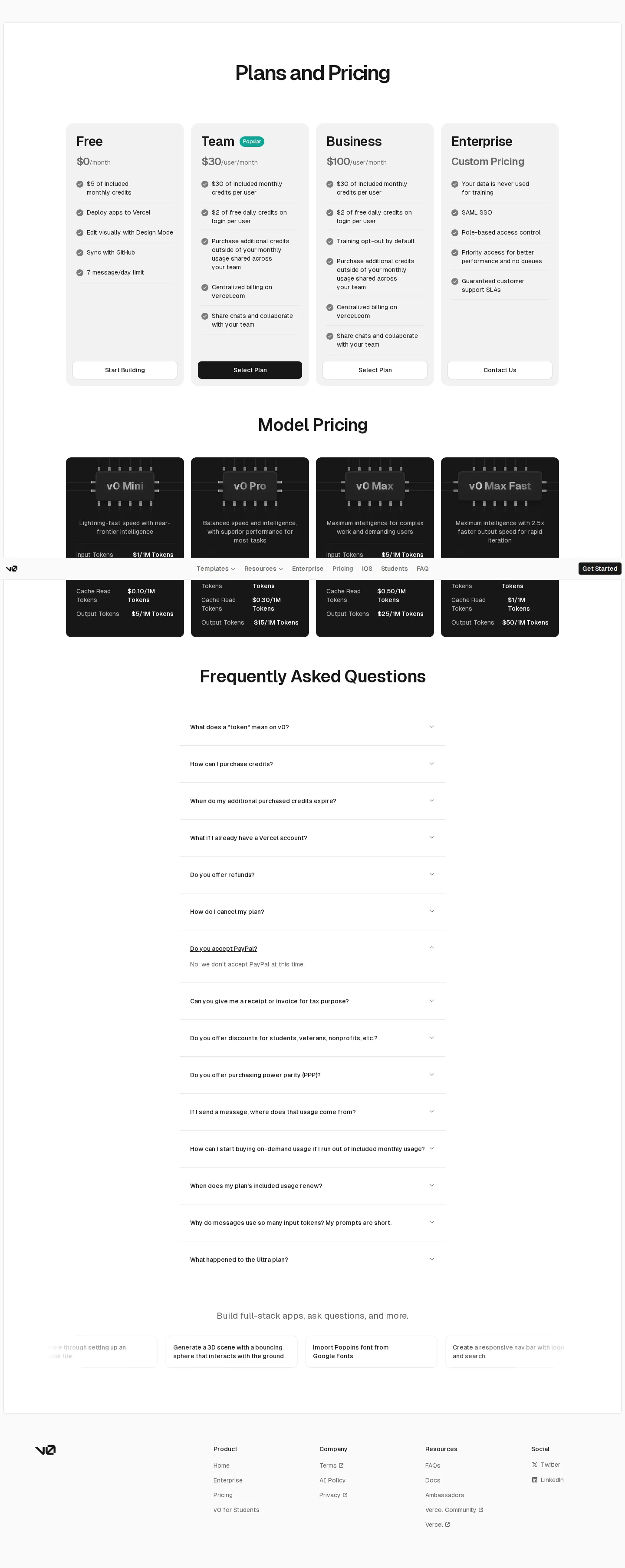
Premium $20/mo sunset; v0 Max Fast model added
The $20/mo Premium individual plan is removed from the pricing page (legacy, closed to new users). A new v0 Max Fast model launches at $30/$150 per 1M in/out for 2.5x faster output.
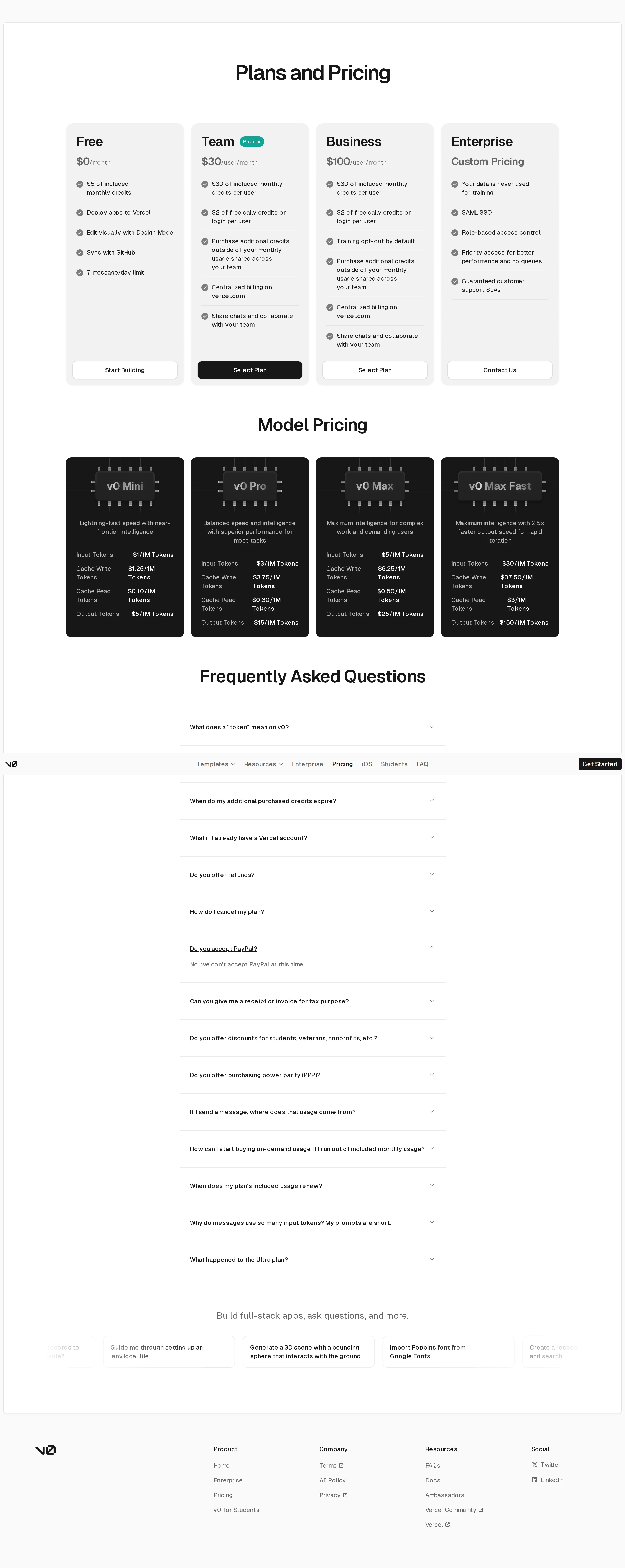
Per-model token rates roughly doubled; cache tokens added
Mini rises to $1/$5, Pro to $3/$15, Max to $5/$25 per 1M in/out — roughly 2x the January rates — and explicit cache-write/cache-read token lines appear (cheaper than input/output).
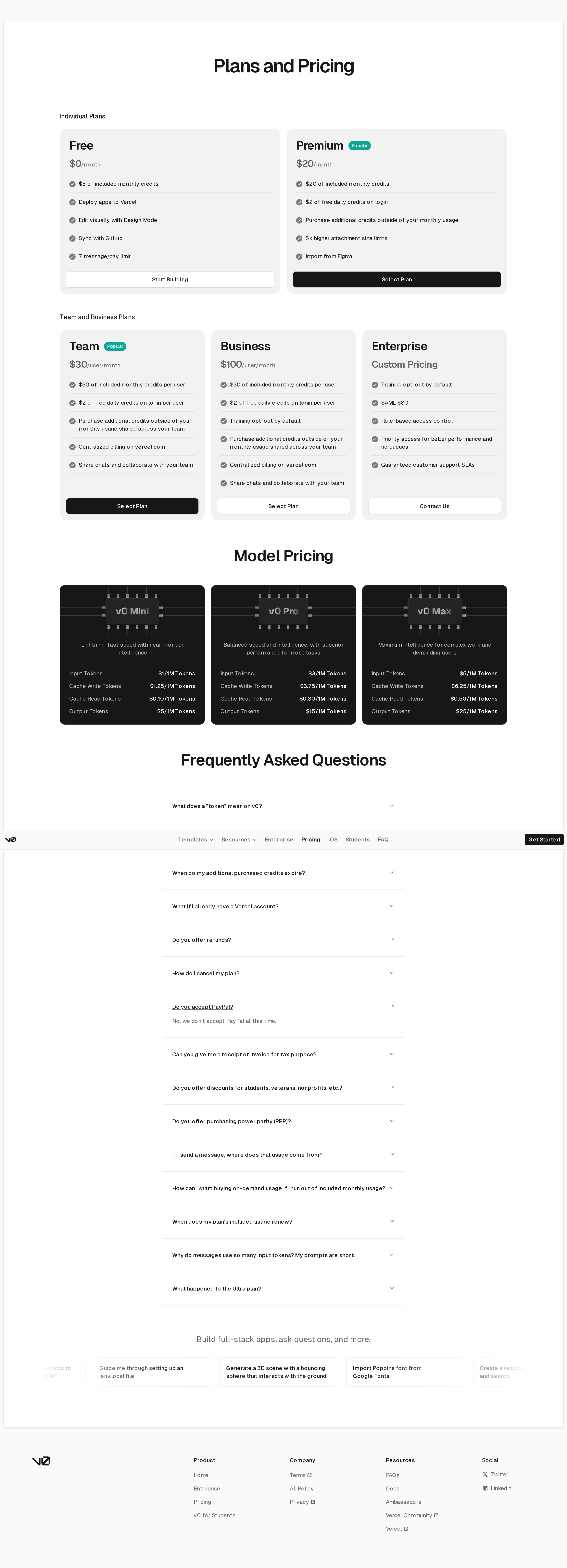
v0.dev rebrands to v0.app; models renamed Mini/Pro/Max
Domain moves to v0.app and the generation models are rebranded v0 Mini ($0.50/$2.50), Pro ($1.50/$7.50), Max ($3.50/$17.50) per 1M in/out. Design Mode now ships on Free.
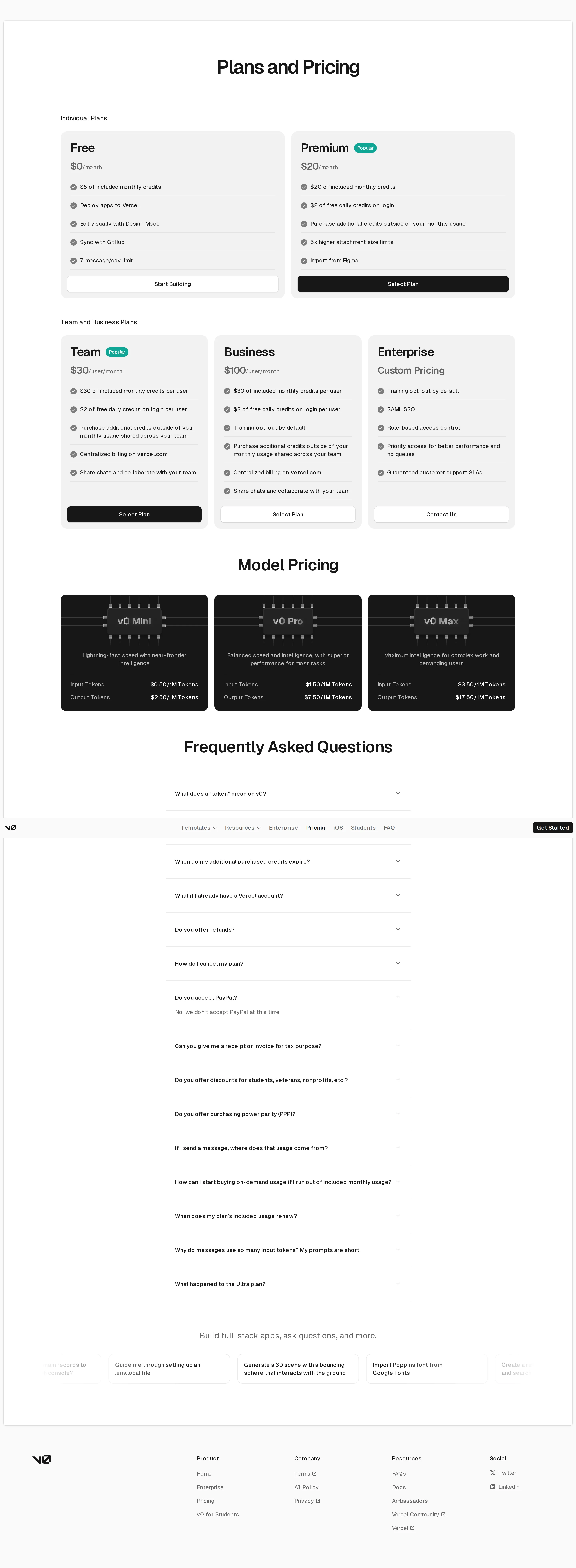
$2 daily login credits + 7 msg/day Free cap
Every paid seat gains $2 of free daily login credits; the Free plan gains a 7 message/day limit on top of its $5 monthly credits. A Black Friday promo cut Business to $80/user/mo (from $100) temporarily.
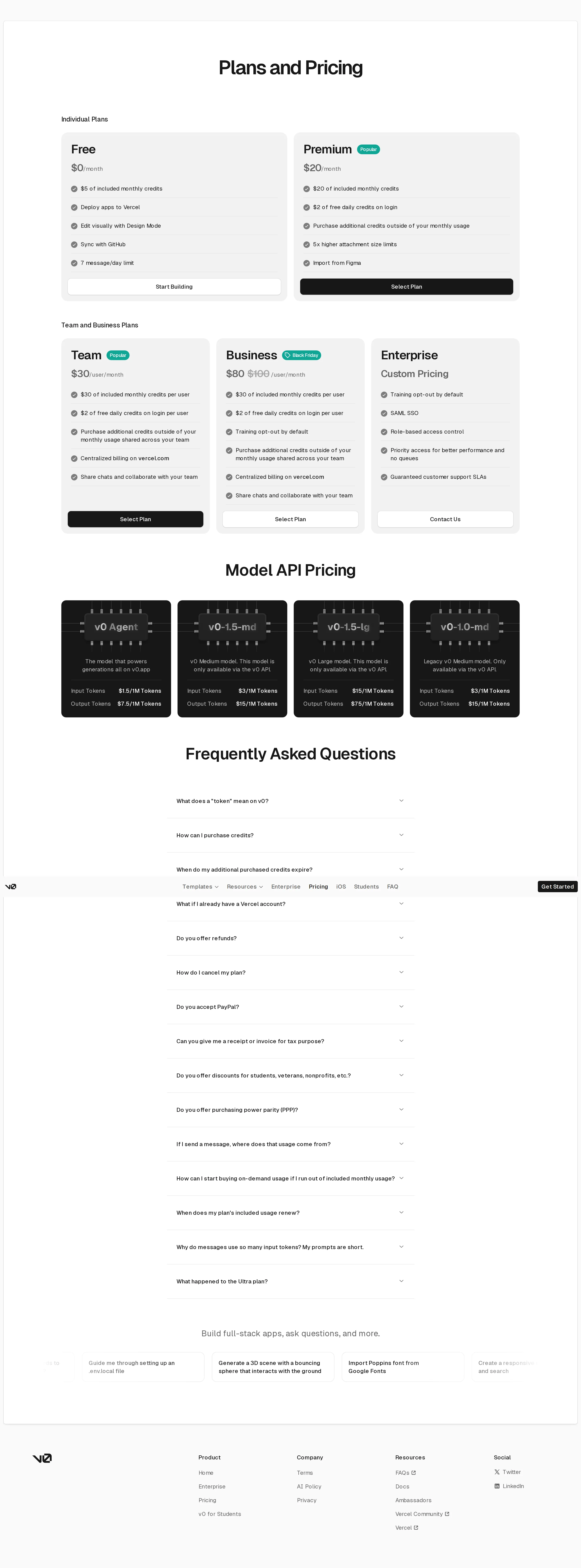
Business $100/user/mo tier added
A Business plan ($100/user/mo, training opt-out by default) slots between Team and Enterprise. The consumer model collapses to a single 'v0 Agent' generation model ($1.50/$7.50), with md/lg models kept API-only.
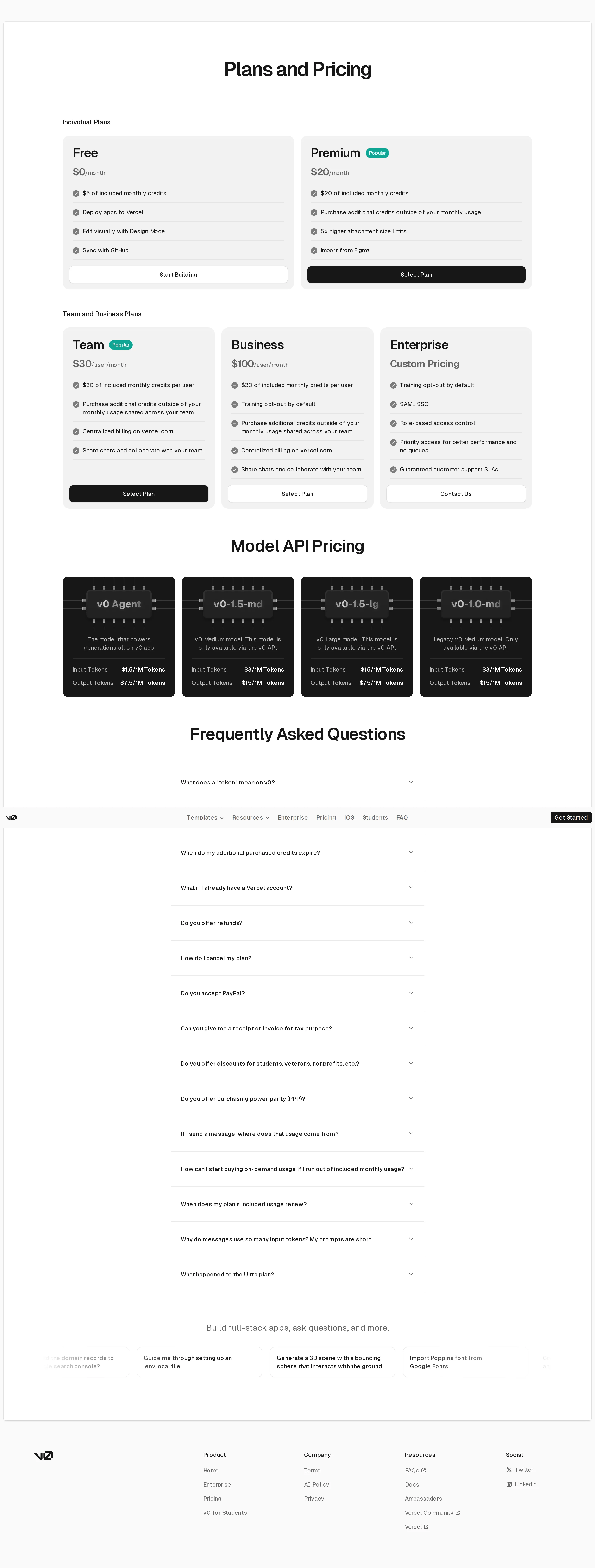
Credit-based pricing live with per-model token rates
v0.app/pricing shows the new credit model: Free $0, Premium $20, Team $30/user, Enterprise. Generations draw down credits at per-model token rates — v0-1.5-sm $0.50/$2.50, md $1.50/$7.50, lg $7.50/$37.50 per 1M in/out — with separate, higher v0 API rates. No Business plan yet.
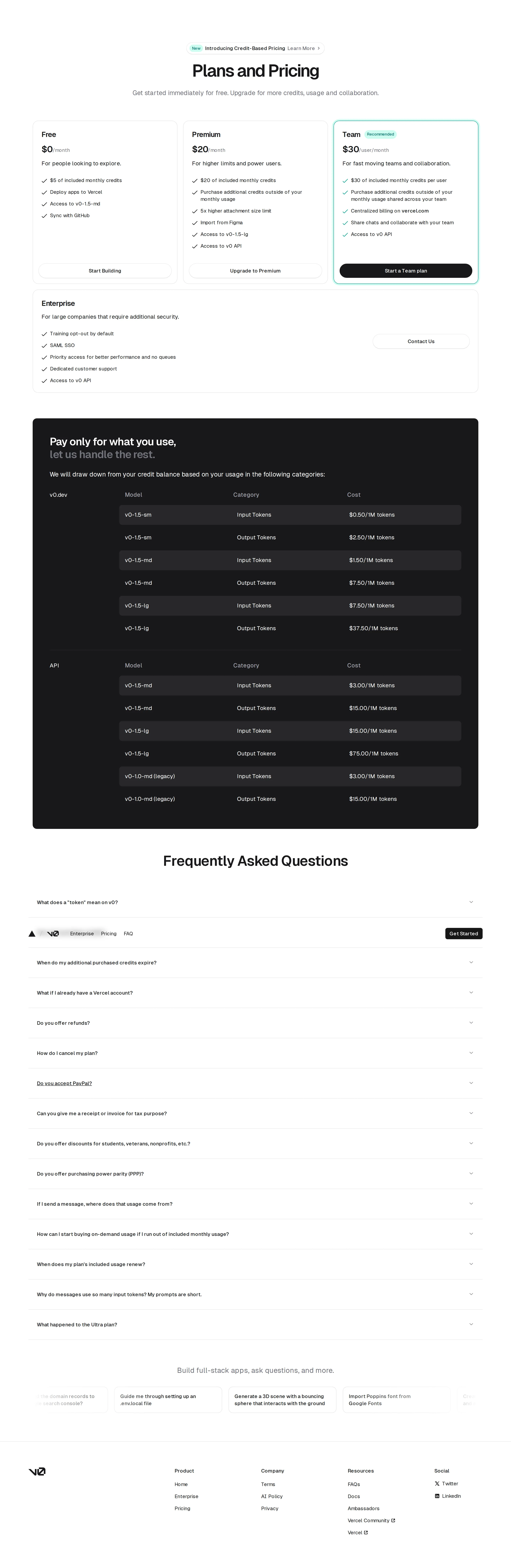
Token-based credit pricing announced
Vercel announced v0 would move from fixed message-count plans to metered credits consumed by input/output tokens. Free $5/mo credits, Premium $20/mo, Team $30/user/mo; existing users migrated at their next billing period (vercel.com/blog/updated-v0-pricing).
- · v0's Free plan gives $5 of monthly credits but caps you at 7 messages per day — a usage gate on top of the credit balance.
- · Paid v0 seats get $2 of free credits just for logging in each day, on top of the $30/user monthly allowance.
- · v0 runs four in-house models — Mini, Pro, Max, and Max Fast — billed at per-1M-token rates from $1/$5 up to $10/$50 in/out.
Questions & answers
- What is v0 by Vercel's pricing model?
- v0 charges a per-seat subscription (Plus $30/user/mo, Business $100/user/mo) on top of a prepaid credit pool. Each seat includes monthly credits, and generation usage is metered against those credits at per-model token rates.
- Does v0 by Vercel offer a free tier?
- Yes. The Free plan costs $0/month and includes $5 of monthly credits with a 7 message/day limit, deploy to Vercel, Design Mode editing, and GitHub sync.
- How much does v0 by Vercel cost per month?
- Free is $0/mo, Plus is $30/user/mo, and Business is $100/user/mo. Enterprise is custom-quoted. The Plus tier was called Team until July 2026, when v0 renamed it without changing the price. A legacy Premium plan at $20/mo is being sunsetted and is no longer available to new users.
- How does v0 meter usage?
- Paid usage runs on credits consumed by per-model token rates per 1M tokens: v0 Mini $1 in / $5 out, v0 Pro $3 / $15, v0 Max $5 / $25, and v0 Max Fast $10 / $50. Unused monthly credits roll over and expire after 65 days.
- How has v0's pricing changed over time?
- v0 launched on v0.dev in 2023 with fixed monthly message counts. In May 2025 Vercel switched it to token-metered credits, added a Business $100/user/mo tier in late 2025, rebranded to v0.app in January 2026, roughly doubled per-model token rates in February 2026, and renamed the $30/user/mo Team plan to Plus in July 2026 — all with seat prices unchanged.
- What happened to v0's Premium plan?
- The $20/mo Premium individual plan is being sunsetted — it was removed from the public pricing page around April 2026 and is closed to new users. Existing Premium subscribers keep the plan, but new individuals start on Free or buy a $30/user/mo Plus seat.