AI Summary
About
xAI is the foundation-model lab founded by Elon Musk in 2023 to build Grok, a family of frontier reasoning models. It monetizes two distinct surfaces: a public, per-million-token developer API (this page’s focus) for the Grok models and agentic tools, and a separate freemium consumer app (Free, SuperGrok, and up) that wraps the same models in a chat product. Enterprise — custom rate limits, dedicated infrastructure, SSO, and compliance — is sold through a sales motion.
xAI’s defining structural move was its March 2025 all-stock acquisition of X (formerly Twitter), which valued X at $33 billion ($45 billion less $12 billion of debt) and xAI at roughly $80 billion, forming a combined entity (X.AI Holdings Corp) worth about $113 billion. That merger folded X’s real-time social data, distribution, and audience into the lab — and is the reason live X-search shows up as a billable agentic tool on the API. xAI has since raised at escalating valuations (around $200 billion in a 2025 equity raise, with later rounds reported higher), funding an aggressive compute build-out anchored by Colossus, a Memphis supercluster xAI describes as the world’s largest, scaled to over 100,000 GPUs in under a year.
The model catalog has moved fast. The API opened in October 2024 with grok-beta; Grok 3 and Grok 3 mini followed in 2025, then Grok 4 (July 2025) and the cost-optimized Grok 4 Fast. By mid-2026 the lineup consolidated on the grok-4.x generation — and in July 2026 xAI shipped grok-4.5, an intelligence-first flagship (500k-token context, $2 / $6 per 1M tokens) that now powers both the top of the API and the consumer SuperGrok tier — sitting above the still-live grok-4.3 (1M context, $1.25 / $2.50), the grok-4.20 reasoning / non-reasoning / multi-agent variants, and grok-build-0.1 for coding. Throughout, xAI has cut per-token prices steeply, positioning Grok as a price-aggressive frontier option versus closed-weight rivals like OpenAI and Anthropic and the open-weight Mistral AI.
Pricing summary : a public per-token API plus a freemium consumer app
xAI runs a two-surface model: pure usage-based pricing for the Grok developer API, billed per million tokens, and a separate freemium subscription ladder for the consumer Grok app. The dimensions are:
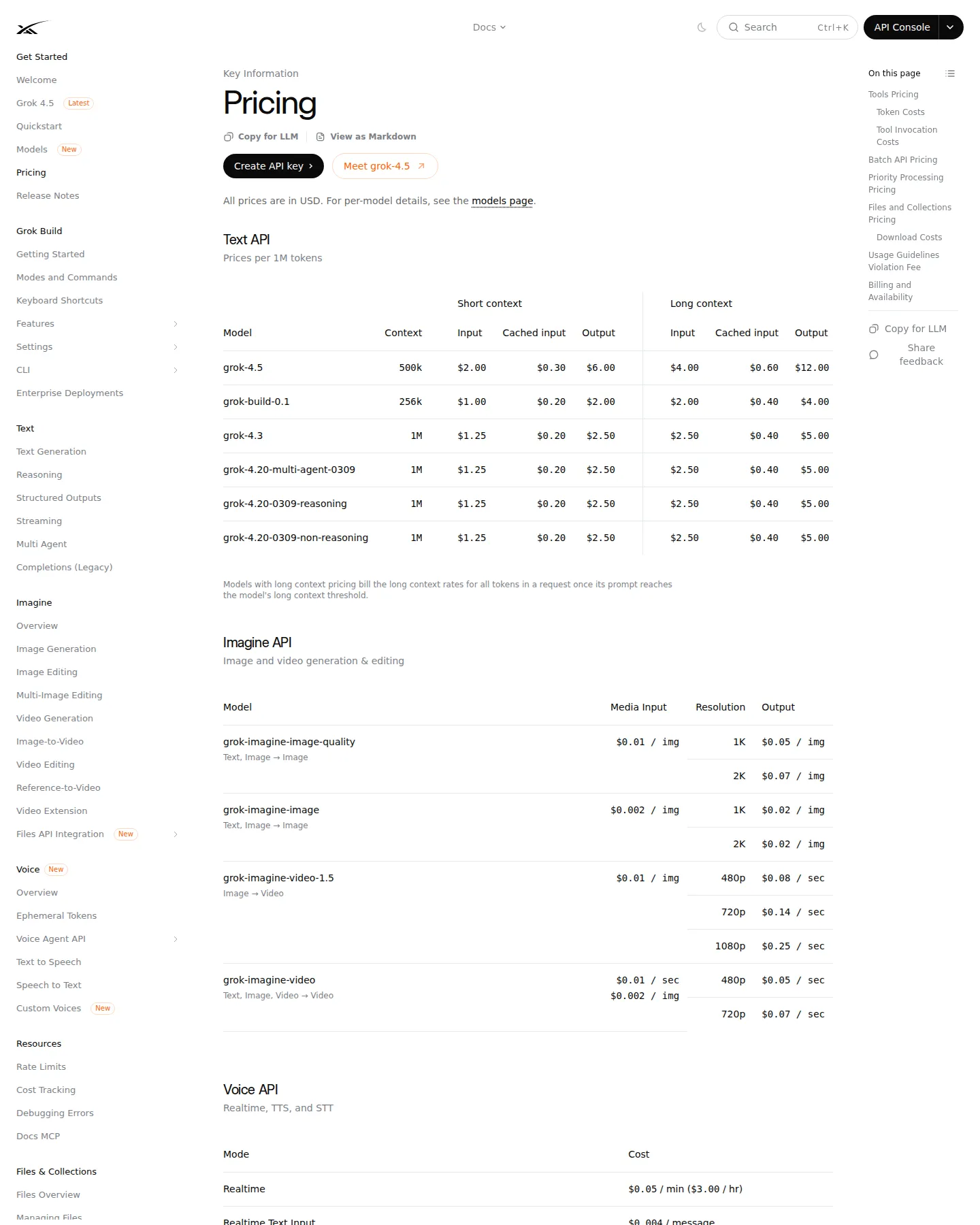
- API tokens (short context) — separate input and output rates per million tokens by model. grok-4.5 (flagship, 500k context) is $2.00 in / $6.00 out (cached $0.30); grok-4.3 (1M context) is $1.25 in / $2.50 out (cached $0.20); grok-build-0.1 (coding, 256k context) is $1.00 in / $2.00 out (cached $0.20).
- API tokens (long context) — a second rate column, roughly 2x short context, that applies once a request’s prompt reaches 200k tokens: grok-4.5 $4.00 in / $0.60 cached / $12.00 out; grok-4.3 and the grok-4.20 variants $2.50 / $0.40 / $5.00; grok-build-0.1 $2.00 / $0.40 / $4.00. Per xAI’s per-model pages: “Requests whose prompt reaches 200k tokens are billed at the higher rate for all tokens in the request.”
- Rate modifiers — a 20% Batch API discount (grok-4.3 and the three grok-4.20 variants only; “models not listed above have no batch discount”) and a 2x Priority Processing premium, billed only when the response confirms
"service_tier": "priority". - Agentic tools — billed per 1,000 calls outside the token meter: Web Search, X Search, and Code Execution at $5 / 1k calls each; Collections Search at $2.50 / 1k; File Attachments at $10 / 1k. Image Understanding, X Video Understanding, and Remote MCP tools carry no invocation fee and are token-based only.
- Media & voice — images from $0.02 each, video from $0.05/second, text-to-speech at $15.00 per 1M characters, realtime voice at $0.05/minute ($3.00/hr), and speech-to-text at $0.10/hr (REST) or $0.20/hr (streaming).
- Storage & fees — file storage $0.025 / GiB / day, collection storage $0.10 / GiB / day, downloads $0.20 / GiB, and a $0.05 usage-guideline violation fee per request blocked before generation in the Responses API.
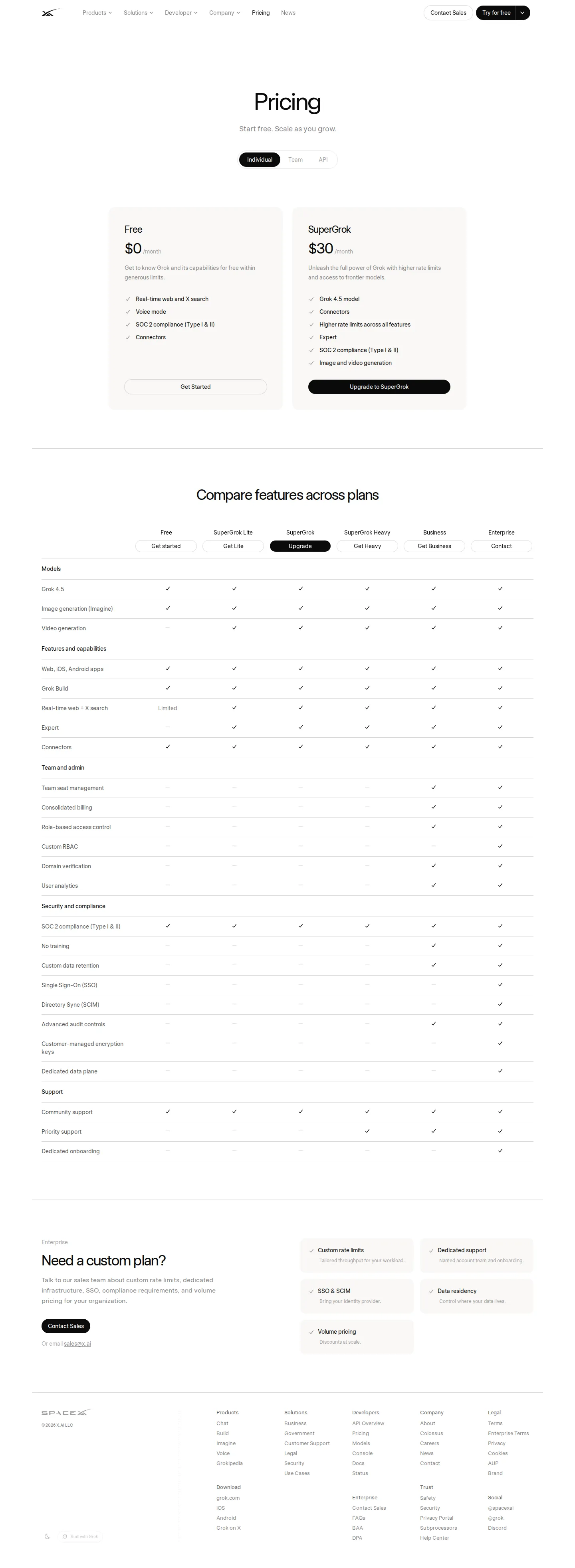
- Consumer app seats — Free ($0/month), SuperGrok ($30/month) and Business ($30/month), plus unpriced SuperGrok Lite and SuperGrok Heavy rungs and a Contact-Sales Enterprise tier — a flat-rate subscription surface distinct from the per-token API.
What makes this different: xAI publishes raw per-million-token billing and prices live X (Twitter) search as a metered agentic tool — turning a proprietary social-data feed, acquired in the X merger, into a per-call line item that closed-data rivals can’t replicate.
Pricing by product
Text API — short-context rates (per million tokens, USD)
| Model | Context | Input /M | Cached input /M | Output /M |
|---|---|---|---|---|
| grok-4.5 | 500k | $2.00 | $0.30 | $6.00 |
| grok-build-0.1 | 256k | $1.00 | $0.20 | $2.00 |
| grok-4.3 | 1M | $1.25 | $0.20 | $2.50 |
| grok-4.20-multi-agent-0309 | 1M | $1.25 | $0.20 | $2.50 |
| grok-4.20-0309-reasoning | 1M | $1.25 | $0.20 | $2.50 |
| grok-4.20-0309-non-reasoning | 1M | $1.25 | $0.20 | $2.50 |
Text API — long-context rates (per million tokens, USD)
Applies once a request’s prompt reaches 200k tokens — a single threshold shared by every model, not a per-model fraction of its context window.
| Model | Input /M | Cached input /M | Output /M | Key mechanics |
|---|---|---|---|---|
| grok-4.5 | $4.00 | $0.60 | $12.00 | Flagship for code + general use; 500k context, long-context band from 200k |
| grok-build-0.1 | $2.00 | $0.40 | $4.00 | Coding-focused; 256k context, so only its top 56k sits in the long-context band |
| grok-4.3 | $2.50 | $0.40 | $5.00 | Value rung; 1M context, so 800k of its range bills long-context |
| grok-4.20-multi-agent-0309 | $2.50 | $0.40 | $5.00 | Multi-agent orchestration; 1M context |
| grok-4.20-0309-reasoning | $2.50 | $0.40 | $5.00 | Reasoning variant; 1M context |
| grok-4.20-0309-non-reasoning | $2.50 | $0.40 | $5.00 | Lower-latency variant; 1M context |
“Requests whose prompt reaches 200k tokens are billed at the higher rate for all tokens in the request” — so crossing 200k reprices the entire request, not just the tokens past it. A 20% Batch API discount applies to grok-4.3, grok-4.20-0309-reasoning, grok-4.20-0309-non-reasoning and grok-4.20-multi-agent-0309 only (“models not listed above have no batch discount”), and covers input, output, cached and reasoning tokens; Priority Processing bills at 2x the standard rate across all token types, with caching discounts applied before the multiplier.
Grok API — agentic tools & media (USD)
| Service | Price | Key mechanics |
|---|---|---|
| Web Search | $5 / 1,000 calls | Live web retrieval as an agent tool |
| X Search | $5 / 1,000 calls | Live X (Twitter) search — xAI’s data moat |
| Code Execution | $5 / 1,000 calls | Sandboxed code-running tool |
| Collections Search | $2.50 / 1,000 calls | Retrieval over indexed collections (RAG) |
| File Attachments | $10 / 1,000 calls | attachment_search over files attached to messages |
| Image Understanding | Token-based | view_image — no invocation fee; billed as image tokens. Applies only to images found by search tools, not images passed directly in messages |
| X Video Understanding | Token-based | view_x_video — no invocation fee; applies only to videos found by X Search |
| Remote MCP Tools | Token-based | No invocation fee; tokens only |
| Image generation | $0.02–$0.07 / image | grok-imagine-image $0.02/img at 1K and 2K; grok-imagine-image-quality $0.05/img (1K) and $0.07/img (2K); media input $0.002–$0.01/img |
| Video generation | $0.05–$0.25 / second | grok-imagine-video $0.05/sec (480p), $0.07/sec (720p); grok-imagine-video-1.5 $0.08/sec (480p), $0.14/sec (720p), $0.25/sec (1080p) |
| Text to Speech | $15.00 / 1M characters | Voice synthesis |
| Realtime voice | $0.05 / minute | Live voice ($3.00/hr); realtime text input $0.004/message |
| Speech to Text | $0.10–$0.20 / hour | $0.10/hr REST, $0.20/hr streaming |
Grok API — storage, batch & fees (USD)
| Item | Price | Key mechanics |
|---|---|---|
| File storage | $0.025 / GiB / day | Files stored on the xAI platform |
| Collection storage | $0.10 / GiB / day | Indexed RAG collections |
| File / collection downloads | $0.20 / GiB | Flat egress rate |
| Batch API | −20% on eligible models | Async processing (grok-4.3 + the three grok-4.20 variants); most complete within 24h; batch requests don’t count toward rate limits. Image and video generation are supported but billed at standard rates |
| Priority Processing | 2x standard token rate | Higher scheduling priority; Chat Completions and Responses endpoints only — not image, video or Batch |
| Usage-guideline violation fee | $0.05 / request | Charged when a request is caught before generation in the Responses API; violations caught after generation are billed as normal generation |
Consumer Grok app — Individual plans
| Tier | Price | Included | Key mechanics |
|---|---|---|---|
| Free | $0 / month | Limited real-time web + X search, voice mode, connectors, SOC 2 (Type I & II), Grok Build, Grok 4.5, image generation | ”Get to know Grok and its capabilities for free within generous limits” |
| SuperGrok Lite | Not published | Full real-time web + X search, Expert, video generation, Grok 4.5 | Rung between Free and SuperGrok; no price shown on the page (“Get Lite”) |
| SuperGrok | $30 / month | Grok 4.5 model, higher rate limits across all features, Expert, connectors, image and video generation | Featured individual tier — “Unleash the full power of Grok” |
| SuperGrok Heavy | Not published | Everything in SuperGrok plus priority support | Higher-usage individual rung; no price shown on the page (“Get Heavy”) |
Consumer Grok app — Team plans
| Tier | Price | Included | Key mechanics |
|---|---|---|---|
| Business | $30 / month | All Grok models including Grok 4.5, Grok Build access, team seat management, consolidated billing, SOC 2 (Type I & II), role-based access control, domain verification, user analytics, custom data retention | Self-serve “Get Business Plan”; “Perfect for small-to-medium teams collaborating with Grok to innovate” |
| Enterprise | Contact Sales | ”Everything in Business, plus:” custom SSO, Directory Sync (SCIM), custom RBAC, advanced user and access management, dedicated onboarding and support, customer-managed encryption keys, dedicated data plane | Sales-led; the Enterprise block also lists custom rate limits, dedicated infrastructure, data residency and volume pricing (“Discounts at scale”) |
Sales motions across products: PLG / self-serve for the pay-as-you-go API and the Free, SuperGrok and Business consumer tiers; sales-led for Enterprise and custom volume API pricing (dedicated infrastructure, SSO, compliance, data residency).
Hidden costs : What xAI users actually pay
xAI’s headline token rates are unusually low, but the real API bill is shaped by three things the per-model row doesn’t show: the output-token premium, the separately-billed agentic tools, and the cache-hit ratio that decides whether you pay $1.25 or $0.20 for input. Two archetypes show how the total assembles.
Archetype 1 — a developer running a live-research agent on the API. Answering questions with grok-4.3 (assume ~40M input + ~12M output tokens/month), plus 30,000 X-search calls and 10,000 code-execution calls a month, with roughly half the input served from cache.
| Line item | Monthly cost |
|---|---|
| grok-4.3 input — 20M tok @ $1.25/M (cache-miss) | $25.00 |
| grok-4.3 cached input — 20M tok @ $0.20/M | $4.00 |
| grok-4.3 output — 12M tok @ $2.50/M | $30.00 |
| X Search — 30,000 calls @ $5 / 1,000 | $150.00 |
| Code Execution — 10,000 calls @ $5 / 1,000 | $50.00 |
| Estimated total | ~$259/mo |
The lesson: on grok-4.3 the agentic tools dominate the bill — $200 of live-search and code-execution calls dwarfs the ~$59 of token cost. The token rates are cheap by frontier standards; the variable cost has shifted to the per-call tools. A high cache-hit ratio (here halving input to $0.20/M) further shrinks the token line, so prompt-caching discipline matters more than model choice for repeat-context workloads.
Archetype 2 — a 10-person team on the consumer Grok app. Ten seats at $30/month, using Grok for research and drafting rather than building on the API.
| Line item | Monthly cost |
|---|---|
| SuperGrok — 10 seats @ $30 / month | $300.00 |
| Business upgrade — published at the same $30 / month headline (adds team seat management, consolidated billing, RBAC) | no headline uplift |
| Estimated total | ~$300/mo |
Here the surprise is that the team step is not a price step: Business is published at the same $30/month headline as individual SuperGrok and is bought self-serve (“Get Business Plan”), so a team that outgrows individual seats picks up seat management, consolidated billing and RBAC without a visible per-seat premium. (The pricing page shows the $30/month figure without stating the seat basis, so confirm how seats are counted before budgeting.) What stays hidden is elsewhere — the SuperGrok Lite and SuperGrok Heavy rungs carry no price on the pricing page at all, and Enterprise (custom rate limits, SSO/SCIM, dedicated data plane, volume discounts) is Contact-Sales only.
Want to estimate your own xAI bill? Use the xAI pricing calculator to model your costs based on token volume, agentic-tool calls, and seat count.
Pricing evolution : xAI pricing history and changes
xAI’s API has billed per million tokens since the grok-beta public beta opened in October 2024 — and the per-token price fell steeply as the model lineup advanced. The flagship rate dropped from $5 / $15 (grok-beta) to $3 / $15 (Grok 4) to $1.25 / $2.50 (grok-4.3), even as context windows grew from 128k to 1M tokens. The July 2026 grok-4.5 launch is the first time xAI priced a new flagship above its predecessor ($2 / $6 vs grok-4.3’s $1.25 / $2.50), keeping the cheaper grok-4.3 live and reserving the premium for higher intelligence. A week later, on 2026-07-21, xAI added a second dimension to the same table: a long-context rate column at roughly 2x the short-context rate. The headline numbers stopped moving; the shape of the meter started to. The dated milestones below are reconstructed from primary announcements and contemporaneous press; per-snapshot reconstruction will be tightened with archived captures on a later pass.
Cadence
| Quarter | Price changes | Product / SKU additions | Notes |
|---|---|---|---|
| 2024 Q4 | 1 | 1 | 2024-10 Grok API public beta opens; grok-beta at $5 / $15 per 1M tokens, $25/mo free credits |
| 2025 Q1 | 0 | 1 | 2025-03 xAI acquires X in an all-stock deal; live X-search becomes a data asset |
| 2025 Q2 | 1 | 1 | 2025-06 Grok 3 ($3 / $15) and Grok 3 mini ($0.30 / $0.50) reach the API |
| 2025 Q3 | 1 | 2 | 2025-07 Grok 4 ($3 / $15, 256k context); Grok 4 Fast added ($0.20 / $0.50, up to 2M context) |
| 2026 Q2 | 1 | 1 | 2026-05 lineup consolidates on grok-4.x; flagship grok-4.3 at $1.25 / $2.50, cached $0.20; legacy models retired |
| 2026 Q3 | 2 | 2 | 2026-07-06 xAI rebrands to SpaceXAI and merges into SpaceX (ownership/identity change, no rate move). 2026-07-14 grok-4.5 launches ($2 / $6, 500k context) as the new flagship above grok-4.3; SuperGrok Lite rung added; Batch (−20%), Priority (2x) and storage fees published. 2026-07-21 Code API and Chat API tables merged into one Text API table with a second long-context column (~2x short context); grok-4.5 cached input cut $0.50 → $0.30 |
Tracked range: 2024 Q4–2026 Q3. Quarters not listed had no publicly announced price or SKU change. Dated milestones below cite primary/secondary sources; per-snapshot price reconstruction is a later pass.
Notable changes
- 2024-10 — Grok API public beta opens with grok-beta at $5 / $15 per 1M tokens and $25/month in free credits (TechCrunch, InfoQ).
- 2025-03 — xAI acquires X in an all-stock deal valuing X at $33B and xAI at ~$80B; the merger underpins live X-search as a billable tool (CNBC).
- 2025-06 — Grok 3 ($3 / $15) and Grok 3 mini ($0.30 / $0.50) reach the API, adding the first low-cost rung.
- 2025-07 — Grok 4 launches at $3 / $15 with a 256k context window; Grok 4 Fast follows at $0.20 / $0.50 with context up to 2M tokens.
- 2026-05 — The lineup consolidates on grok-4.x; flagship grok-4.3 lands at $1.25 / $2.50 with cached input standardized at $0.20/M, and legacy models (Grok 3, Grok 4 Fast) are retired.
- 2026-07-06 — xAI completes a rebrand to SpaceXAI as it fully merges into SpaceX, and Musk separately acquires gas-turbine operator APR Energy (~$1B) to power the training fleet. This is an ownership-and-identity change, not a pricing one: the Grok API rate card, the agentic-tool rates and the consumer plans are all unchanged, and no rate move accompanied the merger. Its bearing on this page is indirect — it deepens the compute-and-energy base (Colossus plus dedicated turbine power) that underwrites xAI’s price-aggressive inference strategy, rather than altering any published price (Business Insider, TradingView, 2026-07-06).
- 2026-07-14 — grok-4.5 launches as the new intelligence-first flagship at $2 / $6 per 1M tokens (500k context, cached $0.50 at launch), sitting above the still-live grok-4.3; the consumer SuperGrok tier switches to Grok 4.5, a SuperGrok Lite rung appears, and xAI publishes a 20% Batch API discount, a 2x Priority Processing premium, storage/download fees, and a $0.05 usage-guideline violation fee (docs.x.ai, updated 2026-07-09).
- 2026-07-21 — The Code API and Chat API rate tables merge into a single Text API table, and every model gains a second long-context rate column at roughly 2x the short-context rate (grok-4.5 $4.00 / $0.60 / $12.00; grok-4.3 and the grok-4.20 variants $2.50 / $0.40 / $5.00; grok-build-0.1 $2.00 / $0.40 / $4.00). The threshold is 200k prompt tokens on every model, and reaching it reprices every token in that request. In the same release grok-4.5 cached input falls from $0.50 to $0.30 per 1M tokens (−40%); short-context headline rates, agentic tool rates, Batch, Priority, storage fees and the consumer plans are all unchanged (docs.x.ai/docs/pricing, captured 2026-07-21).
The price-down march in detail
xAI’s pricing story is a sustained per-token markdown paired with capability gains. The grok-beta launch price of $5 / $15 was squarely in the frontier band of late 2024; by mid-2026 the flagship grok-4.3 charged $1.25 / $2.50 — a roughly 75% cut on input and 83% on output — while the context window grew nearly 8x (128k to 1M). Rather than hold a premium price and harvest margin, xAI used compute scale (Colossus) and the X-data advantage to compete on price, betting that cheap frontier inference plus a proprietary live-search tool wins developer share faster than a high sticker rate. The variable cost it does charge aggressively for is the agentic tools — $5 / 1k for live search and code execution — signaling where xAI thinks the durable value (and willingness to pay) actually sits.
The July 2026 grok-4.5 launch marks the first break in that march. Instead of undercutting grok-4.3, xAI priced the new flagship above it — $2 / $6 vs $1.25 / $2.50 — and kept the cheaper model live rather than retiring it. That is a deliberate shift from a single price-descending flagship to a good-better-best ladder: grok-4.3 becomes the value-inference rung, grok-4.5 the intelligence-premium rung. The signal is that xAI now believes the frontier of capability (not just cheaper tokens) can command a premium — and that the markdown had found a floor at the point where the model stopped being merely “cheaper” and started being meaningfully smarter. The same launch layered on Batch (−20%), Priority (2x), and storage/violation fees, adding rate-modifier and platform-fee dimensions that quietly widen the meter beyond the headline per-token line.
The 2026-07-21 restructure continues that pattern with a sharper instrument. No headline rate moved — grok-4.5 is still $2 / $6, grok-4.3 still $1.25 / $2.50 — but every model now carries a second column that bills at roughly 2x once a prompt reaches its long-context threshold, and the docs are explicit that the higher rate then applies to all tokens in the request. That is a cliff, not a graduated tier: a prompt one token over the line costs about double, not marginally more, and the jump hits input, cached and output tokens together. Economically it is a long-context surcharge introduced without a price rise, and it lands on precisely the workloads xAI’s own 1M-token context windows and RAG tooling invite. The buyer consequence is that prompt size becomes a first-class cost control — the same monthly token volume can cost 1x or 2x depending on how requests are chunked — and the forecasting consequence is that a spend model built on average tokens per month is now wrong unless it also models the distribution of prompt lengths. The simultaneous grok-4.5 cached-input cut ($0.50 → $0.30, −40%) pulls in the opposite direction for the workloads that reuse context rather than expand it, bringing the flagship’s cache discount ratio (now ~85% off the $2.00 cache-miss rate) in line with what grok-4.3 already offered. Read together, the two moves reward small, repeated, cache-friendly requests and penalise single large ones — a deliberate nudge toward the request shape that is cheapest for xAI to serve. Folding the old Code API and Chat API tables into one Text API table makes the rate card simpler to read while the pricing behind it gets more conditional, and it quietly puts grok-build-0.1 on the same page as models that do get the 20% batch discount it does not.
What’s unique : xAI’s distinctive pricing mechanics
1. Live X-search as a metered tool. The March 2025 X acquisition turned a proprietary social-data feed into a billable agentic tool — X Search at $5 per 1,000 calls, priced identically to web search but backed by data no closed competitor can match. xAI prices the data access per action, not per token, making real-time social context an explicit line item rather than a free model feature.
2. Aggressive token markdowns — now paired with an intelligence premium. Where most labs hold flagship pricing steady and add cheaper minis, xAI cut the flagship itself — $5 to $1.25 on input across 18 months — while expanding context to 1M tokens. The July 2026 grok-4.5 launch is the first inflection: at $2 / $6 it prices above the still-live grok-4.3 ($1.25 / $2.50), the first time xAI has charged more for a new flagship than its predecessor. The markdown march didn’t reverse so much as split into rungs — grok-4.3 stays the cheap-inference share-grab funded by compute scale, while grok-4.5 reserves a premium for higher intelligence, an emerging good-better-best structure atop the same token economics.
3. Two surfaces, deliberately separate. Unlike peers that route consumer overage through the API meter, xAI keeps the per-token developer API and the flat-rate consumer Grok app ($0 Free, $30 SuperGrok) as distinct pricing systems. Developers get pure usage billing; consumers get predictable subscriptions — each optimized for its buyer rather than forced through one meter.
4. Cache-first input pricing. Cached input at $0.20/M on grok-4.3 (about 85% off the $1.25 cache-miss rate) is a structural discount that rewards repeat-context, agentic workloads — exactly the prompt-heavy patterns Grok’s tools encourage. The 2026-07-21 cut of grok-4.5 cached input from $0.50 to $0.30 extended the same ~85% ratio to the flagship, so the discount is now a lineup-wide policy rather than a grok-4.3 quirk. The cache rate, not the headline rate, is the real price for production usage-based agents.
5. A long-context cliff instead of a long-context tier. Since 2026-07-21 each model carries two rate columns, and crossing its long-context threshold reprices every token in the request at roughly 2x — input, cached and output alike. Most labs that charge more for long context either apply the premium only to the tokens above the line or sell a separate long-context SKU; xAI applies it retroactively to the whole call. That makes prompt length a binary billing switch rather than a smooth cost curve, and it is the rare case where a vendor raised the effective price of its most demanding workloads without changing a single headline number.
Strengths & weaknesses
| Strengths | Weaknesses |
|---|---|
| Fully public per-million-token API rates — no “contact sales” wall for inference | Agentic tools ($5 / 1k for search and code exec) can dwarf token cost on tool-heavy agents, making totals harder to predict |
| Good-better-best rungs: grok-4.3 at $1.25 / $2.50 (1M context) undercuts most frontier rivals as the value tier, while grok-4.5 at $2 / $6 adds a premium intelligence option | Frequent model churn (grok-beta, 3, 4, 4 Fast, 4.3, 4.5) and confusing version names make historical price tracking hard |
| Live X-search is a genuine data moat sold as a metered tool | The 200k long-context threshold is published only on each model’s detail page — the summary pricing table names the two columns without saying where the line falls, so the doubling is easy to miss at the point of comparison |
| Cached input rewards repeat-context agentic workloads, now at $0.20/M on grok-4.3 and $0.30/M on grok-4.5 after the July 2026 cut | Long-context repricing is a cliff, not a tier — one token past the threshold re-rates the whole request at ~2x, so cost per request is discontinuous and hard to forecast |
| Business team plan is a published, self-serve $30/month — no sales call to get RBAC, consolidated billing and domain verification | Enterprise (custom rate limits, dedicated infra, compliance) is fully sales-gated with no public floor |
| Merging the Code API and Chat API tables into one Text API rate card makes cross-model comparison easier | Batch’s 20% discount silently excludes grok-4.5 and grok-build-0.1 even though they now sit on the same merged rate card as the models that get it |
| Clean separation of developer API and consumer app keeps each surface predictable | Rapid retirement of models (Grok 3, Grok 4 Fast in May 2026) can strand integrations on deprecated SKUs |
| Steep, sustained price cuts signal a credible cost-leadership position | API surface is bot-protected / JS-rendered, so transparent as numbers but harder to archive |
Billing UX : usage tracking and overage controls
- API Console usage dashboard — developers monitor token consumption, tool calls, and spend per model through the xAI Console, with prepaid credits and pay-as-you-go billing.
- Free credits — xAI seeded its 2024 public beta with free monthly API credits and continues to offer promotional credits to onboard developers.
- Cached-input metering — input served from cache is billed at the lower cached rate automatically ($0.20/M on grok-4.3, grok-4.20 and grok-build-0.1; $0.30/M on grok-4.5), so prompt-caching discipline directly lowers the bill without a separate plan.
- Long-context threshold repricing — once a request’s prompt reaches 200k tokens, all tokens in that request bill at the long-context column (roughly 2x short context). The 200k line, not the plan, is the switch that doubles the rate — so prompt size is itself a billing control, and the same threshold applies whether the model’s window is 256k or 1M.
- Per-call tool metering — agentic tools (web search, X search, code execution, collections, file attachments) are tracked and billed per 1,000 calls, separate from the token meter;
view_image,view_x_videoand Remote MCP tools carry no invocation fee and bill tokens only. - Batch API discount — grok-4.3 and the three grok-4.20 variants run at a 20% discount when submitted asynchronously (most complete within 24 hours), across input, output, cached and reasoning tokens; batch requests don’t count against per-minute rate limits, and resulting batch prices are previewed via a “Show batch API pricing” toggle on each model’s detail page.
- Priority Processing — text requests can opt into 2x-rate priority scheduling for lower latency, billed at the priority rate only when the response confirms
"service_tier": "priority"; caching discounts are applied before the multiplier, and priority is unavailable for image, video and Batch requests. - Storage metering — files ($0.025/GiB/day) and RAG collections ($0.10/GiB/day) are billed by storage used, with downloads at $0.20/GiB, all viewable and manageable through the xAI Console or API.
- Usage-guideline violation fee — requests caught in violation before generation in the Responses API still incur a $0.05 fee; violations caught after generation are charged as normal generation.
- Self-serve team billing (Business, $30/month) — team seat management, consolidated billing, role-based access control, domain verification, user analytics, and custom data retention are bought self-serve via “Get Business Plan” rather than through a sales call.
- Enterprise controls — custom rate limits, SSO & SCIM, advanced audit controls, custom data retention, customer-managed encryption keys, and a dedicated data plane are available on Enterprise.
- No-training & compliance — SOC 2 (Type I & II) compliance is available even on Free; Enterprise adds no-training guarantees and custom retention.
Strategic wins : Why xAI’s pricing decisions worked
1. Monetizing the X data moat as a tool
By pricing live X-search as a $5-per-1k-call agentic tool, xAI turned the most distinctive asset from its X acquisition into a metered, recurring revenue line rather than a free model feature. The per-action price makes real-time social context a value metric competitors can’t copy, anchoring xAI’s differentiation in data access rather than raw model quality. See how outcome-shaped pricing is moving the meter from tokens toward actions.
2. Cost leadership funded by compute scale
Cutting the flagship from $5 to $1.25 on input while growing context to 1M tokens is a deliberate share-grab. By using Colossus-scale compute to drive marginal inference cost down, xAI competes on price where rivals hold premiums — a bet that cheap frontier inference accelerates developer adoption. This mirrors the broader shift away from premium per-token pricing as inference commoditizes.
3. Separating the developer and consumer meters
Keeping the per-token API and the flat-rate consumer app distinct lets each be priced for its buyer: developers get transparent usage billing, consumers get a predictable $30 subscription. Avoiding a forced single-meter design means neither surface compromises — a discipline in choosing the right usage metric per audience that multi-product vendors often miss.
4. Charging a premium for intelligence, not just cheaper tokens
The July 2026 grok-4.5 launch ($2 / $6, above the still-live grok-4.3 at $1.25 / $2.50) is the first time xAI priced a new flagship higher than its predecessor — a controlled break from three years of markdowns. By keeping grok-4.3 as the value rung and reserving grok-4.5 for higher intelligence, xAI converts a race-to-the-bottom into a good-better-best ladder where capability, not just cost, sets the price. It is a measured test of whether developers will pay up for the frontier once inference itself has commoditized — value-based pricing layered on top of a cost-led base.
5. Recovering long-context cost without raising a headline price
Long prompts are disproportionately expensive to serve — attention cost grows faster than token count — but raising the headline rate to cover them would have taxed every customer and surrendered xAI’s price-leadership story. The 2026-07-21 two-column table solves that precisely: short-context rates stay exactly where they were, and only requests that reach a model’s long-context threshold pay the ~2x column. The cost is charged to the workloads that create it, the marketing number stays intact, and the same release cut grok-4.5 cached input 40% ($0.50 → $0.30) so the pairing reads as a discount for good behaviour rather than a price rise. It is a textbook example of matching the meter to the cost driver instead of averaging it across the base — the trade-off being that a threshold cliff buys that precision at the expense of predictability.
Areas to improve : Gaps in xAI’s pricing approach
1. Surface agentic-tool cost in the headline
Live search and code execution at $5 / 1k calls routinely dominate the bill on agentic workloads, yet they sit below the token table. As Grok becomes a tool-using agent platform, a combined “estimated cost per agent run” view in the Console would prevent the bill-shock and unpredictability that hits when tool calls outrun token spend.
2. Put the 200k threshold on the rate card, and warn before crossing it
The threshold is published — “Requests whose prompt reaches 200k tokens are billed at the higher rate for all tokens in the request” — but only on each model’s individual detail page. The summary pricing table, which is where buyers actually compare models, labels its two columns “Short context” and “Long context” without saying that 200k is the dividing line. A developer sizing a RAG prompt on grok-4.3 can therefore read the rate card and still not know whether they are paying $1.25/M or $2.50/M, and because the rule re-rates every token the error is a 2x error, not a rounding one. Printing the 200k line in the summary table, returning the applied rate column in the response metadata (as xAI already does for "service_tier": "priority"), and flagging near-threshold requests in the Console would turn a billing surprise into a design constraint developers can engineer around, exactly the bill-shock risk a cliff creates.
3. Stabilize the model lineup and version naming
Rapid model churn and overlapping names (grok-4.3 vs grok-4.20 vs grok-build-0.1) plus the May 2026 retirement of Grok 3 and Grok 4 Fast make it hard to plan around a price. Clearer deprecation timelines and a stable naming scheme would reduce integration risk and make historical token-pricing comparisons legible.
Monetization stack & signals : how xAI builds & buys its revenue engine
Buys 1 Builds 0 2 signal roles
xAI buys its consumer-monetization stack (Amplitude/Mixpanel analytics, a Braze/Iterable-class CRM) and staffs lifecycle/growth around the $30 SuperGrok subscription — see the lifecycle-marketing hire below. Notably absent: any billing or metering engineer, so the meter behind its published per-token API stays undisclosed.
-
“Analyze performance using SQL, Amplitude/Mixpanel, and other tools to identify drop-offs, opportunities, and ROI; report on key KPIs (activation rate, D30/D90 retention, expansion revenue, churn rate, LTV uplift, NRR)”
-
“Hands-on expertise with marketing automation & CRM platforms (Braze, Iterable, Customer.io, Klaviyo, or similar)”
-
“Published per-million-token API and per-1k-call agentic-tool pricing imply a usage meter behind the Grok API, but no vendor or in-house build is disclosed in any posting or blog.”
-
xAI's first revenue-engine hire is a consumer-subscription lifecycle marketer for SuperGrok, not a billing or metering engineer — it buys CRM/automation (Braze/Iterable-class) and runs Amplitude/Mixpanel rather than building, and is investing on the retention/expansion side of its $30 subscription, not the API meter.
“We're looking for a strategic, hands-on Growth Marketing Manager – Lifecycle to own and optimize the full post-acquisition customer journey for xAI's subscription products… map customer journeys, define key stages (onboarding, activation, habit formation, expansion, renewal, win-back)… report on key KPIs (… expansion revenue, churn rate, LTV uplift, NRR)”
-
An Ads + Payments enablement role placed in a "Monetization" org — evidence the merged xAI/X entity runs a consumer Ads + X Payments fintech revenue line alongside the Grok API, a second surface the published token pricing doesn't show.
“Create and facilitate high-impact learning experiences… focused on Ads, payment systems, fintech products… in partnership with Customer Support, Ads & payments stakeholders”
Signals reviewed · derived from public job posts, product docs
Job postings fill and close over time — once a posting is filled we keep it as a dated citation (the quoted evidence remains); use View open roles for current listings.
Key takeaways
- Price the data moat, not just the model. xAI sells live X-search as a $5-per-1k-call tool, turning a proprietary feed from the X merger into a metered value metric rivals can’t replicate. The durable differentiation is data access, priced per action.
- Cheap inference has a floor — intelligence can carry a premium. After cutting the flagship from $5 to $1.25 on input over 18 months, xAI’s July 2026 grok-4.5 broke the pattern by pricing above grok-4.3 and keeping the cheaper model live. The markdown was a share-grab; the premium rung is a bet that frontier capability, not just low cost, is worth paying up for.
- Two surfaces beat one forced meter. Keeping the per-token developer API and the flat-rate consumer app separate lets each be priced for its buyer, instead of laundering consumer overage through an API meter.
- Prompt shape now sets the price more than model choice. Cached input at $0.20/M on grok-4.3 and $0.30/M on grok-4.5 (after the 2026-07-21 cut) rewards reusing context, while the long-context column charges ~2x on every token of a request that crosses the threshold. Because that cliff re-rates the whole request rather than the excess, cost per call is discontinuous: the same monthly token volume can cost 1x or 2x depending on how it is chunked and cached, and an averages-based spend model can understate a long-prompt workload by up to 100%.
- Tools, not tokens, are where the bill lives. On agentic workloads the $5 / 1k tool calls dwarf token spend — an early signal that the meter is shifting from inference toward actions.
UBP implications
- Proprietary data becomes a per-action meter. xAI shows that a distinctive data asset (live X content) can be priced as a per-call agentic tool rather than bundled free into the model. UBP practitioners with unique data should consider metering access to it as its own unit.
- As inference commoditizes, willingness-to-pay migrates — to tools and to a premium intelligence tier. When flagship token rates fall 75% in 18 months, the variable cost shifts to the agentic tools layered on top ($5 / 1k calls) — but xAI’s July 2026 grok-4.5 shows a second destination: a new flagship priced above its predecessor, with the cheaper model kept live as the value rung. UBP design should follow the value to the action and to differentiated capability, not defend a single descending token line. The 2026-07-21 long-context column shows a third move in the same family: charge the expensive workload (long prompts) at ~2x while leaving every headline rate untouched, protecting margin without a visible price rise. Copy the intent, not the mechanics — because xAI’s higher rate applies to all tokens once the threshold is reached, one extra token can double a bill, whereas a graduated band that prices only the tokens above the line recovers the same cost with a continuous, forecastable curve.
- Match the meter to the buyer, not the product. Running a pure per-token API for developers and a flat subscription for consumers — two meters, deliberately — lets each audience get the pricing model it actually wants, a reminder that one universal unit isn’t always the right answer.
Sources
- xAI API overview (accessed 2026-07-21)
- xAI documentation — models (accessed 2026-07-21)
- xAI documentation — pricing (accessed 2026-07-21)
- xAI developer pricing reference (accessed 2026-07-21)
- xAI model detail — grok-4.5 (accessed 2026-07-21)
- xAI model detail — grok-4.3 (accessed 2026-07-21)
- xAI model detail — grok-build-0.1 (accessed 2026-07-21)
- xAI pricing page (consumer plans) (accessed 2026-07-21)
- Grok on the App Store — in-app purchase catalogue (accessed 2026-07-21)
- xAI news — API public beta (accessed 2026-06-11)
- TechCrunch — xAI launches an API (accessed 2026-06-11)
- CNBC — Musk says xAI acquired X at $33B (accessed 2026-06-11)
- Browse the pricing blueprint corpus
Bottom line
xAI prices Grok on two deliberately separate surfaces: a fully public per-million-token developer API (grok-4.3 at $1.25 in / $2.50 out, cached $0.20) with agentic tools metered at $5 per 1k calls, and a freemium consumer app ($0 Free, $30 SuperGrok). The defining moves are a sustained 75% per-token markdown that bets cheap frontier inference wins developer share, and pricing live X-search — the asset from its $33B X acquisition — as a metered tool no closed rival can match. The July 2026 grok-4.5 launch adds a new twist: at $2 / $6 it is the first xAI flagship priced above its predecessor, turning the descending price line into a good-better-best ladder with grok-4.3 held live as the value rung and grok-4.5 charging a premium for intelligence. A week later, on 2026-07-21, xAI stopped competing on the headline number and started shaping the meter instead — one merged Text API table, a second long-context column that bills every token of an over-threshold request at roughly 2x, and a 40% cut to grok-4.5 cached input ($0.50 → $0.30) that rewards the opposite behaviour. The friction is fast model churn, a sales-gated Enterprise tier, and a 200k long-context threshold that is published on each model’s detail page but omitted from the summary rate card buyers actually compare on; the strength is transparent token rates — cheap at the value rung, premium at the frontier — a self-serve $30 Business plan, and a genuine data moat. Buyers should now budget by prompt shape, not just token volume.
Want to compare xAI against other foundation-model providers? See OpenAI and Mistral AI, or browse the full pricing blueprint.
Pricing timeline : Major events on a vertical axis
Each milestone below corresponds to a public pricing change, product launch, or material adjustment. Major events use a filled marker; minor adjustments use a faded one.
Long-context rate column added; grok-4.5 cached input cut to $0.30
xAI merges the separate Code API and Chat API rate tables into a single Text API table and adds a second rate column for long context, roughly 2x the short-context rate: grok-4.5 $4.00 in / $0.60 cached / $12.00 out, grok-4.3 and the grok-4.20 variants $2.50 / $0.40 / $5.00, grok-build-0.1 $2.00 / $0.40 / $4.00. Crossing a model's long-context threshold reprices every token in that request, not just the tokens past the line. In the same release grok-4.5 cached input drops from $0.50 to $0.30 per 1M tokens (-40%), while short-context headline rates, agentic tool rates, Batch (−20%), Priority (2x) and consumer plans are unchanged. (Source: docs.x.ai/docs/pricing, live capture 2026-07-21.)
grok-4.5 launches as the new flagship ($2 / $6 per 1M tokens)
xAI ships grok-4.5 — an intelligence-first flagship for code and general use with a 500k-token context and Feb 2026 knowledge cutoff — priced at $2.00 input / $0.50 cached / $6.00 output per 1M tokens, above the still-live grok-4.3 ($1.25 / $2.50). The consumer SuperGrok tier now runs Grok 4.5, and a new SuperGrok Lite rung appears in the plan ladder. New API billing mechanics are also published: a 20% Batch API discount, a 2x Priority Processing premium, files/collections storage ($0.025 / $0.10 per GiB/day) and a $0.05 usage-guideline violation fee. (Source: docs.x.ai models + pricing, updated 2026-07-09; live capture 2026-07-14.)
Live snapshot: grok-4.3 at $1.25 / $2.50, tools at $5 / 1k
Captured current USD pricing: grok-4.3 $1.25 input / $0.20 cached / $2.50 output per 1M tokens (1M context); grok-build-0.1 $1.00 / $2.00 (256k); agentic Web/X Search and Code Execution at $5 / 1k calls; consumer Free $0 and SuperGrok $30/mo on the Grok app. (Per-token API rates from docs.x.ai; consumer card from live capture.)
Lineup consolidates; legacy models retired
xAI retires Grok 3, Grok 4 Fast, and several variants, consolidating the published API on the grok-4.x generation (grok-4.3 plus grok-4.20 reasoning / non-reasoning / multi-agent and grok-build-0.1). Cached-input pricing is standardized at $0.20/M across the lineup. (Source: docs.x.ai, third-party trackers, 2026-05.)
Grok 4 Fast introduced (then later retired)
xAI ships Grok 4 Fast at $0.20 / $0.50 per 1M tokens with context up to 2M — a deliberate cost-optimized rung that prices well below the flagship. (Grok 4 Fast and several Grok 3 variants were later retired in May 2026 as the lineup consolidated on the grok-4.x generation.)
Grok 4 launches at $3 / $15 per 1M tokens
xAI releases Grok 4 (released 2025-07-09) with a 256k-token context window, priced at $3 per 1M input and $15 per 1M output tokens — matching the frontier-flagship pricing band of the era. Grok 4 becomes the headline model behind the SuperGrok consumer tier.
xAI acquires X (Twitter) in all-stock deal
xAI acquires X in an all-stock transaction valuing X at $33B ($45B less $12B debt) and xAI at roughly $80B, forming a combined ~$113B entity (X.AI Holdings Corp). The merger folds X's real-time data and distribution into xAI — the structural basis for live X-search as a billable agentic tool. (Source: CNBC, 2025-03-28.)
Grok 3 family announced; API access expands
xAI unveils Grok 3 and Grok 3 mini (publicly released on the API in June 2025), adding a cheaper mini tier alongside the flagship. Grok 3 is priced at $3 / $15 per 1M tokens and Grok 3 mini at $0.30 / $0.50 — the first time xAI offers a low-cost model rung on the API.
Grok API public beta launches (grok-beta at $5 / $15)
xAI opens the Grok developer API in public beta with a preview model, grok-beta (128k context, function calling, system prompts), billed at $5 per 1M input tokens and $15 per 1M output tokens — establishing per-token metering as the core API primitive. Every developer gets $25/month in free credits through end of 2024. (Source: TechCrunch, InfoQ, 2024-10/11.)
- · xAI's Grok API per-token price has fallen dramatically: from $5 / $15 per 1M tokens at the Oct 2024 grok-beta launch to $1.25 / $2.50 on grok-4.3 by mid-2026 — a roughly 75% cut on input.
- · Live X (Twitter) search is a billable agentic tool ($5 per 1,000 calls), a data moat made possible by xAI's March 2025 all-stock acquisition of X that valued the social platform at $33 billion.
- · Cached input on grok-4.3 costs $0.20 per 1M tokens — about 85% cheaper than the $1.25 cache-miss rate — so prompt-heavy, repeat-context workloads pay a fraction of the headline price.
Questions & answers
- What is xAI's pricing model?
- xAI bills the Grok developer API per million tokens across a good-better-best model ladder — the grok-4.5 flagship at $2 input / $6 output and the still-live grok-4.3 at $1.25 / $2.50 (cached $0.20) — with agentic tools (web search, X search, code execution) metered separately at $5 per 1,000 calls. A separate consumer Grok app is freemium ($0 Free, $30/mo SuperGrok on Grok 4.5).
- How much does the Grok API cost per million tokens?
- Short-context rates: grok-4.5 (500k context) is $2.00 per 1M input and $6.00 per 1M output, cached input $0.30; grok-4.3 (1M context) is $1.25 / $2.50 (cached $0.20); grok-build-0.1 is $1.00 in / $2.00 out. Once a request's prompt reaches 200k tokens the whole request bills at the long-context column — $4.00 / $12.00 for grok-4.5 and $2.50 / $5.00 for grok-4.3. Media and voice are priced separately (e.g. images from $0.02, TTS $15.00 per 1M characters).
- Does xAI offer a free tier?
- Yes, on two surfaces. The consumer Grok app has a Free plan at $0/month with real-time web and X search, voice mode, and connectors. On the API side, xAI ran $25/month in free credits during the 2024 public beta and continues to offer promotional credits.
- How does Grok API pricing compare to OpenAI and Anthropic?
- At $1.25 in / $2.50 out, grok-4.3 undercuts most frontier flagships on output tokens, while the July 2026 grok-4.5 flagship ($2 / $6) adds a premium intelligence rung above it. Grok 4 launched in July 2025 at $3 / $15 per 1M tokens; xAI then cut per-token rates dramatically before grok-4.5 became its first flagship priced above its predecessor — positioning Grok as price-aggressive at the value rung and competitive at the frontier.
- What does xAI charge for agentic tools and live search?
- Agentic tools are billed per 1,000 calls, separate from tokens: Web Search, X Search, and Code Execution at $5 / 1k calls each; Collections Search at $2.50 / 1k; File Attachments at $10 / 1k. Live X (Twitter) search is a distinctive data advantage following the xAI–X merger.
- How much is SuperGrok?
- The consumer SuperGrok subscription is $30/month, unlocking the Grok 4.5 model, higher rate limits, Expert mode, and image and video generation. A team-oriented Business plan is also $30/month and is bought self-serve, adding seat management, consolidated billing and role-based access control; SuperGrok Lite and SuperGrok Heavy rungs carry no published price, and Enterprise is sales-led. The developer API is billed and packaged separately.