AI Summary
About
Zendesk is the long-running customer-service software company (founded 2007, ~$1.7B revenue band before its 2022 take-private). Zendesk AI is the umbrella for its generative and agentic features: AI agents (bots) that autonomously resolve conversations, Copilot for human agents, intelligent triage, and Forethought AI agents. These ship as a mix of seat-priced tiers, per-agent add-ons, and outcome-based usage.
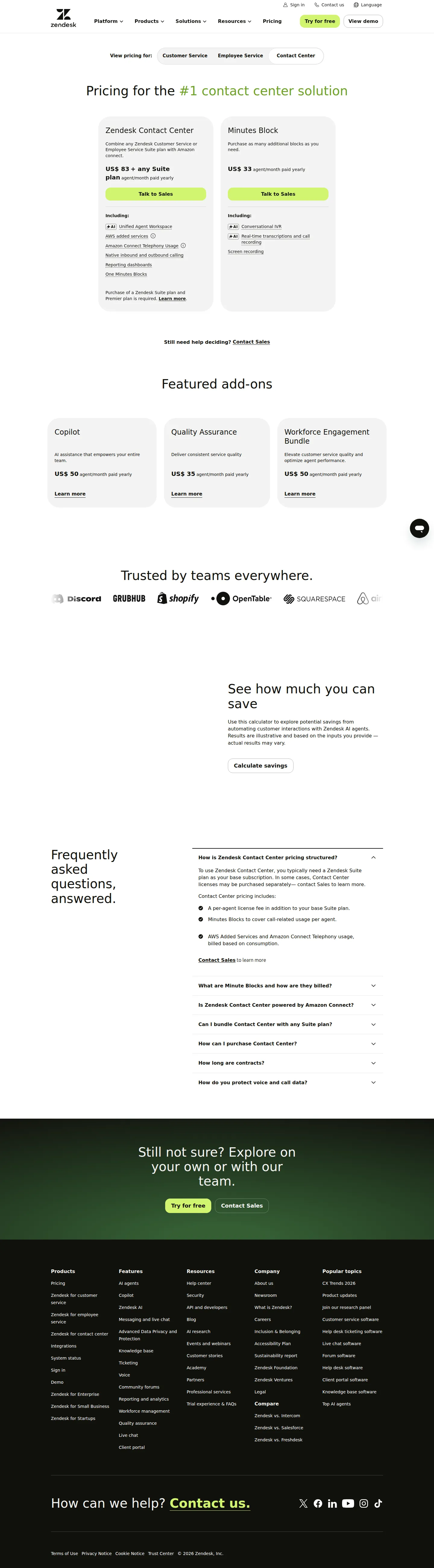
The pricing page now splits into three plan families behind a “View pricing for” tab strip — Customer Service, Employee Service and Contact Center — each with its own plan grid. Customer Service is the flagship Suite ladder; Contact Center is a separately-priced, Amazon Connect-powered voice SKU that sits on top of any Suite plan.
Zendesk matters for pricing analysis because it shows an incumbent SaaS leader bolting outcome-based AI onto a classic per-seat help-desk — a hybrid that contrasts with pure-outcome challengers like Intercom Fin.
For current pricing, see Zendesk pricing.
Pricing summary : How Zendesk AI’s pricing model works
Zendesk pricing is, in the company’s own words, “primarily seat-based (per agent, per month)” — a seat-plus-usage hybrid with four meters stacked on top of each other:
- Base subscription (seats) — the Support/Suite plan tier × number of agent seats: Support Team US$19, Suite Team US$55, Suite Professional US$115 per agent/month paid yearly. Suite Enterprise + Copilot carries no public price and is Talk to Sales.
- Outcome-based AI usage (automated resolutions) — AI agents are “included in every Suite and Support plan, with pricing based on the successful outcomes they deliver.” The automated resolution is “the unit of measurement used for calculating and billing your account for AI agent usage” — you “pay only for customer requests that were successfully resolved by the AI agent, without any escalation to a human agent.” Both the allowance and the rate are published, though only inside the “Compare all plan features” table rather than on the plan cards: every plan includes 5–15 automated resolutions per agent/month (capped at 10k per year), extra committed resolutions are US$1.50 each and pay-as-you-go overage resolutions are US$2.00 each. See per-resolution pricing.
- Feature-level consumption — “certain features like App Builder, Action Builder and Voice are billed based on consumption exceeding applicable plan allowances.” On the Contact Center surface, Amazon Connect telephony usage and AWS Added Services are also “billed based on consumption,” metered through pre-purchased Minutes Blocks.
- Per-agent AI add-ons — Copilot US$50, Workforce Engagement Bundle US$50, Quality Assurance US$35, and Contact Center US$83, all per agent/month paid yearly. Contact Center jumped from US$50 to US$83 between the June and July 2026 captures.
What makes this different: Zendesk grafts an outcome meter (automated resolutions) onto a seat-based platform rather than choosing one or the other, and it now runs three separate plan grids (Customer Service, Employee Service, Contact Center) off one pricing URL. Buyers can adopt AI incrementally — Copilot for humans first, then autonomous AI agents billed by resolution.
Pricing by product
Customer Service (Support and Suite plans)
| Tier | Price | Included | Key mechanics |
|---|---|---|---|
| Support Team | US$19 /agent/mo paid yearly | Email and ticketing system, ticket routing, prebuilt analytics dashboards, pre-written responses, customer context, automations and triggers | Entry seat for teams that have outgrown a shared inbox; self-serve “Buy now” |
| Suite Team | US$55 /agent/mo paid yearly | Support Team features plus AI agents, knowledge base, action builder, omnichannel routing, messaging and live chat, telephony | First tier with AI agents; automated resolutions billed on outcomes above plan allowance |
| Suite Professional | US$115 /agent/mo paid yearly | Suite Team features plus admin copilot, App Builder, writing tools, quick reports, skills-based routing, IVR phone menu | Marked MOST POPULAR; App Builder and Action Builder bill on consumption above allowances |
| Suite Enterprise + Copilot | Talk to Sales | Suite Professional features plus intelligent triage, auto assist, generative AI for voice, approval workflows, sandbox environment, customised agent roles | Sales-led; “enterprise service plans generally require sales engagement” |
The public grid is a subset of the plan inventory. Zendesk’s help centre documents five Suite plan types — Team, Growth, Professional, Enterprise and Enterprise Plus — while the four plan cards price only Team and Professional and fold the rest into “Suite Enterprise + Copilot / Talk to Sales.” The “Compare all plan features” table goes one column wider and prices Suite Growth at US$89 /agent/mo paid yearly (US$115 billed monthly), so the tier is public even though it never appears on the grid. Suite Enterprise carries a US$169 list price in the pricing page’s own plan data, but the card overrides it with a Talk-to-Sales CTA, so US$169 is not an advertised price. Suite Enterprise Plus is unknown from public sources.
Automated resolutions (the AI usage meter)
| Plan | Included automated resolutions | Committed AR rate | Pay-as-you-go AR rate |
|---|---|---|---|
| Support Team | 5 ARs /agent/mo | US$1.50 each | US$2.00 each |
| Suite Team | 5 ARs /agent/mo | US$1.50 each | US$2.00 each |
| Suite Growth | 10 ARs /agent/mo | US$1.50 each | US$2.00 each |
| Suite Professional | 10 ARs /agent/mo | US$1.50 each | US$2.00 each |
| Suite Enterprise | 15 ARs /agent/mo | US$1.50 each | US$2.00 each |
Included allowances are capped at 10k automated resolutions per year. Committed resolutions are pre-purchased in a fixed volume; pay-as-you-go is the un-committed overage rate, so the gap between US$1.50 and US$2.00 is the commitment discount. Assisted-escalation and contained resolutions do not count against the allowance — only verified resolutions do.
Customer Service featured add-ons
| Add-on | Price | Included | Key mechanics |
|---|---|---|---|
| Copilot | US$50 /agent/mo paid yearly | ”AI assistance that empowers your entire team” | Bundled into Suite Enterprise + Copilot; included by default in the 14-day free trial |
| Workforce Engagement Bundle | US$50 /agent/mo paid yearly | Service-quality and agent-performance optimisation | Per-agent flat add-on, priced in parallel with Copilot |
| Contact Center | US$83 /agent/mo paid yearly | Complex contact-centre capabilities | Repriced from US$50 in July 2026; buys through the Contact Center plan surface, not self-serve |
Contact Center (separate plan family)
| Tier | Price | Included | Key mechanics |
|---|---|---|---|
| Zendesk Contact Center | US$83 /agent/mo paid yearly, + any Suite plan | Unified agent workspace, native inbound and outbound calling, reporting dashboards, One Minutes Block — plus AWS added services and Amazon Connect telephony usage, each labelled “Charged on a consumption basis” rather than included in the seat | Talk to Sales only. Footnoted: “Purchase of a Zendesk Suite plan and Premier plan is required.” Combines with any Customer Service or Employee Service Suite plan |
| Minutes Block (additional) | US$33 /agent/mo paid yearly | Conversational IVR, real-time transcriptions and call recording, screen recording | One block per user/month included with Contact Center; extra blocks “must be bought in the same quantity for every Contact Center user (e.g. 1, 2, or 3 blocks per user)“ |
| Quality Assurance | US$35 /agent/mo paid yearly | ”Deliver consistent service quality” | Add-on sold on the Contact Center surface; the cheapest per-agent AI add-on Zendesk lists |
Employee Service (plan family, prices not captured)
The pricing page’s third tab, Employee Service, links to zendesk.com/pricing/employee-service/, which returned a 404 on this capture. Employee Service Suite plans are referenced on the Contact Center surface (“Combine any Zendesk Customer Service or Employee Service Suite plan with Amazon connect”) and in the trial FAQ, but their tier prices are unknown until the surface resolves.
Sales motions across products: self-serve online purchase (pay by card) for Support Team and Suite Team/Professional; sales-led for Suite Enterprise, all Contact Center SKUs and large/complex deployments (invoice billing where eligible).
Hidden costs : What Zendesk AI users actually pay
The seat price is only the start. Example: a 15-agent team on Suite Professional adding Copilot and running AI agents at 500 automated resolutions a month.
| Line item | Monthly cost |
|---|---|
| 15 Suite Professional seats ($115) | $1,725 |
| Copilot add-on ($50/agent × 15) | $750 |
| AI agent automated resolutions (150 included: 10 ARs × 15 agents) | $0 |
| Extra automated resolutions, 350/mo pay-as-you-go @ US$2.00 | $700 |
| App Builder / Action Builder / Voice consumption | Variable usage |
| Estimated base total | $3,175 + consumption features |
Want to estimate your own Zendesk AI bill? Use the Zendesk AI pricing calculator to model seats, add-ons and resolutions.
The watch-outs: (1) automated resolutions above allowance are consumption-billed at US$2.00 each pay-as-you-go (US$1.50 committed), so successful deflection grows the bill — at 500 resolutions a month the AI meter is already 22% of this bill, and every extra 100 resolutions adds US$200; (2) the add-on shelf is no longer one flat number — since the July 2026 reprice it runs US$35 (Quality Assurance) to US$83 (Contact Center), and stacking Copilot plus Contact Center on a Suite Professional seat costs more per agent than the seat itself; (3) App Builder, Action Builder and Voice carry their own consumption meters. Voice is the sharpest of these: the US$83 Contact Center seat is quoted ”+ any Suite plan,” is footnoted as requiring a Premier plan as well, and sits above both extra Minutes Blocks and consumption-billed Amazon Connect telephony — four line items before a single call is answered. For the mechanics of metering these usage tiers, see usage thresholds and overage handling.
Pricing evolution : Zendesk AI pricing history and changes
Cadence
| Period | Price changes | Product / SKU additions | Notes |
|---|---|---|---|
| 2023 | AI as Advanced add-on | Generative AI suite | AI sold as premium layer |
| 2024 | Outcome shift | Automated-resolution billing | Bots priced by outcome |
| 2025 | Stable | Forethought AI agents | Self-improving agents in ecosystem |
| 2026 Q2 | 0 | 0 | Seat ladder and all three featured add-ons verified stable — $19/$55/$115 seats, a uniform US$50 across Copilot, Workforce Engagement and Contact Center |
| 2026 Q3 | 1 (Contact Center US$50 → US$83) | Contact Center plan surface, Minutes Block, Quality Assurance add-on | 2026-07-21 — the uniform US$50 add-on price broke after roughly six weeks; seat ladder unchanged, so the entire move landed on the voice SKU |
Tracked range: 2023–2026 Q3. Periods not listed above were verified stable (0 price changes, 0 SKU additions).
Notable changes
- 2023-08 — Zendesk AI launches as a paid Advanced AI add-on.
- 2024-04 — AI agent pricing moves to outcome-based automated resolutions.
- 2025-05 — Forethought AI agents enter the Zendesk AI ecosystem.
- 2026-06-11 — Suite + AI add-on pricing confirmed from the live pricing page, with Copilot, Workforce Engagement and Contact Center all at US$50/agent/mo.
- 2026-07-21 — Contact Center add-on repriced US$50 → US$83 per agent/month paid yearly (+66%), and a dedicated Contact Center plan surface appeared with a US$33 Minutes Block and a US$35 Quality Assurance add-on. Suite seat prices unchanged.
The Contact Center reprice in detail
The June and July 2026 captures bracket the single most structural pricing move Zendesk has made since it adopted automated-resolution billing. On 2026-06-11 the pricing page showed three featured add-ons — Copilot, Workforce Engagement Bundle and Contact Center — all at the same US$50 per agent/month. On 2026-07-21 Contact Center was gone from that shelf, relocated to its own tab and its own plan card at US$83, while Copilot and Workforce Engagement stayed at US$50.
The move reads as a margin correction rather than a general price rise. Contact Center is the one Zendesk SKU that resells someone else’s infrastructure: it is built on Amazon Connect, and the capture states plainly that “AWS Added Services and Amazon Connect Telephony usage” are “billed based on consumption” on top of the seat fee. A resold-telephony seat and a first-party AI copilot seat do not carry the same cost of goods, so holding both at US$50 was always a packaging convenience. Giving the SKU its own surface lets Zendesk price it against contact-centre incumbents instead of against its own add-on shelf — the same reason the new page carries a dedicated seven-question FAQ about licensing, minutes and contract alignment.
Three things changed for buyers at once, and only the first is a price:
- The voice line item rose 66%. A 15-agent voice deployment moves from US$750 to US$1,245 per month — roughly US$5,940 more per year — with no change in what the seat includes.
- The attach requirement became explicit. The plan card is footnoted “Purchase of a Zendesk Suite plan and Premier plan is required,” and the price is quoted as “US$83 + any Suite plan.” The old add-on tile implied a bolt-on; the new card states a floor made of at least three separate line items.
- Voice became a three-meter product. Minutes Blocks are now a visible, separately-priced unit (one included per user/month, extras at US$33 and purchasable only in equal quantity across every Contact Center user), sitting above the seat fee and below consumption-billed Amazon Connect telephony.
The Quality Assurance add-on at US$35 also became visible for the first time on this surface — it was not on the June pricing page. Taken together, the shelf that read as one flat US$50 number now spans US$33 to US$83, and the cheapest and most expensive AI add-ons differ by 2.5×.
What’s unique : Zendesk AI’s distinctive pricing mechanics
1. Hybrid seat + outcome. Zendesk keeps per-agent seats for humans while billing AI agents by automated resolution — both meters on one invoice.
2. A cost-differentiated add-on shelf. Until June 2026 every featured AI add-on carried the same US$50 tag. The July 2026 reprice replaced that flat shelf with a spread — Quality Assurance US$35, Copilot and Workforce Engagement US$50, Contact Center US$83 — and the spread tracks who bears the underlying cost. The two SKUs Zendesk builds itself held their price; the one it resells from AWS moved 66%.
3. Feature-level consumption meters. App Builder, Action Builder and Voice are individually consumption-billed above allowances, not bundled flat into the seat.
4. A resold SKU priced on its own surface. Contact Center is the only Zendesk product sold from a separate pricing tab with its own FAQ, its own attach footnote (“Purchase of a Zendesk Suite plan and Premier plan is required”) and its own pre-purchased capacity unit (Minutes Blocks). It is effectively a second pricing page for an Amazon Connect deployment that happens to bill through Zendesk — a structure worth watching for any vendor reselling infrastructure inside a seat-plus-usage hybrid.
Strengths & weaknesses
| Strengths | Weaknesses |
|---|---|
| Transparent public seat prices ($19/$55/$115), stable across the June and July 2026 captures | Multi-meter total cost (seats + resolutions + add-ons + consumption), and voice now adds three meters of its own |
| Incremental AI adoption — Copilot then AI agents | Outcome resolutions above allowance are hard to forecast |
| Outcome billing aligns AI cost with deflection value | Add-on prices now span $35–$83, so the “just add $50” upsell shorthand no longer holds |
| Add-on prices are still published, so the July 2026 Contact Center rise was visible without a quote | Contact Center’s US$83 is a floor, not a total — a Suite plan and a Premier plan are required on top |
| Cost-differentiated pricing keeps the resold-AWS SKU from dragging on first-party margin | A 66% jump on a live add-on with no announced change in scope is a renewal-time surprise for voice customers |
Billing UX : Zendesk AI billing controls and transparency
- Two named purchase paths — “Online purchase,” described as “best for individuals and teams who want to get started quickly. Typically paid by card during checkout,” versus “Sales-assisted,” for “larger organisations, complex requirements or enterprise plans,” which “may support invoice-based billing depending on eligibility and terms.” Enterprise service plans “generally require sales engagement” and cannot be bought online.
- Contract term selector — “Zendesk subscriptions are monthly, annually or multi-year.” Monthly gives “more flexibility, typically a higher effective monthly rate”; annual is “usually discounted compared to paying monthly.” Every headline price on the plan cards is quoted “paid yearly,” but the pricing page also carries month-to-month rates: Support Team US$25, Suite Team US$69, Suite Professional US$149 and Suite Growth US$115 per agent/month billed monthly — a 25–32% premium over the yearly rate. On the add-on shelf the premium is uneven: the Workforce Engagement Bundle is US$65 billed monthly against US$50 paid yearly, Copilot is US$50 on either term, and the repriced US$83 Contact Center SKU carries no month-to-month rate at all.
- Upgrade/downgrade handling — “Service plan changes can affect billing and may apply immediately or at renewal, depending on your subscription terms” — no in-product self-serve guarantee for downgrades.
- Payment methods and currencies — Bank account (direct debit), credit or debit card, or PayPal; “for all other types of payments, contact your account representative.” Supported currencies are USD, EUR, GBP and BRL only.
- Savings calculator + ROI calculator — an on-page “Calculate savings” tool models “potential savings from automating customer interactions with Zendesk AI agents,” carrying the disclaimer that “results are illustrative and based on the inputs you provide.” The FAQ points to a separate ROI calculator for total-cost estimation.
- 14-day free trial with named caveats — the default trial is “all features on the Zendesk Customer Service Suite Professional plan for 14 days”; trialling a specific plan or an Employee Service Suite plan requires contacting Zendesk. Copilot is included by default; all other add-ons require contacting Sales. AI access during the trial is “for evaluation purposes, though the capabilities included may vary.”
- Startups programme — the Zendesk Startups Programme gives early-stage startups “a 6-month trial of the Zendesk Suite for up to 50 agents,” gated behind an application.
- Compare-plans surface — a “Compare all plan features” link sits under the plan grid, and the plan grid itself is split by a “View pricing for” tab strip (Customer Service · Employee Service · Contact Center).
Strategic wins : Why Zendesk AI’s pricing decisions worked
1. Protecting the seat base while adding AI
Zendesk monetizes AI without cannibalizing its per-agent revenue — humans still pay per seat, AI pays per outcome. See how AI companies are shifting from per-user licenses.
2. Riding the outcome wave
Adopting automated-resolution billing keeps Zendesk competitive with pure-outcome challengers. Related: outcome-based pricing trends.
3. Repricing the resold SKU instead of the whole shelf
The July 2026 move took the full 66% on Contact Center — the one add-on running on Amazon Connect — and left Copilot, Workforce Engagement and the entire $19/$55/$115 seat ladder untouched. That is the disciplined version of a price rise: the cost pressure sits in resold telephony, so the correction sits there too, and the vast majority of the customer base saw no change at renewal. Vendors that instead spread a margin problem across every SKU teach buyers that all their prices are soft. See choosing the right usage metric.
Areas to improve : Gaps in Zendesk AI’s pricing approach
1. Forecastability of AI usage
Resolution allowances and the US$1.50 / US$2.00 rates are published only inside the “Compare all plan features” table — never on the plan cards, and not in the “How do I estimate my total cost?” FAQ that tells buyers to “factor in expected resolutions exceeding your plan allowance.” The numbers exist; almost no buyer will find them where they need them, which makes total AI cost hard to model up front. See bill shock and cost unpredictability.
2. Add-on sprawl now has uneven prices to match
Four per-agent add-ons at three different prices, plus feature-level consumption meters, make the all-in number harder to reach than at single-meter rivals — and the July 2026 reprice removed the one simplification the shelf had. The fix is not to force the prices back together but to publish a worked all-in example per archetype (Suite Professional + Copilot, Suite + Contact Center + one extra Minutes Block), the way the seat ladder already publishes its own.
3. Outcome definition transparency
What counts as a billable automated resolution is documented in the help centre (only “verified” resolutions draw down the allowance; assisted-escalation and contained resolutions do not) but never on the pricing surface, so the definition that decides the bill sits two clicks away from the price.
4. Surface the Contact Center attach requirement before the quote
The US$83 card is footnoted “Purchase of a Zendesk Suite plan and Premier plan is required,” but Premier appears nowhere else on either pricing surface and carries no published price. A buyer pricing voice therefore cannot compute a floor from public information, which pushes an otherwise-transparent vendor into sales-gated territory for one product line. Listing Premier as a named, priced prerequisite — or stating plainly that it is quoted — would close the gap without giving up the sales motion. See bill shock and cost unpredictability.
Monetization stack & signals : how Zendesk AI builds & buys its revenue engine
Buys 4 Builds 0 1 signal role
Buys its whole quote-to-cash stack — Zuora billing, Salesforce CPQ, Gong revenue intelligence — yet is building its outcome-based AI pricing inside CPQ itself. The tell is the CPQ engineering-manager hire below.
-
“Zuora is the number one choice when it comes to billing systems. — Zack Urlocker, COO, Zendesk”
-
“Make recommendations on Sales Contract/Billing best practices [role explicitly requires SFDC Quote to Cash CPQ Tool]”
-
“Conga [listed as a tool in the Deal Desk Analyst job description alongside Salesforce CPQ]”
-
“To effectively complete this transformation, our teams need a comprehensive dataset, deep customer insights, and automations that drive efficiency — Craig Flower, CIO, Zendesk”
- Metering Metering inferred
-
Zendesk is engineering usage-based and consumption-based pricing models directly inside Salesforce CPQ — the resolution-metering complexity for its outcome-based AI agent pricing lives in CPQ configuration, not a standalone meter vendor.
“Design, implement, and manage usage-based and consumption-based pricing models within Salesforce CPQ to support flexible, subscription-driven, and consumption-driven monetization strategies”
3 more matched roles — supporting evidence
- Analyst, Deal Desk Deal desk Jan 1, 2025
- Manager, Revenue Operations (Deal Desk Systems/Tools) Deal desk Jan 1, 2025
- Revenue Operations Associate RevOps seen Jan 1, 2025
Signals reviewed · derived from public job posts, press & filings
Job postings fill and close over time — once a posting is filled we keep it as a dated citation (the quoted evidence remains); use View open roles for current listings.
Key takeaways
- Seat-based core: Support Team $19, Suite Team $55, Suite Professional $115 per agent/mo.
- Outcome-based AI: automated resolutions above allowance are billed as usage.
- Price add-ons to their cost base, not to each other: a uniform price is a liability once the SKUs stop being alike — Zendesk’s flat $50 shelf held until the resold-AWS Contact Center SKU diverged, and breaking it in July 2026 cost more goodwill than never setting it would have.
- Consumption features: App Builder, Action Builder, Voice metered individually.
- Hybrid model lets buyers adopt AI incrementally without abandoning seats.
UBP implications
- Hybrid seat + outcome is the incumbent’s playbook for adding AI without disrupting existing revenue.
- Resold infrastructure eventually surfaces in the price sheet. Any UBP vendor packaging a third party’s capacity — telephony, GPUs, egress — carries a cost floor it does not control. Zendesk absorbed that for as long as Contact Center sat at the same US$50 as its first-party add-ons, then repriced it 66% in a single step; the alternative is to meter the resold layer from day one rather than flat-rating it.
- Outcome metering on top of seats transfers deflection upside to the vendor while keeping a predictable seat floor.
Sources
- Zendesk pricing page (accessed 2026-07-21)
- Zendesk Contact Center pricing (accessed 2026-07-21)
- Zendesk AI overview (accessed 2026-06-11)
- Zendesk pricing page, US-locale render — second-source confirmation of the US$ seat and add-on figures (accessed 2026-07-21)
- About the Zendesk Suite plan types — help-centre plan inventory (accessed 2026-07-21)
- About automated resolutions for AI agents — second-source confirmation of the 5 / 10 / 15 AR-per-agent/month plan allowances (accessed 2026-07-21)
- About automated resolution tiers — which resolution tiers count against the allowance (accessed 2026-07-21)
- What happens when I exceed my automated resolutions limit? — pay-as-you-go overage vs pause behaviour (accessed 2026-07-21)
Bottom line
Zendesk AI is the incumbent’s hybrid answer to outcome pricing: classic per-agent Suite seats ($19–$115/mo) with outcome-based automated resolutions and a $35–$83 AI add-on shelf layered on top. The July 2026 Contact Center reprice showed where the seams are — the seat ladder is stable and public, but the SKU Zendesk resells from AWS moved 66% in six weeks and now hides its true floor behind a Premier-plan footnote. Buyers get genuinely incremental AI adoption; voice buyers get the least predictable line on the invoice. Browse the pricing blueprint for more fully-researched profiles.
Want to compare Zendesk AI against other customer-service AI companies? Browse the pricing blueprint.
Pricing timeline : Major events on a vertical axis
Each milestone below corresponds to a public pricing change, product launch, or material adjustment. Major events use a filled marker; minor adjustments use a faded one.
Contact Center add-on repriced $50 → $83
The Contact Center add-on jumped from US$50 to US$83 per agent/month paid yearly (+66%), ending the uniform US$50 add-on price Zendesk had held across Copilot, Workforce Engagement and Contact Center. The SKU moved to a dedicated Amazon Connect-powered pricing surface selling $33 Minutes Blocks and a $35 Quality Assurance add-on, footnoted that a Suite plan and a Premier plan are both required. Suite seats held at $19/$55/$115.
Suite + AI add-on pricing confirmed
Pricing page confirms Support Team $19, Suite Team $55, Suite Professional $115 per agent/mo, $50 AI add-ons, and consumption-billed App/Action Builder and Voice.
Forethought AI agents enter the ecosystem
Self-improving Forethought AI agents added to the Zendesk AI ecosystem, usable within Zendesk or on any platform.
Outcome-based automated-resolution pricing
Zendesk moved AI agent (bot) pricing toward an outcome model — billing for automated resolutions above plan allowances rather than flat bot fees.
Zendesk AI launches as advanced add-on
Zendesk introduced its generative-AI suite (bots, intelligent triage, agent copilot) as a paid Advanced AI add-on layered on existing seat plans.
- · Zendesk charges AI agents on an outcome basis — automated resolutions above your plan allowance are billed as usage, not as a flat bot fee.
- · Copilot and the Workforce Engagement Bundle are both $50 per agent/month, but the Contact Center add-on broke that symmetry in July 2026 by jumping from $50 to $83.
- · Zendesk's contact-center SKU is a resold AWS product: it runs on Amazon Connect, and Amazon Connect telephony usage is billed on consumption on top of the $83 seat fee.
Questions & answers
- What is Zendesk AI's pricing model?
- Zendesk pricing is primarily seat-based (per agent/month) across Suite plan tiers, with usage-based AI on top: automated resolutions by AI agents are billed by consumption above plan allowances, and AI add-ons like Copilot are $50 per agent/month.
- How are Zendesk AI agent resolutions priced?
- AI agents resolve conversations on an outcome basis. Each plan includes 5 automated resolutions per agent/month (Support Team, Suite Team), 10 (Suite Growth, Suite Professional) or 15 (Suite Enterprise), capped at 10,000 a year. Beyond that, committed automated resolutions are US$1.50 each and pay-as-you-go resolutions are US$2.00 each.
- How much does Zendesk cost per agent?
- Paid yearly, Support Team is US$19/agent/month, Suite Team US$55, Suite Growth US$89 and Suite Professional US$115. Month-to-month the same plans are US$25, US$69, US$115 and US$149 — a 25-32% premium. Suite Enterprise + Copilot is sales-led (Talk to Sales).
- What AI add-ons does Zendesk offer and what do they cost?
- Copilot and the Workforce Engagement Bundle are US$50 per agent/month, Quality Assurance is US$35, and Contact Center is US$83 (all billed yearly). Some AI features (App Builder, Action Builder, Voice) are billed on consumption above plan allowances.
- How much does Zendesk Contact Center cost?
- Zendesk Contact Center is US$83 per agent/month paid yearly on top of any Zendesk Suite plan, and it is sold sales-led (Talk to Sales). One Minutes Block per user per month is included; extra Minutes Blocks are US$33 per agent/month and Amazon Connect telephony usage is billed on consumption.
- Why did Zendesk Contact Center pricing go up in 2026?
- In July 2026 Zendesk moved Contact Center off the shared featured add-on tile onto its own Amazon Connect-powered pricing surface and repriced it from US$50 to US$83 per agent/month paid yearly, a 66% increase. The new surface also states an attach requirement — a Zendesk Suite plan and a Premier plan are both required — so US$83 is a floor rather than a total.