AI Summary
About
m3ter is usage-based billing and metering infrastructure built for mid-size and large B2B SaaS companies that monetize on consumption. It sits between a company’s product (which emits usage events) and its billing and finance stack, ingesting raw usage data, rating it against complex pricing plans, and producing accurate bills — the metering and rating layer that legacy subscription-billing systems, CRMs, and ERPs were never designed to handle. Its live positioning, per the pricing page, is “the trusted solution for usage-based billing at scale.”
m3ter was founded in 2020 in London by Griffin Parry and John Griffin, who previously built the games-backend company GameSparks. After Amazon’s AWS acquired GameSparks in 2017, the pair spent three-plus years inside AWS studying the world’s most sophisticated usage-based pricing business before leaving to start m3ter. The company came out of stealth in February 2022 with $17.5M in seed funding (Kindred Capital, Union Square Ventures, Insight Partners) and raised a $14M Series A led by Notion Capital in April 2023, bringing total disclosed funding to $31.5M; it reported 375% growth in the year after launch. Named customers include ClickHouse, Onfido, Snyk, Sift, AccelByte, and Codat — a roster skewed toward developer-infrastructure and data companies that bill on events and transactions. m3ter carries AICPA SOC compliance, an IDC Innovator 2024 recognition, and lists PwC and the Salesforce AppExchange as partners. In March 2026 it announced a strategic partnership with and investment from Salesforce, which selected m3ter as the advanced metering-and-rating engine behind Revenue Cloud Advanced and Agentforce Revenue Management; that relationship has since converted into ownership — the live site now leads with a banner reading “m3ter is now part of Salesforce,” the logo lockup reads “m3ter from Salesforce,” and the footer copyright has changed from “M3ter Holdings Limited” to “m3ter from Salesforce.” That puts m3ter on the same path as peer Metronome, which Stripe bought outright, and Orb, acquired by Adyen.
m3ter’s own pricing is fully gated and did not change with the acquisition — the company publishes a structural description of how a quote is built but no dollar amounts, and the /pricing page’s four-step description is word-for-word identical to the pre-acquisition capture. This blueprint records exactly what the pricing page and archived snapshots show and marks every undisclosed figure as gated; for current rates, prospects must engage sales via the m3ter pricing page.
Pricing summary : a four-component custom quote with no public rates
m3ter’s own pricing is sales-led and fully gated: the pricing page discloses the structure of a quote but publishes no dollar amounts, tiers, or per-unit rates. Under the headline “Straightforward, predictable pricing” it frames the model as “Build your pricing in 4 simple steps,” notes the pricing “is designed for the needs of mid-size and large B2B SaaS companies,” and routes every step to “Talk to us.” Consistent with its sales-led pricing posture, there is no checkout, no plan picker, and no published price to configure — itself a usage-based pricing model applied to a metering platform, since m3ter bills its own customers on the volume their accounts push through it.
The four quote components disclosed on the page:
- Core platform fee — a monthly fee sized to the customer’s needs, bundling allowances for usage data ingested and bill calculations performed, plus standard support.
- Add-ons — incremental allowances for usage-data volume and bill-calculation processing, plus pre-built CRM and ERP integrations, purchased only if needed.
- Support package — standard support is included in the platform fee; enhanced support levels are priced separately, and m3ter notes most customers buy up. m3ter’s Support Terms (January 2026) name the two current plans — Silver (the included tier, formerly “Standard”) and Gold (formerly “Pro”) — and state that “higher levels of support are available upon request and are subject to additional Fees.”
- Implementation services — solution design, project management, and m3ter configuration for quote-to-cash transformation projects, charged “for additional Fees … either on a time and materials rate card basis or on a fixed price based on an agreed Statement of Work (SOW)” per the Support Terms.
So the metered dimensions m3ter charges its own customers on are usage-data ingestion volume and bill-calculation throughput — the two transaction-based billing units that scale with a customer’s metering workload.
What makes this different: m3ter prices a metering platform on the very dimensions it meters — data ingested and bills calculated — rather than on seats or a flat SaaS subscription. The platform fee plus add-on allowance structure mirrors a hybrid commit-with-overage model, and the entirely gated presentation reflects a deal-by-deal enterprise motion where every quote is bespoke.
Pricing by product
m3ter publishes no prices at all, and its pricing page publishes no tiers — it describes a single custom quote assembled from four components. Named tiers do exist, but only in the legal documentation: m3ter’s Services Description (July 2025) sets out the entitlements “included in the applicable product tier” across two columns, SMB and Enterprise, and the Support Terms (January 2026) name two support plans, Silver and Gold. Neither document carries a dollar amount, and neither tier is mentioned on the pricing page. The table below reflects the quote structure verbatim — every line is quoted custom.
m3ter platform (quote components)
| Component | Price | Included | Key mechanics |
|---|---|---|---|
| Core platform fee | Custom | Monthly fee sized to needs; bundled allowances for usage data ingested + bill calculations performed; Silver support | The base of every quote; scales with metering workload. Entitlements are set by product tier (SMB or Enterprise) in the Order Form, not by a published plan |
| Add-ons | Custom | Incremental usage-data allowance, incremental bill-calculation processing, pre-built CRM & ERP integrations | Bought only if base allowances are exceeded or integrations are needed |
| Support package | Custom | Gold support above the Silver plan bundled in the platform fee: named TAM, dedicated Slack/Teams + phone channels, Metering SLA “included in applicable Order Form,” QBRs, and Solution Architect access “capped at 8 hours per Business Quarter” | Optional upsell; “higher levels of support are available upon request and are subject to additional Fees.” Silver carries no Metering SLA |
| Implementation services | Custom | Solution design, project management, m3ter configuration | Sold as a Professional Services engagement “on either a time and materials rate card basis or on a fixed price based on an agreed Statement of Work (SOW)” |
No per-event rate, ingestion-volume band, bill-calculation rate, support-plan price, or platform-fee figure is published for any component — all four route through the “Talk to us” / “Schedule a demo” flow, and the SMB/Enterprise tier split and Silver/Gold support plans are described in the legal documents without a single price attached. Undisclosed figures are recorded as gated, not estimated. The Salesforce acquisition has not opened any of this up: the four component descriptions are unchanged word-for-word from the pre-acquisition page, and there is still no rate card, no trial, and no self-serve checkout.
Sales motions across products: sales-led for everything — there is no self-serve tier or published price. All four components route to “Talk to us” / “Schedule a demo” on the pricing page (accessed 2026-07-21).
Hidden costs : the categories a gated m3ter quote actually contains
Because m3ter publishes no public rates, a precise bill cannot be reconstructed from list prices — every figure is quoted through the “Talk to us” flow. What is knowable, from the pricing page’s own four-step description, are the cost categories a buyer should budget for. The classic trap with a metering platform priced on its own throughput is that the headline platform fee is only the floor: the costs that surprise teams are the incremental allowances they breach as their customers’ usage grows, plus the implementation engagement that almost every enterprise deployment requires.
A representative mid-market SaaS vendor adopting m3ter to bill its own usage-based product should expect the following cost shape (dollar values are gated and shown as quoted — this table sets the categories, not the prices):
| Line item | Monthly cost |
|---|---|
| Core platform fee (bundles usage-data + bill-calculation allowances + standard support) | Quoted by sales |
| Incremental usage-data allowance (once ingestion exceeds the bundled allowance) | Quoted add-on |
| Incremental bill-calculation processing (as billable accounts and runs scale) | Quoted add-on |
| Pre-built CRM & ERP integrations (e.g., Salesforce, NetSuite) | Quoted add-on |
| Enhanced support package (above bundled standard support) | Quoted upsell — “most customers buy up” |
| Implementation services (solution design, project management, configuration) | One-off / project-based |
| Estimated total | Gated — depends on ingestion volume, bill-calculation throughput, integrations & support tier |
The two rows that quietly compound are the incremental allowances: because m3ter prices on usage data ingested and bills calculated, a customer whose own product is succeeding — pushing more events, billing more accounts — naturally consumes more allowance and trips into add-on charges. That is the same bill-shock / cost-unpredictability dynamic m3ter exists to help its customers manage, applied to m3ter’s own invoice. The implementation line is the other under-budgeted item: m3ter explicitly frames deployments as part of a “challenging Q2C transformation project,” so the finance and engineering time to roll it out is a real, if off-invoice, cost.
Want to estimate your own m3ter bill? Use the m3ter pricing calculator to model your costs based on ingestion volume, bill-calculation throughput, and add-on scope.
Pricing evolution : a stable gated structure with a shifting go-to-market
m3ter has never published a dollar amount on its pricing surfaces. Across every archived snapshot, the /pricing page has carried the same “Build your pricing in 4 simple steps” structure — core platform fee, add-ons, support package, implementation services — with no rate, band, or tier ever appearing. What actually changed over time was the go-to-market presentation: the call-to-action, the product navigation, the brand, and the headline tagline. There are therefore zero recorded price changes to track; the milestones below are funding, ownership, and presentation events — including a change of owner (2026-07-21) that left the quote structure untouched.
Cadence
| Quarter | Price changes | Product / SKU additions | Notes |
|---|---|---|---|
| 2022 Q1 | 0 | 1 | 2022-02-08: out of stealth with $17.5M seed (TechCrunch). Contact surface uses a “Let’s Talk” CTA; product framed as Metering Engine / Rating Engine / Analytics Engine + Intelligence Suite. |
| 2023 Q2 | 0 | 1 | 2023-04-27: $14M Series A led by Notion Capital, total disclosed funding $31.5M, 375% growth reported (TechCrunch). CTA shifts to a brief “Try m3ter.” |
| 2024 Q3 | 0 | 1 | Site restructured around outcomes (How m3ter Works / Billing Automation / Fix Revenue Leakage / CRM & ERP Integration); CTA settles on “Schedule a demo”; Trust Center, FAQ, Pricing Pioneers + Software Pricing Dictionary added; IDC Innovator 2024. |
| 2025 Q3 | 0 | 0 | Earliest archived /pricing snapshot (2025-07-09) shows the 4-step gated structure; tagline “The trusted billing solution for high-growth software companies.” No dollar amounts. |
| 2026 Q1 | 0 | 1 | 2026-03-04: Salesforce strategic partnership & investment announced; m3ter selected as advanced metering/rating partner for Revenue Cloud Advanced & Agentforce Revenue Management; site-wide banner added. |
| 2026 Q2 | 0 | 0 | Live /pricing keeps the identical 4-component structure; tagline updated to “The trusted solution for usage-based billing at scale.” Still no dollar amounts. |
| 2026 Q3 | 0 | 0 | 2026-07-21: ownership change lands on the site — banner reads “m3ter is now part of Salesforce,” logo lockup and footer copyright become “m3ter from Salesforce” (was “M3ter Holdings Limited”). The /pricing page is word-for-word unchanged; still no dollar amounts. |
Tracked range: 2022-07–2026-07 (Wayback /contact from 2022-07, /pricing from 2025-07). Quarters not listed showed no funding, partnership, or presentation changes. Across the entire range, 0 dollar amounts were ever published — including after the Salesforce acquisition.
Notable changes
- 2022-02-08 — m3ter comes out of stealth with $17.5M in seed funding (Kindred Capital, Union Square Ventures, Insight Partners), per TechCrunch.
- 2023-04-27 — $14M Series A led by Notion Capital; total disclosed funding reaches $31.5M, with the company reporting 375% growth since stealth (TechCrunch).
- 2024 — Navigation restructured around outcomes; CTA settles on “Schedule a demo”; IDC names m3ter an Innovator (Wayback
/contactsnapshot 2024-09). - 2026-03-04 — Salesforce strategic partnership and investment announced; m3ter selected as an advanced metering and rating partner for Revenue Cloud Advanced, Revenue Cloud Billing, Agentforce Sales, and CPQ (BusinessWire, London dateline 2026-03-04). Amount and round were not disclosed, and the deal was presented at the time as an investment-plus-partnership rather than a sale.
- 2026-07-21 — The partnership resolves into ownership: the same banner slot that carried “We’ve announced a strategic partnership and investment by Salesforce” on the 2026-06-02 capture now reads “m3ter is now part of Salesforce,” the header lockup is “m3ter from Salesforce,” and the footer copyright changes from ”© 2021–2026 M3ter Holdings Limited” to ”© 2021–2026 m3ter from Salesforce.” No pricing consequence: the /pricing page’s four components, “Talk to us” routing, and total absence of dollar amounts are identical to the pre-acquisition capture.
The Salesforce acquisition in detail
The single most consequential event in m3ter’s history took five months to complete and changed nothing a buyer pays. On March 4, 2026 Salesforce announced a strategic investment in and partnership with m3ter (BusinessWire / m3ter blog, London dateline), selecting it as an advanced metering and rating partner for Revenue Cloud Advanced (RCA) and Revenue Cloud Billing (RCB) so that Agentforce Revenue Management customers could deploy high-scale rating, mediation, and usage-pricing models. At the time the company stayed M3ter Holdings Limited and the amount and round went undisclosed. By the 2026-07-21 capture that stake had converted into ownership: the banner reads “m3ter is now part of Salesforce,” the logo lockup and footer copyright both read “m3ter from Salesforce,” and the banner links to the acquisition press release.
For buyers, the useful finding is the absence of a change. Acquisitions of billing infrastructure usually arrive with at least one of three follow-ons — a repackaging onto the acquirer’s SKU list, a rate-card publication forced by the parent’s pricing conventions, or a migration notice for standalone customers. Seven weeks after the ownership language went live, m3ter shows none of them: the four quote components are word-for-word identical, there is still no per-event rate or platform-fee floor anywhere on the page, and the “Talk to us” form is unchanged field-for-field. The practical read is that Salesforce bought the rating engine, not the rate card — the commercial terms of a standalone m3ter deal are still negotiated the same bespoke way, and the risk a prospect should actually diligence is roadmap and contract continuity under a new parent, not a near-term price move. That risk is not hypothetical: the standalone product now competes for investment with Salesforce’s own Revenue Cloud line, which is the one thing the pricing page cannot tell you.
What’s unique : a metering vendor priced on the dimensions it meters
1. The cobbler’s-children pattern — it bills on consumption but never shows its own rate. m3ter’s entire product is the ability to meter raw usage and bill on it, yet its own pricing page carries no per-event rate, no ingestion band, and no bill-calculation price — only a four-step structural description that routes to “Talk to us.” For a company selling pricing transparency and predictability to its customers, keeping its own rates fully sales-gated is a deliberate and striking choice.
2. It prices on the exact two dimensions it meters for customers. m3ter’s core platform fee bundles allowances for usage data ingested and bill calculations performed, and add-ons sell incremental amounts of both. So m3ter’s own cost-to-serve and its customer’s bill move on the same axes — a clean alignment where m3ter eats its own usage-based dog food rather than charging on seats or a flat subscription.
3. A platform-fee-plus-allowance commit, not a pure metered rate. The structure is effectively a hybrid commit-with-overage model: a recurring platform fee that includes baseline allowances, with add-ons kicking in only when those allowances are breached. This gives enterprise buyers a predictable floor while letting m3ter capture upside as a customer’s metering workload scales — the same packaging logic m3ter helps its customers build.
4. Implementation is sold as a first-class line item, not bundled away. m3ter explicitly frames deployments as part of a “challenging Q2C transformation project” and sells solution design, project management, and configuration as a distinct implementation-services component. Rather than hide the rollout cost inside the platform fee, it surfaces it — a candid signal that enterprise quote-to-cash migrations are real projects, and a margin line in their own right.
5. Acquired without a repricing. Salesforce’s March 2026 strategic investment converted into outright ownership by the 2026-07-21 capture — banner, logo lockup, and footer copyright all now read “m3ter from Salesforce” — yet the pricing page did not move a word. No SKU folded into a Salesforce price list, no rate card published, no migration notice: the same four-component gated quote and the same “Talk to us” button survive the change of owner. m3ter kept its brand and its commercial motion while losing its independence, which is a rarer outcome than either a clean standalone or a clean absorption.
Strengths & weaknesses
| Strengths | Weaknesses |
|---|---|
| Pricing aligns with cost-to-serve — billed on usage data ingested and bills calculated, the same dimensions it meters for customers | Zero published dollar amounts — buyers cannot estimate cost without a sales call; no rate, band, or platform-fee figure anywhere |
| Platform-fee-plus-allowance structure gives enterprises a predictable floor with metered upside | No free tier and no self-serve path; the only entry point is “Schedule a demo,” which filters out smaller/curious buyers |
| Founders bring deep, first-hand UBP expertise from building and running it inside AWS | Incremental allowance overages can compound quietly as a customer’s own usage grows — the bill-shock dynamic m3ter exists to solve, applied to its own invoice |
| Strong enterprise reference roster (ClickHouse, Onfido, Snyk, Sift, AccelByte, Codat) plus AICPA SOC, IDC Innovator 2024, PwC | Implementation framed as a “challenging” project implies meaningful onboarding time and cost beyond the platform fee |
| Now Salesforce-owned (site rebranded “m3ter from Salesforce” by 2026-07-21) with the metering/rating role inside Revenue Cloud Advanced — distribution and balance-sheet backing a Series-A-funded vendor could not fund alone | Ownership, not partnership: the standalone roadmap, support commitments, and renewal terms now sit inside a CRM giant that also sells competing Revenue Cloud SKUs — and the unchanged, fully gated page gives buyers no contractual signal either way |
Billing UX : the sales-led surfaces a prospect actually touches
Note: m3ter is a billing-UX product for other companies — the controls below describe how a prospect engages with m3ter’s own commercial surfaces, since m3ter exposes no self-serve buy flow or public dashboard pricing.
- “Talk to us” / “Schedule a demo” CTAs — every pricing component on the pricing page routes to a sales conversation; there is no checkout, no plan picker, and no published price to configure.
- Demo-request form (contact surface) — the /contact page is a structured lead form (First Name, Last Name, Work Email, Company, Your Role, “How can we help?”) with explicit data-storage consent and a marketing-opt-in checkbox, gating all pricing discovery behind a qualified-lead handoff.
- “Build your pricing in 4 simple steps” component breakdown — the page’s one transparency control: an itemized description of the core platform fee, add-ons, support package, and implementation services so buyers understand quote structure before contacting sales.
- Log In entry point — existing customers reach the operational metering/billing console via a top-nav “Log In”; pricing for that product is account-specific and not exposed publicly.
- Legal entitlement documents (the closest thing to a public rate card) — the Services Description and Support Terms are versioned, publicly readable, and enumerate exactly what each product tier (SMB / Enterprise) and support plan (Silver / Gold) entitles a customer to — including a 24-month retention floor on ingested usage measurements and the 8-hours-per-quarter Solution Architect cap on Gold. Both defer the commercial terms to “the applicable Customer Order Form,” so a buyer can verify scope but never price.
- Trust & compliance signals — AICPA SOC, IDC Innovator 2024, PwC, and Salesforce AppExchange badges in the footer, a Gartner Peer Insights five-star customer quote mid-page (“the roadmap acceleration it provides across our entire quote to cash process”), and a Trust Center link support the enterprise procurement and security-review motion.
- Site-wide ownership banner — a persistent top bar on every commercial surface reads “m3ter is now part of Salesforce” with a “Read the full press release here” link, replacing the earlier “We’ve announced a strategic partnership and investment by Salesforce” banner; the header logo and footer copyright both now read “m3ter from Salesforce.”
- Salesforce-native configuration (m3ter Connector) — for customers in the Salesforce ecosystem, m3ter exposes usage management configurable natively from within Salesforce (Revenue Cloud Advanced / Billing, CPQ, Agentforce), shifting part of the billing-config experience into the CRM.
Strategic wins : the bets that made m3ter acquisition-grade infrastructure
1. Pricing the product on its own metered dimensions
By charging on usage data ingested and bills calculated — the exact axes it meters for customers — m3ter built a pricing model where its revenue scales with the value delivered and its cost-to-serve. That alignment is the textbook case for choosing a usage metric that tracks value, and it lets m3ter grow inside an account automatically as the customer’s own consumption business succeeds, without renegotiating seats.
2. Founder-market fit forged inside AWS
m3ter’s wedge is credibility: founders Griffin Parry and John Griffin built GameSparks, sold it to AWS, and spent three-plus years operating the most sophisticated usage-based pricing business in the world before starting m3ter. That lived experience let them target the precise gap — that CRMs and ERPs were built for subscriptions, not usage — and win developer-infrastructure reference customers like ClickHouse and Snyk early. See how AI and infra companies are shifting off per-seat licenses for the demand wave they rode.
3. Becoming the rating engine a CRM giant would rather buy than build
m3ter’s third bet was to make itself the component Salesforce could not economically rebuild. It embedded as the advanced metering-and-rating engine inside Revenue Cloud Advanced, Revenue Cloud Billing, and Agentforce Revenue Management, and that dependency escalated in stages: a strategic investment and partnership on 2026-03-04, then full ownership, visible on the site by 2026-07-21 as “m3ter from Salesforce.” Two things make it a win rather than a rescue. The engine was load-bearing enough inside the acquirer’s own revenue product that a partnership was not a stable resting point — and the price of a standalone m3ter deal never had to move to get there, which is the clearest evidence the acquirer valued the technology rather than a book of repriceable contracts. It is a sharp example of billing infrastructure becoming a strategic control point: high-scale usage rating turned out to be something even a CRM leader would buy on the open market.
Areas to improve : where the fully gated model leaves buyers guessing
1. Publish a starting point or a worked example
The hardest thing for a prospect is that there is no way to estimate cost without a sales call — not a platform-fee floor, not an ingestion band, not a sample quote. A billing vendor of all companies could publish a single “starting at” figure or an illustrative bill for a stated event volume, qualifying more buyers and reducing bill-shock anxiety before the first conversation. Full gating reads especially awkwardly next to the transparency m3ter sells to its own customers — and the 2026-07-21 change of owner was the natural moment to fix it, since an acquisition is when buyers most want a signal about future terms and when a rebrand is already touching every page. m3ter shipped the new lockup and left the pricing page untouched.
2. Make allowance overages predictable up front
Because the model bills on incremental usage-data and bill-calculation allowances, a growing customer can quietly trip into add-on charges as its own usage climbs. Publishing the shape of how allowances step up — even without exact prices — would give customers a predictable cost path as they scale and pre-empt the exact surprise-bill dynamic the product is meant to prevent.
3. Offer a lighter on-ramp below enterprise
The structure jumps straight to a sales-led enterprise quote with a “challenging Q2C transformation project,” with nothing for a smaller team that wants to try metering before committing to an implementation engagement. A lighter, more self-serve entry — even a sandbox with published guardrails — would widen the funnel beyond ready-to-buy enterprises and reduce the friction of a forced sales conversation at the evaluation stage.
Monetization stack & signals : how m3ter builds & buys its revenue engine
Buys 0 Builds 1
m3ter IS the meter — it built the high-scale metering/rating engine it sells and prices its own product on the two dimensions it meters. Salesforce escalated its March 2026 strategic investment into a definitive agreement to acquire m3ter (announced June 8, 2026), buying the rating engine for Agentforce Revenue Management rather than building it.
-
“m3ter also announced that Salesforce has selected it as an advanced metering and rating partner for RCA and RCB, so that Agentforce Revenue Management customers can deploy high scale rating, mediation and usage pricing models”
Signals reviewed · derived from press & filings, engineering blogs
Key takeaways
- Price on the dimension that tracks your customer’s value and your cost. m3ter bills on usage data ingested and bills calculated — the same axes it meters — so its revenue, cost-to-serve, and customer value move together. The lesson for other teams: pick a metric that scales with the value you deliver, not with headcount.
- Gated pricing is a deliberate enterprise choice, not an oversight. m3ter publishes zero rates because every quote is bespoke and deal-by-deal. That maximizes sales control and price discrimination, but it forfeits self-serve discovery — a tradeoff teams should make consciously, not by default.
- Sell the cost of change, not the cost of usage. m3ter’s pitch is that CRMs and ERPs cannot handle usage billing and it can — packaging around capability and agility rather than a cheap per-unit rate is what made it strategically valuable to Salesforce.
- Implementation can be a product, not a giveaway. By selling solution design and configuration as a distinct line item, m3ter both sets honest expectations about enterprise rollouts and captures margin most vendors bury. Surfacing the rollout cost can build trust rather than erode it.
- A strategic investment from your biggest distribution partner is often a first instalment. m3ter’s Salesforce deal was announced on 2026-03-04 as an investment plus a partnership and read as a way to stay independent; by 2026-07-21 the site said “m3ter is now part of Salesforce.” Founders should price that trajectory in at signature — when the partner is also the channel and the product is load-bearing inside their stack, partnership terms are a waypoint, not a destination. For customers, the practical tell is that the rate card, not the press release, is where an acquisition either does or does not reach you: m3ter’s has not changed at all.
UBP implications
- The metering layer is consolidating into the CRM and payments stack — at the ownership layer first, the rate card later or never. Salesforce’s strategic stake in m3ter became outright ownership within five months (announced 2026-03-04, live on the site by 2026-07-21), and the pricing page did not change a word in the process. UBP practitioners should expect metering, rating, and invoicing to converge with the platforms that own quote-to-cash — and should read a “strategic investment” in a metering vendor as an early acquisition signal rather than a stable arrangement.
- Usage billing is now a buying criterion for the platforms, not just their customers. Salesforce first selecting m3ter as the rating engine for Revenue Cloud Advanced and Agentforce Revenue Management, then buying the company outright, signals that even CRM and CPQ leaders cannot build high-scale usage rating in-house fast enough — making specialized metering infrastructure foundational to the broader shift toward consumption pricing.
- Alignment beats transparency for infrastructure vendors. m3ter proves a UBP vendor can run a successful gated, sales-led motion as long as its pricing is aligned with customer value (metered on ingestion and bill-calc throughput). For UBP strategy, the durable advantage is matching the metric to value, even when the rate itself stays behind a sales conversation.
Sources
- m3ter pricing page (accessed 2026-07-21)
- m3ter contact / demo-request page (accessed 2026-07-21)
- m3ter Services Description (July 2025) (accessed 2026-07-21)
- m3ter Support Terms (January 2026) (accessed 2026-07-21)
- m3ter official website (accessed 2026-07-21)
- m3ter blog (accessed 2026-07-21)
- m3ter documentation (accessed 2026-07-21)
- Salesforce newsroom — “Salesforce Signs Definitive Agreement to Acquire m3ter” (accessed 2026-07-21)
Funding history (seed announced 2022-02-08, $14M Series A announced 2023-04-27) is cited inline in Pricing evolution against TechCrunch coverage; the Salesforce strategic partnership and investment (announced 2026-03-04, amount undisclosed) is cited against the BusinessWire press release. The change of ownership is confirmed by Salesforce’s own newsroom, which states it “has signed a definitive agreement to acquire m3ter” with the transaction “expected to close in the second quarter of Salesforce’s fiscal year 2027,” and by m3ter’s site as captured 2026-07-21 — the “m3ter is now part of Salesforce” banner, the “m3ter from Salesforce” logo lockup, and the footer copyright change from “M3ter Holdings Limited” to “m3ter from Salesforce.” No financial terms were disclosed by either party, and no m3ter price changed.
Bottom line
m3ter is the rare billing company that publishes none of its own prices: a four-step custom quote — core platform fee, add-ons, support, implementation — and a “Talk to us” button are all a prospect sees. Founded by ex-AWS usage-pricing operators, it prices on the exact dimensions it meters for customers, embedded as the rating engine behind Revenue Cloud Advanced, and is now owned by Salesforce — a change visible on every page of the site by 2026-07-21 and on none of the pricing terms. Its model is a clean argument that for UBP infrastructure, pricing alignment with value matters more than publishing a rate; the open question is no longer independence but whether a Salesforce-owned m3ter keeps quoting standalone deals the same bespoke way, and buyers should diligence continuity rather than a price move.
Want to compare m3ter against other usage-based billing and monetization infrastructure companies like Metronome? Browse the pricing blueprint.
Pricing timeline : Major events on a vertical axis
Each milestone below corresponds to a public pricing change, product launch, or material adjustment. Major events use a filled marker; minor adjustments use a faded one.
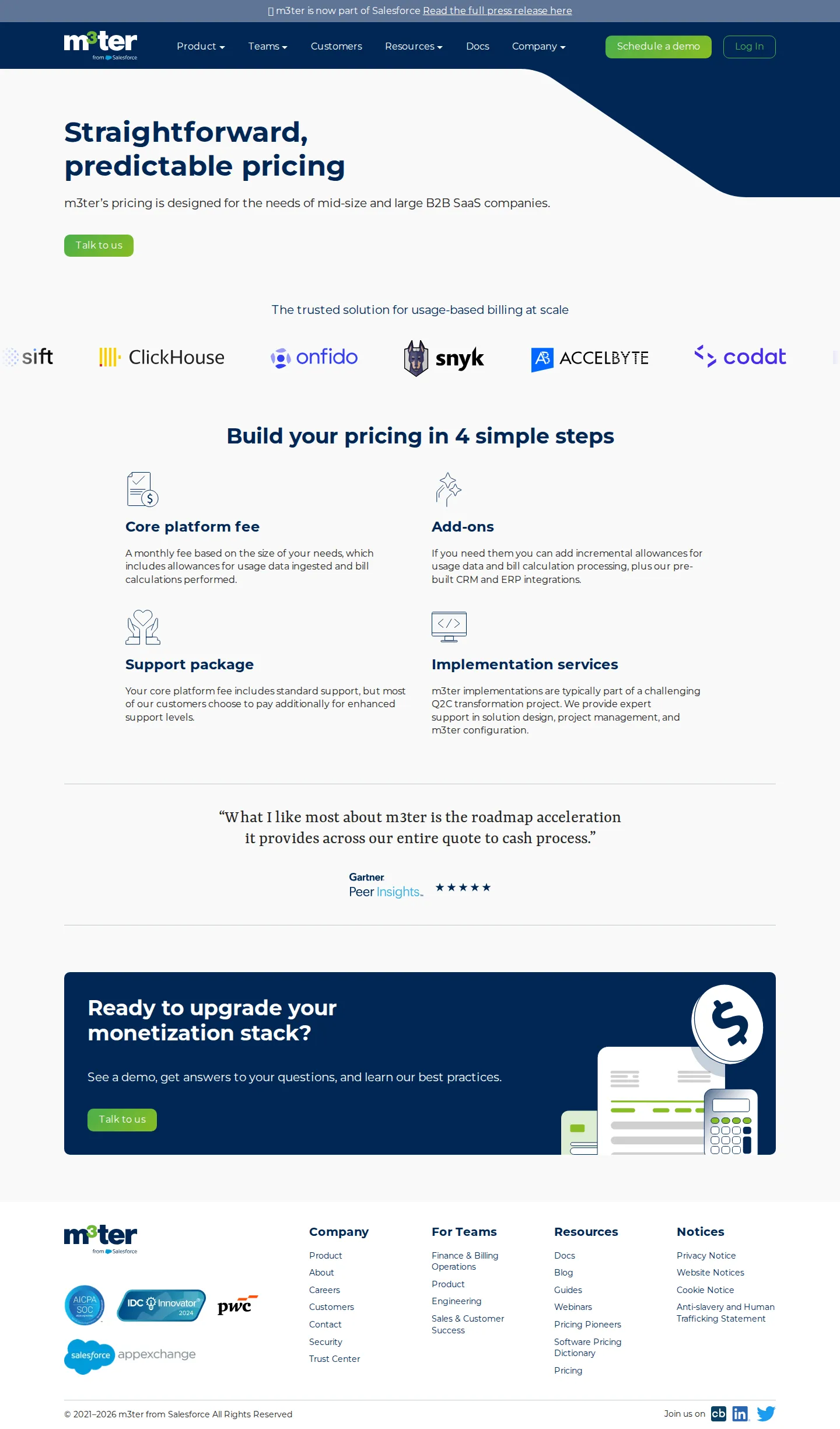
Site rebrands to 'm3ter from Salesforce'; pricing unchanged
The live site now carries a banner reading 'm3ter is now part of Salesforce' (previously 'We've announced a strategic partnership and investment by Salesforce'), the logo lockup reads 'm3ter from Salesforce,' and the footer copyright changed from 'M3ter Holdings Limited' to 'm3ter from Salesforce'. The /pricing page itself is byte-identical in substance: same 'Build your pricing in 4 simple steps' structure (core platform fee, add-ons, support package, implementation services), same 'Talk to us' routing, still zero dollar amounts. Ownership changed; commercial terms did not.
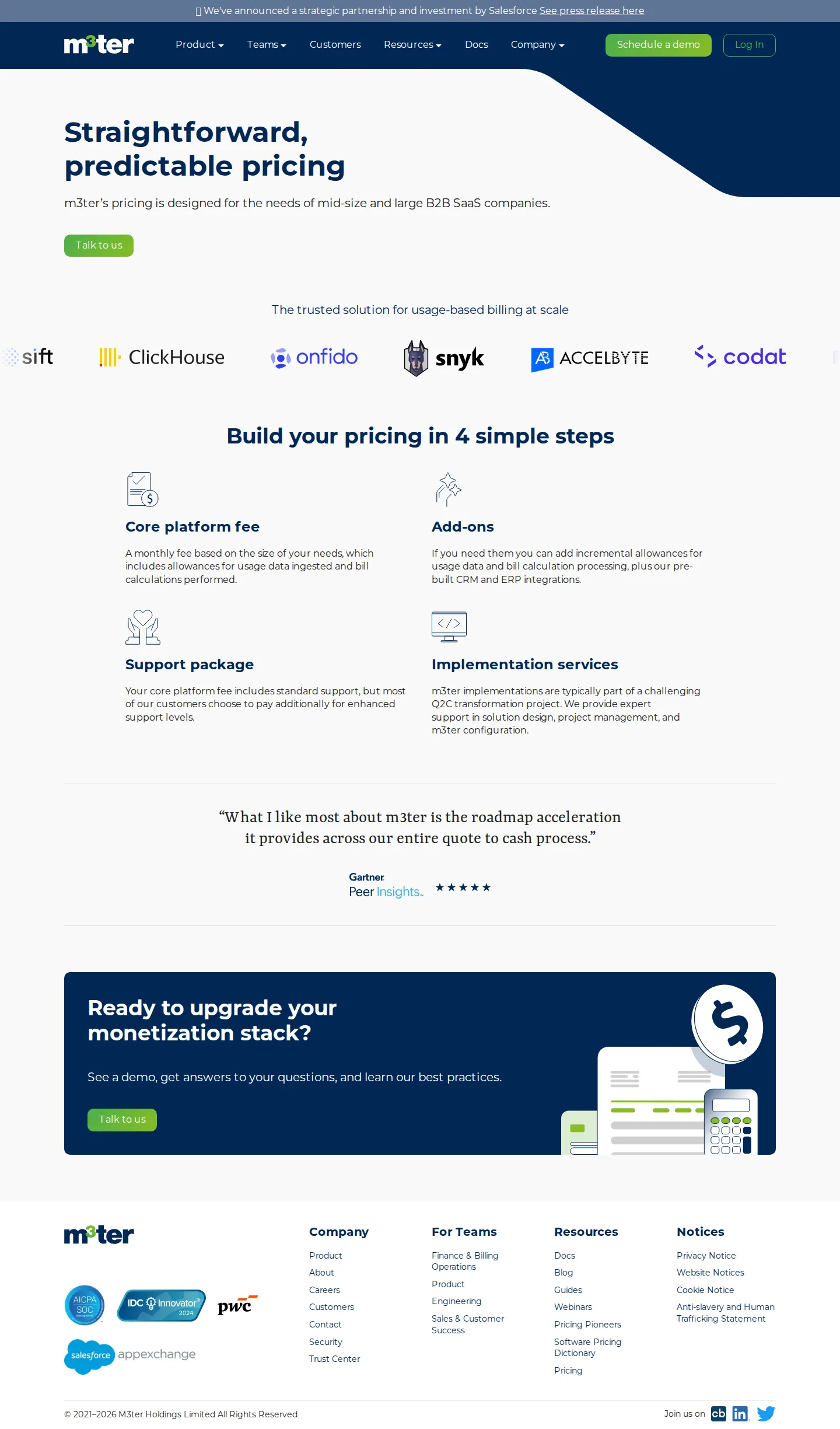
Tagline shift to usage-based billing at scale
Live /pricing page keeps the identical 4-component gated structure and 'Talk to us' routing, with no dollar amounts. The hero tagline updates to 'The trusted solution for usage-based billing at scale,' the Salesforce partnership banner is live, and customer logos include ClickHouse, Onfido, Snyk, Sift, AccelByte and Codat.
Salesforce strategic partnership & investment
m3ter announces a strategic partnership with and investment from Salesforce; Salesforce selects m3ter as an advanced metering and rating partner for Revenue Cloud Advanced (RCA), Revenue Cloud Billing (RCB), Agentforce Sales, and CPQ (BusinessWire / m3ter blog, London, 2026-03-04). Investment amount and round were not disclosed, and the deal is presented at the time as an investment rather than a sale — m3ter is still M3ter Holdings Limited at this date. A site-wide partnership banner goes live; it is replaced by an ownership banner on 2026-07-21.
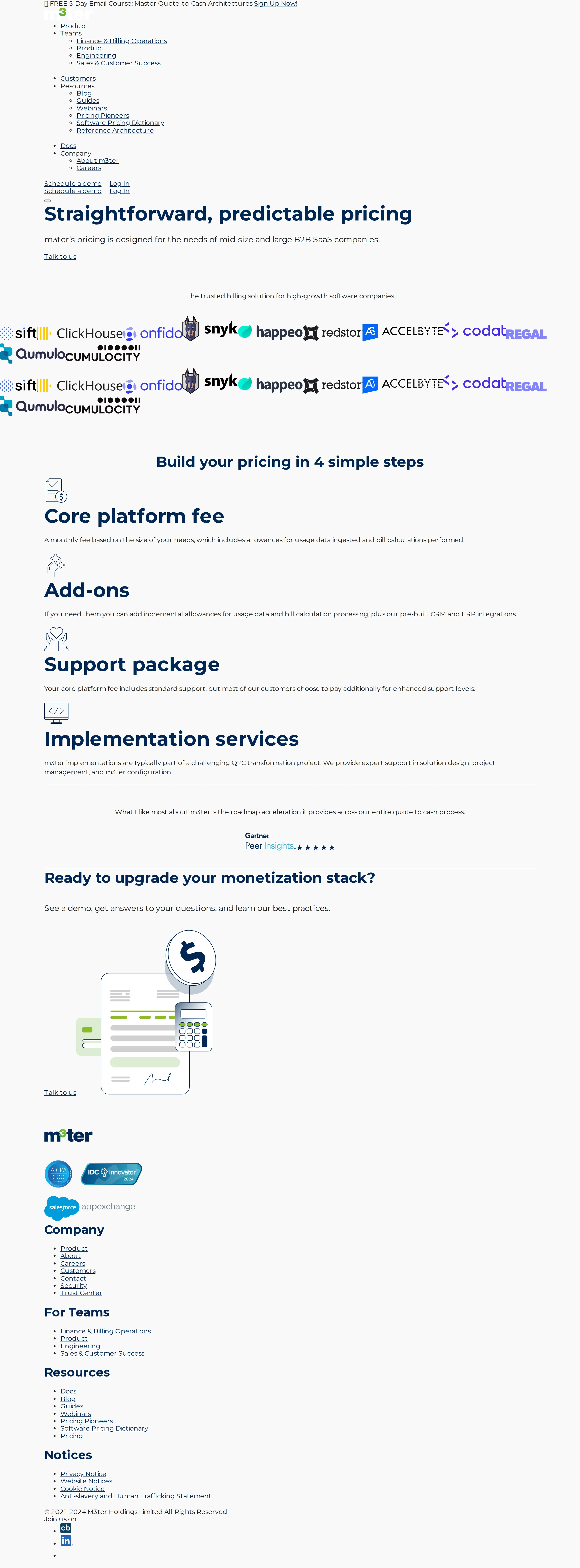
Gated 4-step pricing page (earliest archive)
The earliest archived /pricing snapshot (Wayback 2025-07-09) shows the 'Build your pricing in 4 simple steps' structure — core platform fee, add-ons, support package, implementation services — with zero dollar amounts. Tagline: 'The trusted billing solution for high-growth software companies.' This gated structure persists through every later snapshot.
$14M Series A led by Notion Capital
m3ter raises a $14M Series A led by Notion Capital with Insight Partners, Union Square Ventures and Kindred Capital following, bringing total disclosed funding to $31.5M (TechCrunch, 2023-04-27). The company reported 375% growth since coming out of stealth. The contact CTA shifts to 'Try m3ter' around this period.
Out of stealth with $17.5M seed
m3ter launches publicly with $17.5M in seed funding (Kindred Capital, Union Square Ventures, Insight Partners), per TechCrunch (2022-02-08). The contact surface uses a 'Let's Talk' CTA; product is organized as Metering Engine / Rating Engine / Analytics Engine.
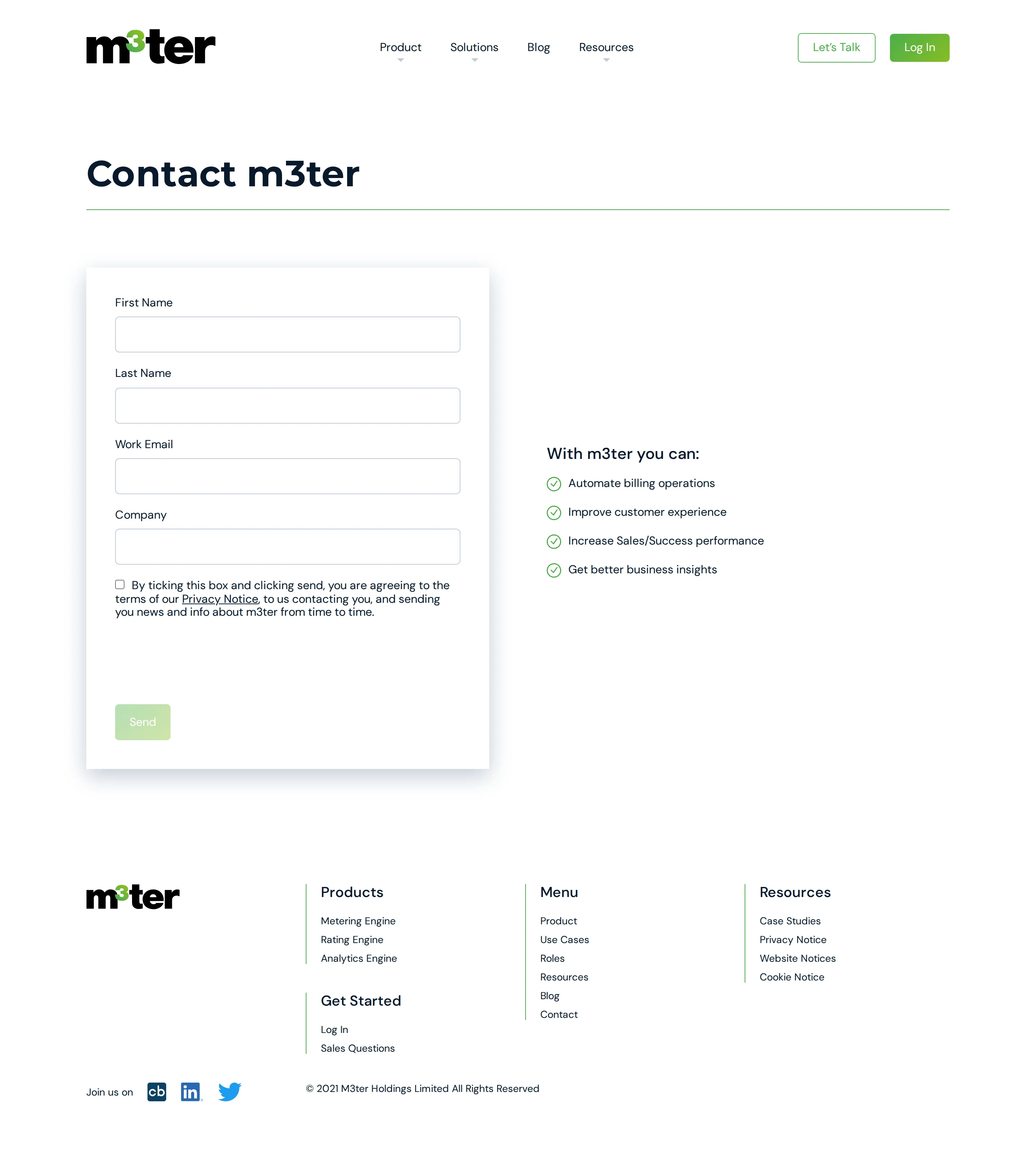
Site restructure; 'Schedule a demo' motion
Navigation is reorganized around outcomes — How m3ter Works / Billing Automation / Fix Revenue Leakage / CRM & ERP Integration — and the CTA settles on 'Schedule a demo'. A Trust Center, FAQ, newsletter, and the Pricing Pioneers / Software Pricing Dictionary content series appear. IDC names m3ter an Innovator (2024).
m3ter founded in London
Griffin Parry and John Griffin found m3ter (M3ter Holdings Limited) to bring usage-based pricing infrastructure to B2B SaaS, drawing on their GameSparks-to-AWS experience. Original product framing: a Metering Engine, a Rating Engine, and an Intelligence Suite (Data Explorer, Executive Dashboards, Pricing Optimizer).
- · m3ter is a billing company that publishes none of its own prices — the pricing page describes a four-step custom quote and routes every path to 'Talk to us,' with no dollar amounts anywhere.
- · m3ter's founders, Griffin Parry and John Griffin, learned usage-based pricing from the inside: their prior startup GameSparks was acquired by Amazon's AWS in 2017, and they spent three-plus years studying AWS's UBP model before starting m3ter in 2020.
- · m3ter prices its own product on the exact two dimensions it meters for customers — usage data ingested and bill calculations performed — bundled as allowances inside a core platform fee.
Questions & answers
- How much does m3ter cost?
- m3ter publishes no dollar amounts. Pricing is a single custom quote assembled from four components — a core platform fee, optional add-ons, a support package, and implementation services — and every path on the pricing page routes to a 'Talk to us' sales conversation.
- Does m3ter offer a free tier?
- No. m3ter has no free tier and no self-serve plan. There is no checkout or plan picker; the only entry point is a 'Schedule a demo' / 'Talk to us' sales form.
- What does m3ter charge its own customers on?
- The core platform fee bundles allowances for usage data ingested and bill calculations performed; if those are exceeded, customers buy incremental add-on allowances. So m3ter prices on metering volume and bill-calculation throughput, not seats. Support and implementation are separate: m3ter's Support Terms say higher support levels are 'subject to additional Fees,' and Professional Services are billed on a time-and-materials rate card or a fixed-price SOW.
- Is m3ter owned by Salesforce?
- Yes. Salesforce first took a strategic investment stake announced March 4, 2026, then acquired the company; the live m3ter site now carries a banner reading 'm3ter is now part of Salesforce,' a 'm3ter from Salesforce' logo lockup, and a footer copyright that changed from 'M3ter Holdings Limited' to 'm3ter from Salesforce'.
- Who founded m3ter and when?
- m3ter was founded in 2020 in London by Griffin Parry and John Griffin, who previously founded GameSparks (acquired by Amazon's AWS in 2017) and spent three-plus years inside AWS learning its usage-based pricing model before starting m3ter.
- How has m3ter's pricing page changed over time?
- m3ter's four-component gated pricing structure has been stable since at least mid-2025, and it survived the Salesforce acquisition word-for-word. The changes have all been presentation: the call-to-action evolved from 'Let's Talk' (2022) to a brief 'Try m3ter' (2023) to 'Schedule a demo' (2024 onward), a Salesforce strategic-partnership banner appeared on March 4, 2026, and by July 21, 2026 that banner read 'm3ter is now part of Salesforce'.