AI Summary
About
Replit is a browser-based coding workspace built around Replit Agent — an AI that builds and deploys full applications from a prompt. You describe what you want, the Agent writes the code, runs it, and ships it to a live URL, all inside the same workspace. That “prompt to deployed app” loop is what Replit now sells, and it reshaped how the company prices.
Founded in 2016 and headquartered in San Francisco, Replit started as an online IDE and REPL for learners and hobbyists. The Agent pivot turned it into one of the most visible “vibe coding” platforms, used by non-engineers and developers alike to spin up business apps, prototypes, and internal tools. The company has raised from investors including a16z and Coatue and reported a sharp jump in revenue through 2025 as Agent usage scaled.
The pricing question Replit has to answer is unusual: an AI agent’s cost is genuinely variable — a one-line fix and a multi-file refactor are not the same compute — so a flat seat price alone can’t cover it. Replit’s answer is a hybrid: you buy a seat, the seat comes with a prepaid dollar wallet of credits, and the Agent (plus your publishing and database usage) draws that wallet down by effort.
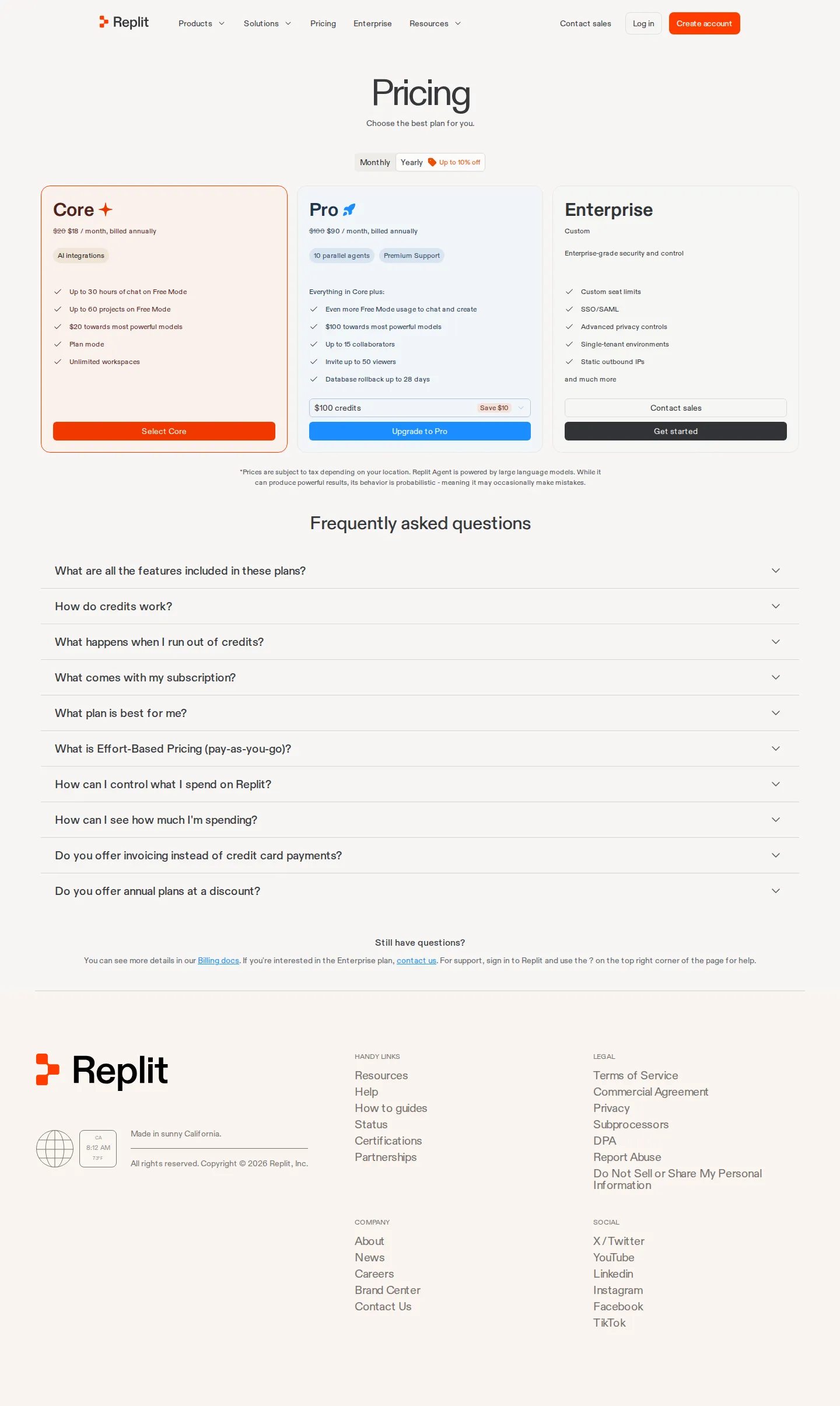
As of the September 2026 check that structure starts at a paid tier. Replit’s pricing page no longer carries the free Starter plan it showed in August; the three cards on offer are Core, Pro and Enterprise. What survives of “free” is Free Mode — an Agent mode launched in August 2026 that doesn’t consume credits — but its allowance is now an entitlement of a paid plan rather than a plan of its own.
For the current rate card, see Replit’s pricing page.
Pricing summary : How Replit’s pricing model works
Replit’s pricing has four layers stacked on top of each other:
- A paid seat tier — Core at $18/mo (billed annually; $20/mo billed monthly), Pro at $90/mo (billed annually on the default credit pack; $100/mo monthly), or custom Enterprise. There is no free plan on the page as of the 2026-09-11 capture. The tier sets your parallel-agent limit, collaborator count, storage and data-transfer allowances, and security controls.
- An included credit wallet — every tier bundles a dollar allotment: $20 towards most powerful models on Core, $100 on Pro. Replit’s own FAQ puts it as “$20 for Core, starting at $100 for Pro,” and says credits “cover all your usage across Replit… building with Agent, publishing (hosting your app or automation on Replit), databases operations, and more.” Credits reset on your monthly renewal date.
- A Free Mode allowance that doesn’t spend credits — Core advertises “up to 30 hours of chat on Free Mode” and “up to 60 projects on Free Mode”; Pro gets “even more Free Mode usage to chat and create.” Replit’s launch post says Core and Pro users stay in Free Mode until they hit limits that reset every 5 hours, then continue in Power or Max modes.
- Effort-Based Pricing beyond the wallet — once credits run out you either buy a credit pack or get charged pay-as-you-go. In Replit’s words: “The Agent will spend more credits as it works longer, which means more complex requests will cost more than simple requests.”
Pro adds a fifth wrinkle: a selector on its card prepays a larger monthly credit pack — 100, 250, 500, 1,000 or 2,500 credits for $90, $215, $425, $825 or $2,000/mo on annual billing — at a discount that widens as the pack grows.
So the headline price is not your real bill. Core’s $18 buys a seat, a $20 credit allotment and a Free Mode allowance; whether you ever pay more depends on how hard you lean on the Agent outside Free Mode and how much always-on compute your published apps consume.
What makes this different: Replit bundles a dollar-denominated credit allowance into a seat price, meters AI work by genuine effort rather than a flat per-task fee, and carves out a credit-free “Free Mode” as a plan benefit. It’s closer to a phone plan with included minutes and off-peak calling than to a classic per-seat SaaS subscription.
Pricing by product
Replit workspace + Agent (subscription plans)
| Tier | Price | Included | Key mechanics |
|---|---|---|---|
| Core | $18/mo billed annually ($20/mo monthly) | $20 towards most powerful models; up to 30 hours of chat and up to 60 projects on Free Mode; Plan mode; AI integrations; unlimited workspaces | Lowest entry point on the rate card — the free Starter plan was removed between the 2026-08-28 and 2026-09-11 captures |
| Pro | $90/mo billed annually ($100/mo monthly), on the default 100-credit pack | $100 towards most powerful models; “even more Free Mode usage”; 10 parallel agents; Premium Support; up to 15 collaborators + 50 viewers; database rollback up to 28 days | Card carries a credit-pack selector that raises both the wallet and the price |
| Enterprise | Custom (“Contact sales”) | Custom seat limits, SSO/SAML, advanced privacy controls, single-tenant environments, static outbound IPs, custom invoicing | Sales-quoted; single-tenant with VPC listed as “Coming soon” |
Across every tier the Agent draws down the included credit wallet first, then bills pay-as-you-go under Effort-Based Pricing. Credits are not Agent-only: Replit’s FAQ says they also cover publishing (hosting your app or automation on Replit) and database operations.
Quantified entitlements (plan-comparison table)
The “What are all the features included in these plans?” panel on the pricing page now shows three columns — Core, Pro, Enterprise — where the August capture showed four:
| Entitlement | Core | Pro | Enterprise |
|---|---|---|---|
| Development outbound data transfer | 100 GiB | 1,000 GiB | Custom |
| Deployments outbound data transfer | 100 GiB | 100 GiB | Custom |
| Storage per app | 50 GiB | 256 GiB | Custom |
| Collaborators | 5 | All team members | All team members |
| Apps / development time | Unlimited | Unlimited | Unlimited |
| Role-based access control | — | Included | Included |
| SSO | — | — | Included |
| Custom invoicing | — | — | Included |
(Pro’s card advertises “Up to 15 collaborators” while the comparison table reads “All team members” — Replit’s own page states both.)
Pro credit-pack ladder
Pro’s card carries a selector (default: “$100 credits”) that prepays a bigger monthly allotment at a discount that widens as the pack grows. Figures below are the annual-billing rates shown when the selector is expanded:
| Credit pack | Monthly price (annual billing) | Discount shown |
|---|---|---|
| 100 credits | $90/mo | Save $10 |
| 250 credits | $215/mo | Save $35 |
| 500 credits | $425/mo | Save $75 |
| 1,000 credits | $825/mo | Save $175 |
| 2,500 credits | $2,000/mo | Save $500 |
Separately, the FAQ notes that when you exhaust your credits you can “either purchase a credit pack or you’ll be charged for additional usage at pay-as-you-go rates.”
Sales motions across products: Core and Pro are fully self-serve / PLG (pick a plan, pay by card, monthly or annual). Enterprise is sales-led — custom seat limits, SSO/SAML, single-tenant environments and custom invoicing are quoted by Replit’s sales team.
Hidden costs : What Replit users actually pay
The seat price is the floor, not the bill. Three things push real spend above it, and none are visible on the plan card:
- Agent effort beyond credits. Each request is one checkpoint, priced on time and compute. Simple changes typically cost less than $0.25; a full feature build runs about $1 to $3 in Agent effort (second-source: Replit billing docs and 2026 pricing analyses). A heavy day of building blows through Core’s $20 wallet fast.
- Always-on deployments. Static deploys are cheap, but an always-on reserved VM typically runs $5 to $20+/month per app, and autoscale deployments bill by use. These are charged against credits / pay-as-you-go on top of your seat.
- Database and storage. Replit’s managed PostgreSQL runs about $1.50 per GB-month plus $0.16 per compute-hour; app storage is roughly $0.03 per GB-month and outbound data transfer about $0.10 per GB.
Put together, heavy Agent users routinely report $100 to $300 per month on top of their base plan.
| Line item | Monthly cost |
|---|---|
| Core seat (month-to-month billing) | $20 |
| Agent/Assistant effort beyond the included $20 wallet | $40–$120 |
| One always-on reserved-VM deployment | $5–$20 |
| Database + storage + transfer | $5–$15 |
| Estimated total (active solo builder) | ~$70–$175/mo |
Want to estimate your own Replit bill? Use the Replit AI pricing calculator to model seat cost plus Agent effort and deployment compute.
For the mechanics behind this, see our guide on usage-based pricing fundamentals and our analysis of bill shock and cost unpredictability.
Pricing evolution : Replit pricing history and changes
Cadence
| Quarter | Price changes | Product / SKU additions | Notes |
|---|---|---|---|
| 2025 Q2 | 1 | 0 | Flat $0.25/checkpoint replaced by effort-based Agent pricing |
| 2026 Q1 | 1 | 1 | Core $25 → $20 (annual); Pro launched; Teams sunset |
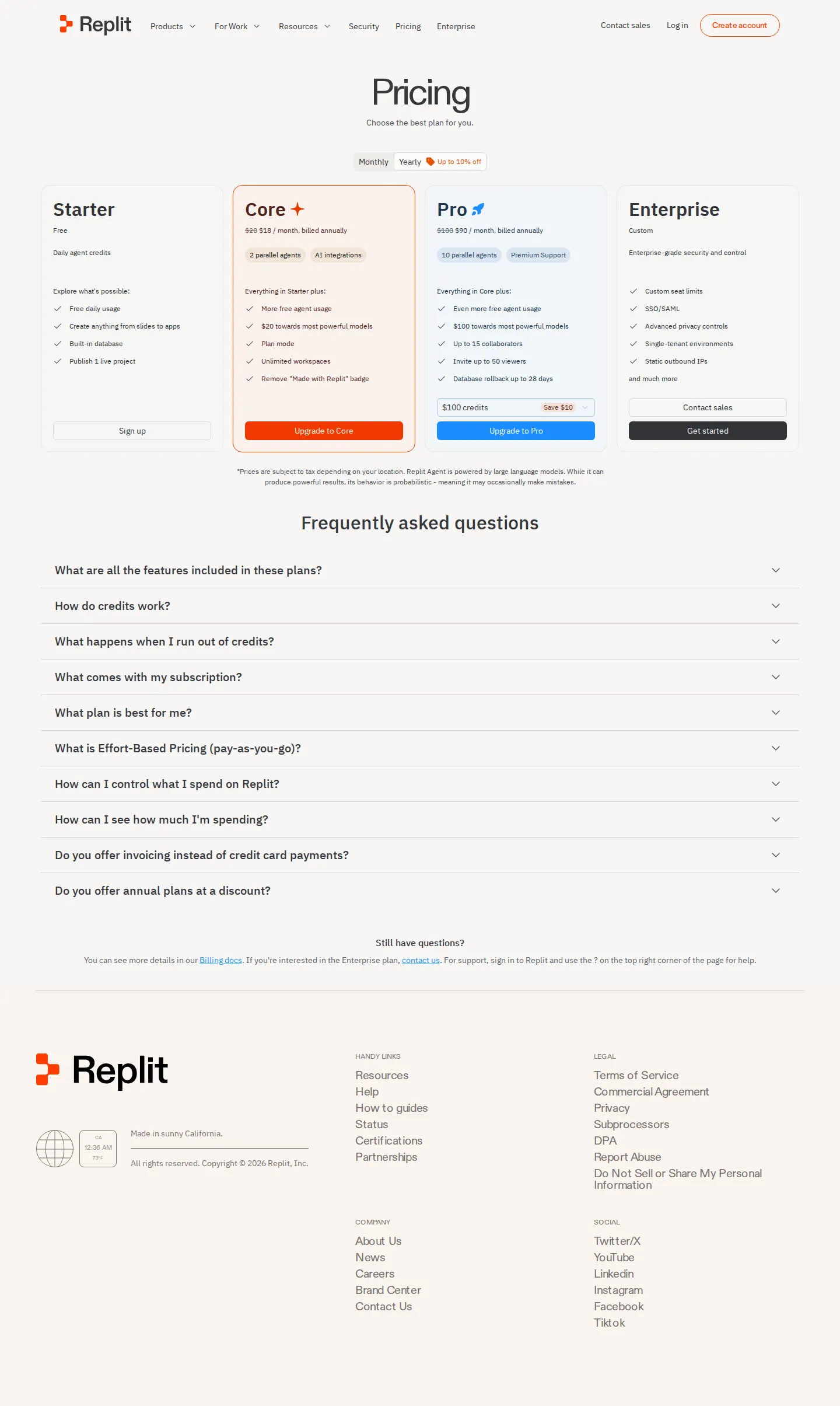
| 2026 Q2–Q3 | 1 | 0 | Core’s annual rate cut again, $20 → $18 (monthly held at $20); Pro’s annual rate cut $95 → $90 (monthly held at $100); annual-billing banner narrowed from “up to 20% off” to a flat “up to 10% off” — observed between the 2026-06-16 and 2026-08-28 captures |
| 2026 Q3 | 0 | −1 | Free Starter plan removed from the pricing page by the 2026-09-11 capture; credit-free “Free Mode” (launched 2026-08-18) re-sold as a paid-plan allowance; no price moved |
Tracked range: 2025–present. History reconstructed from Replit’s effort-based-pricing and Pro-plan announcements plus direct pricing-page comparisons across capture dates. Quarters not listed above were verified stable (0 price changes, 0 SKU additions).
Notable changes
- 2025-06-18 — Replit announced effort-based pricing for Replit Agent (rollout from July 1). The previous flat $0.25-per-checkpoint rate was replaced by per-request pricing that scales with the time and compute each task consumes, alongside new High Power model and Extended Thinking controls.
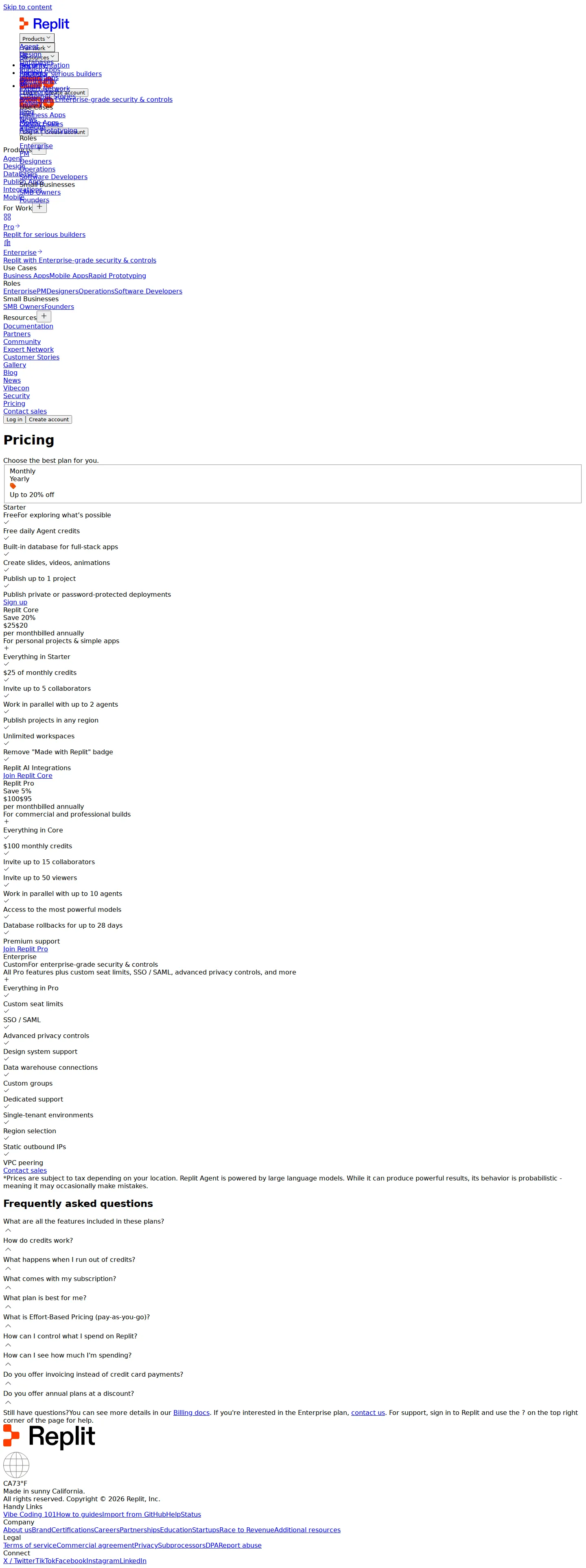
- 2026-02-24 — Replit launched the Pro plan as its serious-builder tier, dropped Core from $25 to $20/mo (annual), and began sunsetting the Teams plan, auto-upgrading Teams subscribers to Pro starting March 3, 2026.
- Observed between 2026-06-16 and 2026-08-28 — Replit cut Core’s annual rate from $20 to $18/mo and Pro’s annual rate from $95 to $90/mo, while both monthly rates held ($20 Core, $100 Pro) and the annual-billing banner narrowed from “up to 20% off” to a flat “up to 10% off” applied evenly across tiers. No dated blog or changelog post was found confirming a formal announcement; the change is reconstructed from pricing-page captures. (An earlier version of this page reported $17 Core, $95 Pro and “up to 15% off” from a same-day “independent re-check,” and explained the mismatch with the screenshot as session-based price variation. On 2026-09-11 a fresh capture and an independent server-side fetch both returned $18, $90 and 10% — so the re-check figures are treated as wrong and the session-variation hypothesis is withdrawn.)
- 2026-09-11 — The free Starter plan disappeared from replit.com/pricing. The 2026-08-28 capture still showed a Starter card (free daily Agent credits, built-in database, one published project); the 2026-09-11 capture shows only Core, Pro and Enterprise, and the plan-comparison panel drops from four columns to three. In its place, Free Mode — the credit-free Agent mode Replit launched on 2026-08-18 — is sold as a paid-plan allowance: “up to 30 hours of chat” and “up to 60 projects” on Core, “even more Free Mode usage” on Pro. Core’s card also quietly lost its “2 parallel agents” line and the “Remove ‘Made with Replit’ badge” perk. No price moved.
The direction has two halves. First, a price cut on the mainstream tier (Core) paired with a higher tier (Pro) and an effort-based meter that captures the variable AI cost — see how AI companies are shifting away from per-user licenses for the broader pattern. Then, in September, a paywall at the mouth of that same funnel: the seat Replit made cheaper twice is now the cheapest thing on the page, because nothing free sits above it.
The free-tier removal in detail
2026-09-11 is not a price change. It is a change in who the rate card asks to pay, and it reads differently depending on which side of the old Starter line you sat on.
- For a would-be evaluator, the advertised entry cost went from $0 to $18/mo (annual, or $20 month-to-month). Starter’s offer — free daily Agent credits, a built-in database and one published project — was the signposted way to watch Replit Agent build something without a card on file. That signpost is gone from the rate card; the cheapest advertised way in is Core. (Replit’s billing docs still describe a free Starter tier, so the plan may survive in-product — but nothing on the pricing page points a buyer to it.)
- For an existing Core subscriber, the bill does not move — but the card gives less. The “2 parallel agents” entitlement and the “Remove ‘Made with Replit’ badge” perk both vanished from Core’s card between captures at an unchanged $18/$20. That is a quiet reduction in value at constant price, the kind of change that never shows up in a price-tracking diff.
- Free Mode is a real substitute, aimed at the wrong problem. It genuinely does not draw down the credit wallet, so Core’s “up to 30 hours of chat” and “up to 60 projects” cushion the effort meter for people who already pay. What it cannot do is acquire anyone: a benefit you unlock after checkout is a retention and margin instrument, not a funnel one. On the rate card, Replit’s free allowance has moved from customer acquisition to included value.
- Billing complexity actually falls. Starter ran on a separate “free daily agent credits” allowance that sat awkwardly beside the dollar-denominated wallet Core and Pro use. Removing it leaves the rate card with one credit regime plus one named, credit-free mode whose published ceilings reset every 5 hours — three comparison columns instead of four, and one fewer allowance mechanic a prospect has to reason about.
- What to watch: whether the entry seat stays cheap. Cutting Core twice in six months made sense while free traffic filled the top of the funnel. With no free tier advertised below it, $18 is now doing acquisition work by itself — and Replit would have room to walk the cuts back if conversion holds, though nothing in the captures says it intends to.
What’s unique : Replit’s distinctive pricing mechanics
1. Dollar-denominated credit wallets inside a seat price. Most SaaS bundles a usage quota (X requests, Y seats). Replit bundles a literal dollar allowance — $20 on Core, $100 on Pro — that the Agent and deployments spend down. The seat price is part subscription, part prepaid wallet.
2. Effort-based Agent metering. Replit abandoned a flat per-checkpoint fee because an AI agent’s real cost is variable. Now each request is one checkpoint priced on the time and compute it consumed, so a trivial edit is cheap and a complex multi-file task costs more — with user-facing High Power and Extended Thinking dials to control it.
3. Repeated entry-price cuts, then a paywall at the door. Replit dropped Core from $25 to $20/mo (annual) when it added Pro in February 2026, then cut it again to $18/mo by the August 2026 capture — with Pro’s annual rate falling $95 to $90 and the annual banner narrowing to a flat 10% off. Two cuts in six months mark the seat as a deliberate funnel lever, priced on the assumption that the effort meter, not the seat, carries heavy-usage revenue. What makes the pattern unusual is the September follow-up: on 2026-09-11 the free Starter plan came off the page entirely, so the cheap seat is now the only advertised door. The implied bet is that a low paid floor converts better than a free tier sitting above it — Replit has not said so, and there is no published data either way yet.
4. A prepaid credit-pack ladder that rewards commitment. Pro’s card hides a selector letting subscribers prepay for a bigger monthly credit allotment — up to $2,500 of credits for $2,000/mo — at a discount that climbs from 10% at the base $100 pack to 20% at the top. It’s a volume-discount mechanic layered on top of the seat-plus-wallet structure, nudging serious builders toward locking in more spend upfront.
5. “Free” is a mode, not a plan. Since the Starter card was removed, the only free thing on Replit’s rate card is Free Mode — a credit-free Agent mode whose allowance (up to 30 hours of chat and 60 projects on Core, more on Pro) unlocks after you subscribe, with limits that reset every 5 hours and weekly caps on top. The word “free” is doing an unusual job here: it sits behind checkout as a buffer against Replit’s own usage meter rather than in front of it as a way in.
Strengths & weaknesses
| Strengths | Weaknesses |
|---|---|
| Free Mode gives paid users a credit-free lane, so routine chat and small projects don’t burn the wallet | No free plan on the rate card since 2026-09-11 — the cheapest advertised way to try the Agent is $18/mo (annual) or $20 month-to-month |
| Included credit wallet means light users rarely pay more than the seat | Heavy Agent use can add $100–$300/mo, surprising new builders |
| Effort pricing aligns AI cost with actual work, not a blunt flat fee | Credits are dollar-denominated, so “how many tasks is $20” is opaque |
| Frontier models (Claude, GPT, Gemini) included, not paid add-ons | Core credits don’t roll over; an idle month wastes the wallet |
| Transparent, public rate card with self-serve checkout | Deployment + database compute stack on top, easy to overlook |
Billing UX : Replit billing controls and transparency
- Budget limits (hard cap) — Replit’s FAQ names two distinct controls: “Usage alerts are a simple way to get a heads-up when you hit a certain spending amount beyond your monthly credits. Budgets are a hard cap on your monthly spending. Once your budget is met or exceeded, we will send you an email notification and temporarily suspend all of your usage-based services.” That is a genuine enforced ceiling, not just a notification.
- Usage page — “You can monitor your credit usage in your Usage page,” with monthly credits resetting on the monthly renewal date.
- Monthly/Yearly toggle — a top-of-page switch flips every card between monthly billing (Core $20, Pro $100) and annual billing (Core $18, Pro $90), badged “Up to 10% off.”
- Pro credit-pack selector — a dropdown on the Pro card, defaulting to “$100 credits,” lets you prepay a larger monthly pack (up to 2,500 credits at $2,000/mo) before clicking “Upgrade to Pro”; each step shows its own “Save $X” badge.
- Free Mode as a spend control — because Free Mode usage does not draw down credits, the Core/Pro Free Mode allowances (up to 30 hours of chat and 60 projects on Core) function as a built-in throttle before effort billing starts. Replit’s launch post describes Free Mode limits resetting every 5 hours, after which you continue in Power or Max modes; Replit’s billing docs add that the Core and Pro allowances “reset every five hours and have weekly limits.”
- Credit packs as an alternative to overage — when credits run out you can buy a pack instead of letting pay-as-you-go rates run.
- Payment options — Self-serve plans are card-billed monthly or annually; “Do you offer annual plans at a discount?” answers “Yes, you can select our annual plans when you checkout.” Enterprise carries custom invoicing. The page footnotes that “prices are subject to tax depending on your location.”
- Price-variation note resolved (2026-09-11) — an earlier entry on this page reported a same-day “independent re-check” of replit.com/pricing returning lower Core and higher Pro annual rates with an “up to 15% off” banner, at odds with the 2026-08-28 screenshot. On 2026-09-11 both a fresh capture and an independent server-side fetch agreed exactly: Core $18 and Pro $90 billed annually, $20 and $100 billed monthly, “Up to 10% off.” The captured figures are therefore treated as correct and the session-variation hypothesis is withdrawn.
- The docs still quote an older Core annual rate — Replit’s own billing docs state “Core is $204/year” (last modified 2026-08-30), which works out to $17/mo, while the rate card advertises “$20 $18 / month, billed annually” — $216 for the year. The same docs page still describes a free Starter plan that the pricing page no longer lists, and prices one-off credit top-ups ($100 for $100, $300 for $290, $500 for $480, $1,000 for $950) on a different ladder from the Pro card’s monthly pack selector. Buy from the rate card, not the docs: where the two disagree, the docs are the stale surface.
For how to design controls like these, see our guide on usage invoicing and billing cycles.
Strategic wins : Why Replit’s pricing decisions worked
1. Bundling a credit wallet to absorb variable AI cost
By putting a $20 (Core) / $100 (Pro) dollar wallet inside the seat, Replit made the seat price feel complete for light users while still metering the genuinely variable Agent cost underneath. Most casual builders never exceed the wallet, so the headline price holds — but power users self-fund their own compute. See choosing the right usage metric for why a dollar wallet beats a raw task quota here.
2. Switching from flat checkpoints to effort
The old $0.25-per-checkpoint model under-charged complex tasks and over-charged trivial ones as the Agent got more capable. Effort-based pricing realigned revenue with cost and gave users dials to manage it — a textbook example of how AI companies structure pricing around real compute. Related: outcome-based pricing trends.
3. Cutting Core twice, then taking the free plan off the card
Lowering Core from $25 to $20/mo (annual) in February 2026 widened the top of the funnel exactly as the “vibe coding” market exploded, while Pro captured the serious builders Teams used to serve. By the 2026-08-28 capture Core’s annual rate had fallen again to $18 and Pro’s to $90 — not a one-time correction but a repeatable lever, because the effort meter rather than the seat carries the heavy-usage revenue.
What the captures show next is a sequence, and the order is the interesting part: the entry seat came down twice before the free Starter plan came off the rate card on 2026-09-11, not after. Replit has published no rationale for either step, so the link between them is our reading rather than a stated strategy — but a $18 floor is a far easier thing to send unconverted traffic to than a $25 one was, and Free Mode now sits behind checkout doing some of the reassurance work the free plan used to do in front of it. Whether that reads as a win depends on a number we can’t see: trial-to-paid volume after the change.
Areas to improve : Gaps in Replit’s pricing approach
1. Spend predictability
Effort-based billing is honest but opaque: “how many features is $20 of credits?” has no fixed answer, and community threads regularly cite surprise bills. Clearer per-action estimates before a checkpoint runs would reduce bill shock.
2. Credit mechanics clarity
Credits are dollar-denominated and Core’s don’t roll over, while Pro’s unused credits carry over for two months — a subtle distinction that’s easy to miss at signup, and one the rate card never states (Replit’s billing docs carry it; the pricing-page FAQ only says credits “reset each month”). Surfacing rollover and burn-rate prominently would help buyers compare tiers honestly.
3. Stacked compute costs
Deployment, database, and storage compute all bill on top of the seat and credits. Bundling a baseline deployment allowance into Core, or showing a live “projected monthly total,” would make the true cost of shipping an app less of a surprise.
4. Nothing to try before you buy
Since 2026-09-11 the rate card offers no free plan, the credit-free Free Mode that replaced it only unlocks after checkout, and Replit’s own billing docs confirm there is no time-limited free trial either — so the first thing a curious buyer meets is a $20 charge (or $216 for the year on annual billing). For a product whose entire pitch is “watch the Agent build your idea,” removing the signposted place where people watch it is a real acquisition cost, and the plan cards no longer answer “what will this actually do for me?” before payment. A time-boxed Free Mode trial, or a capped free allowance limited to a single published project, would restore the evaluation path without reopening Starter’s separate daily-credit mechanic.
Monetization stack & signals : how Replit AI builds & buys its revenue engine
Buys 6 Builds 0 4 signal roles
Buys the money rails — Orb meters the usage, Stripe takes the payment — then builds its own order-to-cash control plane on top, while GTM migrates from HubSpot to Salesforce. The tell is the Money Partnerships req below.
-
“Tools + Tech Stack for this role: Zendesk, Stripe, Slack, Orb”
-
“They sought a solution that could seamlessly integrate and instill confidence in their ability to launch on time, and that is why they chose Orb.”
-
“Tools + Tech Stack for this role: Zendesk, Stripe, Slack, Orb”
-
“Own the Salesforce platform strategy and architecture, ensuring it scales to support complex enterprise sales motions, consumption-based pricing models, and multi-geo operations”
-
“Tools + Tech Stack for this role: Replit, HubSpot CRM, SSO/SAML/SCIM identity systems, Cloud platforms (AWS, GCP, Azure), Slack ...”
-
“Build reliable datasets and dbt models that connect product events, account and identity signals, payment activity, infrastructure usage, content classifications, enforcement actions, appeals, and support outcomes.”
- Staff Software Engineer, Money Partnerships Billing engineering seen May 5, 2026
A dedicated "Money Partnerships" engineer is being hired to integrate agent-to-agent payment protocols (Agentic Commerce Protocol, Universal Commerce Protocol, Machine Payments Protocol, Shared Payment Tokens) — Replit is engineering for its Agents and the apps its users ship to become payers and payees in their own right, not just billable objects.
“Build and maintain Replit's integrations with agentic-commerce protocols (ACP, UCP, MPP) and Shared Payment Tokens, so Replit Agents and the apps Replit users ship can transact across AI surfaces.”
- RevOps Architect RevOpsDeal desk seen Mar 7, 2026
A RevOps Architect req names a Deal Desk function and puts CRM, CPQ, billing, order management and rev-rec under one owner, scaled explicitly for "consumption-based pricing models" — the quote-to-cash layer a sales-led enterprise motion needs on top of Replit's self-serve credit core.
“Define and execute the long-term vision and roadmap for Replit's GTM systems, with direct ownership of CRM and CPQ platforms”
- Principal Software Engineer, Money Infrastructure Billing engineeringMonetization seen Jan 12, 2026
A Principal-level req owns the order-to-cash layer end-to-end — credits, usage-based billing, marketplace payouts and in-app payments — as one internal foundation, but the same JD has it "collaborate with external monetization and payments partners (e.g. billing platforms, payment processors)": Replit builds the control plane, not the rails.
“Own and scale the global order-to-cash foundation supporting credit-based subscriptions, usage-based billing, marketplaces, in-app payments, and commerce for Agents.”
- Staff Software Engineer, Money Billing engineeringMonetization seen Jan 12, 2026
A Principal-level req owns the order-to-cash layer end-to-end — credits, usage-based billing, marketplace payouts and in-app payments — as one internal foundation, but the same JD has it "collaborate with external monetization and payments partners (e.g. billing platforms, payment processors)": Replit builds the control plane, not the rails.
“Own and scale the global order-to-cash foundation supporting credit-based subscriptions, usage-based billing, marketplaces, in-app payments, and commerce for Agents.”
19 more matched roles — supporting evidence
- Enterprise Account Manager Customer success Aug 31, 2026
- Mid-Market Account Manager Customer success Aug 31, 2026
- Enterprise Account Manager (London) Customer success Aug 31, 2026
- Support Systems Lead Customer success Aug 28, 2026
- Premium Support Engineer Customer success Aug 28, 2026
- Social Media Support Specialist Customer success Aug 28, 2026
- Software Engineer, Growth Growth Aug 20, 2026
- Software Engineer, Growth Infrastructure Growth Aug 20, 2026
- Product Lead, Growth Marketing Growth Aug 20, 2026
- Japan Growth Lead Growth Aug 20, 2026
- AEO/GEO/SEO Lead Growth Aug 20, 2026
- Dispute and Chargebacks, Program Manager Billing engineering Aug 17, 2026
- GTM AI Operations Lead, Sales RevOps seen Mar 7, 2026
- GTM AI Operations Lead, Demand Generation RevOps seen Mar 7, 2026
- +5 more matched roles
Signals reviewed · derived from public job posts, press & filings
Job postings fill and close over time — once a posting is filled we keep it as a dated citation (the quoted evidence remains); use View open roles for current listings.
Key takeaways
- Replit’s real price is seat + effort + compute. Core is $18/mo billed annually ($20 month-to-month) with a $20 credit wallet, but Agent effort and deployments determine the actual bill.
- Credits are a dollar wallet, not a quota. Core bundles $20, Pro bundles $100 (with an upgrade path to $2,500/mo) — spent on Agent work and compute, with Pro’s unused credits rolling over for two months.
- Effort-based metering replaced flat checkpoints. Since June 2025, each request costs what it actually consumes, with High Power and Extended Thinking dials.
- Core got cheaper twice in 2026 — then the free plan disappeared. A $25 → $20 (annual) cut paired with the new Pro tier and the Teams sunset in February; by the 2026-08-28 capture Core’s annual rate was $18 and Pro’s $90, with the annual banner flattened to “up to 10% off.” On 2026-09-11 the free Starter plan came off the pricing page, leaving that cheap paid seat as the only advertised entry point.
- Predictability is the trade-off. Honest effort pricing means variable bills; heavy users report $100–$300/mo on top of base.
UBP implications
- Bundle a dollar wallet to make usage pricing feel like a subscription. Replit’s included credits let light users see a flat price while still metering variable AI cost — a clean pattern for any usage-based pricing launch worried about sticker shock.
- Meter by effort when cost is genuinely variable. A flat per-task fee mis-prices an AI agent; effort-based checkpoints align revenue with compute. Pick a usage metric that tracks your real cost driver.
- A cheap enough paid floor can replace a free tier — if a meter carries the heavy use. Replit lowered Core twice in 2026 ($25 to $20, then to $18 on annual billing) because effort billing rather than the seat captures power-user revenue, and then on 2026-09-11 took the free Starter plan off that rate card and re-sold credit-free “Free Mode” as a paid-plan allowance. The sequencing is the lesson: cut the entry seat first, retire the free plan second, and your free allowance stops being an acquisition cost and becomes a buffer against your own usage meter. It is a bet, not a proven play — Replit has published no conversion data, and the removal landed somewhere in the two weeks between the 2026-08-28 and 2026-09-11 captures. Discount policy moved independently throughout, with the annual banner going from “up to 20% off” to a flat “up to 10% off” across both tiers, so seat price, usage meter and discount structure are three separate levers.
Sources
- Replit pricing page (accessed 2026-09-11) — captured via screenshot and independently re-fetched the same day; both sources agree on $18/mo Core and $90/mo Pro billed annually.
- Replit billing docs — Pricing and plans (accessed 2026-09-11) — independent second source on a different host; confirms Pro at $100/month, $20 monthly credits on Core, $100 on Pro, two-month Pro credit rollover and the five-hourly Free Mode reset, but still quotes a stale “$204/year” Core annual rate and a free Starter plan.
- Replit billing docs — Replit Core plan (accessed 2026-09-11) — plan entitlements; defers all pricing to the rate card.
- Replit blog — Introducing Effort-Based Pricing for Replit Agent (accessed 2026-06-16)
- Replit blog — Replit Pro Is Here, and Core Now Offers Even Better Value (accessed 2026-06-16)
- Wayback Machine archive of Replit pricing page, 2026-08-27 (accessed 2026-08-28) — archived snapshot of the pricing page from the day before the 2026-08-28 capture. The $17/mo Core and $95/mo Pro reading once attributed to this snapshot did not reproduce on 2026-09-11 and is no longer relied on.
Browse more fully-researched profiles in the pricing blueprint.
Bottom line
Replit’s $18 Core seat is a doorway, not a ceiling — and since 2026-09-11 it is the only advertised doorway, because the free Starter plan is gone from the rate card. The real model is a seat bundled with a dollar credit wallet, an effort-metered Agent that bills by the compute each request consumes, and pay-as-you-go deployment costs on top — which is why light builders pay the sticker price and heavy ones pay multiples of it.
Want to compare Replit against other AI coding tools? Browse the pricing blueprint.
Pricing timeline : Major events on a vertical axis
Each milestone below corresponds to a public pricing change, product launch, or material adjustment. Major events use a filled marker; minor adjustments use a faded one.
Free Starter plan removed from the pricing page; Free Mode becomes a paid-plan allowance
Replit's pricing page dropped the free Starter card entirely. The 2026-08-28 capture still showed Starter (free daily Agent credits, 1 published project); the 2026-09-11 capture shows only Core, Pro, and Enterprise, and the plan-comparison table has three columns instead of four. In its place, 'Free Mode' — launched 2026-08-18 — is now sold as a paid-plan entitlement: Core advertises up to 30 hours of chat and up to 60 projects on Free Mode, Pro gets 'even more Free Mode usage'. Core also lost its '2 parallel agents' line and the 'Remove Made with Replit badge' perk from the card. Prices were unchanged: Core $20 monthly / $18 annual, Pro $100 monthly / $90 annual, 'Up to 10% off' annually.
Core cut to $20/$18 and its credit wallet trimmed to $20; Pro annual to $90
Between the June and August 2026 captures Replit cut Core from $25 to $20/mo monthly and from $20 to $18/mo annual, while the included wallet shrank from $25 to $20 of monthly credits. Pro's annual rate moved from $95 to $90/mo (monthly held at $100), and the annual-billing banner fell from 'Up to 20% off' to 'Up to 10% off'. Pro's prepaid credit-pack ladder — five steps up to 2,500 credits for $2,000/mo — stayed in place. (An 'independent re-check' logged at the time claimed $17 Core / $95 Pro / 15% off; neither the 2026-08-28 capture nor two independent 2026-09-11 sources reproduce those figures, so this entry now follows the captures.)
Pro plan launches; Core drops to $20, Teams sunset
Replit launched the Pro plan ($95/mo annual, $100 monthly credits) as its serious-builder tier, dropped Core from $25 to $20/mo (annual), and began sunsetting the Teams plan, auto-upgrading Teams users to Pro.
Effort-based pricing replaces flat $0.25 checkpoints
Replit announced effort-based pricing for Replit Agent on June 18, 2025 (rolled out July 1). The old flat $0.25-per-checkpoint rate was replaced by per-request pricing that reflects the time and compute each task consumes, plus High Power and Extended Thinking controls.
- · Replit replaced its flat $0.25-per-checkpoint Agent fee with effort-based pricing in June 2025 — a request that does more work simply costs more, like a metered taxi instead of a flat fare.
- · Every paid tier bundles a dollar-denominated credit allotment, not a usage quota: Core includes $20 of credits, Pro includes $100. The number on the plan is partly a prepaid wallet.
- · Replit Core got cheaper twice in 2026 — $25 to $20 a month, and $20 to $18 a month on annual billing — even as the free Starter plan disappeared from the pricing page entirely.
Questions & answers
- How much does Replit Core cost?
- Replit Core is $18/month billed annually, or $20/month billed monthly, per the pricing page captured 2026-09-11. It includes AI integrations, Plan mode, unlimited workspaces, $20 toward Replit's most powerful models, and Free Mode usage of up to 30 hours of chat and up to 60 projects per month.
- How does Replit Agent billing work?
- Replit uses Effort-Based Pricing. In Replit's words, 'the Agent will spend more credits as it works longer, which means more complex requests will cost more than simple requests.' Usage draws down your included monthly credits first; after that you either buy a credit pack or get charged pay-as-you-go rates, up to any budget limit you set.
- Does Replit have a free tier?
- Not on the rate card any more. As of the 2026-09-11 capture, replit.com/pricing lists only Core, Pro, and Enterprise — the free Starter plan that appeared as recently as the 2026-08-28 capture is gone. What remains is 'Free Mode,' an allowance that comes with a paid plan: Core advertises up to 30 hours of chat and up to 60 projects on Free Mode, and Replit's Free Mode announcement says Core and Pro users can stay in Free Mode until they hit limits that reset every 5 hours. Replit's billing docs still describe a free Starter plan, but it is no longer advertised or selectable on the pricing page.
- What is the difference between Replit Core and Pro?
- Core ($18/mo annual, $20 monthly) includes $20 toward the most powerful models, Plan mode, AI integrations, unlimited workspaces, 5 collaborators, 50 GiB of storage per app, and 100 GiB of outbound data transfer. Pro ($90/mo annual, $100 monthly, on the default 100-credit pack) adds $100 toward the most powerful models, 10 parallel agents, Premium Support, up to 15 collaborators plus 50 viewers, database rollback up to 28 days, 256 GiB storage per app, 1,000 GiB of outbound transfer, and role-based access control. Pro subscribers can also prepay a larger monthly credit pack, topping out at 2,500 credits for $2,000/mo.
- What are the hidden costs of Replit?
- Beyond the seat price, you pay for Agent effort once credits run out, plus deployment compute (autoscale or always-on reserved VMs), database storage, and data transfer. Heavy Agent users report $100 to $300 per month on top of their base plan.