AI Summary
About
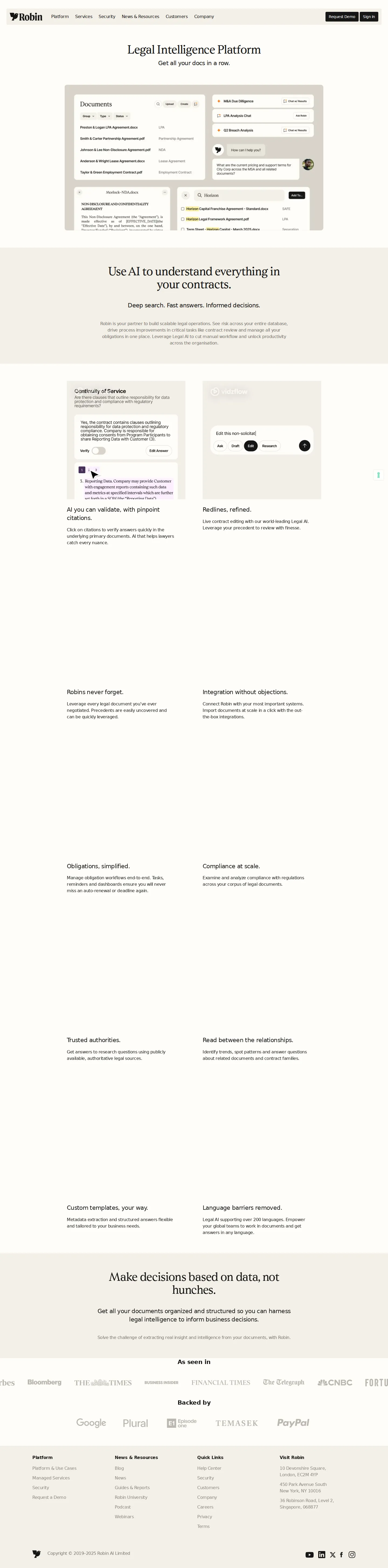
Robin AI is a London-headquartered legal AI company (with offices in New York and Singapore) co-founded in 2019 by Richard Robinson, a former Clifford Chance lawyer, and James Clough, a machine-learning scientist. It sells an AI-powered “Legal Intelligence Platform” for contract review, drafting/redlining, deep search and obligation management, alongside a human-in-the-loop managed-services arm and a developer-facing Robin API. The product targets in-house legal teams, general counsel and operations functions across private markets, financial services, insurance and technology. Robin’s earliest product was a Microsoft Word add-in that claimed to cut contract-review time by roughly 85%.
The company raised about $43 million — a $10.5M Series A in February 2023 (led by Plural) and a $26M Series B in January 2024 (led by Temasek). That funding fuelled US and APAC expansion, but a 2025 cash crunch ended badly: after a failed fundraise and an HMRC winding-up petition, Robin AI entered a distressed sale. In December 2025 AI-enabled law firm Scissero acquired Robin’s ~70-person managed-services arm, and in January 2026 Microsoft acqui-hired its engineering team into the Word product. The marketing site remains live and quote-only as of June 2026, but the company’s independent future is unresolved.
Pricing is not published anywhere on the marketing site today. The platform, managed services and API pages all route to a “Request a Demo” call-to-action; trial users are funnelled to an “Upgrade your account” form, and a separate “First Pass” product sits behind a waitlist. This was not always the case: until early 2025 Robin published a public self-serve price list (Free, a $100/user/month Pro plan, and a “Talk to sales” Enterprise tier). This page documents that public-to-gated transition and the subsequent wind-down using archived snapshots and primary press.
Pricing summary : from a public $100 per-seat list to a fully gated quote
Robin AI today uses a gated, sales-led pricing model with no public price list. As of the June 2026 capture, none of the live surfaces — the Legal Intelligence Platform, Managed Services, or the Robin API — display a tier table, a per-seat price, or any dollar amount, and the /pricing URL returns a 404. Every commercial path resolves to “Request a Demo” or an “Upgrade your account” contact form.
This is a recent change. Until early 2025 Robin published a transparent three-tier list:
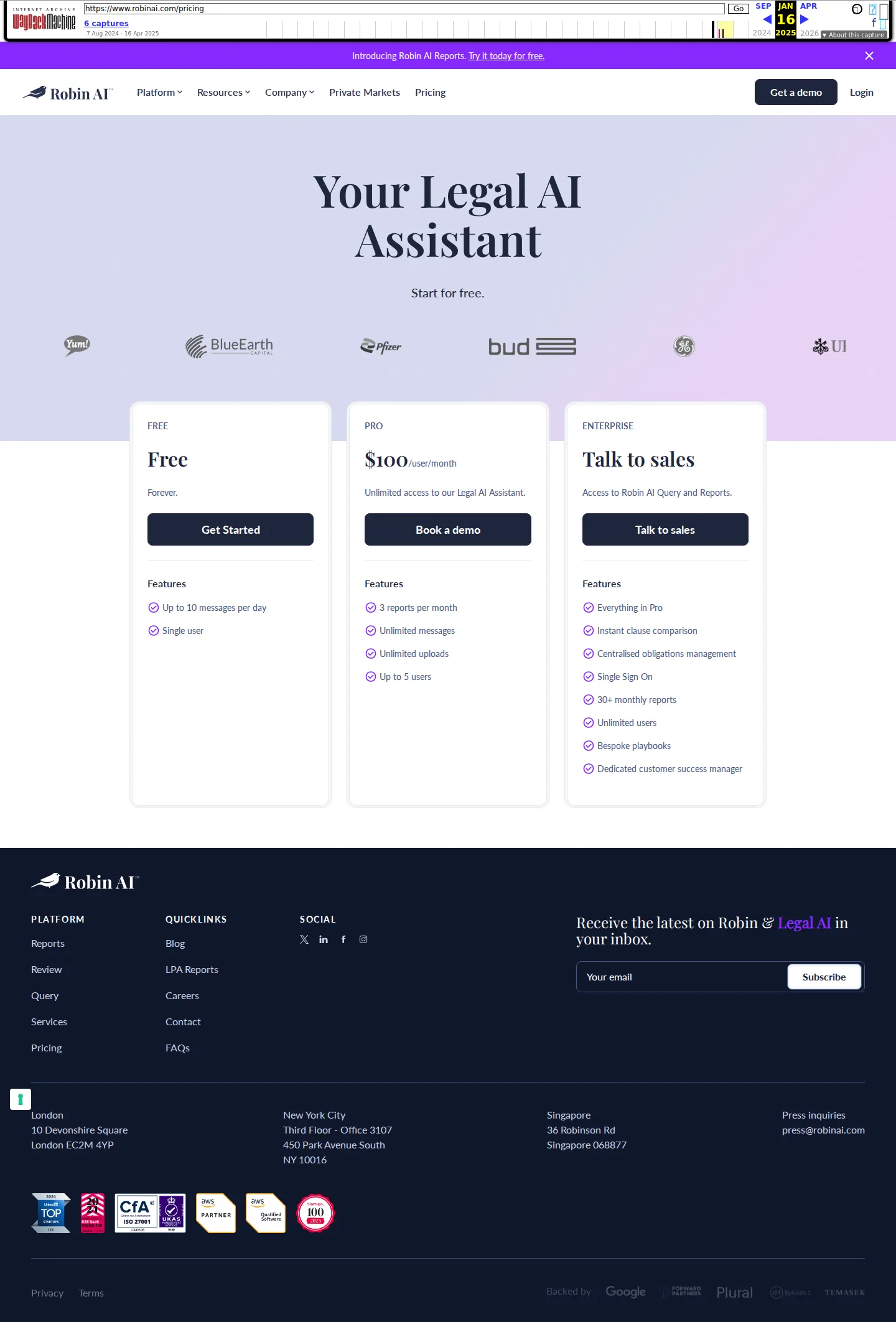
- Free — Free Forever; up to 10 messages/day, single user (price $0, archived 2024-08 to 2025-01).
- Pro — $100/user/month; unlimited messages/uploads, 3 reports/month, up to 5 users (archived 2024-08 to 2025-01).
- Enterprise — “Talk to sales”; SSO, 30+ monthly reports, unlimited users, bespoke playbooks (always quoted).
By April 2025 that list was gone — /pricing began 301-redirecting to the homepage — and today the Platform, Managed Services, Robin API and First Pass surfaces are all quote-on-request with prices unknown.
What makes this different: Robin abandoned a working self-serve per-seat model to chase enterprise deals, pairing software with a managed legal-services arm so contracts are scoped per customer rather than listed — a value-metric and packaging shift that coincided with, rather than prevented, the company’s 2025 cash crunch.
Pricing by product
Two tables follow: today’s live (gated) surfaces, where no price is advertised, and the archived public list from 2024-08 through 2025-01 (last legible snapshot 16 Jan 2025), preserved here because it is the only concrete pricing Robin has ever disclosed.
Live surfaces today (gated)
| Tier | Price | Included | Key mechanics |
|---|---|---|---|
| Legal Intelligence Platform | Custom | AI contract review, redlining, deep search, obligation tracking, 200+ languages | Quoted via “Request a Demo” |
| Managed Services | Custom | Human-in-the-loop document review delivered by Robin’s legal team | Scoped per engagement (arm acquired by Scissero, Dec 2025) |
| Robin API | Custom | Metadata extraction into structured tables; integration with CLM/CRM/ERP/BI systems | Enterprise-scale, quoted |
| First Pass | Custom | Waitlisted product (commercial terms not disclosed) | Gated behind a “Join the waitlist” form |
Archived public list (2024-08 → 2025-01, retired ~April 2025)
| Tier | Price | Included | Key mechanics |
|---|---|---|---|
| Free | $0 | Free Forever; up to 10 messages/day, single user | Self-serve “Get Started” entry point |
| Pro | $100 /user/month | Unlimited messages & uploads, 3 reports/month, up to 5 users | Self-serve; “Book a demo” CTA |
| Enterprise | Talk to sales | Everything in Pro plus SSO, 30+ monthly reports, unlimited users, bespoke playbooks, dedicated CSM | Sales-led, quoted |
Sales motions across products: PLG / self-serve for the former Free and Pro tiers (retired ~April 2025); sales-led / demo-gated for every live surface today. Archived figures verified against web.archive.org snapshots of robinai.com/pricing dated 2024-08-07 and 2025-01-16 (accessed 2026-06-06).
Hidden costs : the report cap and the seat ceiling on the old Pro plan
Robin no longer advertises rates, so a current bill cannot be constructed from public evidence. But the archived Pro plan exposes two real ceilings that pushed buyers toward an Enterprise quote — a pattern worth modelling for any per-seat legal-AI tool.
A five-lawyer team on the old Pro plan ($100/user/month) hits two walls at once:
| Line item | Monthly cost |
|---|---|
| 5 seats × $100/user/month (Pro plan) | $500 |
| 6th lawyer needed — Pro caps at 5 users → Enterprise quote | unknown (sales-led) |
| >3 reports/month needed — Pro caps at 3 → Enterprise quote | unknown (sales-led) |
| Effective floor before Enterprise upsell | $500 + quote |
The two caps (5 users, 3 reports/month) were the real “hidden cost”: a growing team or a report-heavy workflow forced a jump from a transparent $500/month line to an opaque Enterprise contract, which is exactly the unpredictable-cost trap buyers fear. The managed-services arm (human review, scoped per engagement) was always a separate, larger line item on top — a classic land-and-expand lever toward bespoke deals.
Want to estimate your own legal-AI bill? Use the pricing calculators to model per-seat plus overage costs; a dedicated Robin AI pricing calculator will follow if Robin re-publishes rates. For now, request a quote directly from Robin AI.
Pricing evolution : from a public $100 per-seat list to gated, then distressed sale
Cadence
| Quarter | Price changes | Product / SKU additions | Notes |
|---|---|---|---|
| 2024 Q3 | 0 | 0 | Public /pricing archived (2024-08-07): Free, Pro $100/user/mo, Enterprise “Talk to sales”. Robin AI Reports promoted as new. |
| 2025 Q1 | 0 | 0 | 16 Jan 2025 snapshot unchanged — Pro still $100/user/mo. Last archived snapshot showing public prices. |
| 2025 Q2 | 1 | 0 | By 16 Apr 2025 the /pricing URL 301-redirects to the homepage; the public self-serve list is retired and pricing goes fully gated. |
| 2025 Q4 | 0 | 0 | After a failed fundraise + HMRC winding-up petition, 10 Dec 2025 Scissero acquires Robin’s ~70-person managed-services arm; software/tech excluded. |
| 2026 Q1 | 0 | 0 | Jan 2026 Microsoft acqui-hires Robin’s engineering team into Word; Microsoft says it won’t acquire Robin’s technology. |
Tracked range: 2024-08 to 2026-06. Quarters not listed (2024 Q4, 2025 Q3) showed no archived change in the public price list.
Notable changes
- 2024-08-07 — Wayback first archives a public
/pricingpage: Free Forever, Pro $100/user/month (up to 5 users, 3 reports/month), Enterprise “Talk to sales” (web.archive.org/web/20240807054456/https://www.robinai.com/pricing). - 2025-01-16 — Last archived public snapshot; Pro still listed at $100/user/month (
web.archive.org/web/20250116121611/...). - 2025-04-16 —
/pricingnow 301-redirects to the homepage (verified via Wayback response headers); public pricing retired in favour of demo-only quotes. - 2025-12-10 — Scissero acquires Robin AI’s managed-services arm in a distressed sale (Legal IT Insider, Artificial Lawyer, Global Legal Post).
- 2026-01 — Microsoft acqui-hires Robin’s engineering team into the Word product (Artificial Lawyer, Legal IT Insider).
- 2026-06-06 — Live capture:
/pricingreturns 404; platform, API, upgrade and first-pass surfaces are all demo-gated with no price.
The public-to-gated transition in detail
Robin AI’s pricing arc is a clean case study in a vendor walking away from transparency. Through August 2024 and into January 2025, archived snapshots of robinai.com/pricing show an unchanging, fully public three-tier list anchored by a $100/user/month Pro plan with a generous Free Forever entry point — a self-serve, per-seat model that let any in-house lawyer start without talking to sales.
Between January and April 2025 that page was removed: by 16 April 2025 the /pricing URL 301-redirected to the homepage, and every commercial path was rerouted to “Request a Demo”. This is the kind of move companies make when they are shifting away from simple per-user licenses toward bespoke enterprise contracts — but in Robin’s case the gating did not save the model. Within a year the business was in a distressed sale: Scissero took the managed-services arm in December 2025 and Microsoft acqui-hired the engineers in January 2026. The gated quote outlived the public price list by barely twelve months.
What’s unique : software plus a managed legal-services arm
1. Software bundled with managed legal services. Robin pairs its AI platform with a managed-services arm staffed by its own lawyers — a hybrid few pure-software legal-AI vendors offer. That human-review layer was the part with durable value: when the distressed sale came, it was the ~70-person managed-services team Scissero wanted, not the software. The bundle pushed deals toward bespoke, sales-led scoping rather than a clean per-seat list.
2. A documented public-to-gated reversal. Most enterprise vendors are gated from day one; Robin is unusual in having published a transparent $100/user/month Pro plan and then deleting it. The archived snapshots make the reversal concrete and dated — a rare, fully-evidenced example of a vendor retreating from price transparency, which is itself a value-metric and packaging signal.
3. Two hard caps that engineered the upsell. The old Pro plan’s 5-user and 3-report/month ceilings were deliberately low, designed to convert any growing or report-heavy team into an Enterprise quote. It’s a textbook capacity-cap upsell — effective at moving buyers up, but also a source of the bill-shock unpredictability that made the jump to “Talk to sales” jarring.
4. Outcome framing without outcome pricing. Robin marketed concrete outcomes (“review contracts 80% faster”, “answers in under 3 seconds”) yet never billed on them — pricing stayed per-seat, then per-quote. The gap between outcome messaging and outcome-based pricing is common in legal AI, where defensible per-result metrics are hard to define.
Strengths & weaknesses
| Strengths | Weaknesses |
|---|---|
| Software + managed-services hybrid — the human-review arm had real, sellable value | No public pricing today; buyers cannot self-educate or budget without sales |
| Enterprise-grade Robin API for structured legal data extraction | Deleted a working self-serve funnel (Free + $100 Pro) that drove low-friction adoption |
| Strong founding story (ex-Clifford Chance + ML scientist) and ~$43M raised | Pro plan’s 5-user / 3-report caps forced abrupt, opaque Enterprise upsells |
| Outcome-led marketing (80% faster review) resonates with GCs | Gating did not prevent a 2025 cash crunch, distressed sale and team breakup |
| 200+ language support and pinpoint-citation validation | Independent future unresolved after Scissero (services) + Microsoft (eng) carve-outs |
Billing UX : demo-gated, with a trial-to-upgrade contact flow
- Request a Demo — the primary commercial CTA on the platform, services and API pages; no pricing is shown before the demo.
- Upgrade your account form — trial users submit first name, last name, email, company name and a “How was your trial experience?” field; the page states “a member of our team will reach out” (no in-product self-serve checkout or price display).
- First Pass waitlist — a separate email-capture form (“Join the waitlist”) gating access to the First Pass product.
- Sign In — an authenticated app exists for existing customers; in-app billing controls are not publicly visible.
Strategic wins : what Robin’s pricing did get right
1. A genuinely low-friction entry point
The Free Forever tier (10 messages/day, single user) and a single, legible $100/user/month Pro plan let any curious lawyer try Robin without a sales call. For a category as conservative as legal, a self-serve per-seat plan is a strong wedge — it builds bottom-up familiarity before the enterprise sales motion takes over.
2. Monetising the human-review layer separately
By keeping managed services as a distinct, scoped line item rather than folding it into seat fees, Robin built a higher-value offering that ultimately had a buyer of its own. The clean separation of software from human review is a land-and-expand structure that let the services revenue survive the rest of the business.
3. Outcome-led positioning that fit the buyer
Robin marketed in the GC’s language — “80% faster review”, “answers in 3 seconds”, validated citations — rather than tokens or API calls. Speaking the buyer’s outcomes (even while billing per seat) is exactly the framing the value-metric playbook recommends for non-technical buyers.
Areas to improve : where the gated reversal hurt
1. Keep an anchor price visible after going enterprise
Deleting /pricing entirely removed every budgeting anchor for buyers and analysts. A better move would have kept a published “from $100/user/month” or “starts at $X/year” line even while routing serious deals to sales — preserving the transparency that builds trust without exposing every enterprise discount. Fully dark pricing forces buyers to self-disqualify or call competitors with public numbers, like Spellbook.
2. Soften the Pro plan’s capacity cliffs
The 5-user and 3-report ceilings created an abrupt jump from $500/month to an opaque quote. Graduated overage pricing — for example, a published per-extra-seat rate and a per-extra-report charge — would have smoothed the unpredictable-cost cliff and let teams grow on the self-serve plan longer before committing to sales.
3. Tie price to a defensible outcome metric
Robin sold outcomes but billed seats. A usage- or outcome-aligned meter — contracts reviewed, reports generated, obligations tracked — would have aligned revenue with the value GCs actually consumed and reduced the pressure to gate everything behind bespoke negotiation. Choosing a right usage metric is the harder-but-more-durable path for legal AI.
Key takeaways
- Gating pricing is reversible-looking but rarely reversed cleanly. Robin deleted a public $100/user/month list in early 2025 and never restored a visible anchor. Once you go dark on price, buyers and analysts lose the ability to budget — and you lose the bottom-up funnel that public pricing built.
- Capacity caps engineer upsells but also engineer friction. The Pro plan’s 5-user and 3-report ceilings reliably pushed teams toward Enterprise, but the jump from $500/month to “Talk to sales” is exactly the cliff that makes buyers hesitate. Graduated overages convert better than hard walls.
- Separating a human-services layer can be a survival hedge. Because Robin kept managed services as a distinct, scoped offering, it had independent, sellable value — the part that found a buyer (Scissero) when the software did not. Modular packaging has option value in a downturn.
- Outcome marketing without outcome pricing leaves money and clarity on the table. Robin sold “80% faster review” yet billed seats; aligning the meter to the outcome would have tied revenue to value and reduced the need to gate everything.
- Transparency is a trust asset in conservative buyer categories. In legal, where buyers are risk-averse, a published entry price lowers the barrier to evaluation. Removing it shifts more weight onto sales at precisely the moment a struggling company can least afford a longer cycle.
UBP implications
- A retreat from public pricing is a leading signal, not a neutral packaging choice. When a vendor deletes a working self-serve list to chase enterprise quotes, it often reflects pressure to grow ACVs fast — a pattern worth watching as companies shift away from per-user licenses.
- Per-seat models in AI need overage valves, not hard caps. Robin’s binary “5 users then call us” design is the opposite of elastic usage-based pricing; the durable approach pairs a seat floor with metered overages so growth happens on the self-serve plan.
- Outcome-based pricing remains aspirational in legal AI. Robin’s per-seat-then-gated arc shows how hard it is to bill on legal outcomes; vendors that crack a defensible per-result value metric will have a structural advantage over seat-and-quote incumbents.
Sources
- Robin AI Legal Intelligence Platform (accessed 2026-06-06)
- Robin AI Managed Services (accessed 2026-06-06)
- Robin API (accessed 2026-06-06)
- Robin AI upgrade / contact form (accessed 2026-06-06)
- Robin AI First Pass waitlist (accessed 2026-06-06)
- Robin AI Newsroom (accessed 2026-06-06)
- Archived public pricing page, 2024-08-07 (Wayback) (accessed 2026-06-06)
- Archived public pricing page, 2025-01-16 (Wayback) (accessed 2026-06-06)
Browse the pricing blueprint for comparable enterprise legal-AI pricing such as Harvey, Legora and Spellbook.
Bottom line
Robin AI is the clearest case in the corpus of a vendor walking away from price transparency: it published a Free / $100-per-user-per-month Pro / Enterprise list through January 2025, then deleted it by April 2025 in favour of a fully gated “Request a Demo” motion. Within a year a cash crunch forced a distressed sale — Scissero took the managed-services arm in December 2025 and Microsoft acqui-hired the engineers in January 2026. Today no seat, tier or usage price appears on any live surface, and /pricing returns a 404.
Want to compare Robin AI against other enterprise legal-AI pricing? Browse the pricing blueprint.
Pricing timeline : Major events on a vertical axis
Each milestone below corresponds to a public pricing change, product launch, or material adjustment. Major events use a filled marker; minor adjustments use a faded one.
Live surfaces fully gated — no public price
Captured the platform, Robin API, upgrade and first-pass surfaces; none display any price. The /pricing URL 404s and no pricing page exists in the sitemap — all commercial paths are demo-gated.
Microsoft acqui-hires the engineering team
Microsoft acqui-hired Robin AI's engineering team (New York + London) into the Word product to strengthen legal-AI features. Microsoft said it had no plans to acquire Robin AI's technology. Reported by Artificial Lawyer and Legal IT Insider, January 2026.
Distressed sale: Scissero acquires managed-services arm
Following a failed funding round and an HMRC winding-up petition, Robin AI entered a distressed sale. On 10 Dec 2025 AI-enabled law firm Scissero acquired Robin's ~70-person managed-services team (combined org >150); the software/tech group and CEO Richard Robinson were excluded. Reported by Legal IT Insider, Artificial Lawyer and Global Legal Post.
Public pricing removed — /pricing redirects to homepage
By 16 Apr 2025 the /pricing URL 301-redirects to robinai.com/ (verified via Wayback response headers). The public self-serve price list was retired and the commercial motion moved fully to 'Request a Demo'. Source: web.archive.org/web/20250416123253/https://www.robinai.com/pricing.
Pro plan still listed at $100/user/mo
The 16 Jan 2025 Wayback snapshot of /pricing is unchanged from August 2024 — Free, Pro $100/user/month, Enterprise 'Talk to sales'. Last archived snapshot showing public prices. Source: web.archive.org/web/20250116121611/https://www.robinai.com/pricing.
Public self-serve pricing: Free, Pro $100/user/mo, Enterprise
Archived robinai.com/pricing (Wayback 2024-08-07) shows a public three-tier list: a Free Forever plan (up to 10 messages/day, single user), a Pro plan at $100/user/month (up to 5 users, unlimited messages/uploads, 3 reports/month), and a 'Talk to sales' Enterprise tier (SSO, 30+ reports, unlimited users, bespoke playbooks). Source: web.archive.org/web/20240807054456/https://www.robinai.com/pricing.
- · Robin AI once published prices openly: a Wayback snapshot from August 2024 shows a Free Forever tier, a Pro plan at $100/user/month (up to 5 users, 3 reports/month) and a 'Talk to sales' Enterprise tier — all of which had vanished behind a demo wall by 2026.
- · Robin's public /pricing page stopped resolving between January and April 2025: the last archived snapshot (16 Jan 2025) still listed the $100 Pro plan, but by 16 April 2025 the URL 301-redirected to the homepage. The live /pricing path returns a 404 as of June 2026.
- · Robin AI was co-founded in 2019 by Richard Robinson, a former Clifford Chance lawyer, and James Clough, a machine-learning scientist — and its earliest product was a Microsoft Word add-in that claimed to cut contract-review time by roughly 85%.
Questions & answers
- How much does Robin AI cost in 2026?
- Robin AI no longer publishes prices. As of June 2026 every surface — platform, managed services and the Robin API — is sales-led and quoted via 'Request a Demo', and the live /pricing URL returns a 404.
- Did Robin AI used to have public pricing?
- Yes. An archived August 2024 pricing page listed a Free Forever tier, a Pro plan at $100/user/month (up to 5 users, 3 reports/month), and a 'Talk to sales' Enterprise tier. The page was removed by April 2025, when /pricing began redirecting to the homepage.
- Does Robin AI have a free tier?
- Not anymore on any visible surface. The former Free Forever plan (up to 10 messages/day, single user) disappeared when the public price list was taken down; trial users are now routed to an 'Upgrade your account' contact form.
- What happened to Robin AI in 2025 and 2026?
- After a failed funding round, Robin AI entered a distressed sale in late 2025. Scissero acquired its ~70-person managed-services arm in December 2025, and Microsoft acqui-hired its engineering team into the Word product in January 2026.
- How does Robin AI pricing compare to other legal-AI tools?
- Robin AI is now fully sales-led like enterprise peers such as Harvey, whereas it once offered self-serve per-seat pricing closer to Spellbook. Its managed-services component means quotes bundle software and human legal review, so deals are scoped per engagement.