AI Summary
About
6sense is a B2B revenue-intelligence and account-based marketing (ABM) platform. It combines predictive account scoring, third-party buyer-intent data, and AI-driven sales and marketing workflows to help go-to-market teams identify in-market accounts, prioritize outreach, and orchestrate campaigns. The company positions its offering as “Revenue AI,” spanning a Revenue Marketing side (digital advertising, email agents, audience builder, intelligent workflows) and a Sales Intelligence side (predictive scoring, contact and company data, a sales copilot).
6sense serves mid-market and enterprise revenue teams — marketing operations, demand generation, and sales development — that want to concentrate spend on accounts showing buying signals rather than spraying the whole total addressable market. Individual sellers could previously enter through a free Sales Intelligence tier, but around July 2026 6sense removed that free tier from its pricing page — the platform core value (predictive models, orchestration, and large-scale data enrichment) is now sold entirely to teams under annual, sales-led contracts. 6sense was named a Leader in The Forrester Wave: Revenue Marketing Platforms for B2B, Q1 2026.
Commercially, 6sense competes with data-and-intent vendors such as ZoomInfo and Apollo on the data side and with revenue-intelligence platforms like Clari and Gong on the analytics side. It also sits adjacent to the CRM incumbents — Salesforce and HubSpot — whose own AI moves push into the same predictive-and-outreach territory. Where those competitors increasingly publish at least entry-level prices, 6sense keeps its commercials entirely gated — a deliberate enterprise sales-led posture examined throughout this page.
Read through the corpus lens, 6sense is an ABM/revenue-intelligence incumbent layering AI onto a data-credit-consumption model behind fully gated pricing — the “AI over credit-metered data, opaque price” GTM variant. Its closest structural peer is ZoomInfo: both meter enriched B2B records in consumable credits, both bolt predictive/AI features on top, and both keep list prices off the page. Where they diverge, ZoomInfo has drifted toward more visible packaging while 6sense holds the line on total opacity.
Pricing summary : fully gated ABM platform metered in data credits
6sense uses a fully gated, quote-based platform model metered in data credits. As of July 2026 there is no free tier and no published dollar figure anywhere on the pricing page. Three dimensions matter:
- Platform subscription (seats + modules): Sales Intelligence and the broader Revenue Marketing platform are sold as annual, sales-led contracts. No seat price or platform fee is published — every edition routes to Book a Demo.
- Data-credit consumption: Within Sales Intelligence, data credits are the usage meter. Credits are spent to unlock and export emails, phone numbers, and enriched contact and company records; purchasing credits adds access to Company & Contact Data Acquisition, Buyer Discovery, and the List Builder. Credit volumes and per-credit prices are quoted per deal.
- Predictive AI + Sales Copilot bundling: Sales Intelligence is packaged as three additive bundles — Data Credits + Predictive AI, Data Credits alone, or Predictive AI alone — layered on a common base of insights, workflows, and integrations, rather than a linear Good/Better/Best ladder.
What makes this different: 6sense wraps a genuine consumption meter (data credits) inside a category that is otherwise pure seat-and-contract, yet keeps all economics behind a sales quote — the price of a credit and the price of a seat are both unknown until you talk to sales, and even the previously free entry point has now been withdrawn.
Pricing by product
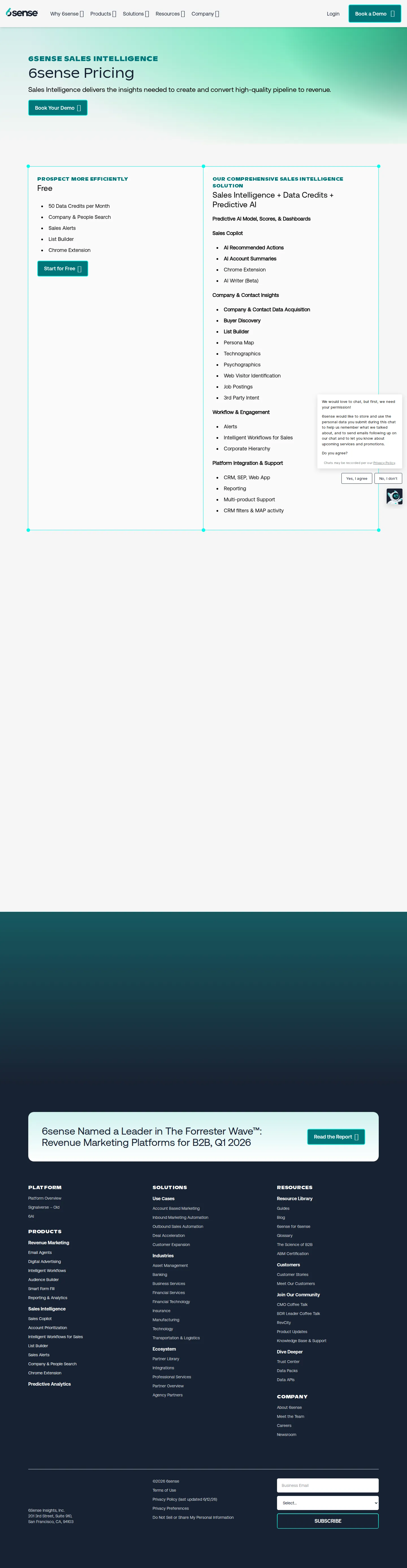
All figures below are drawn directly from the live pricing page. 6sense publishes no dollar amounts, so every price is unknown and marked “Custom (quote)”. As of July 2026 there is no free tier and no concrete published quantity of any kind — the previously advertised free tier (50 data credits/mo, “Start for Free”) was removed from the pricing page.
Sales Intelligence (published editions)
| Tier | Price | Included | Key mechanics |
|---|---|---|---|
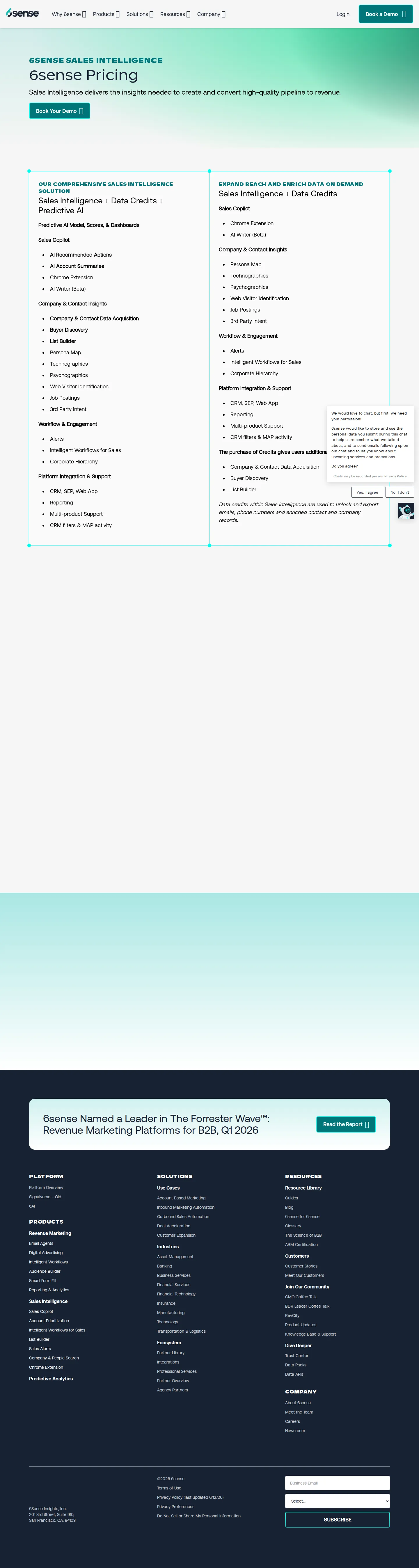
| Sales Intelligence + Data Credits + Predictive AI | Custom (quote) | The comprehensive edition — Predictive AI model, scores & dashboards; Sales Copilot (AI Recommended Actions, AI Account Summaries, AI Writer Beta); full Company & Contact Insights incl. Data Acquisition, Buyer Discovery, List Builder; workflow & integrations | ”Our comprehensive Sales Intelligence solution” — predictions and full data-credit access |
| Sales Intelligence + Data Credits | Custom (quote) | Sales Copilot (Chrome Extension, AI Writer Beta); Company & Contact Insights (persona map, technographics, psychographics, web-visitor ID, job postings, 3rd-party intent); workflow & integrations; purchased credits add Company & Contact Data Acquisition, Buyer Discovery, List Builder | ”Expand reach and enrich data on demand” — credits consumed to unlock/export enriched records |
| Sales Intelligence + Predictive AI | Custom (quote) | Predictive AI model, scores & dashboards; Sales Copilot (AI Recommended Actions, AI Account Summaries, AI Writer Beta); Company & Contact Insights; workflow & integrations | ”Use AI-driven predictions to prioritize” — scoring-led edition without the added data-credit unlock pack |
Revenue Marketing platform (not priced on this page)
| Product line | Price | Included | Key mechanics |
|---|---|---|---|
| Revenue Marketing (Digital Advertising, Email Agents, Audience Builder, Intelligent Workflows, Reporting & Analytics, Smart Form Fill) | Custom (quote) | Full ABM orchestration across advertising, email, and audiences | Entirely demo-gated; no editions or prices published on the pricing page |
Sales motions across products: sales-led (Book a Demo) for all three Sales Intelligence bundles and the entire Revenue Marketing platform. With the free tier withdrawn around July 2026, there is no longer any PLG / self-serve entry point on the pricing page.
Data credits — the consumption unit inside Sales Intelligence
Per the pricing page: “Data credits within Sales Intelligence are used to unlock and export emails, phone numbers and enriched contact and company records.” Purchasing credits gives users access to Company & Contact Data Acquisition, Buyer Discovery, and the List Builder. The per-credit price, included quantities, and paid credit pack sizes are all unknown — not published. (The previously advertised free tier of 50 data credits per month was removed from the pricing page around July 2026.)
Where the AI sits
- Predictive AI: the predictive model, scores, and dashboards that prioritize accounts — the differentiating layer sold in two of the three paid bundles.
- Sales Copilot: AI Recommended Actions, AI Account Summaries, a Chrome Extension, and AI Writer (Beta) — included across the paid Sales Intelligence bundles.
- Broader Revenue AI / 6AI: Email Agents and predictive analytics on the Revenue Marketing side, referenced in navigation but not priced here.
Hidden costs : what a gated credit model can obscure
Because 6sense publishes no prices, a “hidden cost” here is less about advertised-vs-real overage and more about the two levers a buyer cannot see until quote time: seat/module licensing and data-credit consumption. The example below is illustrative of the structure of a bill, not actual 6sense prices — every figure marked unknown is genuinely undisclosed.
Illustrative structure — a mid-market sales team
| Line item | Monthly cost |
|---|---|
| Sales Intelligence platform (annual contract, per seat x team) | unknown |
| Predictive AI module (adds scoring & dashboards) | unknown |
| Data credits consumed to unlock/export contact records | unknown |
| Revenue Marketing add-ons (advertising, email agents) — if bundled | unknown |
| Total | unknown (quote-only) |
The lesson: with 6sense the two variable levers — how many seats/modules you license and how many data credits your team burns unlocking records — are both invisible pre-sales, so the effective cost per unlocked contact can only be reconciled after a quote.
Three archetype costs a buyer should price in
- Credit-consumption limits and overages. Data credits are the meter, and they run out. Paid customers buy a credit pool; heavy prospecting teams that exceed it face overage charges at a per-credit rate that is never published. The free tier’s 50 credits/month is a hard cap; paid pools are quoted, so the true cost per unlocked contact is only knowable after you see your consumption against your quoted rate.
- Annual-contract lock-in. Third-party reviews report 6sense contracts as annual with common 12-24 month commitments. Unlike a month-to-month PLG tool, spend is committed up front against forecasted usage — if your team burns credits slower than modeled, you have pre-paid for capacity you cannot easily claw back. This commitment structure is standard enterprise practice but material to TCO.
- Gated pricing opacity as its own cost. Because nothing is published, the buyer’s own time — running a sales-led evaluation, benchmarking against ZoomInfo or Apollo, negotiating a quote — is a real acquisition cost that transparent competitors partly remove. Add-on implementation and RevOps headcount (reported by third-party trackers at $5K-$50K onboarding and $60K-$120K/yr for dedicated ops) compound it.
Want to estimate your own 6sense bill? A 6sense pricing calculator can help model platform seats plus data-credit consumption once you have quoted rates from sales.
Pricing evolution : acquisitions, AI, a 2025 tier consolidation, and a 2026 free-tier removal — all still gated
Cadence
| Quarter | Price changes | Product / SKU additions | Notes |
|---|---|---|---|
| 2021 Q4 | 0 published | Slintel data acquired | Technographic + keyword-level buyer intent folded in; becomes the seed of credit-metered enrichment. |
| 2022 Q1 | 0 published | Saleswhale / Conversational Email | $200M Series E at $5.2B valuation; AI email execution added to the platform. |
| 2023 Q1-Q2 | 0 published | Revenue AI for Sales; generative AI Writer | Predictive scoring + GPT-4 email writing brought into the seller workflow. |
| 2025 Q2 | Repackaged (still gated) | Additive Sales Intelligence license | Legacy Team / Growth / Enterprise named tiers reported retired for a single license + Credits / Predictive AI add-ons. |
| 2026 Q3 | 0 published | Free tier removed (deprecation) | 2026-07-06 capture showed a free tier (50 credits/mo) plus three additive quote-based bundles; by 2026-07-14 the free tier was pulled, leaving only the three Book-a-Demo bundles, no self-serve entry, and no published quantity. Revenue Marketing platform still fully demo-gated. |
Tracked range: 2021-10 to 2026-07-14, reconstructed from dated press and 6sense’s own AI timeline. Prices have never been published on the pricing page in any period, so no dollar-level cadence exists — the changes above are packaging and product-brand shifts. The pricing-page archive was unreachable in this pass, so historical entries are image-less.
Notable changes
- 2021-10-05 — Acquired Slintel (buyer-intent + technographic data), later the backbone of 6sense’s data-credit enrichment (reported by PRNewswire / Demand Gen Report).
- 2022-01-12 — $200M Series E at a $5.2B valuation, announced alongside the Saleswhale acquisition that became 6sense Conversational Email (reported by PRNewswire).
- 2023-03-14 — Launched 6sense Revenue AI for Sales, the umbrella brand over today’s Predictive AI + Sales Copilot bundles (6sense newsroom).
- 2023-06-06 — Added a generative-AI Email Writer (GPT-4) to Conversational Email — lineage of today’s AI Writer (Beta) and the 2025 AI Email Agents (6sense newsroom).
- 2025-05 — Reported retirement of the legacy Team / Growth / Enterprise Sales Intelligence tiers in favor of a single additive license (Credits, Predictive AI, or both) — the structure on the live page. Still fully gated (reported by third-party pricing reviews; see below).
- 2026-07-06 — Live capture: pricing page covers only Sales Intelligence and publishes no dollar figures; the free tier 50 monthly data credits is the sole concrete quantity (6sense pricing page).
- 2026-07-14 — Free Sales Intelligence tier removed. Between the 2026-07-06 and 2026-07-14 captures 6sense pulled the “Prospect More Efficiently / 50 Data Credits per Month / Start for Free” block and every self-serve CTA, leaving only the three Book-a-Demo bundles and no published quantity of any kind — the pricing page is now fully gated (6sense pricing page; confirmed via captured screenshot + text diff and re-checked live).
The 2025 tier consolidation in detail
Independent pricing trackers (Landbase, Salesmotion, MarketBetter, Warmly) converge on the same account: until roughly May 2025 6sense sold Sales Intelligence as three named tiers — Team, Growth, Enterprise — and then collapsed them into a single Sales Intelligence license to which a buyer adds Data Credits, Predictive AI, or both. That is exactly the additive structure the live page now shows, which is why the current bundles read as combinations rather than a Good/Better/Best ladder.
Prices stayed gated through the change, but the same third-party trackers publish reported estimates — kept here strictly separate from 6sense’s own (unpublished) numbers. Vendr data cited across these reviews puts the median annual contract at ~$55,211, with a working range of roughly $35K-$130K+ and enterprise deployments (full suite, advertising, AI email) reaching $130K-$300K+ per year; one Reddit report cited $120K for a first year. Treat all of these as third-party estimates, not 6sense list prices — the vendor still publishes nothing.
The 2026 free-tier removal in detail
Between the 2026-07-06 and 2026-07-14 captures, 6sense removed the free Sales Intelligence tier — the “Prospect More Efficiently / 50 Data Credits per Month / Start for Free” block and every self-serve “Sign Up For Free” CTA — from its pricing page. What remains is only the three additive Book-a-Demo bundles, with no published dollar figure and no concrete quantity of any kind. The change was confirmed against the captured screenshot and page text and re-verified on the live pricing and Sales Intelligence product pages.
The significance is structural, not cosmetic. The free tier was 6sense’s only product-led entry point in an otherwise pure sales-led category — the wedge by which an individual seller could adopt the Chrome extension and 50 monthly credits, then champion a team-wide contract. Removing it closes that bottoms-up funnel and commits 6sense to qualifying every prospect through a sales conversation. Read alongside the 2025 consolidation to a single additive license, the direction is consistent: 6sense is simplifying and concentrating its go-to-market on enterprise, annual, gated deals — confident enough in its predictive-AI-and-data differentiation to sell without a free hook.
What is unique : a real credit meter sealed behind a full sales gate
1. A real consumption meter inside an ABM suite. Most ABM platforms are pure seat-and-contract sales. 6sense exposes an actual usage unit — data credits — spent to unlock and export contact and company records, a credit-based consumption model most buyers associate with data vendors, not ABM suites. Until July 2026 that meter even fronted a free tier (50 credits/mo); with the free entry removed between the 2026-07-06 and 2026-07-14 captures, the credit meter now survives purely as the paid expansion lever behind a full sales gate.
2. Additive bundles, not a linear ladder. The three paid Sales Intelligence editions are combinations of the same parts — Predictive AI, Data Credits, Sales Copilot — so a buyer selects the intersection they need (predictions, data, or both) rather than climbing a Good/Better/Best staircase.
3. Total price opacity as an enterprise signal. 6sense publishes editions and feature lists but zero prices, routing everything to Book a Demo. That opacity is itself a positioning choice — it filters for teams willing to run a sales-led evaluation and keeps competitive price benchmarking difficult.
Strengths & weaknesses
| Strengths | Weaknesses |
|---|---|
| Proprietary Slintel-sourced intent + technographic data means the records credits unlock are differentiated, not a resold commodity list | No published prices and, since July 2026, no free or self-serve entry — buyers can neither try nor self-estimate before a sales call |
| Data-credit meter makes contact/record consumption explicit and expandable | Two variable levers (seats/modules + credits) are both invisible until a quote |
| Additive bundling lets teams buy exactly predictions, data, or both | Additive naming (+ Data Credits + Predictive AI) is harder to parse than named tiers |
| Predictive AI + Sales Copilot are a real differentiator vs commodity data vendors | Broader Revenue Marketing platform is entirely demo-gated, not even feature-listed by tier |
Billing UX : what the pricing page actually exposes
- “Book a Demo” / “Book Your Demo” / “Schedule a Demo Today” CTAs — every Sales Intelligence edition and the entire Revenue Marketing platform route through a sales-led demo request rather than a checkout; as of July 2026 there is no self-serve or “Start for Free” path anywhere on the page.
- Additive-bundle feature matrix — the page presents Sales Intelligence as three stacked bundles with explicit included-feature lists (Predictive AI Model/Scores/Dashboards, Sales Copilot, Company & Contact Insights, Workflow & Engagement, Platform Integration & Support), but no price column and no quantities.
- Purchased-credit access note — the page states that “the purchase of Credits gives users additional access to” Company & Contact Data Acquisition, Buyer Discovery, and List Builder, making the credit-gated capabilities explicit without publishing a credit price or volume.
- Data-credit definition callout — a standing note explains that “data credits within Sales Intelligence are used to unlock and export emails, phone numbers and enriched contact and company records,” defining the consumption meter even though no credit quantity is shown.
- Removed free-tier control — the previously prominent “Prospect More Efficiently / 50 Data Credits per Month / Start for Free” block is no longer present, so no monthly usage allotment is quantified on the page at all.
Strategic wins : what 6sense packaging gets right
1. A focused, fully sales-led motion after shedding the free tier
By removing the free Sales Intelligence tier in July 2026 (gone between the 2026-07-06 and 2026-07-14 captures), 6sense traded a self-serve top of funnel for a cleaner enterprise motion. A free tier in a data category is expensive to run — it carries entitlement and usage-grant overhead, invites credit-farming, and can cannibalize small paid deals. Routing every edition through Book a Demo lets 6sense qualify for team-wide, annual contracts from the first touch rather than nurturing individual free users toward conversion — the reverse of the product-led-into-sales-led wedge it previously ran. The bet is that its predictive-AI-and-data differentiation is strong enough to sell without a free hook, a defensible read for an incumbent whose buyers are RevOps teams rather than solo sellers.
2. A usage meter that maps to perceived value
Metering data credits against record unlocks ties spend to a concrete unit of value (a usable contact), which is easier to justify than an abstract seat fee. This is textbook value-metric selection — the same value-metric problem every usage-priced vendor faces — and it gives 6sense an expansion lever as teams unlock more records.
3. Additive bundling that matches how buyers think
By selling Predictive AI and Data Credits as independent, stackable additions, 6sense lets a data-hungry team and a scoring-hungry team both buy exactly what they value — a more flexible packaging than a rigid tier ladder, and part of the broader shift we track as AI companies move off per-user licenses.
Areas to improve : where the gated model costs 6sense
1. Publish at least entry-level or credit-pack pricing
Total price opacity increasingly reads as a red flag to buyers who can get indicative pricing from ZoomInfo or Apollo. Publishing a starting credit-pack price — even “from $X for N credits” — would reduce evaluation friction without exposing enterprise discounts, and would blunt the bill-shock and cost-unpredictability concern buyers now bring to every usage-priced tool.
2. Name the paid editions
Sales Intelligence + Data Credits + Predictive AI is descriptive but hard to reference in a sales conversation or renewal. Named editions (e.g. Team / Growth / Enterprise) would make the ladder easier to communicate and benchmark.
3. Surface the Revenue Marketing platform packaging
The advertising, email-agent, and audience-builder products carry no feature-by-tier breakdown at all on the pricing page. Even a gated feature matrix would help marketing buyers scope a deal before the demo, improving qualification.
4. Replace, don’t just remove, the self-serve wedge
Pulling the free Sales Intelligence tier in July 2026 closed 6sense’s only PLG entry point, ceding the individual-seller and bottoms-up evaluator entirely to Apollo and ZoomInfo, both of which still let a prospector start without a sales call. If enterprise demand justifies the move, fair — but a capped free trial or a self-serve credit-pack would preserve top-of-funnel signal and champion-building without undercutting enterprise deals.
Monetization stack & signals : how 6sense builds & buys its revenue engine
Buys 0 Builds 0 1 signal role
6sense discloses no monetization stack it operates itself; the one tell-role worth watching is the product hire below — an AI Platform lead owning model-routing and inference-cost discipline, margin defense on the compute behind its AI, not the data-credit meter or quote-to-cash behind its gated pricing.
-
“Your Experience and Skills Desired: 2+ years of BI (Tableau, Domo, MicroStrategy), Marketing Automation (Marketo, Eloqua or Pardot) or CRM (Salesforce and Dynamics) platforms.”
-
6sense is staffing a dedicated product owner for internal AI model-routing and inference-cost discipline — margin defense on the compute behind Predictive AI/Sales Copilot, not a customer-facing pricing lever.
“Lead Foundational Model Strategy. Drive our model strategy, including routing logic, cost optimization, and compute infrastructure management to maximize both performance and efficiency.”
Signals reviewed · derived from public job posts
Job postings fill and close over time — once a posting is filled we keep it as a dated citation (the quoted evidence remains); use View open roles for current listings.
Key takeaways
- An incumbent can walk away from PLG when its differentiation is strong enough. 6sense ran a genuine free wedge (50 credits/mo, self-serve) alongside total price opacity for years, then removed it in July 2026 — betting its predictive-AI-and-data moat sells team-wide without a free hook. A freemium wedge is a tactic, not a fixture, and mature category leaders will drop it to focus a sales-led motion.
- Credits make an ABM suite feel like a data product. Metering record unlocks in credits gives buyers a tangible value unit and hands the vendor a natural expansion lever, without moving to full pure-usage billing.
- Additive bundles beat rigid ladders when value is multi-dimensional. When customers value two independent things (data volume vs predictive scoring), stackable add-ons capture more willingness-to-pay than a single Good/Better/Best line.
- Opacity is a positioning choice with real costs. Hiding all prices filters for sales-led buyers but cedes the self-service comparison shopper to more transparent competitors.
- Publish the smallest concrete number you can. 6sense one published quantity — 50 credits/mo — is also its most credible pricing signal; more of that would lower buyer friction.
UBP implications
- A consumption meter outlives the free tier it once gated. 6sense used data credits as both its freemium capacity gate and its paid expansion lever; when it removed the free tier in July 2026, the credit meter stayed as the paid expansion mechanic. The meter’s value to the vendor is the expansion lever, not the free-tier gate — usage metering does not depend on freemium to earn its keep.
- The value metric should map to a job, not a resource. Charging per unlocked record (a completed prospecting job) is more defensible than charging per seat or per API call, and points other data platforms toward outcome-adjacent metering.
- Transparency is becoming table stakes even in sales-led categories. As usage-based and credit-based models spread, buyers expect at least indicative rates; fully gated pricing will look increasingly anomalous.
Sources
- 6sense pricing page (accessed 2026-08-05)
- 6sense platform overview (accessed 2026-07-06)
- 6sense blog (accessed 2026-07-06)
- 6sense product updates (accessed 2026-07-06)
Browse the full pricing blueprint to compare 6sense against other ABM and revenue-intelligence platforms.
Bottom line
6sense sells a full ABM and revenue-intelligence platform behind a completely gated price wall — no dollar figure appears anywhere on its pricing page — and, as of July 2026, no free or self-serve entry either: the 50-credit free Sales Intelligence tier that once served as its PLG hook was pulled between the 2026-07-06 and 2026-07-14 captures. Underneath the Book a Demo curtain sits a credit-metered consumption model that makes contact-record spend explicit and additive bundles that let teams buy exactly the predictions and data they value. It is a sophisticated packaging structure wrapped in maximal opacity — now a purely sales-led enterprise motion, powerful for large annual contracts but frustrating for anyone trying to try or estimate the product before talking to sales.
Want to compare 6sense against other revenue-intelligence pricing? Browse the pricing blueprint.
Pricing timeline : Major events on a vertical axis
Each milestone below corresponds to a public pricing change, product launch, or material adjustment. Major events use a filled marker; minor adjustments use a faded one.
Free Sales Intelligence tier removed — page now fully gated
Between 2026-07-06 and 2026-07-14 6sense removed the free Sales Intelligence tier (the 'Prospect More Efficiently' / 50 Data Credits per Month / Start for Free block) from its pricing page. The page now shows only the three quote-based additive Sales Intelligence bundles, all routing to Book a Demo, with no free entry and no published dollar figures of any kind. Confirmed against captured screenshot + text and re-checked on the live product page.
Sales Intelligence pricing: free tier + three quote-based bundles
As captured, 6sense public pricing page covered only Sales Intelligence: a free tier (50 data credits/mo) plus three additive paid bundles (Data Credits + Predictive AI, Data Credits, Predictive AI) — all quote-based with no published dollar figures.
Legacy Team / Growth / Enterprise tiers retired for a single additive license
Multiple third-party pricing trackers report that around May 2025 6sense replaced its legacy named Sales Intelligence tiers (Team / Growth / Enterprise) with a single Sales Intelligence license that can add Credits, Predictive AI, or both — the additive-bundle structure captured on the live page. All figures remained gated. (Archive unreachable in this pass; consolidation reported by Landbase, Salesmotion and MarketBetter pricing reviews, 2025-2026. Reported annual spend, distinct from the gated current state: Vendr median ~$55,211/yr, range ~$35K-$130K+, enterprise $130K-$300K+.)
Generative AI Writer added to Conversational Email
6sense added a generative-AI Email Writer to Conversational Email (2023-06-06), using GPT-4 with intent + predictive signals — the lineage of today's AI Writer (Beta) inside Sales Copilot and the 2025 AI Email Agents. (Reported by 6sense newsroom / SalesTechStar, 2023-06.)
Launches 6sense Revenue AI for Sales
6sense unveiled 6sense Revenue AI for Sales (2023-03-14), packaging predictive scoring, buyer intelligence and contact data into the seller workflow — the umbrella brand under which today's Predictive AI + Sales Copilot bundles sit. (Reported by 6sense newsroom, 2023-03-14.)
$200M Series E at $5.2B valuation; acquires Saleswhale (AI email)
6sense announced a $200M Series E raising its valuation to $5.2B and, alongside it, acquired AI-email startup Saleswhale — later relaunched as 6sense Conversational Email. This moved 6sense from telling teams who is in-market to acting on that signal in-product. (Reported by PRNewswire, 2022-01-12; Saleswhale blog.)
Acquires Slintel — technographic + keyword-level buyer-intent data
6sense acquired Slintel (announced 2021-10-05, terms undisclosed), folding technographic and thematic sales-intent data into the platform. Slintel's dataset (15M companies, 250M B2B profiles) became the seed of 6sense's data-credit-metered contact/company enrichment. (Reported by PRNewswire / Demand Gen Report, 2021-10.)
Predictive ABM platform, sold sales-led
6sense (founded 2013 by Amanda Kahlow) built out its predictive account-scoring and ABM orchestration platform through the mid-2010s, launching Sales Intelligence 1.0 around 2016. Priced entirely via annual enterprise contracts — no public figures. (Archive unreachable in this pass; sourced from 6sense AI timeline + Contrary Research founding story.)
- · By July 2026 6sense had removed even its free Sales Intelligence tier (50 data credits/mo, Start for Free) from the pricing page — the page now publishes NO dollar figures and NO free entry at all, routing all three Sales Intelligence bundles to Book a Demo.
- · 6sense meters paid Sales Intelligence in data credits that are spent to unlock and export contact emails, phone numbers, and enriched company/contact records — a genuine consumption meter sitting behind a fully sales-gated wall.
- · 6sense structures its paid Sales Intelligence bundles as three additive combinations of the same parts: Predictive AI, Data Credits, and Sales Copilot — you buy the intersection you need rather than a linear Good/Better/Best ladder.
Questions & answers
- How much does 6sense cost?
- 6sense does not publish prices. Its pricing page lists three Sales Intelligence editions and their included features, but every plan routes to Book a Demo for a custom, sales-led quote. As of July 2026 there is no published dollar figure or free quantity anywhere on the page.
- Does 6sense have a free plan?
- Not anymore on the pricing page. 6sense previously advertised a free Sales Intelligence tier (50 data credits per month, company and people search, sales alerts, list builder, and a Chrome extension), but around July 2026 that free tier was removed from the pricing page, which now routes all three Sales Intelligence bundles to Book a Demo.
- What are 6sense data credits?
- Data credits are 6sense consumption unit within Sales Intelligence. They are spent to unlock and export emails, phone numbers, and enriched contact and company records. Credit volumes are quoted per deal; the pricing page publishes no per-credit price or included quantity.
- How much do teams actually pay for 6sense per year?
- 6sense publishes no prices, so any figure is a third-party estimate. It licenses platform access (seats and modules) via annual contracts and meters data-record consumption in credits, so both levers vary by deal. Trackers citing Vendr data report a median annual contract around $55,000, a common range of roughly $35K-$130K, and enterprise deployments (full suite plus advertising and AI email) reaching $130K-$300K+ per year. Treat these as reported estimates, not 6sense list prices.
- Did 6sense used to have Team, Growth, and Enterprise plans?
- Multiple third-party pricing reviews report that until around May 2025 6sense sold Sales Intelligence as three named tiers — Team, Growth, and Enterprise — then consolidated them into a single Sales Intelligence license to which buyers add Data Credits, Predictive AI, or both. That additive structure is what the current pricing page shows. Prices stayed gated through the change.
- How does 6sense pricing compare to ZoomInfo?
- Both meter enriched B2B contact and company records in consumable credits and layer AI on top, and both keep list prices off the page. The main difference: ZoomInfo has moved toward somewhat more visible packaging, while 6sense keeps every paid edition behind a Book a Demo quote with no published dollar figures at all.